What is Energy? Complete Guide to Energy Physics
Physics fundamentals • Energy types • Step-by-step explanations
Energy Physics:
Show Energy SimulatorEnergy is the capacity to do work. It exists in various forms and can be transformed from one form to another. Energy is conserved in closed systems - the total amount remains constant. The SI unit of energy is the joule (J), defined as the work done when a force of 1 newton moves an object 1 meter.
Main types of energy:
- Kinetic Energy: Energy of motion
- Potential Energy: Stored energy due to position
- Thermal Energy: Energy from molecular motion
- Chemical Energy: Energy in chemical bonds
- Electromagnetic Energy: Energy in electromagnetic fields
- Nuclear Energy: Energy in atomic nuclei
Energy transformations power everything from biological processes to technological applications.
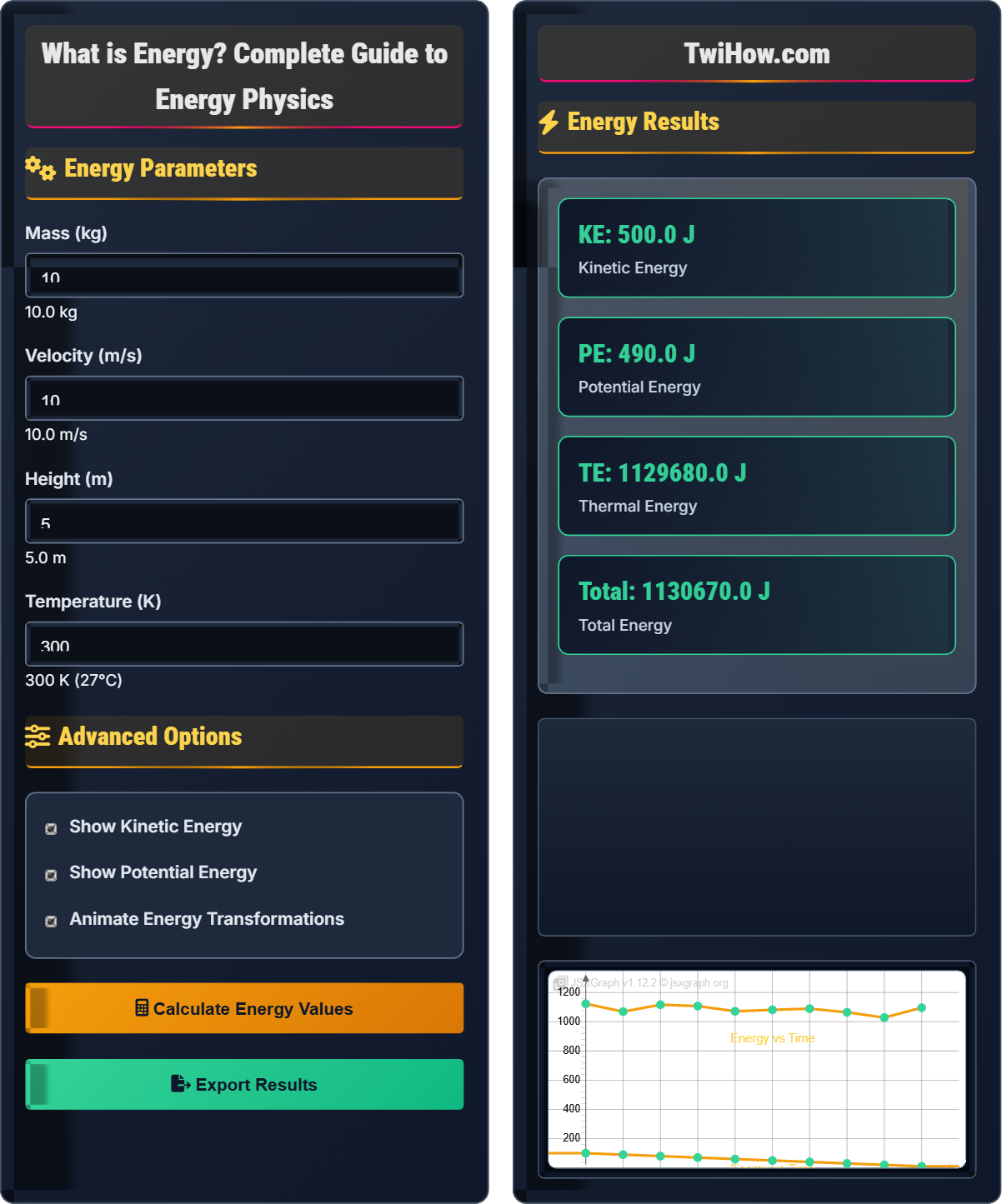
Energy Parameters
Advanced Options
Energy Results
| Type | Formula | Example | Application |
|---|---|---|---|
| Kinetic | ½mv² | Moving car | Transportation |
| Gravitational | mgh | Water behind dam | Hydropower |
| Thermal | mcΔT | Hot water | Heating |
Energy cannot be created or destroyed, only transformed from one form to another. In a closed system, the total energy remains constant.
How Energy Works
Energy is the capacity to do work. It exists in various forms and can be transformed from one form to another. Energy is conserved in closed systems - the total amount remains constant. The SI unit of energy is the joule (J), defined as the work done when a force of 1 newton moves an object 1 meter.
Where:
- KE: Kinetic energy (energy of motion)
- PE: Potential energy (stored energy)
- m: Mass
- v: Velocity
- g: Acceleration due to gravity
- h: Height
- c: Speed of light
These formulas describe the fundamental relationships between energy and physical properties.
The laws of thermodynamics govern energy behavior:
- First Law: Energy is conserved (cannot be created or destroyed)
- Second Law: Entropy of isolated systems always increases
- Third Law: Entropy approaches zero as temperature approaches absolute zero
These laws ensure that while energy is conserved, it becomes less available for useful work over time.
- Power Generation: Converting thermal to electrical energy
- Transportation: Chemical to kinetic energy conversion
- Biology: Photosynthesis and cellular respiration
- Renewable Energy: Solar, wind, hydroelectric systems
- Technology: Batteries, fuel cells, engines
Energy Fundamentals
Kinetic energy, potential energy, conservation of energy, work, power, efficiency.
W = F·d (Work equals force times distance)
Where W = work, F = force, d = displacement in direction of force.
- Energy cannot be created or destroyed
- Energy can be transformed from one form to another
- Efficiency is always less than 100%
- Power is energy transfer rate
Real-World Applications
Power plants, engines, batteries, renewable energy systems, metabolic processes.
- Calorimetry for heat energy
- Power meters for electrical energy
- Accelerometers for kinetic energy
- Spectroscopy for electromagnetic energy
- Energy losses due to friction and heat
- Storage and conversion challenges
- Environmental impacts
- Efficiency improvements
Energy Physics Quiz
If the velocity of an object is doubled, how does its kinetic energy change?
Kinetic energy is given by KE = ½mv², where m is mass and v is velocity.
If velocity doubles (v becomes 2v), the new kinetic energy is:
KE_new = ½m(2v)² = ½m(4v²) = 4(½mv²) = 4 × KE_original
The kinetic energy increases by a factor of 4 (quadruples).
The answer is B) It quadruples.
This demonstrates the quadratic relationship between kinetic energy and velocity. Since velocity is squared in the formula, changes in velocity have a disproportionately large effect on kinetic energy. This is why high-speed impacts are much more dangerous than low-speed ones.
Kinetic Energy: Energy due to motion
Quadratic Relationship: Proportional to the square of a variable
Direct Proportionality: Linear relationship
• KE ∝ v² (quadratic relationship)
• KE = ½mv²
• Mass affects KE linearly
• Remember: velocity is squared in KE formula
• Doubling velocity quadruples KE
• Tripling velocity multiplies KE by 9
• Forgetting the squared relationship
• Thinking KE is linearly related to velocity
• Confusing KE with momentum (mv)
Explain the principle of conservation of energy and provide an example of how energy transforms from potential to kinetic energy. Include the role of friction in energy transformations.
Conservation of Energy: In a closed system, the total energy remains constant. Energy can neither be created nor destroyed, only transformed from one form to another.
Example - Pendulum:
- At the highest point: maximum potential energy (PE), minimum kinetic energy (KE)
- At the lowest point: maximum kinetic energy (KE), minimum potential energy (PE)
- Throughout the swing: PE + KE = constant (ignoring friction)
Role of Friction: In real systems, friction converts mechanical energy into thermal energy. This means the total mechanical energy (KE + PE) decreases over time, but the total energy of the system (including thermal energy) remains constant. The pendulum eventually stops due to energy loss to friction.
The conservation of energy is one of the fundamental principles of physics. It applies to all systems, from subatomic particles to galaxies. While energy may change forms, the total amount remains constant. This principle allows us to analyze complex systems by tracking energy transformations.
Closed System: No energy enters or leaves
Mechanical Energy: Sum of kinetic and potential energy
Friction: Force opposing motion that converts energy to heat
• Total energy is always conserved
• Mechanical energy is conserved in ideal systems
• Friction reduces mechanical energy
• Track all energy forms in a system
• Consider friction as energy loss
• Energy "lost" goes to heat
• Forgetting friction affects mechanical energy
• Thinking energy can disappear
• Confusing energy conservation with efficiency
A 60 kg person climbs a 10-meter flight of stairs in 20 seconds. Calculate the work done, the potential energy gained, and the power output. Assume g = 9.8 m/s².
Work Done:
- W = F × d
- F = mg = 60 kg × 9.8 m/s² = 588 N
- W = 588 N × 10 m = 5,880 J
Potential Energy Gained:
- PE = mgh = 60 kg × 9.8 m/s² × 10 m = 5,880 J
Power Output:
- P = W/t = 5,880 J / 20 s = 294 W
The work done equals the potential energy gained (5,880 J), and the power output is 294 watts. This means the person generated energy at a rate of 294 joules per second.
This example shows the relationship between work, energy, and power. Work and energy have the same units (joules), and work done against gravity equals the potential energy gained. Power measures the rate at which work is done, expressed in watts (joules per second).
Work: Force × distance (in direction of force)
Power: Work per unit time
Watt: Unit of power (1 J/s)
• W = Fd cos θ
• P = W/t
• PE = mgh
• Work and energy have same units
• Power is rate of energy transfer
• Higher power means faster work
• Confusing work with power
• Forgetting to multiply by g in PE
• Using wrong distance in work calculation
A car engine burns gasoline with a chemical energy content of 45 MJ/kg. If 1 kg of gasoline is burned and the car gains 15 MJ of kinetic energy, calculate the efficiency of the engine. Explain why the efficiency is less than 100%.
Efficiency Calculation:
- Input Energy = 45 MJ (chemical energy of gasoline)
- Output Energy = 15 MJ (kinetic energy gained)
- Efficiency = (Output / Input) × 100%
- Efficiency = (15 MJ / 45 MJ) × 100% = 33.3%
Why Efficiency is Less Than 100%:
- Heat loss through exhaust and cooling system
- Friction in engine components
- Sound and vibration energy
- Incomplete combustion of fuel
- Energy used for accessories (alternator, AC, etc.)
Most car engines have efficiencies between 20-35% due to these energy losses.
Efficiency measures how effectively energy is converted from input to useful output. Even though total energy is conserved, not all energy is converted to useful work. The second law of thermodynamics ensures that some energy becomes unavailable for useful work, setting limits on efficiency.
Efficiency: Useful output energy divided by input energy
Joule: SI unit of energy (1 N·m)
Megajoule: 1 million joules (MJ)
• Efficiency ≤ 100%
• Efficiency = (Useful output / Total input) × 100%
• Energy is conserved but not all is useful
• Always identify input and output energy
• Efficiency is a ratio, not absolute amount
• Heat engines have fundamental efficiency limits
• Forgetting to multiply by 100% for efficiency
• Confusing efficiency with energy conservation
• Thinking 100% efficiency is achievable
Which of the following energy transformations occurs in a hydroelectric power plant?
In a hydroelectric power plant:
1. Water at high elevation has gravitational potential energy
2. Water flows down, converting potential energy to kinetic energy
3. Moving water turns turbines, converting kinetic energy to mechanical energy
4. Generators convert mechanical energy to electrical energy
The primary transformation is gravitational potential energy → kinetic energy → electrical energy.
The answer is C) Gravitational Potential → Kinetic → Electrical.
This example shows how energy transformations occur in real systems. Hydroelectric power harnesses the natural water cycle, converting the sun's energy (which evaporates water) into electrical energy. Multiple energy conversions typically occur in practical systems.
Hydroelectric: Power generation using water flow
Gravitational Potential: Energy due to height
Kinetic Energy: Energy of motion
• Energy can transform through multiple stages
• Each transformation has efficiency losses
• Renewable sources use natural cycles
• Trace energy path step by step
• Consider the original energy source
• Recognize common energy transformation patterns
• Oversimplifying multi-step transformations
• Forgetting intermediate energy forms
• Confusing different power generation methods
FAQ
Q: If energy is conserved, why do we need to save energy?
A: While total energy is conserved, usable energy is not. The second law of thermodynamics states that entropy (disorder) always increases in isolated systems. When we "use" energy, we convert it to forms that are harder to harness for useful work. For example, burning fossil fuels converts chemical energy to thermal energy, which disperses into the environment. We conserve energy to preserve high-quality, concentrated energy sources that can be efficiently converted to useful work.
Q: What's the difference between energy and power?
A: Energy is the capacity to do work, measured in joules (J). Power is the rate at which energy is transferred or work is done, measured in watts (W). One watt equals one joule per second. Energy is like the total amount of money in your bank account, while power is like the rate at which you spend it. A 100W light bulb uses energy at a rate of 100 joules per second. If left on for 1 hour, it would consume 360,000 joules of energy (100W × 3600s).
Q: How does Einstein's E=mc² relate to energy?
A: Einstein's equation E=mc² shows that mass and energy are equivalent and can be converted into each other. It means that even a small amount of mass contains an enormous amount of energy (since c² is a huge number). This principle underlies nuclear reactions where a small amount of mass is converted to a large amount of energy. It also explains why particles have rest energy even when not moving. The equation unified our understanding of mass and energy as different forms of the same thing.