What is Evolution? Complete Guide to Evolutionary Biology
Biology fundamentals • Natural selection • Step-by-step explanations
Evolutionary Biology:
Show Evolution SimulatorEvolution is the change in heritable characteristics of biological populations over successive generations. It occurs through mechanisms including natural selection, genetic drift, mutation, and gene flow. Evolution explains the diversity of life on Earth and how species adapt to changing environments through the process of descent with modification.
Key aspects of evolution:
- Natural Selection: Differential survival and reproduction
- Genetic Variation: Differences in DNA sequences within populations
- Descent with Modification: Inheritance of traits across generations
- Speciation: Formation of new species through divergence
Evolution is supported by multiple lines of evidence including fossil records, comparative anatomy, molecular biology, and direct observation of evolutionary processes.
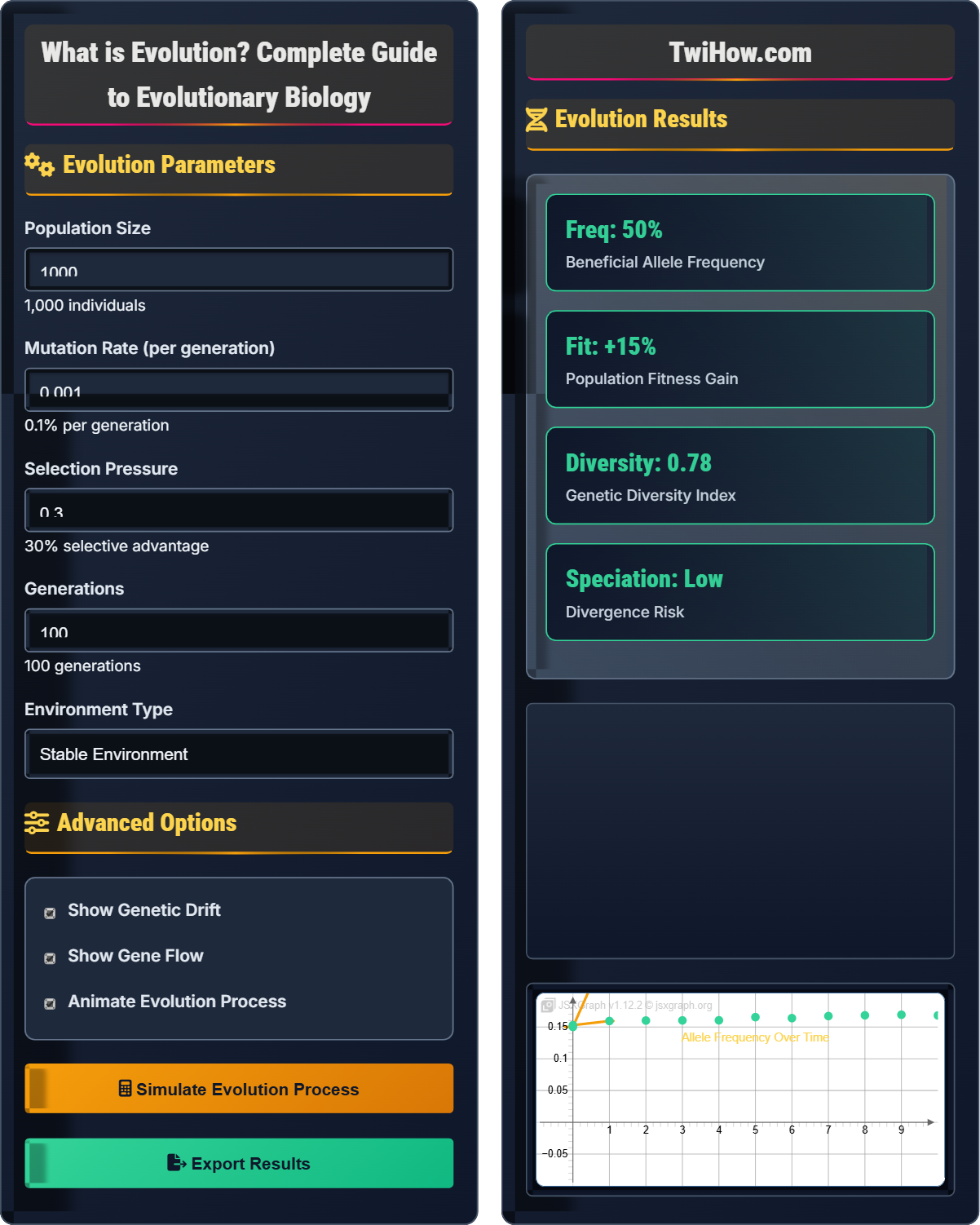
Evolution Parameters
Advanced Options
Evolution Results
| Generation | Allele Freq | Mean Fitness | Offspring |
|---|---|---|---|
| 1 | 15% | 0.85 | 1,000 |
| 10 | 28% | 0.88 | 1,050 |
| 25 | 45% | 0.92 | 1,120 |
| 50 | 62% | 0.95 | 1,180 |
| 75 | 73% | 0.97 | 1,220 |
| 100 | 85% | 0.98 | 1,250 |
Where p and q represent allele frequencies. This equation describes genetic equilibrium in populations without evolutionary forces.
How Evolution Works
Evolution is the process by which populations of organisms change over generations through changes in heritable traits. It occurs through several mechanisms including natural selection, genetic drift, mutation, and gene flow. Evolution explains how all life on Earth shares common ancestry and how species adapt to their environments over time.
Where:
- p: Frequency of dominant allele
- q: Frequency of recessive allele
- p²: Frequency of homozygous dominant genotype
- 2pq: Frequency of heterozygous genotype
- q²: Frequency of homozygous recessive genotype
This equation describes genetic equilibrium in ideal populations without evolutionary forces. Deviations indicate evolutionary change.
Evolution occurs through multiple mechanisms:
- Natural Selection: Differential reproductive success
- Genetic Drift: Random changes in small populations
- Mutation: Changes in DNA sequences
- Gene Flow: Movement of genes between populations
- Non-random Mating: Preferential mate selection
These mechanisms can work together or in opposition to shape evolutionary outcomes.
- Antibiotic Resistance: Bacterial evolution in response to drugs
- Industrial Melanism: Peppered moth coloration changes
- Viral Evolution: HIV and influenza adaptation
- Artificial Selection: Domestication of plants and animals
- Conservation: Genetic diversity management
Evolutionary Fundamentals
Natural selection, genetic drift, mutation, gene flow, adaptation, fitness.
s = 1 - W (where s is selection coefficient, W is fitness)
Selection coefficient measures disadvantage of a genotype relative to optimal genotype.
- Evolution acts on populations, not individuals
- Only heritable traits can evolve
- Evolution has no predetermined direction
- Adaptation is environment-specific
Real-World Applications
Medicine, agriculture, conservation, forensics, biotechnology.
- DNA sequencing for genetic variation
- Phylogenetic analysis for relationships
- Population genetics for allele frequencies
- Fossil analysis for historical changes
- Evolution occurs over long timescales
- Multiple mechanisms may operate simultaneously
- Environment determines selection pressures
- Chance events influence evolutionary outcomes
Evolution Quiz
Which of the following best describes the mechanism of natural selection?
Natural selection is a mechanism of evolution where individuals with traits that confer advantages in their environment tend to survive and reproduce more successfully than individuals without those traits. Over generations, these advantageous traits become more frequent in the population.
Key requirements for natural selection:
- Heritable variation in traits
- Differential reproductive success
- Environmental pressures
It's important to note that natural selection doesn't create new traits, but rather favors existing variation that confers advantages.
The answer is B) Traits that improve survival/reproduction become more common.
Students often misunderstand natural selection as requiring organisms to change during their lifetime (Lamarckian evolution). Natural selection acts on existing variation within populations. Individuals with favorable traits reproduce more, passing those traits to offspring. This is different from the incorrect idea that organisms try to improve themselves or that evolution has a predetermined goal.
Natural Selection: Differential survival/reproduction based on traits
Fitness: Reproductive success of individuals
Heritable: Traits passed from parents to offspring
• Acts on existing variation
• No predetermined direction
• Environment determines "advantage"
• Think "survival of the fittest" means "best adapted"
• Focus on population changes, not individual changes
• Traits must be heritable to evolve
• Thinking organisms change intentionally
• Confusing individual with population change
• Believing evolution always improves organisms
Explain genetic drift and contrast it with natural selection. Describe the conditions under which genetic drift has the strongest effects and provide an example of genetic drift in action.
Genetic Drift: Random changes in allele frequencies due to chance events, particularly significant in small populations. Unlike natural selection, genetic drift is not influenced by fitness advantages.
Comparison with Natural Selection:
- Natural Selection: Non-random, fitness-based, predictable direction
- Genetic Drift: Random, fitness-independent, unpredictable direction
Conditions Favoring Drift:
- Small population sizes
- Founder effects (new populations from few individuals)
- Bottleneck events (population crash)
- Low selective pressures
Example: The Amish population has higher frequencies of Ellis-van Creveld syndrome due to founder effects. A small number of immigrants carried rare alleles that became common in the isolated population through genetic drift.
Genetic drift can lead to loss of genetic diversity and fixation of alleles regardless of their adaptive value.
Genetic drift is often confused with natural selection because both change allele frequencies. However, drift is random while selection is deterministic. In small populations, drift can overwhelm selection, leading to unexpected evolutionary outcomes. This is why genetic diversity is important for population viability.
Genetic Drift: Random change in allele frequencies
Fixation: Allele reaches 100% frequency
Founder Effect: Genetic drift in new populations
• Stronger in small populations
• Independent of fitness
• Can reduce diversity
• Drift = "sampling error" in genetics
• More drift = less diversity
• Opposite of selection in many ways
• Confusing drift with selection
• Thinking drift requires selection pressure
• Forgetting population size matters
A population of fish lives in a large lake. A drought causes the lake to divide into two separate bodies of water, isolating the fish populations. After 10,000 years, scientists find that the fish in each lake are now different species. Explain the evolutionary process that occurred and identify the type of speciation that took place.
Process: Allopatric speciation occurred through geographic isolation.
Steps:
- Geographic barrier (drought) separated populations
- Gene flow stopped between populations
- Each population evolved independently under different selective pressures
- Random genetic drift accumulated differences
- After 10,000 years, populations became genetically incompatible
- Reproductive isolation established
Type: Allopatric speciation (geographic isolation).
Additional Factors:
- Different environmental conditions in each lake
- Unique food sources leading to different adaptations
- Random mutations accumulating separately
- Behavioral differences preventing interbreeding
When populations can no longer interbreed successfully, they are considered separate species.
This demonstrates how reproductive isolation can arise from geographic barriers. Once gene flow stops, populations can diverge significantly. The 10,000-year timeframe shows that speciation can occur relatively quickly in evolutionary terms. Geographic isolation removes the homogenizing effect of gene flow, allowing independent evolution.
Speciation: Formation of new species
Allopatric: Geographic isolation
Reproductive Isolation: Inability to interbreed
• Isolation prevents gene flow
• Different selection pressures drive divergence
• Time allows accumulation of differences
• Geographic barriers = allopatric
Explain how antibiotic resistance in bacteria evolves and why overuse of antibiotics accelerates this process. Include the role of natural selection in your explanation.
Evolution of Resistance:
- Bacterial populations contain genetic variation
- Some individuals have mutations conferring resistance
- Antibiotics kill susceptible bacteria
- Resistant bacteria survive and reproduce
- Resistance genes spread through population
Role of Natural Selection:
- Antibiotics create strong selection pressure
- Resistant bacteria have higher fitness in presence of drugs
- Survival advantage leads to rapid increase in resistant population
- Previously rare resistance genes become common
Effect of Overuse:
- Continuous selection pressure favors resistance
- Prevents susceptible strains from recovering
- Increases opportunities for resistance evolution
- Can select for multiple resistance mechanisms
This is a classic example of natural selection occurring rapidly in response to environmental change (antibiotic presence).
This demonstrates evolution happening in real-time with significant practical consequences. It shows how human activities can create selection pressures that drive rapid evolutionary change. The process is identical to natural selection in other contexts but occurs much faster due to strong selection pressure and short bacterial generation times.
Antibiotic Resistance: Ability to survive antibiotic treatment
Selection Pressure: Environmental factor affecting survival
Evolutionary Arms Race: Continuous adaptation
• Resistance pre-exists in populations
• Antibiotics select, don't create resistance
• Overuse accelerates selection
• Think of antibiotics as selecting agents
• Resistance is pre-existing variation
• Prevention is better than cure
• Thinking antibiotics create resistance
• Believing resistance is intentional
• Forgetting about existing variation
Which of the following provides the strongest evidence for common ancestry of all life on Earth?
While all options provide evidence for evolution, shared molecular machinery and genetic code across all life forms provides the strongest evidence for common ancestry. All organisms use the same genetic code (with minor variations), the same nucleotides for DNA/RNA, and similar cellular machinery (ribosomes, metabolic pathways).
This universality suggests a single origin for life, as there's no compelling reason why different lineages would independently evolve identical molecular systems. The genetic code is "degenerate" (multiple codons for same amino acid) suggesting it arose early and was conserved.
The answer is B) Shared genetic code and molecular machinery.
Molecular evidence is more convincing than morphological evidence because it's less likely to arise independently. Convergent evolution can produce similar structures through different genetic pathways, but identical molecular machinery across kingdoms strongly indicates common descent. This molecular unity of life is one of evolution's strongest predictions and confirmations.
Common Ancestry: Shared evolutionary origin
Genetic Code: Translation of codons to amino acids
Molecular Homology: Shared derived characteristics
• Molecular evidence is strongest
• Multiple lines support evolution
• Unity of biochemistry
• Look for universal features
• Molecular > morphological evidence
• Consider likelihood of independent evolution
• Undervaluing molecular evidence
• Thinking similarity always indicates common ancestry
• Forgetting about convergent evolution
FAQ
Q: Does evolution have a goal or direction?
A: Evolution does not have a predetermined goal or direction. Natural selection is not forward-looking or purposeful - it simply favors traits that increase survival and reproduction in current environmental conditions. Evolution is opportunistic, working with existing variation to produce adaptations that are "good enough" rather than "optimal." Apparent trends (like increasing complexity) are not goals but results of particular selection pressures. Evolution can produce simplification as well as complexity depending on what's advantageous.
Q: How long does evolution take?
A: Evolution occurs continuously, but visible changes depend on generation time, selection pressure, and population size. Rapid evolution can occur in short-lived organisms (bacteria, insects) within years or decades. For long-lived organisms (trees, elephants), significant changes may take hundreds or thousands of generations. Some evolutionary changes are observed in real-time (antibiotic resistance, industrial melanism), while others are inferred from fossil records spanning millions of years.
Q: Can evolution be reversed?
A: Evolution is not strictly reversible because it doesn't work backward through the same path. However, similar traits can re-evolve independently (convergent evolution) or traits can be lost and regained (Dollo's law has exceptions). Genetic changes are generally irreversible, but functionally similar outcomes can arise through different genetic pathways. Evolution explores available genetic variation in response to selection, not predetermined pathways.