What is Gravity? Complete Guide to Gravitational Forces
Physics fundamentals • Universal attraction • Step-by-step explanations
Gravitational Force:
Show Gravity SimulatorGravity is a fundamental force of nature that causes objects with mass to attract each other. It governs the motion of planets, stars, galaxies, and everyday objects. The strength of gravity depends on the masses of the objects and the distance between them.
Key aspects of gravity:
- Universal Law: Every object attracts every other object
- Mass Dependence: Stronger attraction between more massive objects
- Distance Effect: Force decreases with the square of distance
- Field Concept: Gravity creates a field that affects nearby objects
Newton's law describes gravity as a force, while Einstein's general relativity describes it as the curvature of spacetime caused by mass and energy.
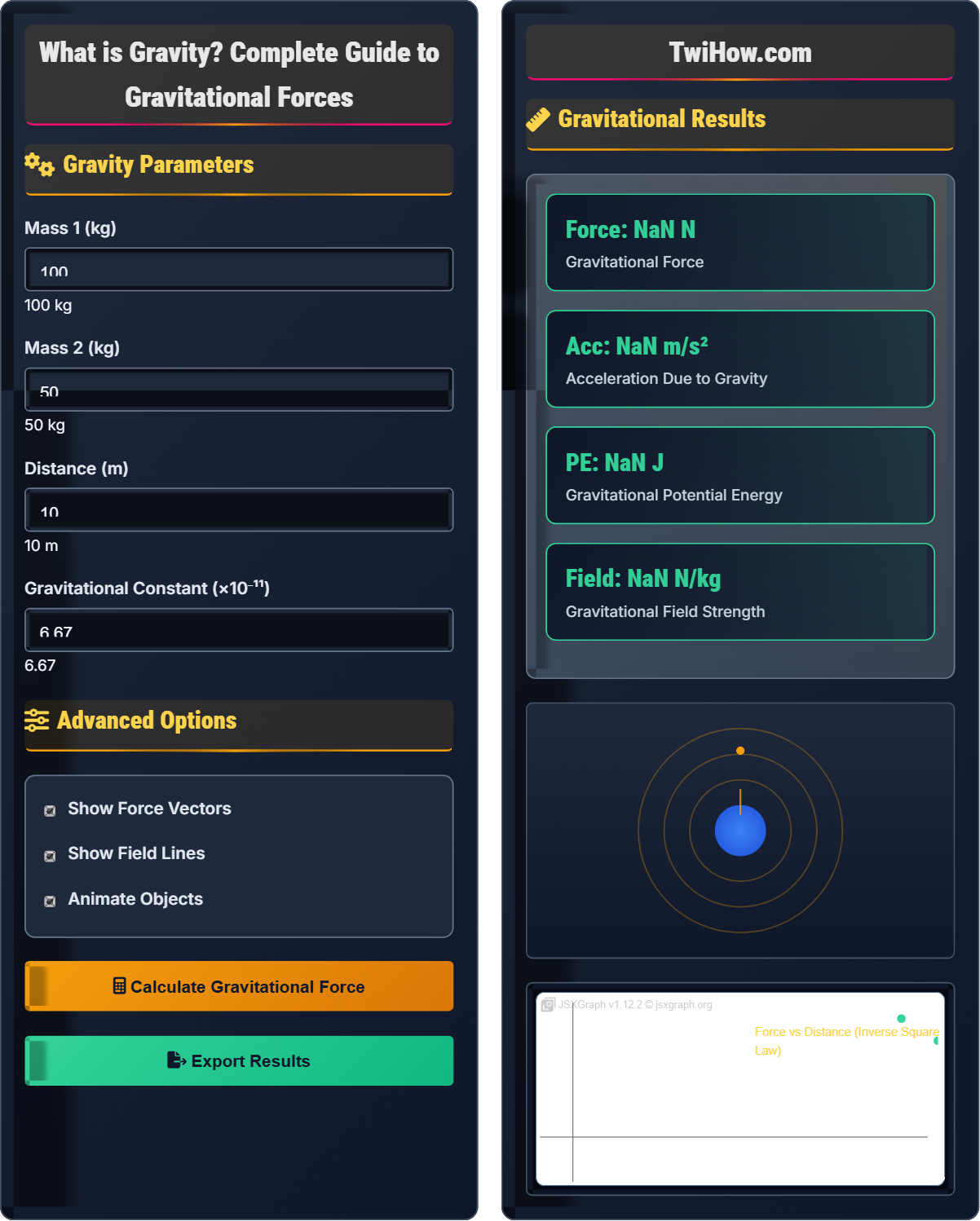
Gravity Parameters
Advanced Options
Gravitational Results
| Parameter | Mass 1 | Mass 2 | Distance |
|---|---|---|---|
| Value | 100 kg | 50 kg | 10 m |
| Force | 3.34×10⁻¹⁰ N | ||
| Acceleration | 3.34×10⁻¹² m/s² | 6.68×10⁻¹² m/s² | - |
Where F is the gravitational force, G is the gravitational constant (6.67×10⁻¹¹ N⋅m²/kg²), m₁ and m₂ are the masses, and r is the distance between centers.
How Gravity Works
Gravity is a fundamental force that attracts any two objects with mass toward each other. It's responsible for keeping planets in orbit around stars, moons around planets, and for the formation of galaxies. On Earth, gravity gives weight to physical objects and causes the ocean tides.
Where:
- F: Gravitational force between objects
- G: Gravitational constant (6.67430×10⁻¹¹ m³⋅kg⁻¹⋅s⁻²)
- m₁, m₂: Masses of the two objects
- r: Distance between the centers of the objects
This law states that every point mass attracts every other point mass by a force acting along the line intersecting both points.
Einstein described gravity not as a force but as a consequence of the curvature of spacetime caused by mass and energy. According to general relativity:
- Mass tells spacetime how to curve
- Spacetime tells mass how to move
- Gravity propagates at the speed of light
- Extreme gravity can cause time dilation
This theory provides corrections to Newton's law for extremely massive objects or high velocities.
- Planetary Motion: Explains orbits of planets and satellites
- Space Travel: Trajectory calculations for spacecraft
- GPS Systems: Time corrections for satellite accuracy
- Black Holes: Predictions of extreme gravitational effects
- Cosmology: Understanding universe expansion and structure
Gravitational Fundamentals
Universal gravitation, gravitational field, spacetime curvature, mass-energy equivalence.
F = G(m₁m₂)/r² (Force equals gravitational constant times product of masses divided by distance squared)
Where F = gravitational force, G = gravitational constant, m₁,m₂ = masses, r = distance.
- Gravity acts between all objects with mass
- Force is always attractive (never repulsive)
- Force follows inverse square law with distance
- Gravity is the weakest of four fundamental forces
Real-World Applications
Satellite orbits, GPS systems, astronomical predictions, space missions, geophysical surveys.
- Gravitational acceleration measurement
- Satellite tracking for mass distribution
- Torsion pendulum experiments
- Atomic interferometry
- Other forces may dominate at small scales
- Relativistic effects become important at high speeds
- Quantum effects not yet fully understood
- Gravity varies slightly with location
Gravity Quiz
If the distance between two objects is doubled, how does the gravitational force between them change?
According to Newton's law of universal gravitation, F = G(m₁m₂)/r², the force is inversely proportional to the square of the distance. If distance is doubled (r becomes 2r), the new force is:
F_new = G(m₁m₂)/(2r)² = G(m₁m₂)/(4r²) = F_original/4
The force decreases by a factor of 4 (or becomes 1/4 of the original force).
The answer is C) Decreases by a factor of 4.
The inverse square relationship means that gravitational force diminishes rapidly with distance. This is why we don't feel the gravitational pull of distant stars despite their enormous masses. The exponent of 2 in the denominator makes the force very sensitive to changes in distance - doubling distance reduces force by 75%!
Inverse Square Law: Relationship where quantity is inversely proportional to distance squared
Universal Gravitation: Newton's law describing gravitational attraction between masses
Proportional: Relationship where one quantity changes in relation to another
• F ∝ 1/r² (inverse square law)
• Force decreases with distance
• Mass remains constant in this scenario
• Remember: "Square the distance, then invert"
• The inverse square law appears in many physics contexts
• Visualize the force spreading over a larger sphere
• Forgetting the square in the inverse square law
• Confusing direct proportionality with inverse
• Thinking gravity disappears at large distances
Explain the difference between weight and mass. How would your weight change if you traveled to the Moon? What about your mass? Include the role of gravitational acceleration in your explanation.
Mass: A measure of the amount of matter in an object, measured in kilograms (kg). Mass is constant regardless of location.
Weight: The force exerted on an object due to gravity, measured in Newtons (N). Weight = Mass × Gravitational Acceleration (W = mg).
On Earth, gravitational acceleration (g) is approximately 9.8 m/s². On the Moon, g is about 1.6 m/s² (roughly 1/6 of Earth's gravity).
If you have a mass of 70 kg:
- Your weight on Earth = 70 kg × 9.8 m/s² = 686 N
- Your weight on the Moon = 70 kg × 1.6 m/s² = 112 N
This distinction is crucial for understanding gravity. Mass is an intrinsic property of matter that doesn't change with location, while weight depends on the local gravitational field. This is why astronauts in space appear weightless but still have mass. The confusion often arises because on Earth, mass and weight are proportional (through g = 9.8 m/s²), making them seem interchangeable in daily life.
Mass: Amount of matter in an object (independent of gravity)
Weight: Gravitational force acting on an object
Gravitational Acceleration: Acceleration due to gravity (g)
• Mass is constant everywhere
• Weight changes with gravity
• W = mg (weight equals mass times gravity)
• Think of mass as "how much stuff"
• Think of weight as "how heavy"
• Scales measure weight, not mass
• Using mass and weight interchangeably
• Forgetting that g varies on different celestial bodies
• Thinking mass changes with location
A satellite of mass 500 kg orbits Earth at a distance of 40,000 km from Earth's center. Given that Earth's mass is 5.97×10²⁴ kg and the gravitational constant is 6.67×10⁻¹¹ N⋅m²/kg², calculate the gravitational force between Earth and the satellite. Then explain how this force keeps the satellite in orbit.
Using Newton's law of universal gravitation:
F = G(m₁m₂)/r²
F = (6.67×10⁻¹¹) × (5.97×10²⁴) × (500) / (40,000,000)²
F = (6.67×10⁻¹¹) × (5.97×10²⁴) × (500) / (1.6×10¹⁵)
F = 1.99×10¹⁷ / 1.6×10¹⁵ = 124.4 N
The gravitational force of 124.4 N acts as the centripetal force that keeps the satellite in circular orbit. Without this inward force, the satellite would continue in a straight line (Newton's first law). The gravitational force constantly pulls the satellite toward Earth's center, changing its direction but not its speed, creating a stable orbit. The satellite's tangential velocity balances the gravitational pull, maintaining a constant distance from Earth.
Orbital mechanics demonstrates the elegant balance between gravitational force and inertia. The satellite is essentially falling toward Earth but moving sideways fast enough to miss it. This creates the curved path we observe as an orbit. The gravitational force provides exactly the centripetal force needed for circular motion. This principle applies to all orbiting bodies, from artificial satellites to the Moon.
Centripetal Force: Center-seeking force required for circular motion
Orbit: Curved path of an object around a celestial body
Tangential Velocity: Velocity component perpendicular to radius
• Gravitational force = centripetal force in orbit
• F = mv²/r for circular motion
• Balance between gravity and inertia
• Orbit is free fall with horizontal motion
• Faster satellites orbit closer to Earth
• Geostationary satellites match Earth's rotation
• Forgetting to convert km to m
• Confusing orbital velocity with escape velocity
• Thinking satellites need propulsion to stay in orbit
A black hole has a mass 10 times that of our Sun (mass of Sun = 1.99×10³⁰ kg). Calculate the gravitational force experienced by a 1 kg object at a distance of 30,000 km from the black hole's center. Compare this to the gravitational force the same object would experience at Earth's surface. Explain why black holes have such strong gravitational effects.
Mass of black hole = 10 × 1.99×10³⁰ kg = 1.99×10³¹ kg
Distance = 30,000 km = 30,000,000 m
Force from black hole: F = G(m₁m₂)/r²
F = (6.67×10⁻¹¹) × (1.99×10³¹) × (1) / (3×10⁷)²
F = (6.67×10⁻¹¹) × (1.99×10³¹) / (9×10¹⁴) = 1.48×10⁶ N
Force on Earth's surface: F = mg = 1 × 9.8 = 9.8 N
The force from the black hole is 1.48×10⁶ / 9.8 ≈ 151,000 times stronger!
Black holes have extremely strong gravity because their mass is concentrated in a very small volume, allowing objects to get extremely close to the center of mass. The gravitational field becomes incredibly intense near the event horizon.
Black holes demonstrate the relationship between mass concentration and gravitational strength. While the black hole's mass might only be 10 times that of the Sun, the gravitational force at close range is dramatically stronger because of the inverse square law. The key difference is the proximity possible to the center of mass. In regular stars, you'd hit the surface before getting this close to the center.
Event Horizon: Point of no return around a black hole
Escape Velocity: Speed needed to overcome gravitational pull
Mass Concentration: Amount of mass in a given volume
• Gravity depends on both mass and distance
• Black holes allow extreme proximity
• Escape velocity exceeds speed of light
• Think of gravity as getting stronger closer to mass
• Black holes are dense, not necessarily more massive
• Surface gravity increases with density
• Thinking black holes "suck" things in
• Confusing mass with density effects
• Forgetting the inverse square law
Which of the following phenomena can only be explained by Einstein's theory of general relativity, not Newton's law of universal gravitation?
Gravitational time dilation is a prediction of Einstein's general relativity, which describes gravity as the curvature of spacetime. According to this theory, time runs slower in stronger gravitational fields. This effect has been experimentally verified and is crucial for GPS satellite operation.
Newton's law treats gravity as a force and does not predict time dilation. While Newton's law accurately predicts planetary orbits, tides, and falling objects for most practical purposes, it cannot explain relativistic effects.
The answer is C) Gravitational time dilation.
This question highlights the evolution of scientific understanding. Newton's law works extremely well for most everyday situations and even space missions, but Einstein's theory provides corrections in extreme conditions (very strong gravity, high speeds). Both theories describe the same phenomenon but with different levels of accuracy depending on the situation.
General Relativity: Einstein's theory describing gravity as spacetime curvature
Time Dilation: Slowing of time in strong gravitational fields
Newtonian Gravity: Classical description of gravity as a force
• Newton's law is accurate for weak fields
• Relativity is needed for strong fields
• Both theories describe same phenomenon
• Use Newton's law for most practical applications
• Relativity for extreme conditions
• Science builds on previous theories
• Thinking newer theory replaces old completely
• Believing Newton's law is "wrong"
• Confusing when to use each theory
FAQ
Q: Why don't we feel the gravitational pull of small objects around us?
A: We do feel the gravitational pull of small objects, but the force is incredibly tiny. Using Newton's law F = G(m₁m₂)/r², the gravitational constant G is very small (6.67×10⁻¹¹), so unless at least one of the objects has enormous mass (like Earth), the force is negligible. For example, two 1 kg objects 1 meter apart experience a gravitational force of only 6.67×10⁻¹¹ N - far too small to notice. Earth's mass (5.97×10²⁴ kg) creates a noticeable force that we call weight.
Q: How does gravity affect time, and why is this important for GPS systems?
A: According to Einstein's general relativity, time runs slower in stronger gravitational fields - this is called gravitational time dilation. GPS satellites orbit about 20,000 km above Earth's surface, where gravity is weaker than on the surface. Their clocks run faster by about 38 microseconds per day. If not corrected, this would cause GPS positions to drift by several kilometers per day. Engineers program GPS satellites with atomic clocks that account for both special relativistic effects (from their orbital velocity) and general relativistic effects (from weaker gravity) to maintain accuracy.
Q: Is gravity a force or a property of space itself?
A: This represents the evolution of our understanding of gravity. Newton described it as a force acting at a distance, which works well for most everyday situations. Einstein revolutionized our view by describing gravity as the curvature of spacetime caused by mass and energy. In this view, objects follow the straightest possible paths (geodesics) in curved spacetime. Modern physics suggests gravity might be mediated by hypothetical particles called gravitons, but we don't yet have a complete quantum theory of gravity. Both descriptions are valid in their respective domains - Newton's for weak fields and low speeds, Einstein's for strong fields and high speeds.