How can non-scientists engage with and understand biological research?
Complete biology guide • Step-by-step explanations
Biological Research Literacy:
Show Research Literacy SimulatorEngaging with biological research as a non-scientist requires developing research literacy skills, critical thinking abilities, and an understanding of scientific methodology. This involves learning to interpret research findings, evaluate sources, and distinguish between reliable and unreliable information.
Modern approaches emphasize science communication, fact-checking, and understanding the peer-review process. With the abundance of information available today, developing these skills is crucial for making informed decisions about health, environment, and policy matters.
Key literacy components:
- Source Evaluation: Assessing credibility and reliability of research
- Methodology Understanding: Grasping research design and limitations
- Statistical Interpretation: Understanding significance and effect sizes
- Peer Review Awareness: Recognizing the importance of validation
Developing these skills empowers citizens to participate meaningfully in science-related discussions and make evidence-based decisions in their daily lives.
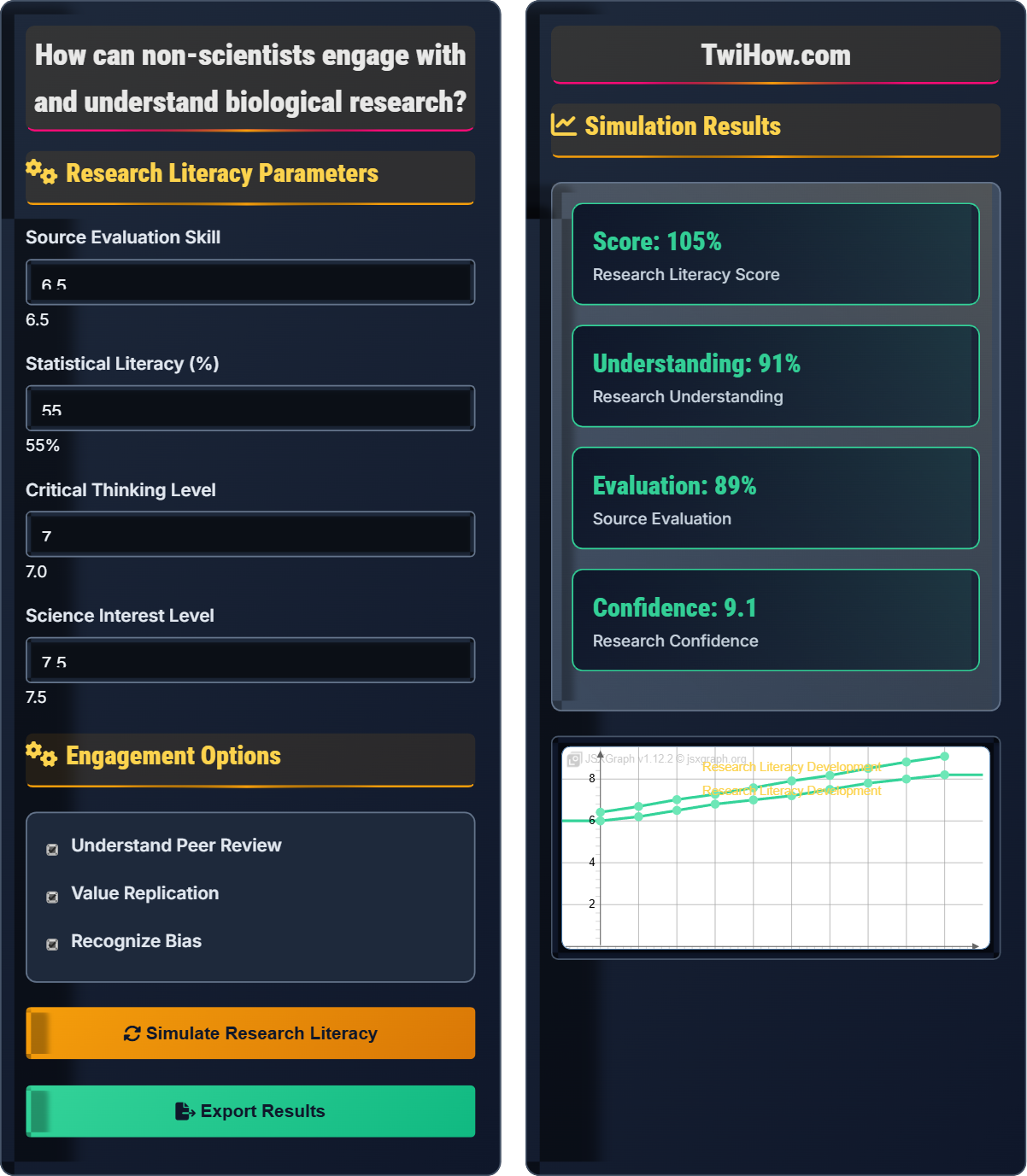
Research Literacy Parameters
Engagement Options
Simulation Results
| Skill | Level | Progress | Importance |
|---|---|---|---|
| Source Evaluation | 6.5 | 65% | High |
| Statistical Literacy | 5.5 | 55% | High |
| Critical Thinking | 7.0 | 70% | Very High |
| Methodology Understanding | 6.2 | 62% | High |
Based on simulation parameters:
- Check publication venue and peer review
- Assess sample size and methodology
- Look for funding sources and conflicts
- Verify results with multiple sources
Assessment based on simulation:
- Fact-checking websites (Snopes, PolitiFact)
- Research databases (PubMed, Google Scholar)
- Science communication resources
- Statistical interpretation guides
Biological Research Literacy Explained
Research literacy is the ability to access, evaluate, and understand scientific information. For non-scientists, this means developing skills to interpret research findings, assess the credibility of sources, and make informed decisions based on evidence. It involves understanding scientific methodology, statistical concepts, and the peer review process.
The development of research literacy can be modeled as a combination of key competencies:
Where:
- Critical Thinking: Ability to analyze and evaluate arguments
- Statistical Understanding: Comprehension of data interpretation
- Source Evaluation: Skills to assess credibility and reliability
- Scientific Knowledge: Foundational understanding of scientific principles
Key areas where research literacy skills are applied:
- Health Decisions: Evaluating medical research and treatment options
- Environmental Issues: Understanding climate science and conservation
- Policy Making: Participating in evidence-based civic discussions
- Consumer Choices: Assessing product claims and safety
- Education: Helping children with science projects and learning
- Workplace: Making informed decisions in various professions
- Science Communication: Following reputable science communicators
- Online Courses: Taking MOOCs on research methods and statistics
- Journal Clubs: Participating in community reading groups
- Library Resources: Using academic databases and guides
- Professional Development: Attending public lectures and workshops
- Peer Discussions: Engaging in thoughtful conversations
Research Literacy Fundamentals
Research literacy, critical thinking, peer review, statistical significance, source evaluation, methodology.
RL = f(CT, SU, SE, SK)
Where RL = research literacy, CT = critical thinking, SU = statistical understanding, SE = source evaluation, SK = scientific knowledge.
- Correlation does not imply causation
- Peer review is crucial for validation
- Sample size affects reliability
Applications
Health decisions, environmental awareness, policy participation, consumer choices, education, workplace decisions.
- Evaluate research credibility
- Understand statistical significance
- Identify research limitations
- Seek multiple perspectives
- Stay curious and open-minded
- Verify information independently
- Consider multiple sources
- Recognize personal biases
Research Literacy Learning Quiz
What does a p-value of 0.03 indicate in a research study?
A p-value of 0.03 means there is a 3% probability of observing the results (or more extreme results) if the null hypothesis is true. In other words, if there were truly no effect or difference, we would expect to see results like this by random chance only 3% of the time. This is commonly used as a threshold for statistical significance (p < 0.05).
The answer is B) There is a 3% chance of observing these results if the null hypothesis is true.
Understanding p-values is crucial for interpreting research results. The p-value does not tell us the probability that the alternative hypothesis is true, nor does it measure the size or importance of an effect. It simply indicates how surprising the observed data would be if there were truly no effect. This is a fundamental concept in statistical inference.
P-value: Probability of observing results assuming null hypothesis is true
Null Hypothesis: Default assumption of no effect or difference
Statistical Significance: Result unlikely to be due to chance alone
• P-value doesn't measure effect size
• P < 0.05 is common significance threshold
• Look for effect sizes alongside p-values
• Consider sample size when interpreting p-values
• P-values don't prove causation
• Thinking p-value indicates probability of truth
• Equating statistical significance with practical importance
• Ignoring effect size and confidence intervals
Explain the peer review process in scientific publishing and discuss its importance for research quality. Include the steps involved and potential limitations.
Peer Review Process: Scientific papers undergo evaluation by experts in the same field before publication. The process typically includes:
1) Submission: Authors submit manuscript to journal
2) Editorial Assessment: Editor checks for scope and basic quality
3) Reviewer Selection: Independent experts are invited to review
4) Review Process: Reviewers evaluate methodology, significance, and validity
5) Decision: Editor makes publication decision based on reviews
Importance: Ensures quality control, validates methodology, and maintains scientific standards. It helps identify errors, strengthens arguments, and improves clarity.
Limitations: Can be slow, may miss fraud, reviewers may have biases, and not all quality research gets published.
The peer review process is a cornerstone of scientific integrity, serving as a quality assurance mechanism. Understanding this process helps readers appreciate the rigor behind published research while also recognizing its limitations. Peer review is not perfect but represents the best available system for maintaining scientific standards.
Peer Review: Evaluation of scientific work by experts in the field
Blind Review: Identity of authors/reviewers concealed
Double-blind: Both author and reviewer identities concealed
• Peer review ensures quality control
• Experts evaluate methodology and significance
• Process has limitations and biases
• Prefer peer-reviewed sources
• Understand the process has limitations
• Look for replication of results
• Assuming peer review guarantees truth
• Not recognizing review limitations
• Dismissing valid research as flawed
You come across a research article claiming that a new supplement cures cancer with a 95% success rate. The study was conducted by the supplement manufacturer, has a sample size of 10 patients, and was published in a journal you've never heard of. Calculate the credibility score using the following criteria: manufacturer funding (-20%), small sample size (-25%), unknown journal (-15%), and no peer review (-20%). Starting with 100%, what is the final credibility score?
Credibility Calculation: Starting score: 100%
Manufacturer funding deduction: 100% - 20% = 80%
Small sample size deduction: 80% - 25% = 55%
Unknown journal deduction: 55% - 15% = 40%
No peer review deduction: 40% - 20% = 20%
Final credibility score: 20%
Evaluation: This source has extremely low credibility. Warning signs include conflict of interest (manufacturer funding), insufficient sample size for meaningful conclusions, questionable publication venue, and lack of peer review. Such claims require independent verification through larger, properly controlled studies published in reputable journals.
This problem illustrates how multiple red flags can dramatically reduce the credibility of research. Each warning sign compounds the others, creating a cumulative effect that makes the research highly suspect. Understanding these warning signs helps non-scientists avoid being misled by unreliable sources.
Conflict of Interest: Financial or personal interests affecting research
Sample Size: Number of participants in a study
Reputable Journal: Established publication with rigorous peer review
• Look for conflicts of interest
• Consider sample size adequacy
• Verify publication venue reputation
• Check funding sources
• Verify journal reputation
• Look for independent replication
• Not checking funding sources
• Accepting small samples as definitive
• Not verifying journal quality
You read a study showing that people who drink coffee live longer than those who don't. The researchers followed 50,000 people for 20 years and found a statistically significant correlation. Design a critical evaluation of this research and explain what additional information would be needed to establish causation.
Critical Evaluation:
1) Study Design: This appears to be an observational study, which cannot establish causation
2) Confounding Variables: Coffee drinkers may have healthier lifestyles, higher income, better healthcare access
3) Reverse Causation: Healthier people might be more likely to drink coffee
4) Dose-Response Relationship: Need to know amount consumed
Additional Information Needed:
• Randomized controlled trial results
• Adjustment for lifestyle factors (diet, exercise, smoking)
• Biological mechanism explanation
• Consistent results across different populations
• Temporal sequence verification
Conclusion: Correlation does not imply causation; further research is needed.
This example demonstrates the critical distinction between correlation and causation, one of the most important concepts in research literacy. Observational studies can identify associations but cannot prove causation. Understanding this distinction prevents misinterpretation of research findings and helps develop critical thinking skills.
Correlation: Statistical relationship between variables
Causation: Cause-and-effect relationship
Confounding Variable: Factor affecting both variables being studied
• Correlation does not equal causation
• Randomized trials establish causation
• Consider confounding variables
• Look for randomized controlled trials
• Consider alternative explanations
• Seek replication of results
• Assuming correlation implies causation
• Ignoring confounding variables
• Overgeneralizing from observational studies
Which research design would provide the strongest evidence for determining if a new drug is effective?
A randomized controlled trial (RCT) provides the strongest evidence because it randomly assigns participants to treatment and control groups, minimizing selection bias. The randomization helps ensure that the groups are comparable, and the control group provides a baseline for comparison. This design allows researchers to establish cause-and-effect relationships and control for confounding variables.
The answer is B) Randomized controlled trial.
Understanding research design hierarchy is fundamental to evaluating evidence quality. RCTs are considered the gold standard for establishing causation because they minimize bias and control for confounding variables. Different research designs answer different types of questions with varying degrees of certainty.
Randomized Controlled Trial: Study assigning participants randomly to groups
Case Study: Detailed examination of single subject or situation
Control Group: Group not receiving experimental treatment
• RCTs provide strongest causal evidence
• Randomization minimizes bias
• Control groups provide comparison baseline
• RCTs are gold standard for causation
• Larger sample sizes increase reliability
• Double-blinding reduces bias
• Not understanding research design strengths
• Overvaluing anecdotal evidence
• Ignoring study limitations
FAQ
Q: How can I tell if a news article about scientific research is accurate?
A: Here are key strategies to evaluate science news articles:
Source Verification: Check if the article cites the original research paper and verify it was published in a peer-reviewed journal.
Language Assessment: Look for measured language ("suggests," "may," "associated with") rather than absolute claims ("cures," "proves," "reveals").
Expert Opinions: See if the article includes quotes from independent experts not involved in the study.
Context: Does the article place the findings in context with existing research?
Sample Size: Are the number of participants/study subjects clearly stated and reasonable?
Funding Disclosure: Is the source of funding for the research disclosed?
Reputable sources include established science journalism outlets, university press releases, and direct reporting of peer-reviewed studies.
Q: What resources can I recommend to my students for learning about biological research?
A: Excellent resources for students include:
Primary Sources: PubMed (free access to biomedical literature), Google Scholar, and institutional repositories.
Summarized Research: ScienceDaily, EurekAlert!, and university news releases that summarize peer-reviewed research.
Visual Learning: HHMI BioInteractive, National Geographic Education, and Khan Academy's biology sections.
Interactive Tools: PhET simulations, virtual labs, and research databases with student-friendly interfaces.
Communication Skills: Nature's "News and Views" articles, which explain research in accessible language.
Verification Tools: Fact-checking websites and research evaluation rubrics to teach critical analysis skills.
Start with simpler, well-summarized research and gradually introduce more complex primary literature as students develop literacy skills.