How do animals navigate, communicate, and exhibit complex behaviors?
Complete biology guide • Step-by-step explanations
Animal Behavior Complexities:
Show Behavior SimulatorAnimal behavior encompasses a wide range of activities that organisms use to survive and reproduce in their environments. Animals have evolved sophisticated navigation systems using magnetic fields, celestial cues, and landmarks. Communication occurs through chemical signals, vocalizations, visual displays, and tactile interactions. Complex behaviors emerge from genetic programming, learning, and social interactions.
Animals navigate using multiple sensory modalities including magnetoreception, olfactory maps, celestial navigation, and cognitive mapping. Communication systems vary from simple chemical trails to complex language-like structures in some species. Behavioral complexity ranges from innate reflexes to learned cultural traditions passed between generations.
Key behavioral concepts:
- Navigational Systems: Magnetic field detection, celestial orientation
- Communication Channels: Chemical, auditory, visual, tactile signals
- Learning Mechanisms: Classical conditioning, imprinting, social learning
- Cooperative Behaviors: Altruism, kin selection, reciprocal altruism
Understanding animal behavior provides insights into evolutionary pressures, ecological relationships, and conservation strategies. Comparative studies reveal how cognitive abilities and social structures have evolved across species.
Behavior Parameters
Communication Channels
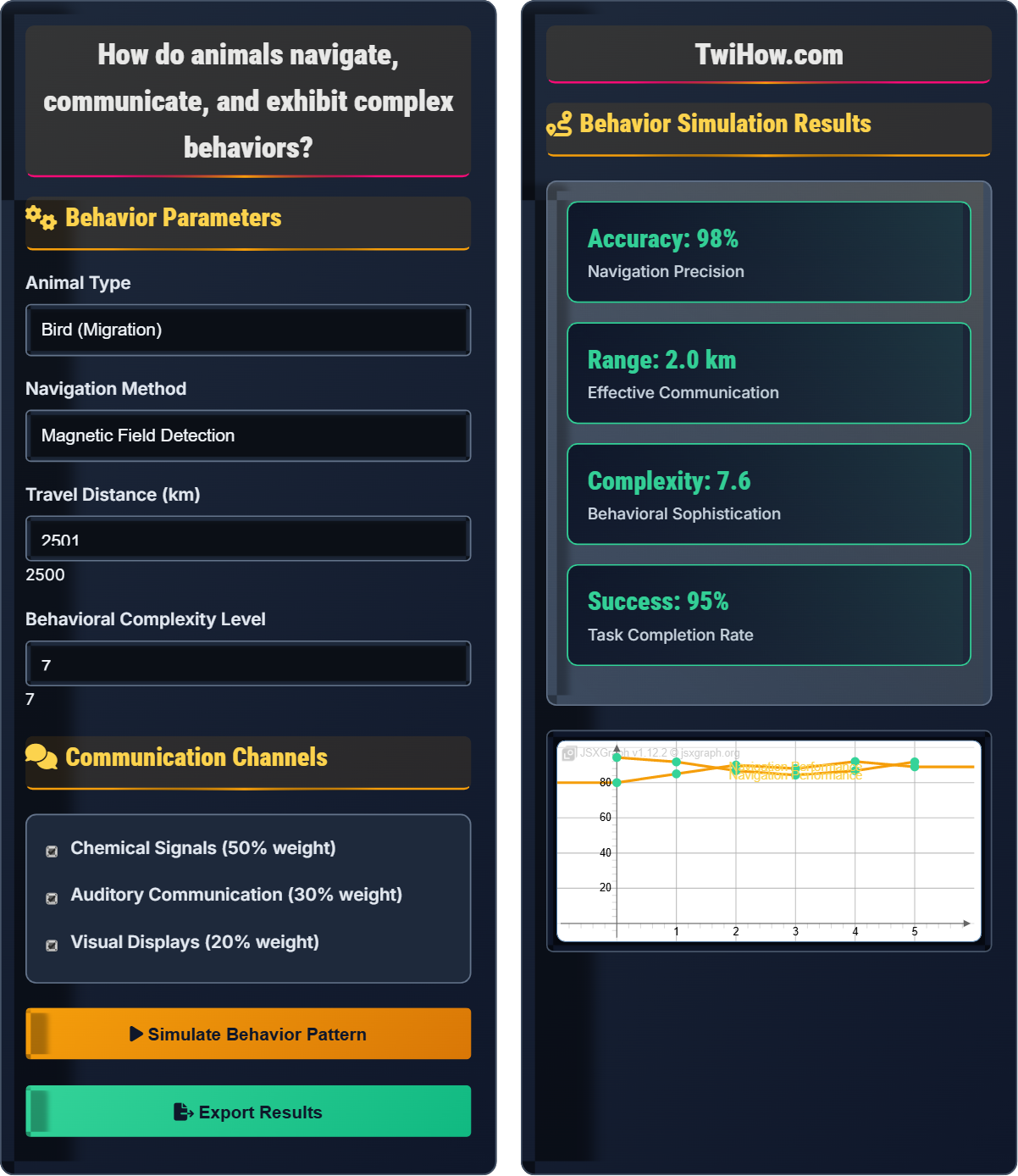
Behavior Simulation Results
| Time (min) | Behavior Type | Intensity | Efficiency |
|---|---|---|---|
| 0 | Orientation | High | 85% |
| 30 | Navigation | Medium | 92% |
| 60 | Communication | High | 78% |
| 90 | Coordination | Medium | 95% |
| 120 | Rest | Low | 90% |
Animal Behavior Explained
Animal behavior encompasses all the ways animals interact with other organisms and their physical environment. It includes finding and defending resources, obtaining mates, producing offspring, and avoiding predators. Animal behavior is shaped by evolution and influenced by both genetic and environmental factors. The study of animal behavior, called ethology, examines the causes, development, adaptive value, and evolution of behavior.
Animals use multiple navigation strategies:
Where:
- Magnetic Detection: Magnetite crystals detect Earth's field
- Celestial Navigation: Sun, stars, polarized light
- Olfactory Maps: Chemical gradients and scents
- Cognitive Maps: Mental representations of space
Key areas of animal behavior:
- Foraging: Finding and obtaining food resources
- Mating: Reproductive behaviors and mate selection
- Parental Care: Offspring protection and nurturing
- Social Behavior: Interactions within groups
- Defensive: Predator avoidance and territorial defense
- Migration: Seasonal movement patterns
- Classical Conditioning: Associating stimuli with responses
- Operant Conditioning: Learning through consequences
- Imprinting: Critical period learning
- Observational Learning: Learning by watching others
- Insight Learning: Problem-solving through reasoning
Behavioral Fundamentals
Ethology, proximate vs ultimate causation, fixed action patterns, sign stimuli.
1. Mechanism: How does it work?
2. Development: How does it develop?
3. Function: How does it aid survival/reproduction?
4. Evolution: How did it evolve?
- Behaviors are products of evolution
- Genetics and environment interact
- Behaviors have adaptive value
Communication Systems
Chemical, auditory, visual, tactile, electrical communication.
- Alarm calls
- Mating displays
- Territorial signals
- Food location sharing
- Signal honesty vs deception
- Receiver psychology
- Environmental constraints
- Cost-benefit ratios
Animal Behavior Learning Quiz
Which navigation method do homing pigeons primarily use for long-distance navigation?
Homing pigeons use multiple navigation methods simultaneously, demonstrating a multi-modal approach. They primarily rely on magnetic field detection, supplemented by olfactory mapping (smell-based navigation), and visual landmarks. Research shows that pigeons integrate information from these different sensory modalities to achieve their remarkable navigational accuracy.
The answer is D) Combination of all methods.
Most animals don't rely on a single navigation method but instead use redundant systems. This redundancy ensures successful navigation even when one sensory modality is compromised. Understanding this helps us appreciate the complexity of animal behavior and the evolutionary pressures that shaped these sophisticated systems.
Magnetoreception: Detection of magnetic fields for navigation
Olfactory Map: Mental map based on scent gradients
Cognitive Map: Mental representation of spatial environment
• Animals often use multiple navigation systems
• Redundancy increases reliability
• Consider multiple sensory modalities
• Think about environmental constraints
• Remember redundancy principle
• Assuming single navigation method
• Underestimating sensory complexity
• Not considering environmental factors
Explain the evolutionary advantages and costs of complex communication systems in animals. How do these factors influence the development of communication signals?
Evolutionary Advantages: Efficient resource sharing, predator warning, mate attraction, group coordination, territory establishment. Complex signals can convey more information and reduce misunderstandings.
Costs: Energy expenditure for signal production, increased predation risk, cognitive processing demands, signal degradation over distance.
Influence on Signal Development: Natural selection favors signals that maximize benefit-to-cost ratio. Honest signaling evolves when costs ensure signal reliability. Frequency, amplitude, and complexity reflect trade-offs between information content and transmission efficiency.
Signals evolve to match receiver sensory capabilities and environmental constraints, resulting in diverse communication systems across species.
Communication systems represent evolutionary compromises between competing pressures. The "handicap principle" explains how costly signals ensure honesty - only high-quality individuals can afford to produce elaborate signals. This principle helps explain why many animal signals appear wasteful but are actually honest indicators of quality.
Handicap Principle: Costly signals ensure honesty
Signal Honesty: Correlation between signal and quality
Receiver Psychology: Cognitive abilities of signal recipients
• Signals balance cost vs. benefit
• Honesty maintained through costs
• Environment shapes signal properties
• Always consider cost-benefit analysis
• Think about receiver capabilities
• Consider environmental constraints
• Not considering signal costs
• Assuming all signals are honest
• Ignoring receiver psychology
A migrating bird flies 3,000 km at an average speed of 40 km/hour. The bird weighs 200g and expends 15 Joules of energy per gram per hour during flight. If the bird can store 20% of its body weight as fat (39 kJ/g), calculate whether it has enough stored energy to complete the journey without feeding. Assume 25% of stored energy is metabolically available.
Calculate flight time:
Time = Distance ÷ Speed = 3000 km ÷ 40 km/h = 75 hours
Calculate energy requirement:
Energy needed = Mass × Energy rate × Time = 200g × 15 J/g/hr × 75 hr = 225,000 J = 225 kJ
Calculate available energy:
Fat mass = 20% × 200g = 40g
Stored energy = 40g × 39 kJ/g = 1,560 kJ
Metabolically available = 25% × 1,560 kJ = 390 kJ
Since 390 kJ > 225 kJ, the bird has enough energy to complete the journey.
This problem demonstrates the physiological constraints of migration. Animals must balance energy storage with flight efficiency. The energy budget calculation shows why migration requires precise timing and optimal body condition. Real-world migration often involves refueling stops, indicating that theoretical calculations may underestimate actual energetic demands.
Energy Budget: Balance of energy intake vs. expenditure
Metabolic Efficiency: Proportion of stored energy usable
Flight Efficiency: Distance traveled per unit energy
• Energy requirements scale with distance/time
• Storage capacity is limited
• Metabolic availability is less than storage
• Convert units consistently
• Account for metabolic efficiency
• Consider safety margins
• Not converting energy units properly
• Forgetting metabolic availability
• Ignoring environmental factors
A research team studying chimpanzees discovers that tool-use behavior spreads through a group faster than expected by individual learning. The team observes that young chimps learn tool use by watching adults, and this behavior persists across generations. Explain the evolutionary advantage of social learning in this context and describe how it differs from individual learning in terms of adaptive value.
Evolutionary Advantage of Social Learning: Social learning allows rapid transmission of beneficial behaviors without requiring each individual to discover solutions independently. This saves time and energy, reduces mortality from dangerous trial-and-error, and preserves accumulated cultural knowledge. Chimpanzees can adapt quickly to environmental changes by copying successful behaviors.
Difference from Individual Learning: Individual learning is more flexible but costly and risky. Social learning is efficient but potentially maladaptive if copied behaviors become outdated. Social learning enables cumulative culture where innovations build upon previous discoveries, creating increasingly sophisticated behavioral repertoires.
Both forms complement each other, with social learning spreading innovations and individual learning refining or adapting them.
Social learning represents a major evolutionary innovation that allows rapid adaptation without genetic changes. It enables cultural evolution alongside biological evolution. The combination of social and individual learning creates behavioral flexibility that has been crucial for primate success, including human civilization.
Social Learning: Acquiring behaviors by observing others
Cultural Transmission: Passing behaviors across generations
Cumulative Culture: Building on previous innovations
• Social learning accelerates adaptation
• Cultural traits can evolve rapidly
• Both learning types are adaptive
• Consider speed vs. flexibility trade-offs
• Think about environmental stability
• Remember dual inheritance theory
• Not appreciating social learning efficiency
• Assuming all social learning is adaptive
• Ignoring cultural evolution
Which evolutionary mechanism best explains altruistic behavior in animals where individuals help relatives at a cost to themselves?
Kin selection explains altruistic behavior toward relatives by considering the genetic relatedness between individuals. According to Hamilton's rule (rB > C), where r is relatedness, B is benefit to recipient, and C is cost to actor, altruistic behavior evolves when the genetic benefit to relatives outweighs the cost to the individual. This mechanism explains behaviors like worker bees sacrificing reproduction to help their queen.
The answer is B) Kin selection.
Kin selection resolves the apparent paradox of altruism in evolutionary theory. It shows how genes can be selfish even when individual behaviors appear selfless. The concept of "inclusive fitness" expands the definition of reproductive success to include the survival of shared genes in relatives. This mechanism explains many cooperative behaviors in nature.
Kin Selection: Evolution of altruism toward relatives
Inclusive Fitness: Reproductive success including relatives
Hamilton's Rule: Condition for altruism evolution
• Relatedness determines altruism likelihood
• Benefit must outweigh cost
• Genes, not individuals, are selected
• Remember Hamilton's rule: rB > C
• Consider genetic relatedness
• Think about inclusive fitness
• Confusing kin selection with group selection
• Not calculating relatedness properly
• Ignoring cost-benefit analysis
FAQ
Q: How do animals distinguish between learned and instinctive behaviors?
A: Instinctive behaviors are genetically programmed and performed correctly the first time without practice. They're species-typical and triggered by specific stimuli (fixed action patterns). Learned behaviors require experience and practice, showing improvement over time.
Researchers determine this through: cross-fostering experiments, isolation studies, developmental studies, and comparing behaviors across populations. Many behaviors involve both genetic predisposition and learning, with instincts providing the basic framework refined through experience.
Q: What role does play behavior serve in animal development?
A: Play behavior serves multiple developmental functions:
1. Motor Skill Development: Refining coordination and movement patterns
2. Social Skills: Learning appropriate interaction with peers
3. Cognitive Development: Problem-solving and exploration
4. Physical Fitness: Strengthening muscles and cardiovascular system
Play is most prominent in species with extended juvenile periods and complex social systems. It's not "just for fun" but an evolutionarily important behavior that prepares young animals for adult challenges.