How Do Brains Process Information and Create Consciousness?
Complete neuroscience guide • Step-by-step explanations
Brain Function Fundamentals:
Show Brain SimulationThe brain processes information through complex networks of interconnected neurons that communicate via electrical and chemical signals. Consciousness emerges from the integration of sensory inputs, memories, emotions, and executive functions across distributed neural networks.
Key processes:
- Neural Networks: Interconnected neurons forming circuits for specific functions
- Information Integration: Combining sensory inputs into coherent perceptions
- Memory Formation: Encoding, storing, and retrieving information
- Executive Functions: Planning, decision-making, and conscious awareness
Consciousness remains one of neuroscience's greatest mysteries, involving global workspace theories, integrated information theory, and the binding problem of how separate neural processes create unified experience.
Brain Parameters
Simulation Options
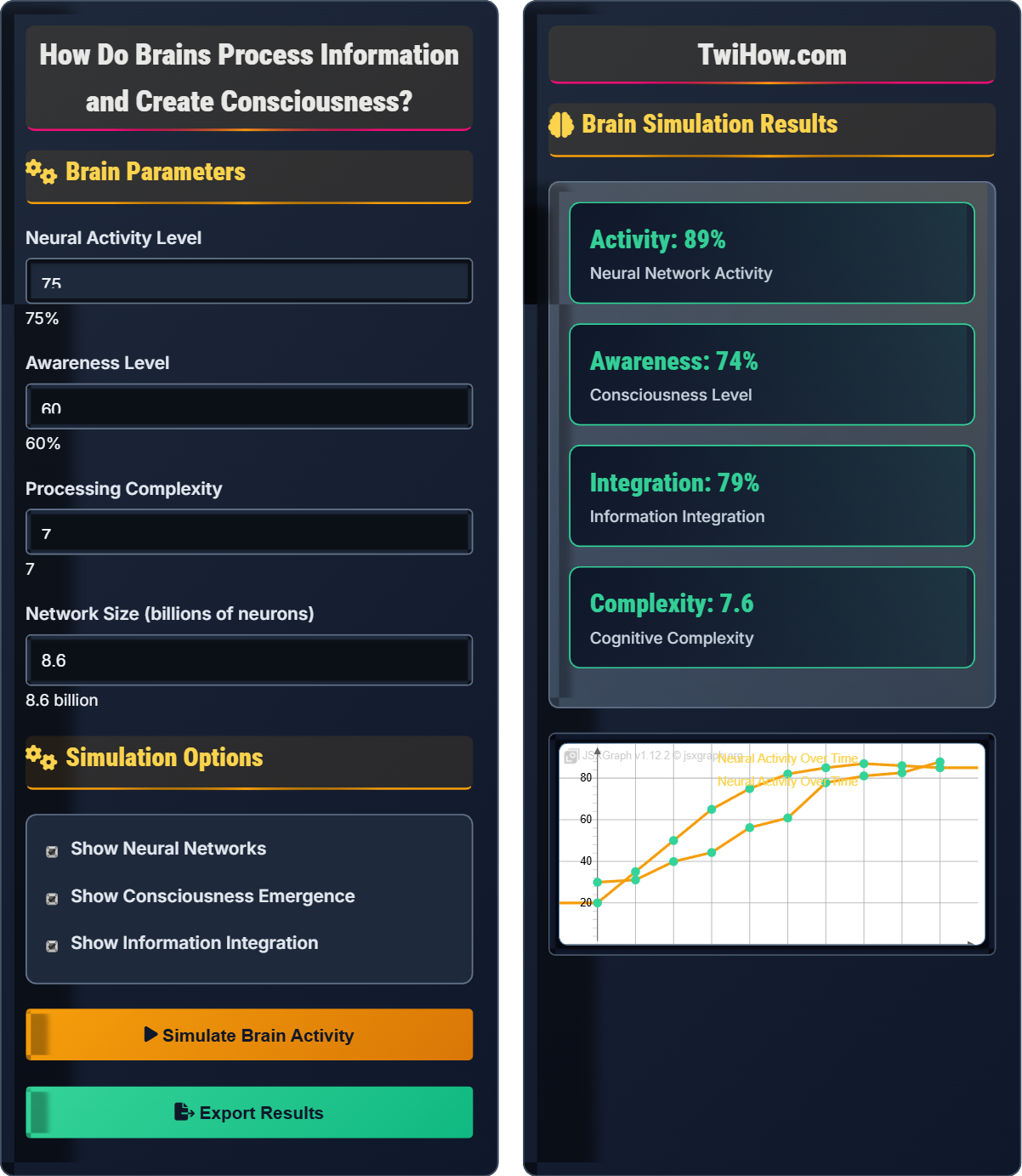
Brain Simulation Results
| Time (ms) | Activity | Awareness | Integration |
|---|---|---|---|
| 100 | 20% | 15% | 10% |
| 200 | 35% | 25% | 20% |
| 300 | 50% | 40% | 35% |
| 400 | 65% | 55% | 50% |
| 500 | 75% | 65% | 65% |
Consciousness emerges from integrated neural activity across multiple brain regions.
Information flows through neural networks connecting sensory, memory, and executive areas.
How Brain Information Processing Works
The brain processes information through complex networks of neurons that communicate via electrical and chemical signals. Information processing involves receiving sensory inputs, integrating them with memories and emotions, and producing appropriate behavioral responses. Consciousness emerges from this integrated neural activity.
Information processing occurs through:
Where:
- Neural Activity: Electrical and chemical signaling in neurons
- Integration: Combining information from multiple sources
- Consciousness: Emergent property of integrated activity
Leading theories explaining consciousness:
- Global Workspace Theory: Consciousness as information broadcast globally
- Integrated Information Theory: Consciousness as integrated neural activity
- Higher-Order Thought Theory: Consciousness as thoughts about thoughts
- Predictive Processing: Brain as prediction-error minimization system
- Binding Problem: How separate processes create unified experience
- Default Mode Network: Active during introspective thought
- Global Thalamocortical Loops: Reciprocal connections enabling integration
- Frontoparietal Network: Executive control and attention
- Temporal Parietal Junction: Self-other distinction
- Anterior Cingulate Cortex: Conflict monitoring and attention
Brain Function Fundamentals
Neural networks, information integration, consciousness, neural plasticity, binding problem.
Input → Processing → Integration → Output
Where Processing = neural computation, Integration = consciousness emergence.
- Consciousness emerges from neural network activity
- Information integration occurs across distributed networks
- Plasticity enables learning and adaptation
Consciousness Theories
Global workspace, integrated information, higher-order thought, predictive processing.
- Sensory input processing
- Perceptual organization
- Memory integration
- Executive control
- Conscious awareness emergence
- Hard problem of consciousness remains unsolved
- Multiple theories attempt to explain emergence
- Neural correlates identified but mechanisms unclear
Brain Function Learning Quiz
How do neurons primarily communicate with each other?
Neurons communicate through synapses, where chemical neurotransmitters are released from the presynaptic neuron and bind to receptors on the postsynaptic neuron. This chemical signaling allows for precise, modulated communication between neurons.
While neurons do have electrical properties within themselves (action potentials), communication between neurons occurs chemically across the synaptic cleft. This allows for amplification, inhibition, and modulation of signals that would be impossible with direct electrical connections.
The answer is B) Via chemical neurotransmitters across synapses.
Students often confuse electrical and chemical signaling in the brain. Within neurons, electrical signals (action potentials) travel along axons, but between neurons, chemical signaling dominates. This electrochemical nature allows for complex processing and integration of information.
Synapse: Connection point between neurons
Neurotransmitter: Chemical messenger between neurons
Action Potential: Electrical signal within neurons
• Communication between neurons is chemical
• Communication within neurons is electrical
• Synapses allow for signal modulation
• Remember: "Electrical within, chemical between"
• Synapses = chemical connections
• Allows for complex signal processing
• Thinking neurons touch each other directly
• Not understanding synaptic function
Explain Global Workspace Theory of consciousness and how it accounts for conscious awareness. Include the key components and mechanisms proposed by this theory.
Global Workspace Theory (GWT): Proposed by Bernard Baars, this theory suggests that consciousness arises from a "global workspace" where information becomes globally available to multiple cognitive systems.
Key Components:
1. Global Workspace: A central information-sharing system that broadcasts information to specialized processors.
2. Specialized Processors: Unconscious modules that perform specific tasks (vision, hearing, memory).
3. Attention: Controls what information enters the global workspace.
4. Broadcasting: When information enters the workspace, it becomes globally available.
Consciousness Emergence: Information becomes conscious when it's broadcast globally, making it available to multiple cognitive systems simultaneously. This allows for integration, flexible control, and reportability of information.
Example: When you see a red apple, the visual processing occurs unconsciously until attention selects it for global broadcasting, making you consciously aware of seeing the apple.
GWT provides an intuitive framework for understanding consciousness as information sharing. Students should visualize the brain as having many specialized, unconscious modules that compete for access to a global broadcasting system. This theory helps explain why we can only be conscious of a limited amount of information at once.
Global Workspace: Central system for information sharing
Specialized Processor: Task-specific unconscious module
Broadcasting: Making information globally available
• Consciousness = global information availability
• Limited capacity for global broadcasting
• Attention controls access to workspace
• Think of global workspace as a "stage" in theater
• Conscious = on stage, unconscious = in audience
• Attention = spotlight controlling what's on stage
• Confusing GWT with other theories
• Not understanding the limited capacity aspect
• Thinking all information is conscious
A 30-year-old stroke patient loses the ability to speak but gradually recovers language function over several months of rehabilitation. Explain the neural mechanisms that allow for this recovery and connect it to the concept of neural plasticity. How does this relate to information processing and consciousness?
Neural Plasticity Mechanisms:
1. Synaptic Plasticity: Existing neural connections strengthen or weaken based on activity patterns.
2. Neurogenesis: Formation of new neurons (limited in adult brain).
3. Functional Reorganization: Other brain areas take over functions previously performed by damaged regions.
4. Dendritic Sprouting: New connections form between surviving neurons.
Recovery Process: During rehabilitation, repeated activation of neural circuits strengthens alternative pathways. As new connections form and strengthen, information processing can be rerouted around damaged areas.
Connection to Information Processing: The brain's ability to rewire itself demonstrates its dynamic information processing capabilities. Consciousness remains intact because the brain can adapt its neural networks while preserving the integrated processing necessary for awareness.
Consciousness Implications: Recovery shows that consciousness isn't localized to specific neurons but emerges from distributed network properties that can be reorganized.
This example demonstrates that consciousness and information processing are emergent properties of neural networks rather than fixed locations. Neural plasticity shows how the brain can adapt its structure while maintaining function, supporting theories that consciousness emerges from network properties rather than specific neurons.
Neural Plasticity: Brain's ability to reorganize and adapt
Synaptic Plasticity: Strengthening/weakening of neural connections
Functional Reorganization: Brain areas taking over functions
• Brain can reorganize after injury
• Consciousness can persist despite structural changes
• Information processing adapts to new network configurations
• Think of brain as a flexible network, not fixed wiring
• Plasticity allows for recovery and adaptation
• Consciousness is resilient to some structural changes
• Thinking brain function is permanently lost after injury
• Not appreciating the brain's adaptability
• Confusing structure with function
Explain the "binding problem" in consciousness and why it's considered one of the fundamental challenges in neuroscience. How do researchers propose to solve this problem, and what evidence supports these theories?
The Binding Problem: How the brain integrates separate neural processes into unified conscious experience. For example, when viewing a red apple, color processing occurs in one area, shape in another, and motion in yet another, but we perceive a unified object.
Why It's Challenging:
• Information is processed in distributed brain areas
• No obvious "central integrator" exists
• Timing and coordination of separate processes unclear
Proposed Solutions:
1. Synchronous Oscillations: Neural groups firing in synchrony may bind information together
2. Global Workspace: Information becomes bound when globally accessible
3. Reentrant Connections: Reciprocal connections between areas integrate information
Supporting Evidence: Studies show gamma wave synchronization during conscious perception, and disruption of these rhythms affects conscious awareness.
The binding problem highlights the mystery of how subjective unity emerges from neural diversity. Students should understand that while we can identify where different aspects of perception occur in the brain, we still don't fully understand how these separate processes create unified experience. This remains one of neuroscience's greatest unsolved problems.
Binding Problem: How separate neural processes create unified experience
Synchronous Oscillations: Coordinated neural firing patterns
Reentrant Connections: Reciprocal neural pathways
• Separate processes must be integrated
• Unity of consciousness is fundamental
• Still no complete solution exists
• Think of binding as "glue" holding separate parts together
• Synchronization may be the neural glue
• Unity despite distributed processing
• Thinking there's a "Cartesian theater" in the brain
• Not appreciating the complexity of unity
• Assuming a simple solution exists
According to Integrated Information Theory (IIT), what property of neural networks is most closely associated with consciousness?
Integrated Information Theory proposes that consciousness corresponds to the amount of integrated information (denoted as Φ or "phi") generated by a system. According to IIT, consciousness is identical to integrated information.
IIT measures how much information is generated by a system as a whole that is not reducible to the information generated by its parts. The theory suggests that any system with integrated information has some degree of consciousness.
The theory attempts to explain why consciousness depends on specific brain regions and why it disappears during certain states like deep sleep or anesthesia.
The answer is B) Amount of integrated information (phi).
IIT represents an attempt to quantify consciousness mathematically. Students should understand that IIT suggests consciousness is a fundamental property of integrated information processing, not dependent on biological substrate. This theory attempts to address the "hard problem" of consciousness by identifying a measurable correlate.
Integrated Information Theory: Theory linking consciousness to integrated information
Phi (Φ): Measure of integrated information
Consciousness: According to IIT, identical to integrated information
• Consciousness = integrated information
• Measurable mathematical property
• Not dependent on biological substrate
• IIT = Integrated Information Theory
• Phi (Φ) = measure of consciousness
• Integration is key, not just processing
• Confusing IIT with other theories
• Thinking consciousness requires biological matter
• Not understanding the integration aspect
FAQ
Q: Is consciousness just the brain being very complex, or is it something special?
A: This is one of the biggest debates in neuroscience:
Emergent Properties View: Consciousness emerges from complex neural activity, like wetness emerging from H₂O molecules. It's not special, just a product of sufficient complexity and integration.
Something Special View: Consciousness might involve special properties not explained by neural complexity alone. Some propose quantum effects or unknown physical principles.
Current Evidence: Brain damage studies show consciousness can be altered by changing neural networks, supporting the emergence view. But we still can't fully explain subjective experience (the "hard problem").
Most scientists lean toward consciousness as an emergent property, but the debate continues.
Q: Will we ever fully understand how consciousness works?
A: This remains deeply uncertain:
Optimistic View: Continued advances in brain imaging, computational modeling, and neural recording may eventually reveal consciousness mechanisms. We've made significant progress understanding neural correlates.
Pessimistic View: Consciousness might involve properties that are fundamentally inaccessible to scientific investigation. The subjective "what it's like" aspect may be beyond objective measurement.
Current Progress: We understand many neural mechanisms related to consciousness, but the "hard problem" of subjective experience remains unsolved.
Most researchers believe we'll understand many aspects of consciousness, but whether we'll solve the fundamental mystery remains open.