How Do Cells Communicate and Coordinate in Complex Organisms?
Complete biology guide • Step-by-step explanations
Cell Communication Fundamentals:
Show Cell Communication SimulatorCells in complex organisms communicate through various signaling mechanisms to coordinate activities and maintain homeostasis. Communication occurs through chemical signals, electrical impulses, and direct contact between cells.
Key communication types:
- Endocrine Signaling: Hormones travel through bloodstream to distant targets
- Paracrine Signaling: Local chemical messengers affect nearby cells
- Synaptic Signaling: Neurotransmitters transmit signals across synapses
- Direct Contact: Gap junctions and cell adhesion molecules
Signal transduction pathways involve reception, transduction, and response phases. Cells coordinate complex processes like growth, metabolism, immune responses, and stress responses through integrated signaling networks.
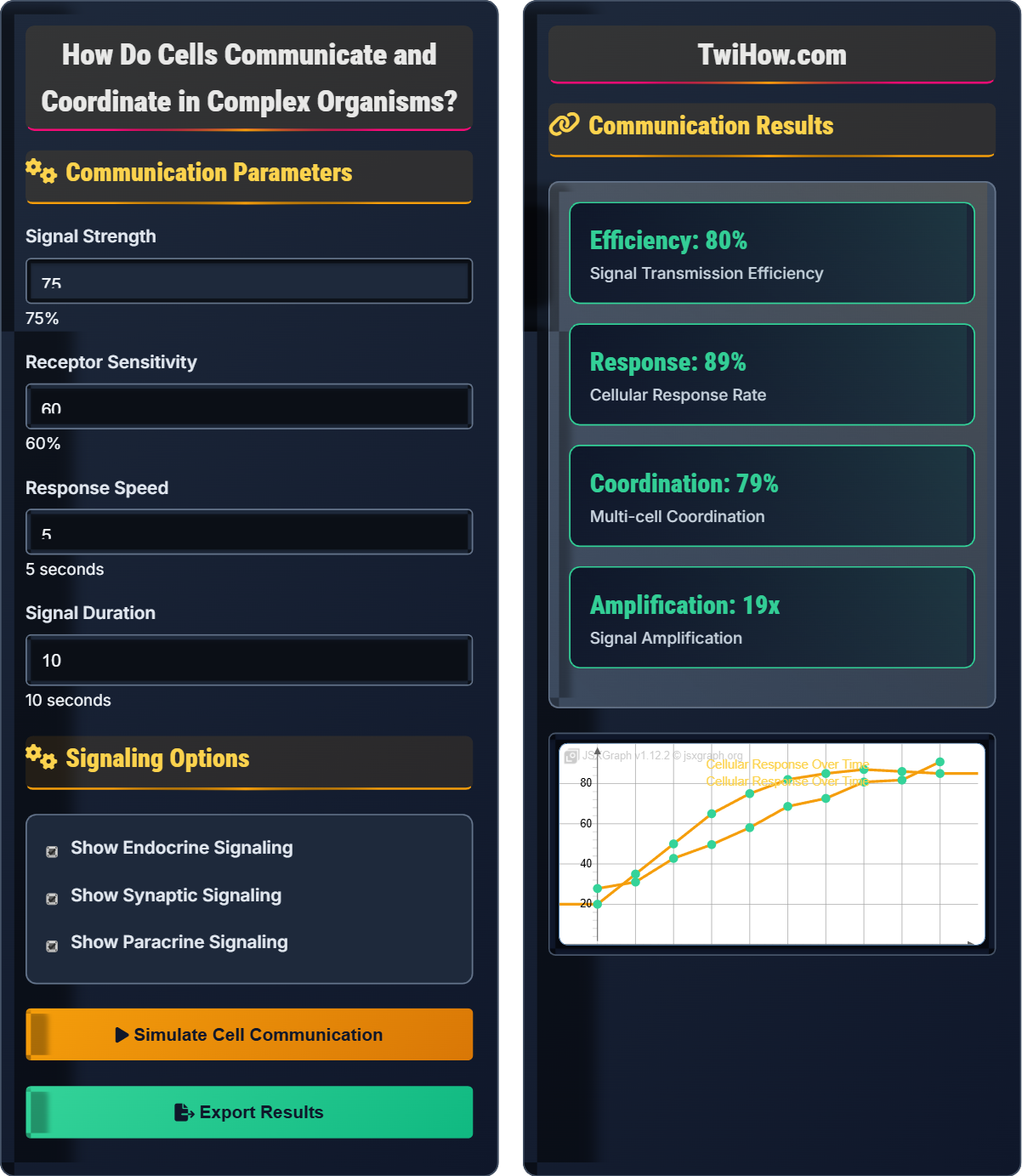
Communication Parameters
Signaling Options
Communication Results
| Time (s) | Signal Strength | Response Rate | Coordination |
|---|---|---|---|
| 1 | 20% | 15% | 10% |
| 2 | 35% | 30% | 25% |
| 3 | 50% | 45% | 40% |
| 4 | 65% | 60% | 55% |
| 5 | 75% | 72% | 68% |
Endocrine signaling: Hormones travel through bloodstream to distant target cells.
Synaptic signaling: Neurotransmitters cross synapses to communicate with adjacent neurons.
How Cell Communication Works Explained
Cell communication is the process by which cells send, receive, and respond to chemical and electrical signals. In complex multicellular organisms, cells must coordinate their activities to maintain homeostasis, respond to environmental changes, and carry out specialized functions. Communication ensures that cells work together as an integrated system.
Cells communicate through several mechanisms:
Where:
- Endocrine: Hormones released into bloodstream affect distant cells
- Paracrine: Local chemical signals affect nearby cells
- Autocrine: Cells respond to their own secreted signals
- Direct Contact: Physical connection between adjacent cells
Key types of signaling molecules include:
- Hormones: Long-distance chemical messengers (insulin, adrenaline)
- Neurotransmitters: Chemical signals in nervous system (acetylcholine, dopamine)
- Cytokines: Immune system signaling proteins (interleukins, interferons)
- Growth Factors: Stimulate cell division and differentiation
- Second Messengers: Amplify signals inside cells (cAMP, calcium ions)
- Insulin Signaling: Regulates blood glucose levels throughout the body
- Immune Response: Coordinated attack on pathogens by multiple cell types
- Neural Communication: Rapid signal transmission through nervous system
- Development: Coordinated growth and differentiation during embryogenesis
- Stress Response: Coordinated physiological changes during fight-or-flight
Cell Communication Fundamentals
Signal transduction, receptors, ligands, second messengers, amplification cascades.
Signal → Receptor → Transduction → Response
Where Signal = ligand/receptor interaction, Response = cellular effect.
- Signals must bind to specific receptors
- Response depends on cell type and receptor availability
- Signaling is reversible and regulated
Signaling Pathways
Endocrine, paracrine, autocrine, synaptic, and direct contact signaling.
- Signal reception by membrane or intracellular receptors
- Signal transduction through biochemical pathways
- Cellular response through protein activation or gene expression
- Signal termination to prevent continuous activation
- Specificity of signal-receptor binding
- Amplification of cellular responses
- Integration of multiple signals
Cell Communication Learning Quiz
Which type of cell signaling involves the release of hormones into the bloodstream to affect distant target cells?
Endocrine signaling is characterized by the release of hormones into the bloodstream, which then travel throughout the body to reach distant target cells. Examples include insulin released by pancreatic beta cells affecting liver, muscle, and fat cells, or adrenaline released by the adrenal glands affecting multiple organ systems.
Other options: Paracrine signaling affects nearby cells locally; autocrine signaling affects the same cell that released the signal; synaptic signaling occurs across synapses between nerve cells.
The answer is B) Endocrine signaling.
Students must understand the spatial and temporal aspects of different signaling mechanisms. Endocrine signaling is unique in its ability to coordinate responses across the entire organism simultaneously. The circulatory system serves as the communication highway for endocrine signals, allowing for coordinated systemic responses to stimuli.
Endocrine Signaling: Long-distance communication via hormones in bloodstream
Hormone: Chemical messenger secreted by endocrine glands
Target Cell: Cell with specific receptors for a hormone
• Endocrine signals travel via bloodstream
• Effects are widespread and coordinated
• Response time is relatively slow compared to other types
• Remember "endocrine" = "ends of the body" (glands throughout body)
• Endocrine signals are slower but longer-lasting
• Think of insulin regulating glucose everywhere
• Confusing endocrine with paracrine signaling
• Thinking hormones act immediately
• Not understanding the systemic nature of endocrine effects
Describe the three main steps of signal transduction and explain how signal amplification occurs during this process.
Three Main Steps of Signal Transduction:
1. Reception: A signaling molecule (ligand) binds to a specific receptor protein on or in the target cell. The receptor has a specific shape that fits only certain ligands, ensuring specificity.
2. Transduction: The signal is converted to a form that can trigger a cellular response. This often involves a cascade of molecular changes, including the activation of enzymes and the production of second messengers.
3. Response: The cell responds through changes in gene expression, enzyme activity, or cellular processes. This could involve turning genes on/off or altering protein activity.
Signal Amplification: Occurs primarily during the transduction phase. One original signal molecule can activate multiple receptor proteins, each of which can activate many enzymes in a cascade. Each activated enzyme can catalyze many reactions, resulting in millions of activated molecules from a single original signal.
Signal amplification is crucial for cells to respond sensitively to low concentrations of signaling molecules. The cascade effect allows small changes in signal concentration to produce large cellular responses. This is why hormones can have profound effects even at very low concentrations in the bloodstream.
Ligand: Molecule that binds to a receptor
Second Messenger: Small, nonprotein molecule that relays signals
Signal Cascade: Series of molecular changes that amplifies the signal
• Specificity is determined by receptor-ligand binding
• Cascade reactions provide regulation points
• Think of signal transduction as translating one language to another
• Amplification is like a chain reaction
• Each step in cascade multiplies the signal
• Confusing reception with transduction
• Not understanding the magnitude of amplification
• Thinking all signaling is the same intensity
After eating a meal rich in carbohydrates, blood glucose levels rise. Describe the complete signaling pathway from increased glucose to the cellular response in target tissues. Include the hormone involved, the type of signaling, and the ultimate cellular effect.
Initiating Event: Blood glucose levels increase after carbohydrate consumption.
Signal Detection: Beta cells in pancreatic islets detect elevated glucose through glucose sensors.
Hormone Released: Insulin is secreted by pancreatic beta cells into the bloodstream.
Type of Signaling: Endocrine signaling - hormones travel through bloodstream to distant targets.
Target Tissues: Liver, skeletal muscle, and adipose tissue.
Cellular Response: Insulin binds to insulin receptors on target cells, triggering:
• Increased glucose uptake by cells
• Conversion of glucose to glycogen in liver and muscle
• Conversion of glucose to fat in adipose tissue
• Decreased glucose production by the liver
Result: Blood glucose levels return to normal range, maintaining homeostasis.
This example demonstrates how cell communication maintains homeostasis. The insulin signaling pathway is a classic example of negative feedback regulation. Students should understand that this pathway involves multiple cell types working together: pancreatic beta cells detect the stimulus, release the signal, and target cells respond appropriately.
Homeostasis: Maintenance of stable internal conditions
Negative Feedback: Response reduces the original stimulus
Glucose Homeostasis: Regulation of blood sugar levels
• Insulin lowers blood glucose levels
• Multiple tissues respond to insulin
• Response restores homeostasis
• Remember: Insulin "puts glucose away"
• Insulin is released when glucose is high
• Multiple organs coordinate glucose regulation
• Thinking insulin increases glucose levels
• Not recognizing the multi-organ response
• Confusing insulin with other hormones
Explain how acetylcholine functions as a neurotransmitter at the neuromuscular junction. Describe the sequence of events from nerve impulse arrival to muscle contraction, including the role of signal amplification and termination.
Sequence of Events:
1. Nerve Impulse Arrival: Action potential reaches axon terminal of motor neuron.
2. Calcium Influx: Voltage-gated calcium channels open, Ca²⁺ enters terminal.
3. Neurotransmitter Release: Acetylcholine (ACh) vesicles fuse with membrane and release ACh into synaptic cleft.
4. Receptor Binding: ACh binds to nicotinic receptors on muscle fiber membrane.
5. Ion Channel Opening: Receptor activation opens sodium channels, causing depolarization.
6. Action Potential Generation: Muscle fiber generates action potential.
7. Muscle Contraction: Action potential triggers calcium release and muscle contraction.
Signal Amplification: One ACh molecule can open multiple ion channels, amplifying the signal.
Signal Termination: Acetylcholinesterase breaks down ACh in synaptic cleft, stopping the signal.
The neuromuscular junction exemplifies synaptic signaling with precise timing and rapid response. Students should understand that this is a local, fast-acting communication system. The role of acetylcholinesterase is crucial for preventing continuous muscle contraction, demonstrating the importance of signal termination.
Neurotransmitter: Chemical messenger between neurons or neuron and effector
Synaptic Cleft: Gap between presynaptic and postsynaptic cells
Acetylcholinesterase: Enzyme that breaks down acetylcholine
• Synaptic signaling is fast and localized
• Signal termination is essential for proper function
• Calcium is required for neurotransmitter release
• Remember: ACh causes muscle contraction
• Calcium triggers ACh release
• AChE stops the signal quickly
• Confusing neurotransmitter with hormone
• Not understanding the role of calcium
• Forgetting about signal termination
Which of the following is NOT a common second messenger in signal transduction pathways?
Insulin is a hormone, not a second messenger. Hormones are first messengers that initiate signaling pathways. Second messengers are small, nonprotein molecules that relay signals from receptors to target molecules inside the cell.
cAMP, calcium ions, and diacylglycerol (DAG) are all common second messengers:
• cAMP activates protein kinase A
• Ca²⁺ regulates many cellular processes
• DAG activates protein kinase C
Insulin is the primary signal that acts on cell surface receptors to initiate signal transduction pathways.
The answer is C) Insulin.
Students must distinguish between first messengers (hormones, neurotransmitters) and second messengers (intracellular molecules). This distinction is crucial for understanding signal amplification and regulation. First messengers bind to receptors on the cell surface or inside the cell, while second messengers relay the signal internally and often amplify it.
First Messenger: Extracellular signaling molecule
Second Messenger: Intracellular molecule that relays signals
Signal Amplification: Increase in signal strength during transduction
• Hormones are first messengers
• Second messengers are small intracellular molecules
• Second messengers amplify the original signal
• First messengers stay outside the cell
• Second messengers are made inside the cell
• Think of second messengers as "internal translators"
• Confusing first and second messengers
• Thinking all signaling molecules are the same
• Not understanding the location differences
FAQ
Q: How do cells know which signals to respond to and which to ignore?
A: Cell specificity is determined by the presence of specific receptors:
1. Receptor Specificity: Each cell type expresses specific receptor proteins that can only bind to certain signaling molecules (ligands)
2. Structural Complementarity: Receptors have specific binding sites that match the shape and chemical properties of their target ligands (like lock and key)
3. Gene Expression: Different cell types express different sets of receptor genes based on their specialized functions
4. Receptor Concentration: Even cells with the same receptor type may have different numbers of receptors, affecting sensitivity
For example, liver cells have insulin receptors but skeletal muscle cells have different types and numbers of insulin receptors, allowing for tissue-specific responses to the same hormone.
Q: What happens when cell communication goes wrong?
A: Disrupted cell communication can lead to serious health problems:
Diabetes: Either insufficient insulin production (Type 1) or insulin resistance (Type 2) disrupts glucose homeostasis.
Cancer: Mutations in growth factor receptors or signaling pathways can lead to uncontrolled cell division.
Autoimmune Diseases: Faulty communication between immune cells can cause attacks on healthy tissues.
Neurological Disorders: Problems with neurotransmitter signaling can affect mood, memory, and movement.
Endocrine Disorders: Hormone imbalances affect growth, metabolism, and reproduction.
Many medications work by modulating cell communication pathways, either enhancing or blocking specific signals.