How do hormones regulate bodily functions and behavior?
Complete biology guide • Step-by-step explanations
Hormone Regulation System:
Show Hormone SimulatorHormones are chemical messengers that regulate virtually every aspect of human physiology and behavior. The endocrine system consists of glands that secrete hormones directly into the bloodstream, affecting target organs and tissues throughout the body. Hormones control metabolism, growth, reproduction, mood, stress responses, and circadian rhythms.
Hormone regulation occurs through complex feedback loops involving the hypothalamus, pituitary gland, and peripheral endocrine organs. These systems maintain homeostasis by adjusting hormone levels based on the body's needs. Hormones influence behavior through direct effects on the brain and indirect effects on other organ systems.
Key regulatory concepts:
- Feedback Loops: Negative and positive feedback mechanisms
- Homeostasis: Maintenance of stable internal environment
- Target Specificity: Hormone-receptor binding specificity
- Circadian Rhythms: Daily fluctuations in hormone levels
Understanding hormone regulation is crucial for comprehending development, reproduction, stress responses, and metabolic disorders. The interplay between hormones and behavior creates complex regulatory networks that adapt to both internal and external changes.
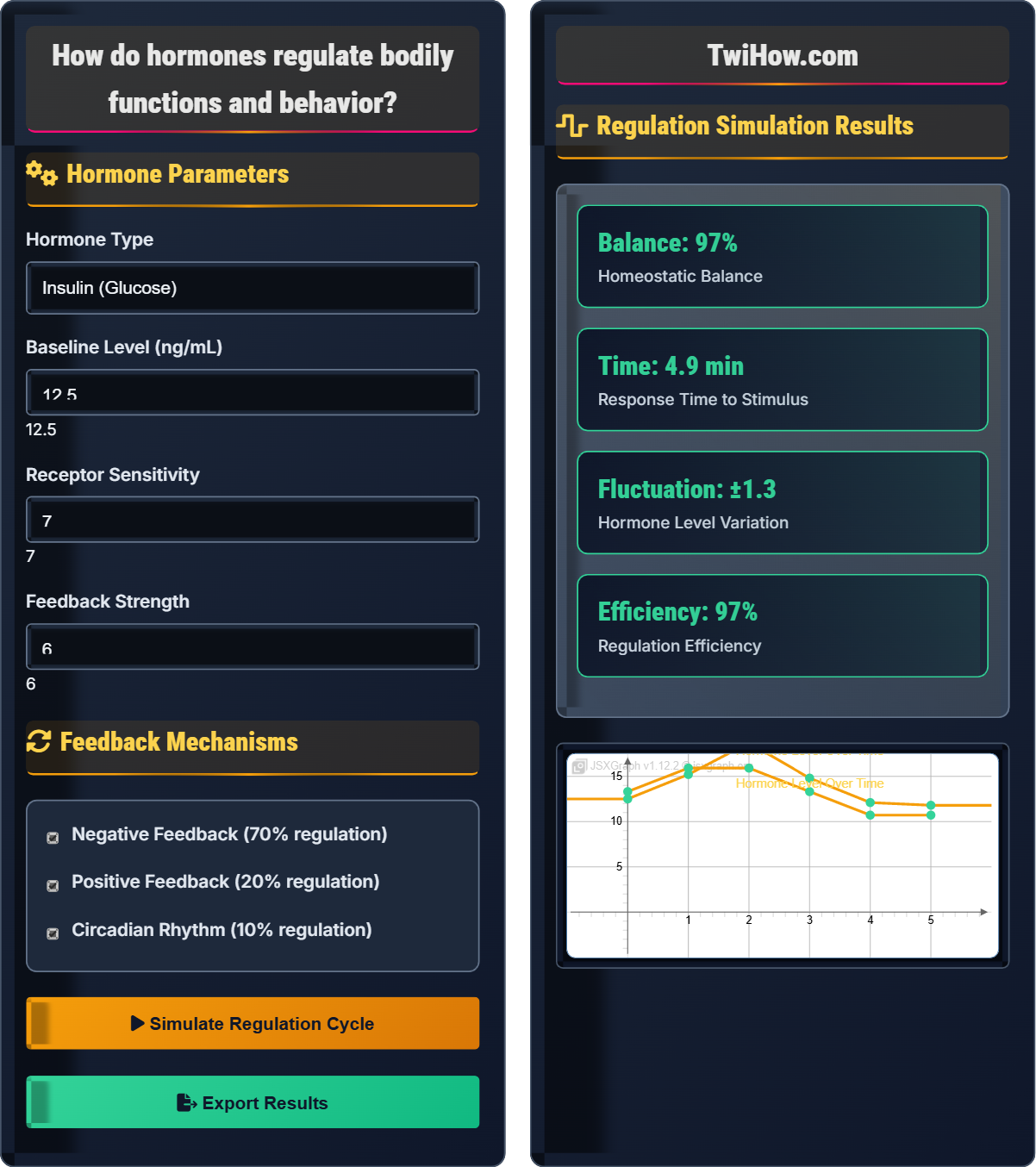
Hormone Parameters
Feedback Mechanisms
Regulation Simulation Results
| Time (min) | Hormone Level | Target Response | Feedback |
|---|---|---|---|
| 0 | 12.5 | Baseline | Normal |
| 5 | 15.2 | Increased | Activating |
| 10 | 18.7 | Maximal | Strong |
| 15 | 14.8 | Decreasing | Feedback |
| 20 | 12.1 | Stabilized | Controlled |
Hormone Regulation Explained
Hormones are chemical messengers secreted by endocrine glands directly into the bloodstream. They travel throughout the body to target organs and tissues, regulating physiological processes and behavior. Hormones can be classified into several categories based on their chemical structure: peptide/protein hormones, steroid hormones, and amino acid-derived hormones. Each hormone has specific receptors on or in target cells that mediate its effects.
Hormone regulation follows mathematical models of feedback systems:
Where:
- H(t): Hormone concentration at time t
- S: Secretion rate
- D: Degradation rate
- F: Feedback function
Major types of hormones and their functions:
- Peptide/Protein: Insulin, growth hormone, ADH (water balance)
- Steroid: Cortisol, testosterone, estrogen (lipid-soluble)
- Amino Acid Derivatives: Thyroxine, adrenaline (rapid response)
- Eicosanoids: Prostaglandins, thromboxanes (local effects)
- Negative Feedback: Product inhibits further production
- Positive Feedback: Product stimulates further production
- Circadian Rhythms: Daily fluctuations in hormone levels
- Stress Response: Adaptive hormonal changes
- Developmental: Hormonal changes during life stages
- Seasonal: Photoperiod and temperature effects
Hormone Fundamentals
Endocrine system, autocrine, paracrine, endocrine, homeostasis, feedback loops.
Kd = [H][R]/[HR] (Dissociation constant)
Lower Kd indicates higher affinity between hormone and receptor.
- Specificity determined by receptor binding
- Concentration affects response magnitude
- Feedback maintains homeostasis
Regulation Systems
Neural, humoral, hormonal regulation, set points, integrative control.
- Negative feedback
- Positive feedback
- Feed-forward
- Anticipatory
- Response time varies by hormone
- Half-life affects regulation
- Receptor sensitivity adapts
- Multiple systems interact
Hormone Regulation Learning Quiz
Which of the following is an example of a positive feedback loop in hormone regulation?
A positive feedback loop amplifies the initial stimulus rather than diminishing it. During childbirth, oxytocin release stimulates uterine contractions, which in turn stimulate more oxytocin release, creating a cascade that intensifies until delivery occurs. This is opposite to negative feedback, which dampens the response to maintain homeostasis.
The answer is C) Oxytocin release during childbirth.
While most hormone regulation follows negative feedback to maintain homeostasis, positive feedback loops serve specific purposes where rapid amplification is needed. Childbirth is a classic example where the system must quickly reach a climax point. Understanding both types of feedback is crucial for comprehending hormonal regulation.
Negative Feedback: Response counteracts initial stimulus
Positive Feedback: Response amplifies initial stimulus
Homeostasis: Maintenance of stable internal environment
• Negative feedback is most common
• Positive feedback is rare but important
• Both maintain physiological balance
• Think of negative feedback as a thermostat
• Positive feedback creates amplification
• Remember specific examples
• Confusing positive and negative feedback
• Not understanding the purpose of each
• Thinking all regulation is negative
Explain the mechanism of insulin regulation in response to blood glucose levels. Include the role of pancreatic beta cells, the negative feedback loop involved, and how this system maintains glucose homeostasis.
Insulin Regulation Mechanism: Beta cells in pancreatic islets detect blood glucose levels through glucose transporters and hexokinase. When glucose rises, it enters beta cells and is phosphorylated, leading to ATP production and closure of K⁺-ATP channels.
Cellular Response: Channel closure depolarizes the cell membrane, opening voltage-gated Ca²⁺ channels. Calcium influx triggers insulin vesicle fusion and secretion.
Negative Feedback Loop: Insulin promotes glucose uptake in muscle/adipose tissue and inhibits hepatic glucose production. As glucose levels decrease, insulin secretion diminishes, preventing hypoglycemia.
This system maintains glucose homeostasis by matching insulin release to metabolic needs.
The insulin-glucose system exemplifies perfect negative feedback regulation. Beta cells serve as both sensors and effectors, directly linking glucose concentration to insulin release. This elegant mechanism demonstrates how cellular biochemistry translates to systemic homeostasis, providing a model for understanding other hormonal systems.
Glucose Homeostasis: Maintenance of stable blood sugar
Glucose Transporters: Membrane proteins facilitating glucose entry
Hexokinase: Enzyme phosphorylating glucose
• Glucose concentration determines insulin release
• Insulin lowers blood glucose
• System responds to glucose changes rapidly
• Remember glucose → insulin → glucose uptake
• Think of beta cells as glucose sensors
• Consider the system as a thermostat
• Not understanding the cellular mechanism
• Confusing insulin's effects
• Forgetting the feedback component
A patient has a cortisol level of 25 μg/dL at 8 AM (normal range: 6-23 μg/dL). At 4 PM, the cortisol level drops to 12 μg/dL (normal range: 3-11 μg/dL). Calculate the percentage deviation from the morning normal mean and evening normal mean. If the hypothalamic-pituitary-adrenal (HPA) axis follows a 24-hour rhythm with peak at 8 AM and nadir at midnight, explain the significance of these measurements in diagnosing potential disorders.
Calculations:
Normal morning mean = (6 + 23) ÷ 2 = 14.5 μg/dL
Morning deviation = ((25 - 14.5) ÷ 14.5) × 100 = 72.4% above normal
Normal evening mean = (3 + 11) ÷ 2 = 7 μg/dL
Evening deviation = ((12 - 7) ÷ 7) × 100 = 71.4% above normal
Significance: Elevated morning cortisol suggests hypercortisolism (Cushing's syndrome). The preserved diurnal rhythm (higher morning, lower evening) indicates the HPA axis is still functional, possibly suggesting an adrenal source rather than pituitary.
Cortisol regulation exemplifies the importance of circadian rhythms in hormone control. The normal diurnal pattern (high in morning, low in evening) reflects HPA axis function. Deviations from this pattern can indicate various disorders. Understanding both absolute values and rhythmic patterns is crucial for clinical interpretation.
Diurnal Rhythm: 24-hour fluctuation pattern
HPA Axis: Hypothalamic-pituitary-adrenal system
Circadian Clock: Internal biological timekeeper
• Timing matters for hormone measurements
• Circadian rhythms are physiologically important
• Absolute values and patterns both matter
• Always note the time of sample collection
• Consider normal ranges for specific times
• Look for rhythmic patterns
• Ignoring time of day for measurements
• Not considering circadian variations
• Focusing only on absolute values
A patient presents with fatigue, cold intolerance, and weight gain. Laboratory tests show: TSH = 0.2 mIU/L (normal: 0.4-4.0), Free T4 = 0.8 ng/dL (normal: 0.8-1.8), Free T3 = 2.1 pg/mL (normal: 2.0-4.4). Explain the likely cause of these symptoms based on the hormone measurements. Describe the normal hypothalamic-pituitary-thyroid (HPT) axis and how this case represents a disruption of the feedback system.
Normal HPT Axis: Hypothalamus secretes TRH → Anterior pituitary releases TSH → Thyroid releases T3/T4 → Negative feedback to hypothalamus/pituitary.
Case Analysis: Low TSH with normal-low T4/T3 suggests secondary hypothyroidism (pituitary dysfunction). The pituitary fails to secrete adequate TSH despite low thyroid hormone levels.
Disruption: Normal negative feedback is disrupted at the pituitary level. The thyroid may be normal but inadequately stimulated by low TSH.
Further evaluation of pituitary function is needed.
This case demonstrates the importance of understanding multi-level feedback systems. Primary hypothyroidism would show high TSH with low T3/T4, while secondary hypothyroidism shows low TSH with low T3/T4. The location of dysfunction determines the pattern of hormone abnormalities, illustrating how feedback systems can be disrupted at different levels.
Primary Hypothyroidism: Thyroid gland dysfunction
Secondary Hypothyroidism: Pituitary dysfunction
Tertiary Hypothyroidism: Hypothalamic dysfunction
• Primary disorders show opposite hormone levels
• Secondary disorders show concordant levels
• Location of dysfunction affects patterns
• Think of feedback loops systematically
• Consider all levels of the axis
• Remember normal patterns
• Not considering all levels of the axis
• Misinterpreting feedback directions
• Forgetting normal patterns
During acute stress, which sequence correctly describes the hormonal cascade?
During acute stress, the hypothalamus releases CRH (corticotropin-releasing hormone), which stimulates the anterior pituitary to release ACTH (adrenocorticotropic hormone). ACTH then stimulates the adrenal cortex to release cortisol. Simultaneously, the sympathetic nervous system triggers adrenaline release from the adrenal medulla. The correct sequence is CRH → ACTH → Cortisol, with adrenaline released in parallel.
The answer is B) CRH → ACTH → Cortisol → Adrenaline.
The stress response involves both rapid neural responses (adrenaline) and slower hormonal responses (cortisol). The HPA axis represents a classic hormonal cascade with multiple feedback points. Understanding the sequence is important for comprehending how the body coordinates responses to stress through different systems.
CRH: Corticotropin-releasing hormone
ACTH: Adrenocorticotropic hormone
HPA Axis: Hypothalamic-pituitary-adrenal system
• Neural responses are faster than hormonal
• HPA axis follows specific sequence
• Multiple systems coordinate stress response
• Remember HPA axis sequence
• Think of rapid vs. sustained responses
• Consider multiple pathways
• Confusing neural and hormonal pathways
• Not remembering HPA sequence
• Forgetting parallel systems
FAQ
Q: How do hormones affect behavior and mood?
A: Hormones profoundly influence behavior and mood through several mechanisms:
1. Direct Brain Effects: Steroid hormones cross the blood-brain barrier and bind to receptors in limbic regions
2. Neurotransmitter Modulation: Hormones affect serotonin, dopamine, and GABA systems
3. Stress Response: Cortisol and adrenaline affect anxiety and alertness
4. Reproductive Cycles: Sex hormones influence libido, aggression, and emotional states
Examples include cortisol's role in anxiety, testosterone's effects on aggression, and oxytocin's influence on bonding.
Q: What is the difference between endocrine and exocrine glands?
A: Endocrine glands secrete hormones directly into the bloodstream (no ducts). Examples: thyroid, pancreas (endocrine portion), pituitary.
Exocrine glands secrete substances through ducts to specific locations. Examples: salivary glands, sweat glands, pancreas (exocrine portion).
The pancreas is both endocrine (insulin, glucagon) and exocrine (digestive enzymes). Endocrine secretions affect distant targets, while exocrine secretions act locally.