How do immune systems recognize and fight pathogens?
Complete biology guide • Step-by-step explanations
Immune System Defense:
Show Immune Response SimulatorThe immune system is a complex network of cells, tissues, and organs that work together to defend the body against harmful pathogens. It consists of two main branches: the innate immune system (first responders) and the adaptive immune system (specific and memory responses). The system recognizes foreign antigens and mounts targeted responses to eliminate threats.
Key components include white blood cells, antibodies, the complement system, and lymphoid organs. The immune system distinguishes between self and non-self through pattern recognition receptors and major histocompatibility complexes. It creates immunological memory for faster responses to previously encountered pathogens.
Immune responses:
- Innate Immunity: Immediate, non-specific response
- Adaptive Immunity: Specific, memory-forming response
- Humoral Response: Antibody-mediated immunity
- Cell-Mediated Response: T cell-mediated immunity
Understanding immune function is crucial for developing vaccines, treating autoimmune diseases, and managing infections. The system must balance protection with tolerance to avoid attacking the body's own tissues.
Immune Response Parameters
Immune Components
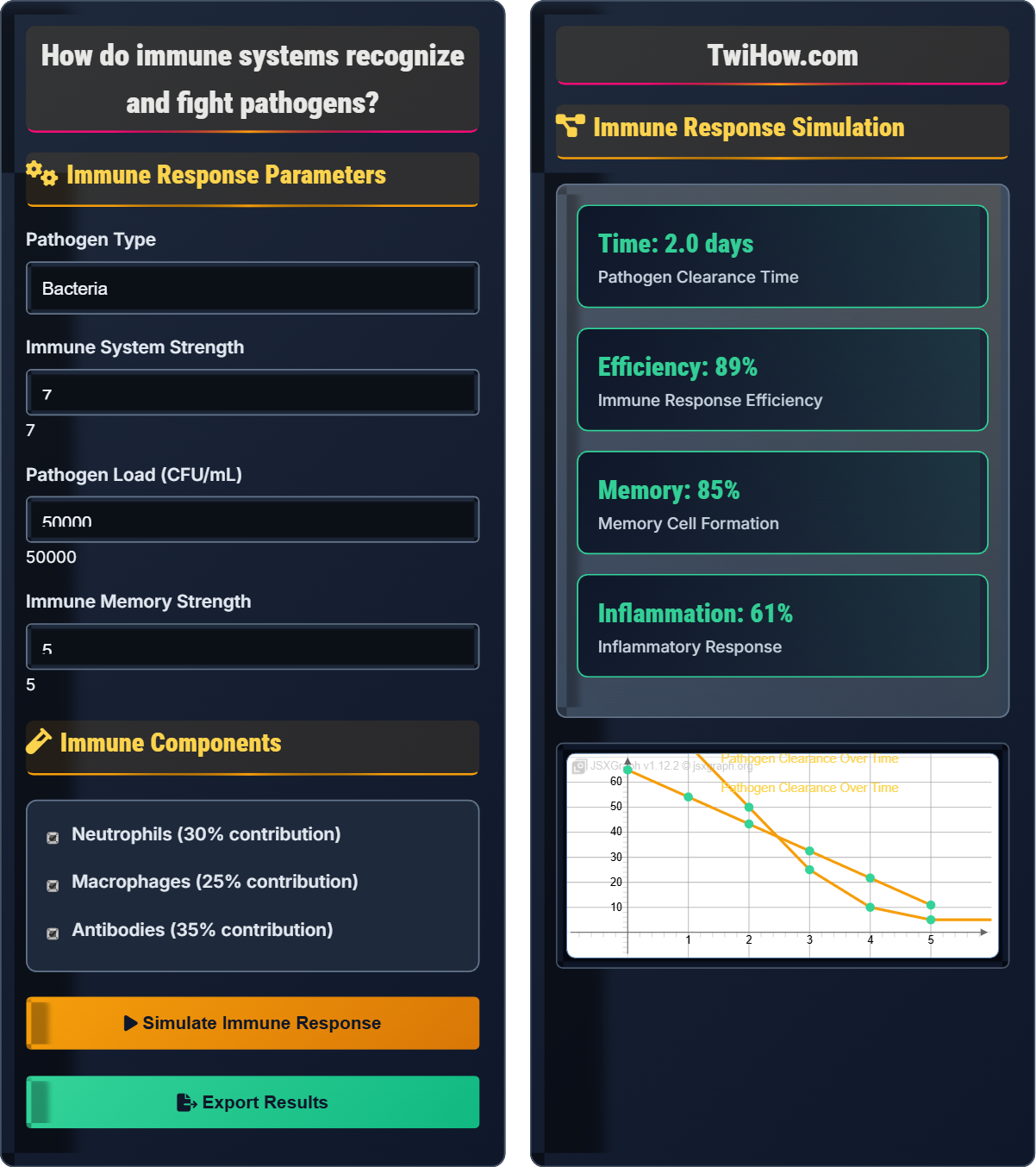
Immune Response Simulation
| Day | Pathogen Load | Immune Activity | Memory Formation |
|---|---|---|---|
| 0 | 50,000 | Low | None |
| 1 | 75,000 | Medium | Initiating |
| 2 | 60,000 | High | Forming |
| 3 | 30,000 | Very High | Developing |
| 4 | 10,000 | High | Established |
Immune System Explained
The immune system is a complex network of cells, tissues, and organs that work together to defend the body against harmful pathogens including bacteria, viruses, fungi, and parasites. It consists of two main components: the innate immune system (non-specific, immediate response) and the adaptive immune system (specific, memory-forming response). The system recognizes foreign antigens and mounts targeted responses to eliminate threats while maintaining tolerance to self-antigens.
Immune response kinetics:
Where:
- P(t): Pathogen concentration at time t
- I(t): Immune cell activity at time t
- k_immune: Immune clearance rate constant
Key components of the immune system:
- White Blood Cells: Neutrophils, macrophages, dendritic cells, T cells, B cells
- Antibodies: IgG, IgM, IgA, IgE, IgD
- Complement System: Proteins that enhance immune responses
- Lymphoid Organs: Thymus, spleen, lymph nodes
- Cytokines: Signaling molecules that coordinate responses
- MHC Molecules: Antigen presentation to T cells
- Innate Response: Immediate, non-specific defense mechanisms
- Adaptive Response: Specific, memory-forming responses
- Humoral Response: Antibody-mediated immunity
- Cell-Mediated Response: T cell-mediated immunity
- Primary Response: First encounter with antigen
- Secondary Response: Faster, stronger response to memory
Immune System Fundamentals
Antigen, antibody, epitope, MHC, cytokines, complement, immunoglobulin.
Kd = [Ab][Ag]/[Ab-Ag] (Dissociation constant)
Lower Kd indicates higher binding affinity.
- Self vs non-self recognition is critical
- Specificity ensures targeted responses
- Memory provides lasting protection
Immune Responses
Innate, adaptive, humoral, cell-mediated, primary, secondary.
- Phagocytosis
- Antibody production
- Complement activation
- Cell-mediated killing
- Balance between protection and tolerance
- Timing of responses matters
- Memory responses are faster
- Autoimmunity must be prevented
Immune System Learning Quiz
Which of the following best describes the main difference between innate and adaptive immunity?
The main difference between innate and adaptive immunity is their specificity and timing. Innate immunity provides immediate, non-specific responses to pathogens through physical barriers, phagocytes, and inflammatory responses. Adaptive immunity provides specific, targeted responses through B and T cells and creates immunological memory for faster responses to previously encountered pathogens.
The answer is C) Innate immunity provides immediate, non-specific responses while adaptive immunity is specific and forms memory.
Understanding the distinction between innate and adaptive immunity is fundamental to immunology. The innate system acts as the first line of defense with immediate but non-specific responses, while the adaptive system provides targeted responses and immunological memory. These systems work together to provide comprehensive protection against pathogens.
Innate Immunity: Non-specific, immediate immune response
Adaptive Immunity: Specific, memory-forming immune response
Immunological Memory: Faster response to previously encountered antigens
• Innate responds immediately
• Adaptive responds specifically
• Adaptive creates memory
• Think "innate = immediate, non-specific"
• "Adaptive = specific, remembers"
• Both systems work together
• Confusing response timing
• Mixing up specificity
• Not appreciating cooperation
Describe the structure of antibodies and explain how their structure relates to their function in immune responses.
Antibody Structure: Antibodies (immunoglobulins) are Y-shaped proteins consisting of two heavy chains and two light chains held together by disulfide bonds. Each antibody has two identical antigen-binding sites (Fab regions) at the tips of the Y and a constant region (Fc region) at the base.
Structure-Function Relationship: The variable regions of the Fab portions provide specificity for antigen binding through unique amino acid sequences. The Fc region mediates effector functions like complement activation and binding to immune cells. The Y-shape allows cross-linking of antigens.
Classes: Five classes (IgG, IgM, IgA, IgE, IgD) have different functions and tissue distributions based on their Fc regions while maintaining similar antigen-binding specificity.
The structure of antibodies perfectly exemplifies the relationship between form and function in biology. The modular design allows for both antigen recognition and effector functions. The variable regions provide the diversity needed to recognize countless antigens, while the constant regions mediate the biological effects of antibody binding.
Fab Region: Antigen-binding fragment
Fc Region: Crystallizable fragment
Variable Region: Antigen-specific binding site
• Variable regions determine specificity
• Constant regions determine function
• Structure enables cross-linking
• Think "Y-shape = binding + function"
• Variable = specificity
• Constant = effector function
• Confusing Fab/Fc regions
• Not understanding variable/constant
• Forgetting cross-linking function
In a laboratory experiment, researchers measure T cell activation in response to antigen presentation. If 200,000 CD4+ T cells are present and 15% become activated after encountering antigen-presenting cells, calculate how many T cells are activated. If each activated T cell divides 4 times during clonal expansion, calculate the total number of effector cells generated from the original activated population.
Activated T cells:
Original T cells = 200,000
Activation rate = 15% = 0.15
Activated T cells = 200,000 × 0.15 = 30,000 T cells
Clonal expansion:
Each activated cell divides 4 times
After 1 division: 2 cells
After 2 divisions: 4 cells
After 3 divisions: 8 cells
After 4 divisions: 16 cells
Total effector cells = 30,000 × 16 = 480,000 effector cells
Therefore, 30,000 T cells are activated, generating 480,000 effector cells.
Clonal expansion is a critical feature of adaptive immunity that allows a small number of antigen-specific lymphocytes to generate a large population of effector cells. This amplification ensures that the immune system can mount a robust response even when the initial number of antigen-specific cells is small.
Clonal Expansion: Proliferation of antigen-specific lymphocytes
Effector Cells: Active immune cells performing function
CD4+ T Cells: Helper T lymphocytes
• Clonal expansion provides amplification
• Each division doubles cell number
• Small starting population can expand significantly
• Remember 2^n for divisions
• Clonal expansion = amplification
• Small numbers can become large
• Forgetting exponential growth
• Calculating linear instead of exponential
• Not appreciating amplification
A pharmaceutical company is developing a vaccine against a new viral pathogen. Explain how the vaccine should be designed to elicit both humoral and cell-mediated immune responses. What type of immune cells would be activated, what antibodies would be produced, and how would immunological memory be established? What are the advantages of creating memory responses?
Vaccine Design: The vaccine should contain viral antigens processed by dendritic cells to activate both B cells (humoral) and T cells (cell-mediated). Adjuvants can enhance immune activation.
Humoral Response: B cells recognize viral antigens, differentiate into plasma cells, and produce antibodies (primarily IgG for systemic protection). Memory B cells are also formed.
Cell-Mediated Response: Antigen-presenting cells activate CD4+ helper T cells and CD8+ cytotoxic T cells. CD8+ T cells kill infected cells.
Memory Formation: Both memory B cells and memory T cells are generated, providing long-lasting immunity.
Advantages: Faster, stronger responses to reinfection; reduced disease severity; potential for sterilizing immunity.
Effective vaccines must stimulate both arms of adaptive immunity to provide comprehensive protection. The goal is to create immunological memory without causing disease. This approach has been successfully used for decades to protect against numerous pathogens and represents one of medicine's greatest achievements.
Vaccine: Preparation stimulating immunity without disease
Adjuvant: Substance enhancing immune response
Immunological Memory: Faster response to previously encountered antigens
• Vaccines mimic natural infection
• Both responses provide protection
• Memory ensures long-term immunity
• Think "mimic infection safely"
• Activate both B and T cells
• Memory = long-term protection
• Only thinking about antibodies
• Not considering cell-mediated responses
• Forgetting memory importance
What is the primary function of Major Histocompatibility Complex (MHC) molecules?
The primary function of MHC molecules is to present antigens to T cells. MHC class I molecules present peptides to CD8+ cytotoxic T cells, while MHC class II molecules present peptides to CD4+ helper T cells. This antigen presentation is essential for T cell activation and the adaptive immune response.
The answer is B) To present antigens to T cells.
MHC molecules serve as the communication bridge between antigen-presenting cells and T cells. They allow T cells to "see" what antigens are present in the body, enabling the immune system to distinguish between self and non-self. This is a fundamental mechanism underlying adaptive immunity and self-tolerance.
MHC Class I: Presents to CD8+ T cells
MHC Class II: Presents to CD4+ T cells
Antigen Presentation: Displaying antigen fragments
• MHC essential for T cell activation
• Class I → CD8+ T cells
• Class II → CD4+ T cells
• MHC = Molecular ID card
• Class I for "killers" (CD8+)
• Class II for "helpers" (CD4+)
• Confusing MHC function
• Mixing up Class I/II functions
• Not understanding presentation concept
FAQ
Q: What's the difference between passive and active immunity?
A: Active immunity: Body produces its own antibodies and memory cells after exposure to antigen (vaccination or infection). Long-lasting protection.
Passive immunity: Antibodies transferred from another source (maternal antibodies, antibody injection). Provides immediate but temporary protection.
Active immunity involves the body's own immune response and creates memory, while passive immunity provides ready-made antibodies without activating the immune system.
Q: Why do some people get autoimmune diseases?
A: Autoimmune diseases occur when the immune system fails to distinguish between self and non-self:
1. Genetic Predisposition: Certain HLA types increase risk
2. Molecular Mimicry: Pathogen proteins resemble self-proteins
3. Breakdown of Tolerance: Regulatory mechanisms fail
4. Environmental Triggers: Infections, stress, chemicals
Examples include rheumatoid arthritis, lupus, type 1 diabetes, and multiple sclerosis.