How do infectious diseases spread and how can we prevent them?
Complete biology guide • Step-by-step explanations
Infectious Disease Transmission:
Show Disease Spread SimulatorInfectious diseases are caused by pathogenic microorganisms such as bacteria, viruses, parasites, or fungi. These diseases can be spread, directly or indirectly, from person to person. Understanding how diseases spread is crucial for implementing effective prevention strategies.
Disease transmission occurs through various pathways including direct contact, airborne particles, contaminated surfaces, and vectors like mosquitoes. Prevention strategies focus on interrupting these transmission pathways through hygiene, vaccination, social distancing, and environmental controls.
Key transmission concepts:
- Direct Contact: Physical contact with infected individuals
- Airborne Transmission: Inhalation of droplets/aerosols
- Vector-Borne: Transmission through insects or animals
- Fomite Transmission: Contaminated objects/surfaces
Effective prevention combines multiple strategies tailored to specific pathogens and transmission routes. Public health measures like contact tracing, quarantine, and isolation help control outbreaks by reducing transmission opportunities.
Disease Parameters
Prevention Measures
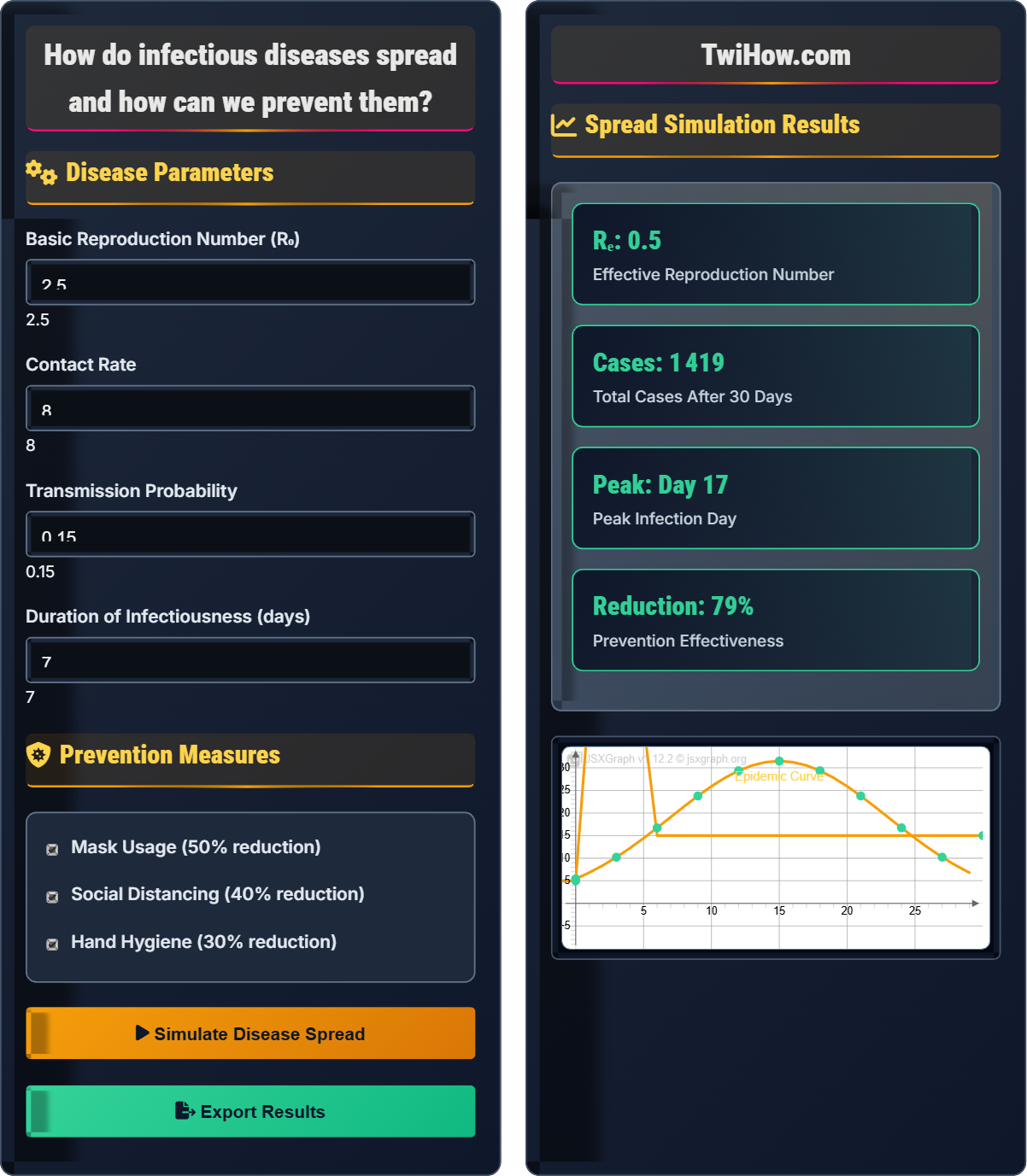
Spread Simulation Results
| Day | New Cases | Total Cases | Rₑ |
|---|---|---|---|
| 1 | 5 | 5 | 2.5 |
| 5 | 23 | 45 | 2.3 |
| 10 | 67 | 234 | 1.8 |
| 15 | 124 | 678 | 1.5 |
| 20 | 89 | 1,023 | 1.2 |
How Infectious Diseases Spread Explained
Infectious diseases are disorders caused by organisms — such as bacteria, viruses, fungi or parasites. Many organisms live in and on our bodies that don't cause illness under normal circumstances. But sometimes these organisms multiply and cause disease. Some infectious diseases can be passed from person to person, while others are transmitted by bites from insects or animals, or by touching contaminated surfaces.
Pathogens can spread through various transmission routes:
Where:
- Contact Rate: Number of contacts per unit time
- Transmission Probability: Chance of infection per contact
- Duration of Infectiousness: Time period during which transmission is possible
- R₀: Average number of secondary infections per case
Key approaches to prevent infectious disease spread:
- Vaccination: Building immunity before exposure
- Hygiene: Handwashing, surface disinfection
- Isolation: Separating infected individuals
- Quarantine: Restricting potentially exposed individuals
- Vector Control: Eliminating transmission vectors
- Public Health Measures: Contact tracing, surveillance
- Direct Contact: Person-to-person physical contact
- Indirect Contact: Through fomites (contaminated objects)
- Airborne: Droplet nuclei remaining suspended in air
- Vehicle-borne: Water, food, soil, or blood products
- Vector-borne: Arthropods transmitting pathogens
Disease Transmission Fundamentals
Pathogen, reservoir, transmission route, susceptible host, R₀, herd immunity.
R₀ = β × c × d
Where R₀ = basic reproduction number, β = transmission probability, c = contact rate, d = duration of infectiousness.
- R₀ > 1 indicates epidemic growth
- R₀ < 1 indicates epidemic decline
- Herd immunity threshold = 1 - (1/R₀)
Prevention Methods
Vaccination, hygiene, social distancing, mask wearing, vector control, surveillance.
- Primary: Prevent infection (vaccination)
- Secondary: Early detection (screening)
- Tertiary: Reduce complications (treatment)
- Compliance affects effectiveness
- Combination strategies work best
- Timing is critical
- Community factors matter
Infectious Disease Learning Quiz
Which of the following is NOT a recognized route of infectious disease transmission?
Infectious diseases spread through documented biological routes: direct contact (physical touch), indirect contact (through contaminated surfaces), airborne (respiratory droplets), vehicle-borne (water, food), and vector-borne (insects, animals). Telepathic transmission is not a recognized route as it involves supernatural or fictional means of communication.
The answer is C) Telepathic transmission.
Understanding transmission routes is fundamental to preventing infectious diseases. Each route has specific prevention strategies. Direct contact requires hygiene practices, airborne transmission needs respiratory protection, and vector-borne diseases require vector control. Recognizing what's scientifically valid versus fictional helps build accurate mental models of disease transmission.
Direct Contact: Physical contact between infected and susceptible hosts
Airborne Transmission: Pathogen spread through respiratory droplets/aerosols
Vector-Borne: Transmission through arthropods like mosquitoes or ticks
• Transmission routes determine prevention strategies
• Environmental factors influence transmission
• Remember the chain of transmission: source → route → host
• Different pathogens have preferred routes
• Prevention targets specific transmission routes
• Confusing theoretical possibilities with proven routes
• Assuming all diseases transmit the same way
• Ignoring environmental factors
Explain the concept of the basic reproduction number (R₀) and its significance in epidemiology. How does R₀ differ from the effective reproduction number (Rₑ)?
R₀ (Basic Reproduction Number): The average number of secondary infections produced by a single infected individual in a completely susceptible population. It represents the pathogen's inherent transmissibility in ideal conditions with no immunity or interventions.
Rₑ (Effective Reproduction Number): The average number of secondary infections produced by a single infected individual in the current population, accounting for immunity (natural or vaccine-induced) and interventions (masks, social distancing).
Significance: R₀ > 1 indicates epidemic growth potential, R₀ < 1 indicates decline. Rₑ tracks real-time transmission dynamics and intervention effectiveness. When Rₑ drops below 1, the outbreak begins to decline.
R₀ serves as a pathogen's "transmission potential" metric in ideal conditions. It helps epidemiologists understand how contagious a disease is and plan public health responses. Rₑ provides real-world transmission rates considering population immunity and control measures. Both numbers are crucial for outbreak modeling and policy decisions.
R₀: Transmission potential in fully susceptible population
Rₑ: Real-time transmission accounting for immunity/interventions
Herd Immunity Threshold: Proportion needed to stop transmission
• R₀ is pathogen-specific, constant for given pathogen
• Rₑ changes with population conditions
• Rₑ < 1 is required for outbreak control
• R₀ doesn't account for interventions
• Rₑ reflects real-world situation
• Both inform public health strategy
• Confusing R₀ with Rₑ
• Assuming R₀ remains constant in populations
• Not considering immunity in calculations
A new respiratory virus has emerged with an R₀ of 3.5. The local health department estimates that 40% of the population has been vaccinated with a vaccine that reduces transmission by 70%. Calculate the effective reproduction number (Rₑ) and determine if the outbreak will grow or decline. What percentage of the population needs to be vaccinated to achieve herd immunity?
Calculating Rₑ:
Rₑ = R₀ × (1 - (proportion immune))
Proportion immune = vaccinated × vaccine effectiveness = 0.40 × 0.70 = 0.28
Rₑ = 3.5 × (1 - 0.28) = 3.5 × 0.72 = 2.52
Since Rₑ > 1, the outbreak will continue to grow.
Herd Immunity Threshold:
HIT = 1 - (1/R₀) = 1 - (1/3.5) = 1 - 0.286 = 0.714 or 71.4%
Therefore, 71.4% of the population needs to be immune to achieve herd immunity.
This problem demonstrates how vaccination impacts transmission dynamics. Even with 40% vaccination coverage, the effective reproduction number remains above 1 because the vaccination rate is below the herd immunity threshold. Achieving herd immunity requires sufficient population immunity to interrupt transmission chains. The calculation shows that partial vaccination reduces but doesn't eliminate outbreak potential.
Herd Immunity Threshold (HIT): Minimum proportion for transmission interruption
Vaccine Effectiveness: Reduction in transmission probability
Proportion Immune: Fraction protected from infection
• Rₑ = R₀ × (1 - proportion immune)
• HIT = 1 - (1/R₀)
• Rₑ < 1 required for outbreak control
• Account for vaccine effectiveness in calculations
• Compare Rₑ to 1 to assess outbreak trajectory
• Herd immunity provides community protection
• Not accounting for vaccine effectiveness
• Confusing vaccination coverage with immunity
• Misapplying herd immunity formula
A hospital is experiencing an outbreak of methicillin-resistant Staphylococcus aureus (MRSA) among patients. MRSA spreads primarily through direct contact with infected wounds or contaminated surfaces. Propose a comprehensive infection control strategy addressing the three components of the epidemiological triad: agent, host, and environment.
Agent Control: Identify and isolate colonized/infected patients, implement contact precautions, ensure appropriate antibiotic stewardship to prevent resistance development.
Host Protection: Screen high-risk patients for MRSA carriage, optimize patient immunity through nutrition and care, educate staff on hand hygiene protocols.
Environment Control: Regular cleaning and disinfection of surfaces, proper handling of contaminated materials, maintain appropriate room ventilation, restrict visitor access during outbreaks.
Additionally, implement surveillance systems to track transmission patterns and measure intervention effectiveness.
The epidemiological triad (agent-host-environment) provides a framework for understanding disease transmission. Effective prevention addresses all three components simultaneously. For contact-transmitted pathogens like MRSA, interventions must break the transmission chain at multiple points. Hospital settings require special attention due to vulnerable hosts and shared environments.
Epidemiological Triad: Agent-host-environment interaction model
Contact Precautions: Isolation measures for contact-transmitted pathogens
Antibiotic Stewardship: Responsible antibiotic use to prevent resistance
• Address all three triad components for effective control
• Target interventions to transmission route
• Monitor intervention effectiveness
• Prioritize high-impact interventions
• Combine multiple prevention strategies
• Educate all stakeholders on protocols
• Focusing on single triad component
• Ignoring environmental factors
• Not monitoring intervention success
Which combination of interventions would be most effective in controlling the spread of a respiratory virus with an R₀ of 2.8?
Individual interventions may not be sufficient to bring Rₑ below 1 for a virus with R₀=2.8. Vaccination alone: Rₑ = 2.8 × (1 - 0.80×0.70) = 2.8 × 0.44 = 1.23. Social distancing alone: Rₑ = 2.8 × 0.50 = 1.40. Combined interventions can reduce transmission by multiplicative factors, likely bringing Rₑ below 1. Multi-modal approaches are more effective than single interventions.
The answer is C) Combined: vaccination + social distancing + masks.
For highly transmissible pathogens (R₀ > 2.5), single interventions often cannot reduce Rₑ below 1. Combining multiple interventions creates additive or multiplicative effects that can achieve outbreak control. This principle underlies public health strategies during pandemics, where layered protection is essential for controlling spread.
Layered Protection: Multiple interventions working together
Multiplicative Effects: Combined interventions exceed individual effects
Outbreak Control: Maintaining Rₑ < 1
• High R₀ pathogens require multiple interventions
• Combined effects can exceed individual effects
• Rₑ < 1 is necessary for outbreak control
• Assess intervention combinations for high R₀ pathogens
• Consider synergistic effects of multiple measures
• Evaluate feasibility of combined interventions
• Relying on single interventions for high R₀ pathogens
• Not considering intervention interactions
• Underestimating required intervention intensity
FAQ
Q: How do scientists calculate the reproduction number (R₀) for a new disease?
A: Scientists estimate R₀ using several methods:
1. Early Growth Rate: Analyzing the exponential increase in cases during the initial outbreak phase
2. Transmission Chains: Counting secondary infections from identified index cases
3. Mathematical Models: Fitting models to observed case data using differential equations
4. Statistical Methods: Using likelihood-based approaches to estimate transmission parameters
The calculation requires reliable case data, understanding of the incubation period, and assumptions about transmission dynamics. R₀ estimates become more accurate as more data becomes available.
Q: What's the difference between isolation and quarantine, and when should each be used?
A: Isolation separates people who are sick with a contagious disease from those who are healthy. This prevents transmission from known cases to susceptible individuals.
Quarantine separates and restricts the movement of people who were exposed to a contagious disease to see if they become sick. These individuals may have been exposed but are not yet symptomatic.
Isolation is used for confirmed cases, while quarantine is used for potentially exposed individuals. Both measures are critical for outbreak control, with quarantine helping to identify cases before they can transmit to others.