How Do Plants Sense and Respond to Their Environment?
Complete botany guide • Step-by-step explanations
Plant Sensory Systems:
Show Plant Response SimulatorPlants possess sophisticated sensory systems that allow them to detect and respond to environmental stimuli including light, gravity, touch, chemicals, temperature, and water availability. These responses are mediated by complex hormonal signaling networks and cellular mechanisms.
Key environmental responses:
- Phototropism: Growth toward light sources
- Gravitropism: Growth in response to gravitational pull
- Thigmotropism: Growth in response to touch
- Hydrotropism: Growth toward water sources
Plants use specialized cells and hormones like auxins, cytokinins, gibberellins, and ethylene to coordinate these adaptive responses and optimize survival in changing environments.
Environmental Parameters
Response Options
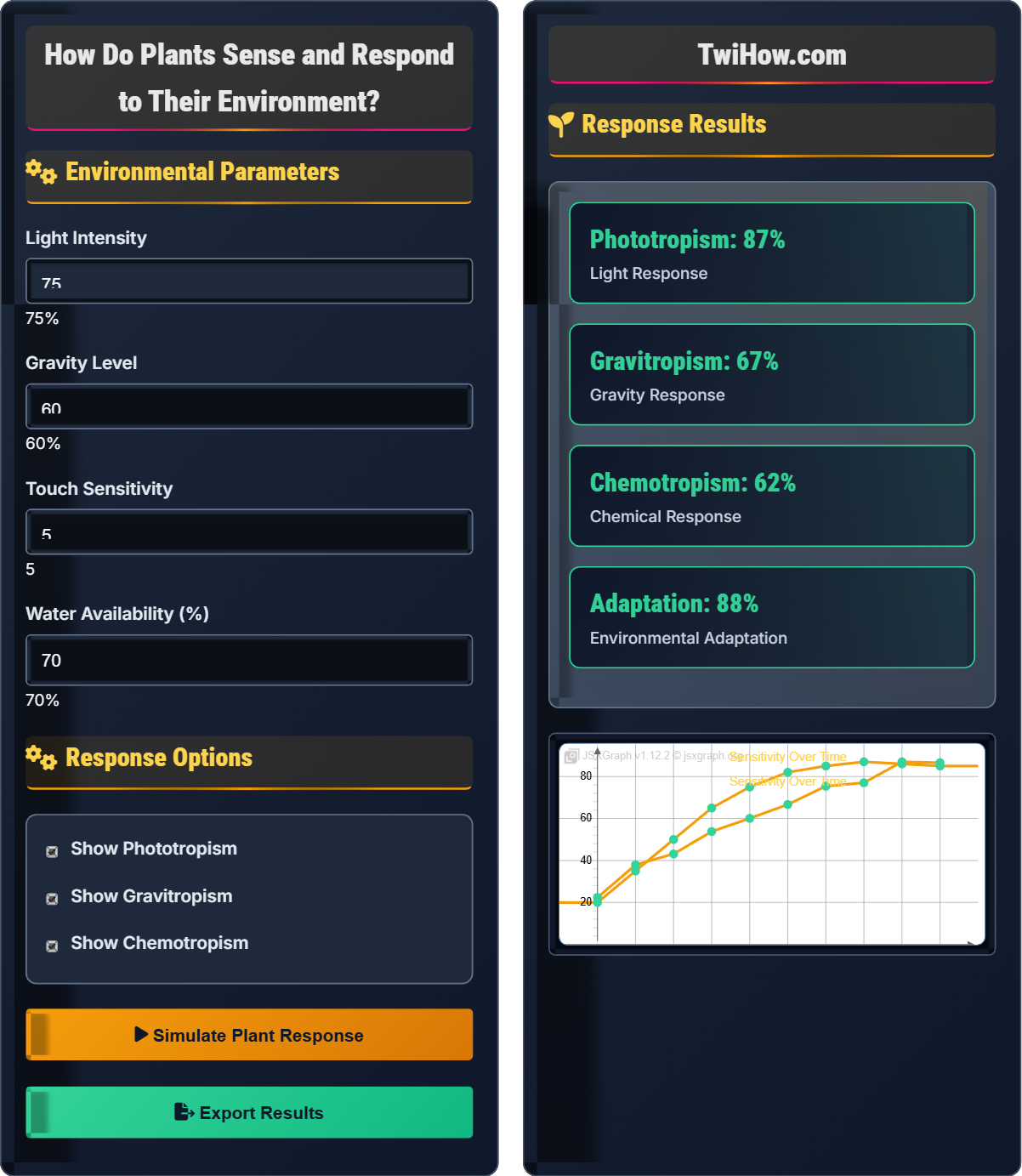
Response Results
| Time (days) | Light Response | Gravity Response | Chemical Response |
|---|---|---|---|
| 1 | 20% | 15% | 10% |
| 3 | 35% | 30% | 25% |
| 5 | 50% | 45% | 40% |
| 7 | 65% | 60% | 55% |
| 10 | 75% | 70% | 65% |
Phototropism: Plants grow toward light sources using auxin hormones.
Gravitropism: Roots grow downward, shoots grow upward in response to gravity.
Plant Environmental Sensing Explained
Plants possess sophisticated sensory systems that allow them to detect and respond to environmental stimuli including light, gravity, touch, chemicals, temperature, and water availability. Unlike animals, plants cannot move away from unfavorable conditions, so they have evolved complex mechanisms to adapt their growth and development to optimize survival.
Plant responses to environmental stimuli involve:
Where:
- Stimulus: Environmental cue (light, gravity, chemicals)
- Hormone: Chemical messenger (auxin, ethylene, cytokinin)
- Cellular Mechanism: Cell elongation, division, or differentiation
Major types of plant responses include:
- Phototropism: Growth toward or away from light
- Gravitropism: Growth in response to gravitational pull
- Thigmotropism: Growth in response to touch
- Hydrotropism: Growth toward water sources
- Chemotropism: Growth in response to chemical gradients
- Photoperiodism: Response to day length
- Auxins: Promote cell elongation, phototropism, gravitropism
- Cytokinins: Promote cell division, delay senescence
- Gibberellins: Promote stem elongation, seed germination
- Ethylene: Promotes fruit ripening, leaf abscission
- Abscisic Acid: Promotes dormancy, closes stomata
Plant Sensory Systems
Phototropism, gravitropism, thigmotropism, hormones, auxins, receptors.
Stimulus → Receptor → Signal → Hormone → Response
Where Response = adaptive growth or development change.
- Plants respond to environmental cues
- Hormones mediate most responses
- Responses optimize survival
Environmental Responses
Phototropism, gravitropism, thigmotropism, hydrotropism, chemotropism.
- Stimulus detection by specialized cells
- Signal transduction pathway activation
- Hormone synthesis and transport
- Cellular response execution
- Adaptive outcome realization
- Responses are directional
- Hormones coordinate responses
- Timing is crucial for survival
Plant Sensory Learning Quiz
What is the primary hormone responsible for phototropic responses in plants?
Auxin is the primary hormone responsible for phototropic responses in plants. When light hits one side of a plant stem, auxin accumulates on the shaded side, promoting cell elongation and causing the stem to bend toward the light source.
The mechanism involves photoreceptors (phototropins) detecting blue light, which triggers auxin redistribution. The higher concentration of auxin on the shaded side stimulates cell wall loosening and expansion, resulting in directional growth toward the light.
The answer is B) Auxin.
Students should understand that auxin is a master regulator of plant growth responses. The phototropic response demonstrates how plants use hormones to coordinate growth directionally in response to environmental cues. This is a fundamental example of how plants adapt to optimize light capture for photosynthesis.
Phototropism: Growth response to light direction
Auxin: Plant hormone promoting cell elongation
Phototropins: Blue light receptors in plants
• Auxin promotes cell elongation
• Light causes auxin redistribution
• Directional growth optimizes light capture
• Remember: Auxin = A for Angle (bending toward light)
• Higher auxin concentration = more growth
• Shaded side gets more auxin = bends toward light
• Confusing auxin with other hormones
• Thinking auxin moves to the lit side
• Not understanding the concentration gradient
Explain the mechanism of gravitropism in plants, including the role of statoliths, amyloplasts, and auxin in root and shoot responses.
Gravitropism Mechanism:
1. Detection: Specialized cells called statocytes in roots and shoots contain dense organelles called amyloplasts (starch-filled plastids) that settle to the bottom of the cell due to gravity.
2. Signal Transduction: The settling of amyloplasts triggers biochemical pathways that ultimately affect hormone distribution.
3. Root Response: Auxin accumulates on the lower side of roots, but unlike shoots, this inhibits growth, causing roots to grow downward.
4. Shoot Response: Auxin accumulates on the lower side of shoots, promoting growth and causing shoots to grow upward.
Key Difference: Roots and shoots respond oppositely to auxin - roots show negative gravitropism (grow downward) while shoots show positive gravitropism (grow upward).
This mechanism allows plants to maintain proper orientation regardless of how they are positioned.
Gravitropism demonstrates how the same hormone (auxin) can have opposite effects depending on the plant organ. Students should understand that gravity sensing involves physical settling of dense particles (amyloplasts) rather than chemical detection. This shows the complexity of plant responses.
Gravitropism: Growth response to gravitational pull
Statocytes: Gravity-sensing cells in plants
Amyloplasts: Dense starch-containing organelles
• Amyloplasts settle due to gravity
• Roots grow downward (negative gravitropism)
• Shoots grow upward (positive gravitropism)
• Think: Roots go down, shoots go up
• Amyloplasts = "gravity stones"
• Same hormone, opposite responses
• Thinking auxin has the same effect on roots and shoots
• Confusing statocytes with other cell types
• Not understanding the physical detection mechanism
Explain how climbing plants like morning glories respond when they encounter a support structure. Describe the cellular and hormonal mechanisms involved in this response and how it benefits the plant.
Thigmotropism Response:
Detection: Specialized cells in the tendril or stem tip detect physical contact with a support structure.
Signal Transduction: Touch triggers rapid cellular and hormonal changes. Calcium ions play a key role in signal transmission.
Hormonal Response: Auxin redistributes to the side opposite the contact point, and ethylene levels may also change.
Cellular Response: Cells on the non-contacted side elongate more rapidly than those on the contacted side, causing the tendril to curl around the support.
Benefits:
• Provides structural support for upright growth
• Allows access to better light conditions
• Conserves energy by not building thick supportive stems
• Increases chances of successful reproduction
This response occurs rapidly, sometimes within minutes of contact, demonstrating the plant's sophisticated sensory capabilities.
Thigmotropism shows that plants can respond to mechanical stimuli with remarkable speed and precision. Students should understand that this response is directional and adaptive, allowing climbing plants to optimize their growth strategy. The rapid response time demonstrates that plant responses can be quite dynamic.
Thigmotropism: Growth response to touch or contact
Tendrils: Specialized organs for climbing
Calcium Signaling: Cellular communication mechanism
• Touch triggers rapid response
• Directional growth toward support
• Hormones mediate the response
• Think of tendrils as "feelers" for support
• Touch = curl = support
• Rapid response shows plant sensitivity
• Thinking it's a random response
• Not understanding the adaptive benefit
• Confusing with other tropisms
Explain how plant roots respond to water gradients in soil. Describe the mechanism of hydrotropism, the role of abscisic acid (ABA), and how this response contributes to plant survival during drought conditions.
Hydrotropism Mechanism:
Detection: Root cap cells detect moisture gradients in the soil. Specialized aquaporins and osmoreceptors sense water potential differences.
Signal Transduction: Water stress triggers the production of abscisic acid (ABA) and other signaling molecules.
Root Response: Roots grow toward areas of higher moisture concentration, with cells on the drier side elongating less than those on the moist side.
ABA Role: ABA accumulates in drier regions, inhibiting growth and promoting the root to grow toward water sources. ABA also helps regulate stomatal closure to conserve water.
Survival Benefits:
• Maximizes water uptake efficiency
• Allows plants to locate water sources in dry soil
• Helps maintain turgor pressure and cellular function
• Increases drought tolerance through adaptive growth
Hydrotropism is particularly important in arid environments where water is scarce and patchily distributed.
Hydrotropism demonstrates how plants can sense and respond to water availability, which is crucial for survival. Students should understand that ABA is a key stress hormone that coordinates multiple responses to water scarcity. This shows the integration of different sensory systems in plant adaptation.
Hydrotropism: Growth response to water gradients
Abscisic Acid (ABA): Stress hormone regulating water relations
Aquaporins: Water channel proteins
• Roots grow toward water
• ABA mediates stress responses
• Water sensing is crucial for survival
• Think of roots as "water hunters"
• ABA = "Abscisic Acid" = Abscission (leaf drop)
• Hydrate = water, tropism = turning
• Not understanding ABA's role in water stress
• Thinking roots grow randomly
• Confusing hydrotropism with other responses
Which plant hormone is primarily responsible for fruit ripening and leaf abscission?
Ethylene is the gaseous plant hormone primarily responsible for fruit ripening and leaf abscission. Ethylene is unique among plant hormones because it is a gas that can diffuse through air spaces and affect neighboring tissues.
Fruit Ripening: Ethylene triggers the ripening process by activating enzymes that soften cell walls and convert starches to sugars.
Leaf Abscission: Ethylene promotes the formation of an abscission layer at the base of leaves, allowing them to fall off.
Ethylene also affects flower senescence, stem elongation, and stress responses. Its gaseous nature allows it to act as a signal between different parts of the plant.
The answer is C) Ethylene.
Ethylene is unique among plant hormones because it's a gas, making it particularly effective for coordinating responses across the plant. Students should remember that ethylene is the "ripening hormone" and is responsible for the famous "one bad apple spoils the bunch" phenomenon, where a ripe fruit releases ethylene that ripens surrounding fruits.
Ethylene: Gaseous hormone for ripening and senescence
Abcission: Shedding of plant organs
Ripening: Maturation process in fruits
• Ethylene is a gas hormone
• Responsible for ripening and senescence
• Can affect surrounding plants
• Ethylene = E for Edible (fruit ripening)
• Gas hormone spreads easily
• "Bad apple" effect is ethylene
• Confusing with auxin or other hormones
• Not remembering it's a gas
• Thinking it only affects one process
FAQ
Q: Why do houseplants always seem to grow toward windows?
A: This is phototropism in action! Plants grow toward light sources because they need light for photosynthesis.
Mechanism: When light hits one side of a plant stem, auxin hormone accumulates on the shaded side, causing those cells to elongate more than the cells on the lit side. This makes the stem bend toward the light.
Why it matters: This adaptation ensures that plants get maximum light exposure for energy production. In nature, this helps plants compete for sunlight in crowded environments.
Tip: Rotate your houseplants regularly so all sides get light and they grow evenly!
Q: Do plants have anything like a nervous system?
A: Plants don't have a nervous system like animals, but they have sophisticated communication systems:
Chemical Signaling: Plants use hormones (auxin, ethylene, etc.) and other chemical signals to coordinate responses throughout the plant.
Electrical Signals: Plants can transmit electrical signals, though much slower than animal nerves. These help coordinate responses to damage or stress.
Systemic Responses: When one part of a plant is stressed, it can send signals to other parts to prepare them.
Memory: Some plants can "remember" past stresses and respond differently to future threats.
While not a nervous system, plants have evolved complex ways to sense, communicate, and respond to their environment.