How do scientists discover and develop new medicines?
Complete biology guide • Step-by-step explanations
Drug Discovery Process:
Show Drug Development SimulatorThe drug discovery and development process is a complex, lengthy, and expensive journey from initial research to market approval. Scientists begin by identifying molecular targets associated with diseases, then screen thousands of compounds to find potential therapeutic agents. Each stage involves rigorous testing for safety, efficacy, and quality.
The process typically takes 10-15 years and costs billions of dollars. It involves multiple phases of testing, from laboratory studies to clinical trials in humans. Regulatory agencies like the FDA review extensive data before approving new medications. Success rates are low, with most compounds failing during development.
Key development stages:
- Target Identification: Finding molecular targets
- Lead Discovery: Finding promising compounds
- Preclinical Testing: Laboratory and animal studies
- Clinical Trials: Phases I, II, III in humans
Modern drug discovery leverages advanced technologies like high-throughput screening, computer modeling, and genomics to accelerate the process and improve success rates.
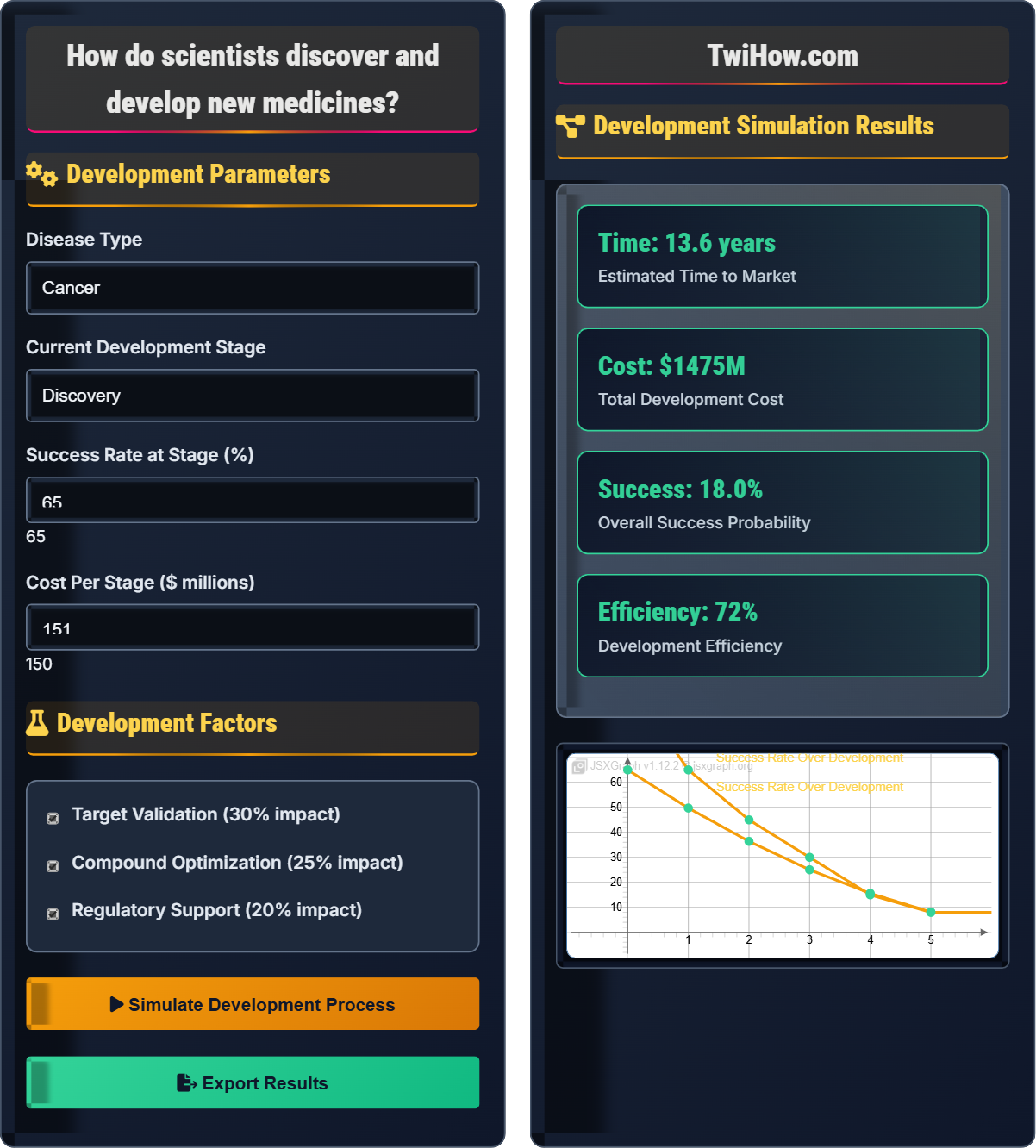
Development Parameters
Development Factors
Development Simulation Results
| Stage | Duration | Success Rate | Cost ($M) |
|---|---|---|---|
| Discovery | 2-3 years | 10% | 500 |
| Preclinical | 1-2 years | 30% | 200 |
| Phase I | 1 year | 70% | 50 |
| Phase II | 2 years | 40% | 150 |
| Phase III | 3 years | 60% | 300 |
Drug Discovery Explained
Drug discovery is the process by which new candidate medications are discovered or designed. It involves identifying and validating biological targets, screening compounds for therapeutic potential, optimizing lead compounds, and conducting preclinical testing. The process begins with understanding disease mechanisms and ends with identifying safe and effective compounds ready for clinical trials.
Overall success rate calculation:
Where P_i represents the success probability at each stage.
Key phases of drug development:
- Discovery: Target identification and compound screening
- Preclinical: Laboratory and animal testing
- Phase I: Safety testing in small groups
- Phase II: Efficacy testing in larger groups
- Phase III: Large-scale efficacy and safety studies
- Regulatory: FDA review and approval
- High-Throughput Screening: Automated compound testing
- Computational Modeling: Virtual drug design
- Genomics: Personalized medicine approaches
- Structure-Based Design: Target-specific drug design
- AI/ML: Predictive modeling and optimization
- Biomarkers: Treatment response indicators
Development Fundamentals
Lead compound, target validation, pharmacokinetics, toxicology, regulatory compliance.
IC50 = Concentration causing 50% inhibition
Measure of compound potency in target assays
- Success rates decrease at each stage
- Costs increase significantly through development
- Safety is paramount at all stages
Regulatory Process
IND, NDA, BLA, FDA guidelines, clinical protocols, safety monitoring.
- Pre-IND meetings
- IND submission
- Clinical trials
- NDA/BLA submission
- Regulatory review
- Post-market surveillance
- Safety vs. efficacy balance
- Regulatory compliance
- Global harmonization
- Post-market monitoring
Drug Discovery Learning Quiz
Which phase of clinical trials typically involves the largest number of participants?
Phase III clinical trials typically involve the largest number of participants, ranging from hundreds to thousands of patients. This phase compares the new treatment to standard therapy and confirms efficacy and safety in a large population. Phase I usually involves 20-100 participants, Phase II involves 100-300, and Phase III involves 1,000-3,000 or more participants.
The answer is C) Phase III.
Each phase of clinical trials serves a specific purpose with increasing numbers of participants. Phase I focuses on safety in small groups, Phase II tests efficacy in moderate-sized groups, and Phase III confirms results in large populations. Phase IV occurs after approval and monitors long-term effects. The increasing scale reflects the growing confidence in the drug's safety and efficacy.
Phase I: Safety and dosage determination
Phase II: Efficacy and side effects
Phase III: Large-scale efficacy and safety
• Phase I: Safety first
• Phase II: Efficacy testing
• Phase III: Confirmation in large groups
• Remember: Safety → Efficacy → Confirmation
• Numbers increase with each phase
• Risk decreases as confidence increases
• Confusing phase purposes
• Not remembering participant numbers
• Forgetting safety emphasis
Explain the process of lead compound optimization in drug discovery. What properties are scientists trying to improve, and what techniques are commonly used?
Lead Optimization Process: After identifying promising compounds, scientists modify their chemical structure to improve drug-like properties. This involves synthesizing analogs and testing them systematically.
Properties to Improve: Potency (binding affinity), selectivity (avoiding off-target effects), bioavailability, metabolic stability, safety profile, and manufacturability.
Techniques Used: Structure-activity relationship (SAR) studies, computational modeling, crystallography, medicinal chemistry, and high-throughput screening of analogs.
The goal is to create a viable drug candidate with optimal therapeutic properties.
Lead optimization is like fine-tuning a prototype. Initial hits from screening are rarely optimal drugs. Scientists must balance multiple properties simultaneously - improving one property might negatively affect another. This iterative process requires understanding of chemistry, biology, and pharmacology to create compounds suitable for clinical testing.
Lead Compound: Promising initial hit for optimization
SAR: Structure-activity relationship studies
Bioavailability: Fraction of drug reaching circulation
• Balance multiple properties simultaneously
• Maintain potency while improving other factors
• Consider manufacturing feasibility
• Start with good lead compound
• Make systematic modifications
• Test early and often
• Improving one property at expense of others
• Not considering ADMET properties early
• Making too many changes at once
A pharmaceutical company is developing a new cancer drug. Historical data shows that the success rates for oncology drugs are: Phase I: 70%, Phase II: 45%, Phase III: 55%, FDA Approval: 85%. Calculate the overall probability that a compound entering Phase I will ultimately receive FDA approval. If the company starts with 100 compounds in Phase I, how many would you expect to be approved?
Overall Success Rate:
P(overall) = P(Phase I) × P(Phase II) × P(Phase III) × P(Approval)
P(overall) = 0.70 × 0.45 × 0.55 × 0.85
P(overall) = 0.147 or 14.7%
Expected Approvals from 100 compounds:
Expected approvals = 100 × 0.147 = 14.7 ≈ 15 compounds
Therefore, approximately 15 out of 100 compounds would be expected to receive FDA approval.
This calculation demonstrates why drug development is so expensive and risky. Even with relatively high success rates at individual stages, the cumulative probability of success is quite low. This is why pharmaceutical companies must maintain large pipelines and why successful drugs need to recoup enormous development costs.
Success Rate: Probability of advancing to next stage
Cumulative Probability: Overall chance of final approval
Pipeline: Portfolio of developing compounds
• Multiply probabilities for sequential events
• Individual success doesn't guarantee overall success
• Pipelines must be large to ensure success
• Always multiply sequential probabilities
• Consider the cumulative effect
• Think about portfolio management
• Adding instead of multiplying probabilities
• Not understanding sequential nature
• Forgetting cumulative effect
A research team is studying Alzheimer's disease and has identified amyloid-beta plaques as a potential therapeutic target. Explain the rationale for targeting amyloid-beta, the challenges in developing anti-amyloid therapies, and the lessons learned from previous clinical trials. How might this knowledge influence future drug development strategies?
Rationale: Amyloid-beta plaques are hallmark pathological features of Alzheimer's disease. The amyloid hypothesis suggests that plaque accumulation initiates the cascade of events leading to neurodegeneration.
Challenges: Difficulty crossing blood-brain barrier, timing of intervention (too late after symptom onset), potential side effects, and complex disease pathology involving multiple pathways.
Lessons Learned: Many anti-amyloid therapies failed in Phase III despite clearing plaques, suggesting that plaque reduction alone may not be sufficient. This highlights the importance of understanding disease mechanisms and patient stratification.
Future Strategies: Combination therapies, earlier intervention, biomarker-guided trials, and targeting multiple pathways simultaneously.
The Alzheimer's experience illustrates the complexity of drug development. Even with a well-established target, clinical translation can fail due to incomplete understanding of disease mechanisms. This emphasizes the importance of robust preclinical models, appropriate patient populations, and timing of intervention in drug development.
Amyloid Hypothesis: Theory linking plaques to disease
Blood-Brain Barrier: Limits drug access to brain
Biomarkers: Indicators of disease or treatment
• Target validation is critical
• Disease mechanisms are complex
• Clinical translation is challenging
• Understand disease mechanisms thoroughly
• Consider multiple pathways
• Learn from failures
• Oversimplifying complex diseases
• Not considering timing of intervention
• Ignoring disease heterogeneity
What does the FDA's "accelerated approval" pathway allow for?
The FDA's accelerated approval pathway allows for approval of drugs that treat serious conditions and fill unmet medical needs based on a surrogate endpoint that is reasonably likely to predict clinical benefit. This pathway speeds access to promising treatments while requiring confirmatory trials to verify clinical benefit after approval.
The answer is B) Approving drugs based on surrogate endpoints for serious conditions.
Accelerated approval balances the need for faster access to potentially life-saving treatments with safety requirements. Surrogate endpoints (like tumor shrinkage) may be used instead of clinical endpoints (like survival) to speed approval. However, companies must conduct post-marketing studies to confirm clinical benefit, and the FDA can withdraw approval if benefits aren't verified.
Surrogate Endpoint: Biomarker predicting clinical benefit
Clinical Endpoint: Direct measure of patient outcome
Confirmatory Trial: Post-approval study verifying benefit
• Safety is never compromised
• Confirmatory trials are required
• Benefits must be verified post-approval
• Accelerated doesn't mean unsafe
• Surrogate endpoints speed approval
• Post-marketing studies are mandatory
• Thinking accelerated means less rigorous
• Not understanding surrogate endpoints
• Forgetting confirmatory requirements
FAQ
Q: What's the difference between a small molecule drug and a biologic?
A: Small molecule drugs: Chemically synthesized, low molecular weight (<1000 Da), oral administration possible, target intracellular proteins.
Biologics: Large molecules (proteins, antibodies, nucleic acids), produced by living cells, high molecular weight (>5000 Da), usually injected, target extracellular or cell surface molecules.
Biologics are more complex to manufacture and regulate, but can be highly specific. Small molecules are easier to manufacture but may have more off-target effects.
Q: Why do some drugs cost so much?
A: Drug costs reflect several factors:
1. Development Costs: $1-3 billion average to bring a drug to market
2. Research Investment: 10-15 year development process
3. Manufacturing Complexity: Especially for biologics
4. Patent Protection: Limited time to recoup investment
5. Market Size: Orphan drugs for rare diseases cost more
6. Regulatory Requirements: Extensive safety testing
Prices also reflect the value provided to patients and healthcare systems.