How Do Scientists Study and Model Complex Biological Systems?
Complete systems biology guide • Step-by-step explanations
Systems Biology Fundamentals:
Show Systems Modeling SimulatorScientists study complex biological systems using a combination of experimental techniques, computational modeling, and data analysis. Systems biology approaches integrate multiple levels of biological organization to understand emergent properties that arise from interactions between components.
Key methodologies:
- Omics Technologies: Genomics, proteomics, metabolomics for comprehensive analysis
- Computational Modeling: Mathematical models to simulate system behavior
- Network Analysis: Mapping and analyzing biological networks
- Experimental Validation: Testing predictions experimentally
These approaches enable scientists to understand how biological systems function as integrated wholes rather than collections of individual parts.
Modeling Parameters
Analysis Options
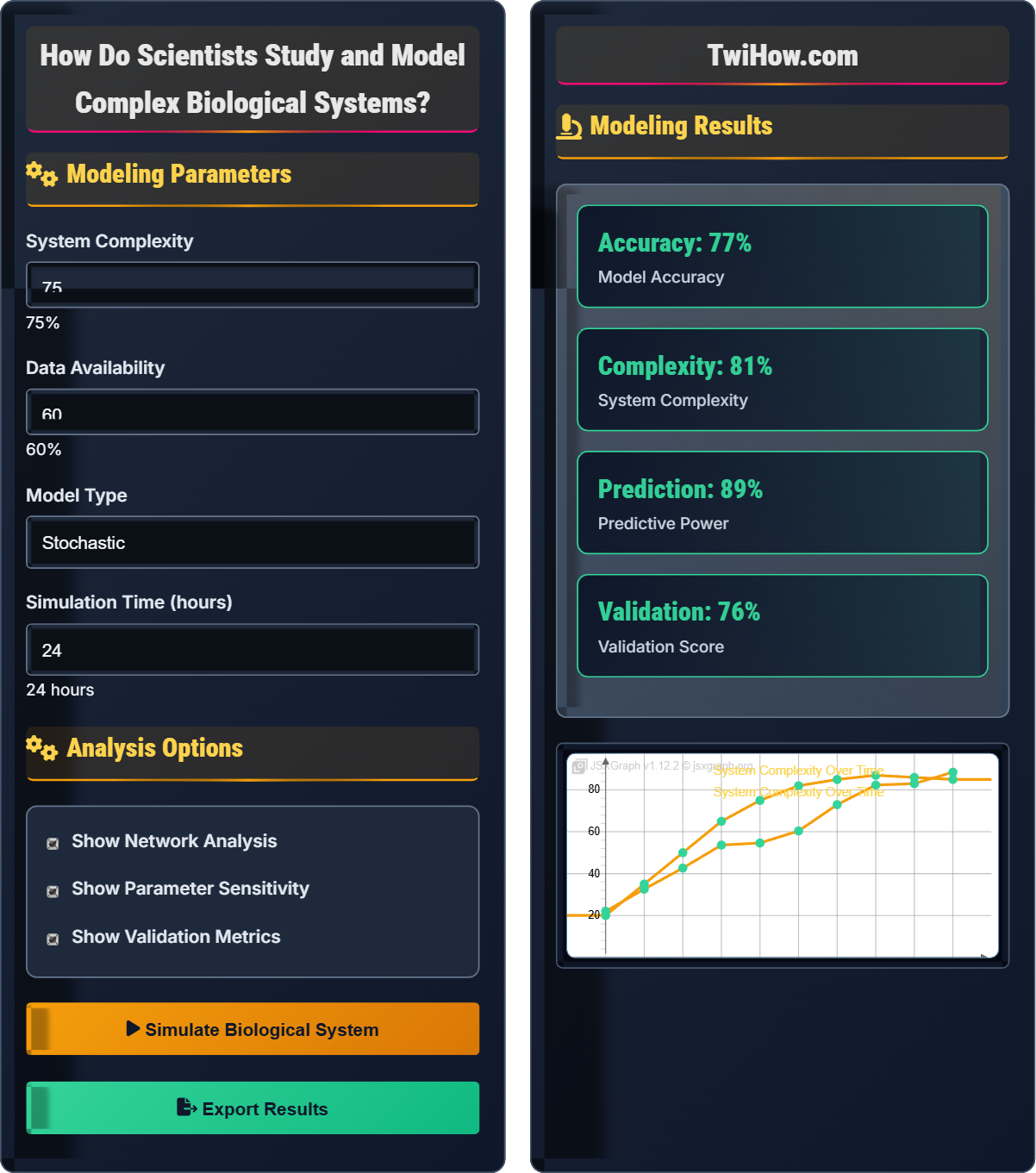
Modeling Results
| Step | Completeness | Accuracy | Reliability |
|---|---|---|---|
| System Definition | 20% | 15% | 10% |
| Data Collection | 40% | 30% | 25% |
| Model Building | 60% | 45% | 40% |
| Parameter Estimation | 80% | 65% | 55% |
| Validation | 90% | 78% | 70% |
Computational Modeling: Mathematical equations representing biological processes.
Experimental Validation: Testing model predictions in laboratory settings.
Systems Biology Approaches Explained
Systems biology is an interdisciplinary field that focuses on understanding biological systems as integrated wholes rather than collections of individual parts. It combines experimental techniques, computational modeling, and mathematical analysis to study how components interact and give rise to emergent properties.
Systems biology employs several complementary approaches:
Where:
- Experimental Data: Omics measurements and observations
- Computational Models: Mathematical representations of biological processes
- Mathematical Analysis: Quantitative description of system behavior
- Network Theory: Analysis of component interactions
Various modeling approaches are used in systems biology:
- Differential Equations: Describe continuous changes in system variables
- Boolean Networks: Represent discrete on/off states of components
- Stochastic Models: Account for randomness in biological processes
- Agent-Based Models: Simulate individual component behavior
- Constraint-Based Models: Analyze metabolic networks using stoichiometry
- Network Models: Analyze topology and connectivity patterns
- Genomics: Study of DNA sequences and gene expression
- Proteomics: Analysis of protein abundance and modifications
- Metabolomics: Measurement of small molecule metabolites
- Transcriptomics: Study of RNA expression patterns
- Phenomics: Comprehensive measurement of phenotypic traits
- Multi-omics Integration: Combined analysis of multiple data types
Systems Biology Approaches
Systems biology, network analysis, computational modeling, omics technologies.
dX/dt = f(X, parameters, interactions)
Where X = system variables, f = functional relationships.
- Focus on emergent properties
- Integrate multiple data types
- Combine experimental and computational approaches
Modeling Techniques
Differential equations, Boolean networks, stochastic models, constraint-based.
- Define system boundaries
- Collect experimental data
- Construct mathematical model
- Run simulations
- Validate predictions
- Refine and iterate
- Models should be falsifiable
- Balance complexity and tractability
- Validate with independent data
Systems Biology Learning Quiz
Which of the following best describes the purpose of omics technologies in systems biology?
Omics technologies (genomics, proteomics, metabolomics, transcriptomics) measure all components of a biological system simultaneously, providing comprehensive snapshots of system state. This systems-level approach is essential for understanding how components interact and give rise to emergent properties.
Unlike traditional reductionist approaches that study individual components, omics technologies enable holistic views of biological systems, which is the foundation of systems biology.
The answer is B) Measure all components of a biological system simultaneously.
Students should understand that "omics" refers to comprehensive, systems-level approaches. The "-omics" suffix indicates a complete set of measurements (genome = all genes, proteome = all proteins, metabolome = all metabolites). This contrasts with traditional biology's focus on individual components.
Omics Technologies: Comprehensive measurement of biological components
Genomics: Study of all genes in an organism
Proteomics: Study of all proteins in a system
• Omics = comprehensive measurement
• Systems approach, not reductionist
• Think of omics as "all of something"
• Genomics = all genes, Proteomics = all proteins
• Systems biology = holistic view
• Thinking omics is reductionist
• Confusing with individual component studies
• Not understanding comprehensive nature
Explain the role of mathematical modeling in systems biology, including the types of models used and how they help understand biological systems.
Role of Mathematical Modeling: Mathematical models serve as formal representations of biological systems that allow scientists to make quantitative predictions, test hypotheses, and understand system behavior.
Types of Models:
• Differential Equation Models: Describe continuous changes in system variables using ordinary or partial differential equations
• Boolean Networks: Represent discrete on/off states of components using logical rules
• Stochastic Models: Account for randomness and noise in biological processes
• Agent-Based Models: Simulate individual components and their interactions
Benefits:
• Enable prediction of system behavior under different conditions
• Allow testing of hypotheses without expensive experiments
• Reveal emergent properties not apparent from individual components
• Identify key regulatory points in biological networks
• Guide experimental design and interpretation
Mathematical models bridge the gap between experimental observations and mechanistic understanding.
Mathematical modeling in biology transforms qualitative observations into quantitative, testable predictions. Students should understand that models are tools for thinking and hypothesis generation, not perfect representations of reality. The goal is to capture essential features while remaining tractable.
Mathematical Model: Formal representation of system behavior
Differential Equations: Mathematical expressions describing rate changes
Emergent Properties: System behaviors arising from component interactions
• Models should be falsifiable
• Balance complexity with tractability
• Always validate with experimental data
• Models are tools for understanding, not reality
• Start simple, add complexity as needed
• Always test predictions experimentally
• Thinking models must be perfect
• Not validating predictions
• Adding unnecessary complexity
A systems biologist is studying a protein-protein interaction network in cancer cells. Explain how network analysis approaches can help identify potential therapeutic targets and predict drug resistance mechanisms.
Network Analysis Approaches:
Centrality Analysis: Identify hub proteins that are critical for network integrity. These highly connected proteins often represent promising therapeutic targets.
Community Detection: Find clusters of densely connected proteins that may represent functional modules. Disrupting key modules can have therapeutic effects.
Pathway Analysis: Map signaling pathways to identify bottlenecks and feedback loops that can be targeted.
Predicting Drug Resistance:
• Alternative Pathways: Network analysis can identify redundant pathways that may compensate when a target is inhibited
• Compensatory Interactions: Identify potential rewiring of the network that could bypass drug effects
• Robustness Analysis: Assess how the network responds to perturbations to predict resistance mechanisms
Therapeutic Applications:
• Target hub proteins for maximum network disruption
• Identify combinations of targets to prevent resistance
• Predict off-target effects of drugs
Network analysis provides a systems-level view that is essential for rational drug design and understanding complex disease mechanisms.
Network analysis demonstrates how systems approaches can identify therapeutic targets that wouldn't be apparent from studying individual proteins. Students should understand that network properties like centrality can predict the importance of individual components. This approach is particularly valuable for understanding complex diseases like cancer.
Network Centrality: Measure of node importance in network
Hub Protein: Highly connected protein in network
Community Detection: Finding clusters in network
• Hubs are often good therapeutic targets
• Network redundancy can cause resistance
• Systems view is essential for complex diseases
• Think of networks as social connections
• Hubs = influential people
• Communities = friend groups
• Not understanding network topology
• Thinking individual targets are sufficient
• Ignoring network redundancy
Explain how integrating genomics, transcriptomics, and proteomics data can provide insights into biological systems that single-omics approaches cannot. Include specific examples of how each layer contributes to understanding system behavior.
Multi-Omics Integration Benefits:
Genomics: Provides information about genetic variations, copy number changes, and mutations that affect system behavior. Example: Identifying cancer driver mutations that activate oncogenes.
Transcriptomics: Reveals gene expression changes and regulatory patterns. Example: Detecting changes in transcription factor activity that aren't apparent from DNA sequence alone.
Proteomics: Shows actual protein levels and post-translational modifications that determine function. Example: Identifying phosphorylated proteins that indicate active signaling pathways.
Integration Insights:
• Post-transcriptional Regulation: Discrepancies between mRNA and protein levels reveal regulatory mechanisms
• Feedback Loops: Changes at multiple levels reveal regulatory circuits
• Functional States: Post-translational modifications indicate protein activity
• Temporal Dynamics: Different omics layers respond at different time scales
Example Application: In cancer research, integrated analysis might reveal that a gene is amplified (genomics), overexpressed (transcriptomics), and the protein is hyperphosphorylated (proteomics), indicating a highly active oncogenic pathway that would be missed by any single approach.
Multi-omics integration demonstrates how biological systems operate at multiple levels simultaneously. Students should understand that each omics layer provides different information, and integration reveals the complete picture of system behavior. This approach is essential for understanding complex diseases and biological processes.
Multi-omics: Integration of multiple omics data types
Post-translational Modifications: Chemical changes to proteins after synthesis
Regulatory Circuits: Feedback loops controlling system behavior
• Each omics layer provides different information
• Integration reveals complete system picture
• Discordance between layers reveals regulation
• DNA → RNA → Protein = information flow
• Each level can be regulated independently
• Integration provides systems-level view
• Thinking DNA = RNA = Protein
• Not understanding post-transcriptional regulation
• Underestimating the value of integration
Which of the following best characterizes the main difference between systems biology and traditional reductionist approaches?
Systems biology differs from traditional reductionist approaches by focusing on emergent properties that arise from interactions between components, rather than studying individual parts in isolation. While traditional biology seeks to understand components separately, systems biology examines how components work together to produce system-level behavior.
Emergent properties are characteristics that arise from the collective behavior of components and cannot be predicted from studying individual parts alone. Examples include cellular decision-making, organism-level responses, and disease states.
The answer is C) Systems biology focuses on emergent properties from component interactions.
This question highlights the fundamental philosophical difference between systems and reductionist approaches. Students should understand that systems biology doesn't replace reductionist methods but rather complements them by focusing on integration and emergent behavior. Both approaches are valuable for understanding biological systems.
Systems Biology: Study of biological systems as integrated wholes
Reductionist Approach: Study of individual components
Emergent Properties: System behaviors from component interactions
• Systems approach examines interactions
• Emergent properties arise from integration
• Both approaches are valuable
• Systems = whole picture, Reductionist = parts
• Emergent = more than sum of parts
• Integration reveals new properties
• Thinking systems biology replaces traditional methods
• Not understanding emergent properties
• Confusing with just computational biology
FAQ
Q: Do I need to be good at math to study systems biology?
A: While systems biology does involve mathematical modeling, you don't need to be a mathematician to study it:
Essential Skills: Basic calculus, statistics, and linear algebra are helpful. Many software tools handle the complex mathematics for you.
Conceptual Understanding: More important than mathematical skill is understanding biological concepts and how components interact.
Collaborative Approach: Systems biology is highly collaborative, so biologists often work with mathematicians and computer scientists.
Learning Resources: There are many user-friendly tools and online courses that teach systems biology concepts without heavy mathematical prerequisites.
Start with conceptual understanding and gradually build mathematical skills as needed for your specific interests.
Q: What are the main challenges in modeling biological systems?
A: Modeling biological systems faces several significant challenges:
Data Limitations: Biological systems are complex and not all interactions are known or measurable.
Scale Issues: Models must capture phenomena across multiple scales (molecular to organismal) and time scales (milliseconds to years).
Stochasticity: Biological systems are inherently noisy and probabilistic, making deterministic models inadequate.
Parameter Estimation: Many model parameters are difficult to measure experimentally and must be estimated.
Validation Challenges: Testing model predictions experimentally can be expensive and time-consuming.
Emergent Behavior: Complex systems can exhibit unexpected behaviors that are difficult to predict from individual components.
Despite these challenges, systems biology continues to advance our understanding of biological complexity.