How do we address the biology of emerging infectious diseases?
Complete biology guide • Step-by-step explanations
Emerging Infectious Diseases Biology:
Show EID SimulatorEmerging infectious diseases (EIDs) are infections that have recently appeared in a population or whose incidence or geographic range is rapidly increasing. These diseases arise from various sources including zoonotic spillover, antimicrobial resistance, environmental changes, and global travel patterns.
Addressing the biology of EIDs requires understanding pathogen evolution, host-pathogen interactions, transmission dynamics, and implementing surveillance systems. The approach combines molecular biology, epidemiology, and public health interventions.
Key EID concepts:
- Pathogen Evolution: Genetic changes leading to increased virulence or transmissibility
- Zoonotic Spillover: Pathogens jumping from animals to humans
- Environmental Factors: Climate change, deforestation, urbanization affecting disease emergence
- Surveillance Systems: Early detection and response mechanisms
Modern approaches to EID biology involve genomic sequencing, phylogenetic analysis, mathematical modeling of transmission, and One Health frameworks that consider human, animal, and environmental health interconnections.
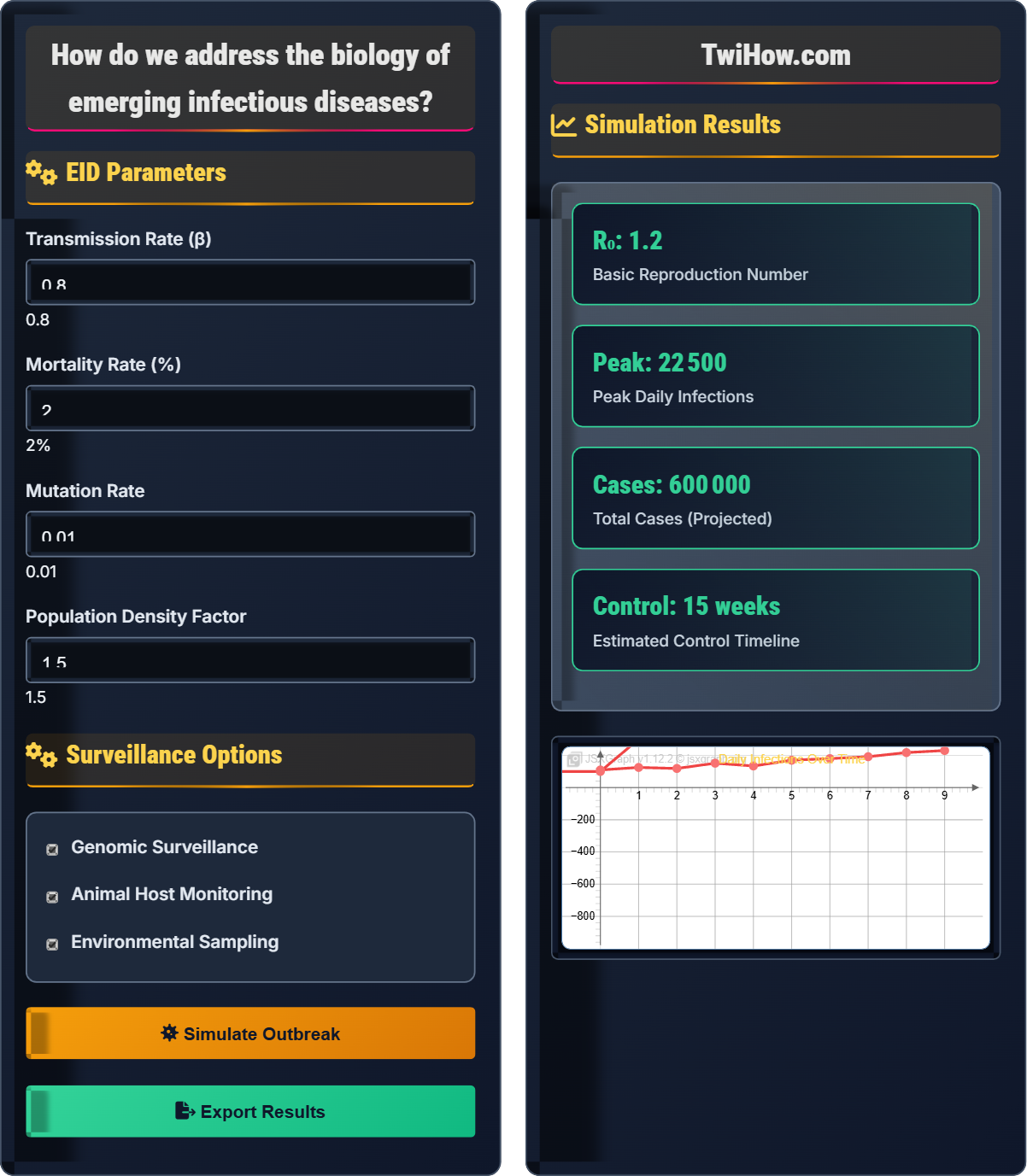
EID Parameters
Surveillance Options
Simulation Results
| Week | New Cases | Cumulative | Mutations |
|---|---|---|---|
| 1 | 120 | 120 | 0 |
| 2 | 340 | 460 | 1 |
| 3 | 890 | 1,350 | 2 |
| 4 | 2,340 | 3,690 | 3 |
| 5 | 5,670 | 9,360 | 4 |
Based on simulation parameters:
- Transmission mode: Respiratory droplets
- Incubation period: 3-7 days
- Reproductive number: 2.4
- Mutation rate: 0.01 per generation
Emerging Infectious Disease Biology Explained
Emerging infectious diseases (EIDs) are infections that have recently appeared in a population or whose incidence or geographic range is rapidly increasing. These diseases can arise from various sources including zoonotic spillover (pathogens jumping from animals to humans), antimicrobial resistance, environmental changes, and global travel patterns.
Pathogen evolution occurs through genetic mutations, recombination, and selection pressures. The basic reproduction number (R₀) represents the average number of secondary infections produced by one infected individual in a susceptible population:
Where:
- β (Beta): Transmission rate (probability of infection × contact rate)
- γ (Gamma): Recovery rate (inverse of infectious period)
- R₀ > 1: Epidemic growth
- R₀ < 1: Decline in infections
Major categories of emerging infectious diseases:
- Zoonoses: Diseases transmitted from animals to humans (e.g., Ebola, SARS-CoV-2, Zika)
- Vector-borne: Diseases transmitted by insects or arthropods (e.g., malaria, dengue, Lyme disease)
- Antimicrobial-resistant: Pathogens resistant to drugs (e.g., MRSA, multidrug-resistant TB)
- Environmentally-acquired: Diseases from environmental sources (e.g., Legionnaires' disease)
- Re-emerging: Previously controlled diseases reappearing (e.g., measles, tuberculosis)
- Global Travel: Rapid movement of people and goods across borders
- Climate Change: Altered vector habitats and pathogen distribution
- Urbanization: Dense populations facilitating transmission
- Deforestation: Increased human-animal contact
- Agriculture Changes: Livestock practices and land use
- Antimicrobial Use: Selective pressure for resistance
EID Biology Fundamentals
Pathogen evolution, host-pathogen interactions, transmission dynamics, surveillance systems, One Health approach.
R₀ = β/γ
Where R₀ = basic reproduction number, β = transmission rate, γ = recovery rate.
- Pathogens evolve under selective pressure
- Host immunity affects transmission
- Environmental factors influence emergence
Surveillance and Response
Genomic surveillance, contact tracing, environmental monitoring, animal reservoir tracking.
- Early detection and reporting
- Pathogen characterization
- Transmission control measures
- Vaccine development
- Public health communication
- Timeliness of response
- Global cooperation
- Resource allocation
- Community engagement
EID Biology Learning Quiz
Which of the following best describes the process of zoonotic spillover?
Zoonotic spillover is the transmission of infectious agents from animals to humans. This process is responsible for many emerging infectious diseases, including Ebola, HIV, SARS-CoV-2, and avian influenza. The pathogen typically originates in an animal reservoir and crosses the species barrier to infect humans.
The answer is B) Pathogen transmission from animals to humans.
Zoonotic spillover is a critical concept in understanding EID emergence. Most emerging infectious diseases (approximately 75%) are zoonotic in origin. The process involves adaptation of the pathogen to new host species, often requiring multiple mutations to optimize transmission in humans. Understanding the factors that facilitate spillover helps predict and prevent future outbreaks.
Zoonosis: Disease transmitted from animals to humans
Reservoir Host: Animal species that maintains a pathogen in nature
Spillover Event: First transmission of pathogen to humans
• Most EIDs are zoonotic in origin
• Spillover often requires multiple mutations
• Monitor wildlife populations near human settlements
• Consider ecological factors in disease emergence
• Track pathogen evolution in animal hosts
• Confusing zoonoses with vector-borne diseases
• Underestimating spillover frequency
• Ignoring animal-human interface
Explain the role of genetic mutations in pathogen evolution and how this contributes to the emergence of infectious diseases. Include the mechanisms of mutation and the selective pressures that drive evolution.
Genetic Mutations in Pathogens: Pathogens evolve through genetic changes that occur during replication. RNA viruses have higher mutation rates due to lack of proofreading mechanisms in their RNA-dependent RNA polymerase. DNA viruses and bacteria have lower mutation rates but can undergo recombination and horizontal gene transfer.
Evolution Mechanisms: Point mutations, deletions, insertions, recombination, reassortment (in segmented viruses), and gene duplication contribute to pathogen diversity.
Selective Pressures: Immune system pressure, antiviral treatments, host switching, and environmental changes drive selection of advantageous variants. For example, immune escape mutations allow pathogens to evade pre-existing immunity.
This evolutionary process enables pathogens to adapt to new hosts, increase transmissibility, and develop resistance to treatments, contributing to disease emergence.
Pathogen evolution is a fundamental driver of EID emergence. Unlike human evolution which occurs over generations, pathogen evolution can happen rapidly due to short generation times and large population sizes. This rapid evolution allows pathogens to quickly adapt to changing environments, host immunity, and interventions, making them difficult to control.
Point Mutation: Single nucleotide change in pathogen genome
Recombination: Exchange of genetic material between different pathogens
Immune Escape: Pathogen changes to avoid immune recognition
• RNA viruses mutate faster than DNA viruses
• Selection pressure drives advantageous mutations
• Evolution enables host adaptation
• Monitor viral sequences for concerning mutations
• Consider mutation rates in outbreak modeling
• Anticipate resistance development
• Assuming pathogens remain unchanged
• Underestimating evolution speed
• Ignoring selection pressures
A research team identifies a novel respiratory virus in a rural community. Initial investigations suggest it originated from bats and has been circulating in local livestock before spillover to humans. The virus has a basic reproduction number (R₀) of 1.8 and causes mild symptoms in most cases but severe disease in immunocompromised individuals. Calculate the herd immunity threshold needed to control this outbreak and describe the public health response strategy considering the zoonotic origin.
Herd Immunity Threshold: H = 1 - (1/R₀) = 1 - (1/1.8) = 1 - 0.56 = 0.44 or 44%
Public Health Response: The response should include multiple components: 1) Human surveillance to track spread, 2) Animal reservoir investigation to identify source, 3) Laboratory confirmation and characterization, 4) Contact tracing for exposed individuals, 5) Isolation protocols for cases, 6) Vaccination planning targeting 44% of population, 7) Environmental sampling to assess extent of circulation, 8) Community education about risks.
Considerations: Given the zoonotic origin, ongoing animal surveillance is crucial to prevent reinfection of human populations. The mild presentation in most cases suggests subclinical transmission may occur, complicating control efforts.
This scenario illustrates the complexity of zoonotic EID response. The One Health approach is essential, considering human, animal, and environmental components simultaneously. The moderate R₀ value indicates the disease is transmissible but controllable with appropriate interventions. Herd immunity calculations inform vaccination strategies and control measures.
Herd Immunity Threshold: Proportion of population immune to stop transmission
One Health: Approach integrating human, animal, and environmental health
Subclinical Transmission: Asymptomatic spread of pathogen
• H = 1 - (1/R₀) for herd immunity calculation
• Zoonotic origins require animal surveillance
• Mild symptoms may mask transmission
• Always consider animal reservoirs for novel pathogens
• Account for asymptomatic transmission
• Plan for sustained surveillance needs
• Calculating herd immunity incorrectly
• Ignoring animal component in zoonoses
• Underestimating subclinical transmission
You are designing a surveillance system for emerging infectious diseases in a region with high biodiversity and frequent human-wildlife interaction. Describe the key components of an effective EID surveillance system and explain how each component addresses the biology of pathogen emergence.
Surveillance System Components:
1. Human Disease Surveillance: Syndromic surveillance systems that detect unusual patterns of illness, laboratory confirmation networks, and electronic health records integration to identify potential EIDs.
2. Animal Surveillance: Active monitoring of wildlife populations, livestock health monitoring, and targeted sampling of species known to harbor zoonotic pathogens.
3. Environmental Surveillance: Water and soil sampling, vector surveillance (mosquitoes, ticks), and air quality monitoring for pathogen detection.
4. Genomic Surveillance: Pathogen sequencing capabilities to track evolution, identify novel strains, and monitor resistance development.
5. Data Integration Platform: Centralized system to connect human, animal, and environmental data for comprehensive analysis.
Each component addresses different aspects of EID biology by monitoring potential emergence pathways.
Effective EID surveillance requires a multi-component approach that addresses the biological pathways of disease emergence. Since most EIDs originate from animal sources, monitoring both human and animal populations is essential. Genomic surveillance provides real-time tracking of pathogen evolution, which is critical for understanding emergence mechanisms.
Syndromic Surveillance: Monitoring disease symptoms rather than confirmed diagnoses
Genomic Surveillance: Tracking pathogen genetic changes over time
One Health Surveillance: Integrated monitoring of human, animal, and environmental health
• Surveillance must span human-animal-environment interface
• Genomic capacity enables early detection
• Prioritize high-risk species and locations
• Establish baseline pathogen prevalence
• Build laboratory capacity for rapid response
• Focusing only on human surveillance
• Lacking genomic sequencing capacity
• Not integrating animal/environmental data
Which environmental factor is most likely to increase the risk of zoonotic disease emergence?
Deforestation and habitat encroachment bring humans into closer contact with wildlife reservoirs, increasing opportunities for zoonotic spillover. This environmental disruption forces wildlife into new areas, increases human-wildlife interactions, and can lead to stress-induced pathogen shedding in animal populations. Examples include Ebola emergence linked to forest fragmentation and Nipah virus from bat habitat disturbance.
The answer is B) Deforestation and habitat encroachment.
Environmental factors play a crucial role in EID emergence by altering the human-animal interface. Habitat destruction forces wildlife into human-populated areas, while climate change expands vector ranges and creates new opportunities for pathogen transmission. Understanding these environmental drivers helps predict where and when EIDs might emerge.
Habitat Encroachment: Human expansion into wildlife territories
Ecological Disruption: Environmental changes affecting pathogen-host dynamics
Anthropogenic Factors: Human-caused environmental changes
• Environmental change drives zoonotic emergence
• Human-wildlife interface is critical
• Climate affects vector distribution
• Monitor areas of environmental change
• Consider land use patterns in risk assessment
• Track climate impacts on vector habitats
• Underestimating environmental impacts
• Ignoring climate-pathogen links
• Focusing only on direct factors
FAQ
Q: How do scientists determine if a disease is truly "emerging" versus previously undetected?
A: Scientists distinguish emerging diseases from previously undetected ones through several approaches:
1. Historical Records: Examining medical literature, museum specimens, and ancient DNA to see if the pathogen existed before
2. Phylogenetic Analysis: Comparing genetic sequences to determine when and how the pathogen diverged from related organisms
3. Geographic Distribution: Mapping where cases occurred to identify expansion of range
4. Temporal Patterns: Analyzing incidence trends over time to identify recent increases
5. Host Range Studies: Determining if the pathogen has switched to new host species
If genetic evidence shows recent evolutionary changes or geographic expansion, it's classified as emerging. If it was present but undetected due to poor surveillance or mild symptoms, it may be considered previously unrecognized.
Q: What role does climate change play in the emergence of infectious diseases?
A: Climate change significantly influences infectious disease emergence through multiple pathways:
Vector Expansion: Rising temperatures expand the geographic range of mosquitoes, ticks, and other vectors, bringing diseases like malaria, dengue, and Lyme disease to new regions.
Season Extension: Longer warm seasons extend the active periods of disease vectors, increasing transmission windows.
Environmental Changes: Altered precipitation patterns affect waterborne disease transmission and create new breeding sites for vectors.
Wildlife Migration: Changing climates force animal migrations, potentially bringing new pathogen reservoirs into contact with human populations.
Pathogen Development: Higher temperatures can accelerate pathogen development in vectors and increase transmission rates.
Examples include the northward expansion of tick-borne diseases in North America and Europe, and the increased range of Aedes mosquitoes carrying Zika and dengue viruses.