How do we conserve endangered species and restore habitats?
Complete biology guide • Step-by-step explanations
Conservation Biology Fundamentals:
Show Conservation SimulatorConservation biology is the scientific study of the nature and status of Earth's biodiversity with the aim of protecting species, their habitats, and ecosystems from excessive rates of extinction. It combines ecology, evolutionary biology, genetics, and environmental science to develop strategies for preserving biodiversity.
Conservation efforts focus on protecting endangered species through captive breeding programs, habitat protection, and legal frameworks. Habitat restoration involves rebuilding degraded ecosystems, removing invasive species, and reintroducing native flora and fauna. Success requires understanding species' ecological requirements and threats.
Key conservation concepts:
- Population Viability: Minimum viable population sizes
- Habitat Fragmentation: Island biogeography effects
- Genetic Diversity: Bottleneck and founder effects
- Ecological Niches: Species-specific requirements
Modern conservation integrates traditional approaches with cutting-edge technologies like genetic rescue, assisted migration, and landscape connectivity planning. Community involvement and sustainable development are essential for long-term success.
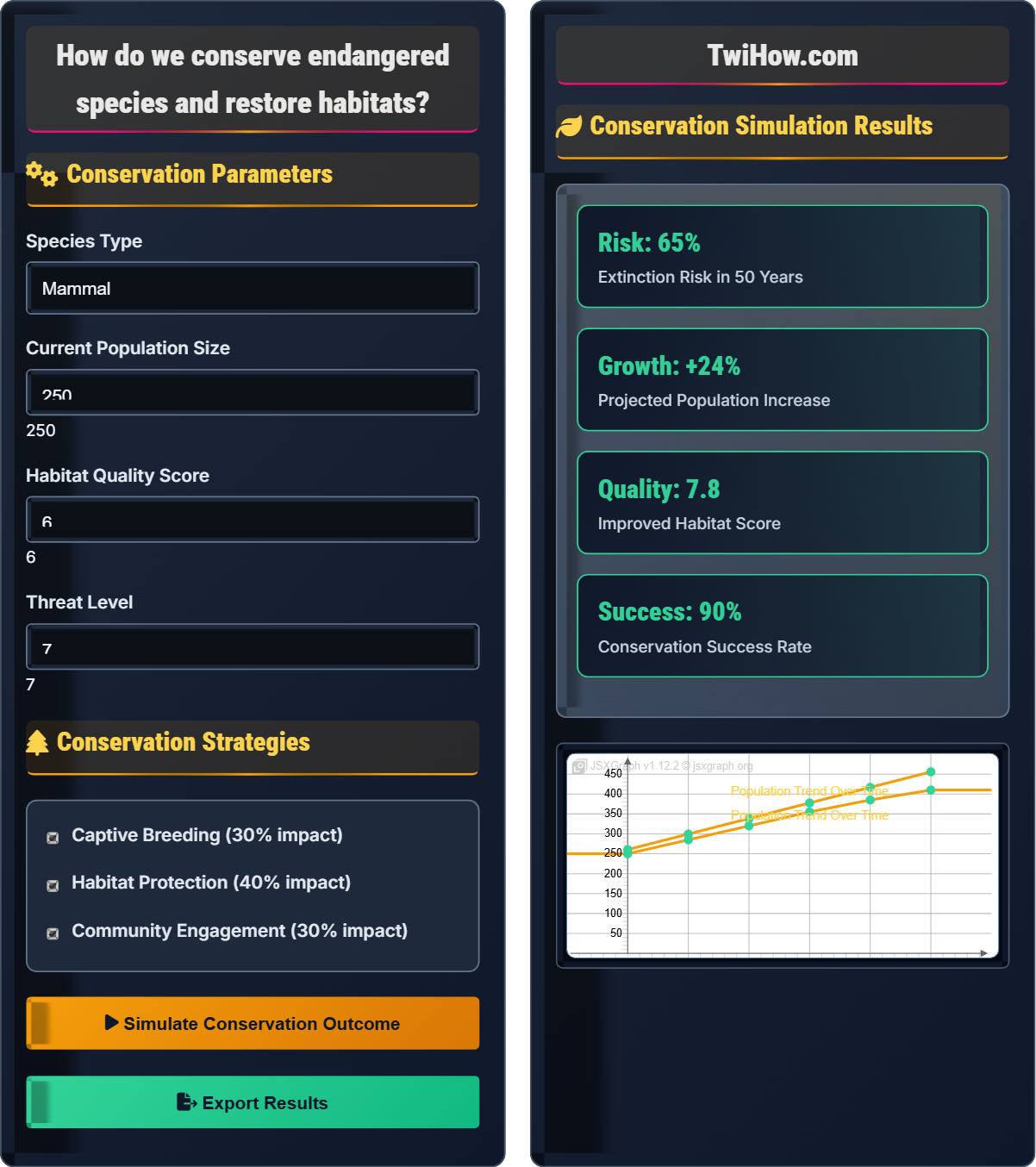
Conservation Parameters
Conservation Strategies
Conservation Simulation Results
| Year | Population | Habitat Quality | Threat Level |
|---|---|---|---|
| 2024 | 250 | 6.0 | 7.0 |
| 2029 | 285 | 6.5 | 6.2 |
| 2034 | 320 | 7.0 | 5.8 |
| 2039 | 355 | 7.3 | 5.2 |
| 2044 | 385 | 7.6 | 4.8 |
Conservation Biology Explained
Conservation biology is an interdisciplinary field that aims to protect and restore biodiversity by studying the dynamics of populations, communities, and ecosystems. It combines ecological, genetic, and evolutionary principles to develop evidence-based strategies for preserving species and habitats. Conservation biologists work to understand the causes of biodiversity loss and implement solutions to halt or reverse these trends.
Population viability is determined by the minimum viable population (MVP) size:
Where:
- N_e: Effective population size
- Δt: Time interval
- P_ext: Probability of extinction
- ln: Natural logarithm
Key approaches to species conservation:
- In-situ: Protect species in their natural habitat
- Ex-situ: Captive breeding and genetic banks
- Habitat Restoration: Rebuild degraded ecosystems
- Legal Protection: Legislation and enforcement
- Community Involvement: Local engagement and education
- Corridor Creation: Connect fragmented habitats
- Habitat Loss: Deforestation, urbanization
- Climate Change: Temperature and precipitation shifts
- Pollution: Chemical contamination
- Invasive Species: Competition and predation
- Overexploitation: Hunting, fishing, harvesting
- Disease: Pathogens affecting wildlife
Conservation Fundamentals
Biodiversity, habitat fragmentation, edge effects, keystone species, umbrella species.
Minimum Viable Population = 50/500 Rule
50 to avoid inbreeding depression, 500 to maintain evolutionary potential.
- Smaller populations face greater extinction risk
- Genetic diversity is crucial for survival
- Connectivity between habitats is essential
Conservation Strategies
Protected areas, wildlife corridors, genetic rescue, species reintroduction.
- Legal frameworks
- Habitat management
- Species-specific actions
- Community engagement
- Cost-effectiveness of strategies
- Local community needs
- Political feasibility
- Long-term sustainability
Conservation Biology Learning Quiz
According to the 50/500 rule in conservation biology, what population size is needed to avoid inbreeding depression?
The 50/500 rule is a widely accepted guideline in conservation biology. It states that 50 individuals are needed to avoid inbreeding depression in the short term, while 500 individuals are needed to maintain evolutionary potential in the long term. This rule accounts for genetic drift and inbreeding effects in small populations.
The answer is A) 50 individuals.
Small populations face two main genetic threats: inbreeding depression (short-term) and loss of evolutionary potential (long-term). The 50/500 rule provides a simple heuristic for conservation managers to assess minimum viable population sizes. However, actual MVP requirements vary by species and environment.
Minimum Viable Population (MVP): Smallest population size with low extinction risk
Inbreeding Depression: Reduced fitness due to mating between relatives
Effective Population Size: Number of breeding individuals
• 50 individuals prevent inbreeding depression
• 500 individuals maintain evolutionary potential
• Actual MVP varies by species
• Remember 50/500 rule
• Consider genetic factors in small populations
• MVP is species-specific
• Confusing 50 with 500 for inbreeding
• Not considering genetic factors
• Applying generic MVP to all species
Explain the concept of habitat fragmentation and its effects on biodiversity. How do edge effects contribute to the negative impacts of fragmented habitats?
Habitat Fragmentation: The process where large, continuous habitats are divided into smaller, isolated patches. This occurs through deforestation, urbanization, agriculture, and infrastructure development.
Effects on Biodiversity: Reduces population sizes, increases extinction risk, limits gene flow, and creates edge habitats that favor generalist species over specialists.
Edge Effects: Changes in environmental conditions at habitat boundaries (temperature, humidity, light, wind) that create inhospitable conditions for interior forest species. Edge habitats are more vulnerable to invasive species, predation, and disturbance.
Fragmentation reduces overall habitat quality and connectivity, making populations more vulnerable to stochastic events and genetic degradation.
Habitat fragmentation is one of the leading causes of biodiversity loss worldwide. The creation of habitat islands disrupts ecological processes and increases extinction risk. Edge effects magnify these impacts by reducing the amount of suitable interior habitat. Conservation efforts focus on maintaining habitat connectivity and reducing edge effects.
Habitat Fragmentation: Breaking continuous habitat into smaller patches
Edge Effects: Environmental changes at habitat boundaries
Habitat Connectivity: Linkages between habitat patches
• Fragmentation reduces effective habitat
• Edge effects degrade habitat quality
• Connectivity is essential for survival
• Think of habitat as islands
• Consider edge-to-area ratios
• Focus on connectivity
• Not appreciating edge effect magnitude
• Ignoring connectivity importance
• Underestimating fragmentation impacts
A wildlife reserve has a carrying capacity of 500 individuals for a particular endangered species. The current population is 200 individuals, and the species has an intrinsic growth rate (r) of 0.15 per year. Using the logistic growth equation, calculate the expected population size after 5 years. The logistic growth equation is: P(t) = K / (1 + ((K-P₀)/P₀) * e^(-rt)), where K is carrying capacity, P₀ is initial population, r is growth rate, and t is time.
Given:
K = 500, P₀ = 200, r = 0.15, t = 5
Substitute into logistic equation:
P(5) = 500 / (1 + ((500-200)/200) * e^(-0.15×5))
P(5) = 500 / (1 + (300/200) * e^(-0.75))
P(5) = 500 / (1 + 1.5 * e^(-0.75))
P(5) = 500 / (1 + 1.5 * 0.4724)
P(5) = 500 / (1 + 0.7086)
P(5) = 500 / 1.7086
P(5) = 292.7 ≈ 293 individuals
The population is expected to grow to approximately 293 individuals after 5 years.
The logistic growth model accounts for density-dependent factors that limit population growth as it approaches carrying capacity. Unlike exponential growth, logistic growth slows as the population nears its environmental limits. This model is crucial for conservation planning as it helps predict population trajectories under different management scenarios.
Carrying Capacity: Maximum population size environment can support
Intrinsic Growth Rate: Maximum per capita growth rate
Logistic Growth: Density-dependent population growth
• Populations grow exponentially initially
• Growth slows as population approaches K
• K depends on resource availability
• Understand density dependence
• Remember K limits growth
• Consider environmental factors
• Using exponential instead of logistic growth
• Incorrect algebra in equation
• Not considering environmental limits
A conservation biologist studying a temperate forest ecosystem identifies wolves as a keystone species. Explain why wolves are considered keystone species in this ecosystem and describe the potential cascading effects of wolf removal on the forest community. How might this understanding inform conservation priorities?
Keystone Species Role: Wolves regulate herbivore populations (especially deer), which prevents overgrazing of vegetation. Their presence maintains the balance between herbivores and plant communities.
Cascading Effects of Removal: Without wolves, deer populations increase dramatically, leading to overbrowsing of understory vegetation, reduced tree regeneration, altered plant community composition, and impacts on other species dependent on dense understory (birds, small mammals).
Conservation Implications: Protecting wolves maintains ecosystem integrity and benefits numerous other species. This demonstrates that conserving keystone species can have disproportionate positive effects on entire ecosystems, making them high-priority targets for conservation efforts.
Conservation should focus on maintaining intact food webs rather than individual species.
Keystone species have disproportionately large effects on ecosystems relative to their abundance. The wolf example (particularly studied in Yellowstone) illustrates how apex predators maintain ecosystem structure. Removing keystone species can trigger trophic cascades that affect multiple levels of the food web, demonstrating the interconnected nature of ecosystems.
Keystone Species: Species with disproportionate ecological impact
Trophic Cascade: Effects propagating through food web levels
Apex Predator: Top of food chain
• Keystone effects are disproportionate to abundance
• Removing keystones affects entire ecosystems
• Conservation should prioritize ecosystem function
• Look for disproportionate ecological effects
• Consider trophic relationships
• Think ecosystem-wide impacts
• Confusing keystone with dominant species
• Not appreciating cascading effects
• Focusing only on individual species
Which IUCN Red List category indicates the highest risk of extinction?
The IUCN Red List categories are ranked from least to most threatened: Least Concern (LC), Near Threatened (NT), Vulnerable (VU), Endangered (EN), Critically Endangered (CR), Extinct in the Wild (EW), and Extinct (EX). Critically Endangered is the highest risk category before extinction, indicating an extremely high risk of extinction in the wild.
The answer is C) Critically Endangered (CR).
The IUCN Red List provides a standardized system for assessing extinction risk globally. The categories reflect quantitative criteria including population size, decline rate, and geographic range. Understanding these categories helps prioritize conservation efforts and allocate resources to species most in need of immediate intervention.
IUCN: International Union for Conservation of Nature
Red List: Global inventory of species extinction risk
Quantitative Criteria: Standardized metrics for assessment
• CR > EN > VU in threat level
• NT is closer to LC than VU
• Categories based on quantitative criteria
• Remember: CR > EN > VU
• Quantitative criteria matter
• Prioritize highest risk categories
• Confusing IUCN category order
• Not understanding quantitative criteria
• Misinterpreting risk levels
FAQ
Q: What's the difference between in-situ and ex-situ conservation?
A: In-situ conservation protects species in their natural habitats through protected areas, habitat restoration, and ecosystem management. This maintains ecological relationships and evolutionary processes.
Ex-situ conservation involves protecting species outside their natural habitats, such as in zoos, botanical gardens, seed banks, and breeding facilities.
Both approaches are complementary: in-situ maintains natural processes while ex-situ provides insurance against extinction and supports reintroduction programs.
Q: How does climate change affect conservation strategies?
A: Climate change forces conservationists to think beyond static protected areas:
1. Shifting Ranges: Species move to track suitable climates
2. Assisted Migration: Moving species to suitable habitats
3. Climate Corridors: Creating pathways for movement
4. Refugia: Identifying climate-stable areas
5. Adaptive Management: Flexible strategies that respond to changing conditions
Traditional conservation approaches must incorporate climate resilience and dynamic habitat connectivity.