How do we study and protect ocean and marine life?
Complete biology guide • Step-by-step explanations
Marine Conservation & Research:
Show Marine Conservation SimulatorMarine biology and ocean conservation encompass the study and protection of marine ecosystems, from microscopic plankton to large marine mammals. Scientists use various research methods including tagging, satellite tracking, underwater observations, and genetic analysis to understand marine life. Conservation efforts focus on establishing marine protected areas, sustainable fishing practices, pollution reduction, and climate change mitigation.
Marine ecosystems face numerous threats including overfishing, pollution, climate change, ocean acidification, and habitat destruction. Effective conservation requires international cooperation, scientific research, and sustainable management practices. Marine protected areas serve as crucial sanctuaries for biodiversity.
Research methods:
- Tracking: Satellite tags, acoustic monitoring
- Sampling: Net tows, water sampling, ROVs
- Genetics: DNA analysis, population genetics
- Remote Sensing: Satellite imagery, sonar mapping
Conservation strategies include sustainable fisheries, marine protected areas, pollution control, and international agreements to protect marine biodiversity.
Marine Research Parameters
Conservation Factors
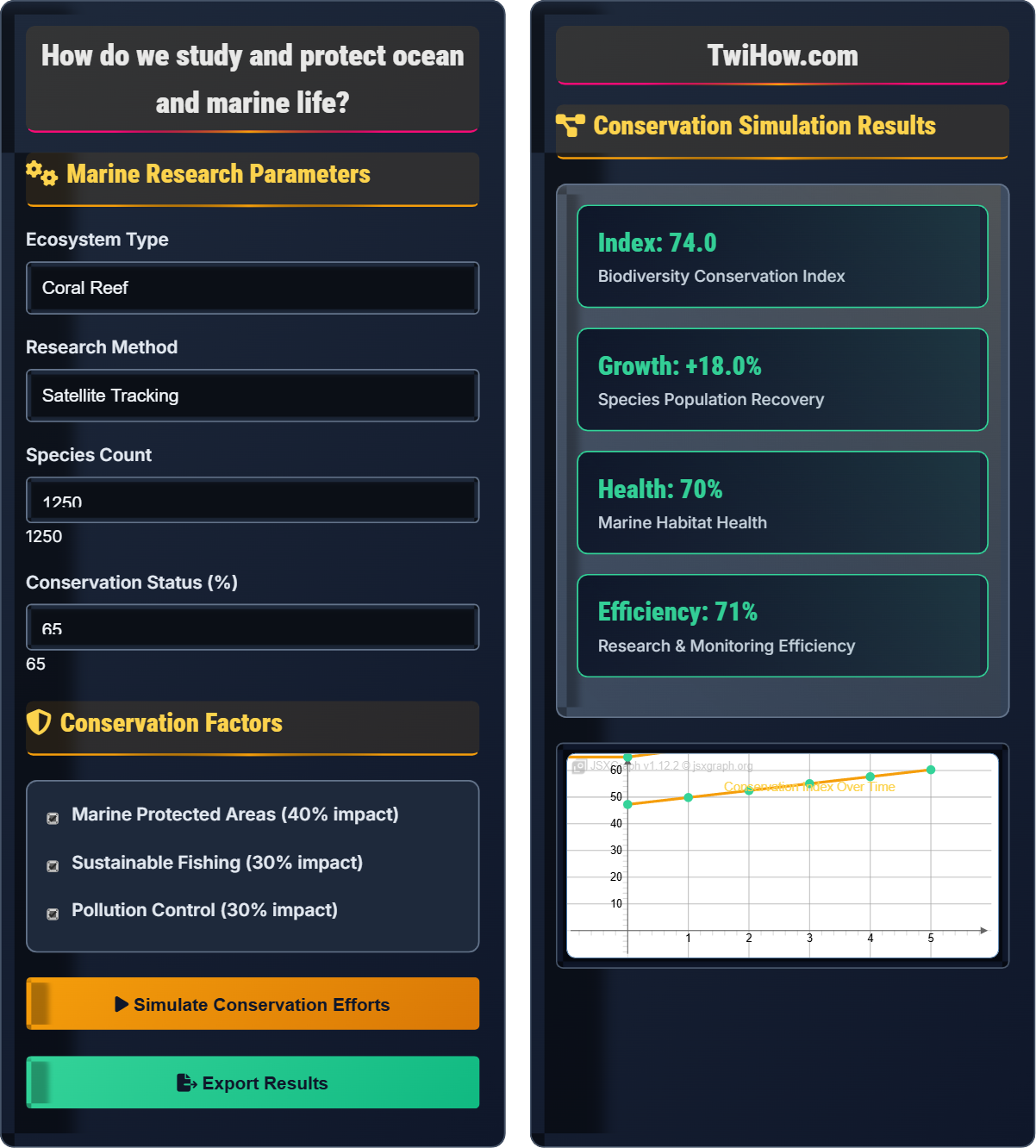
Conservation Simulation Results
| Method | Species Studied | Effectiveness | Cost ($/year) |
|---|---|---|---|
| Satellite Tracking | Large Mammals | 90% | $250K |
| ROV Surveys | Deep Sea Species | 85% | $500K |
| Net Sampling | Plankton | 75% | $100K |
| Acoustic Monitoring | Whales/Sharks | 80% | $200K |
| Genetic Analysis | All Species | 95% | $300K |
Marine Conservation Explained
Marine conservation is the protection and preservation of ocean ecosystems and marine life. It encompasses the study, management, and protection of marine environments including coral reefs, estuaries, deep-sea environments, and open ocean areas. Marine conservation addresses threats such as overfishing, pollution, climate change, and habitat destruction while promoting sustainable use of marine resources.
Marine population growth model:
Where:
- N: Population size
- r: Intrinsic growth rate
- K: Carrying capacity
- H(N): Harvesting pressure function
Key approaches to marine conservation:
- Marine Protected Areas: Designated zones with restrictions
- Sustainable Fisheries: Quotas and gear restrictions
- Pollution Control: Reducing runoff and waste
- Habitat Restoration: Coral reef and wetland rehabilitation
- International Cooperation: Treaties and agreements
- Community Engagement: Local participation and education
- Satellite Tagging: Track large marine animals
- ROVs/AUVs: Explore deep ocean environments
- Environmental DNA: Detect species presence in water
- Acoustic Monitoring: Listen to marine life sounds
- Genetic Analysis: Study population structure
- Remote Sensing: Monitor ocean conditions
Marine Research Fundamentals
Biodiversity, ecosystem services, carrying capacity, trophic levels, keystone species.
Shannon-Wiener Index: H' = -Σ(pi × ln(pi))
Where pi is the proportion of species i in the community.
- Marine ecosystems are interconnected
- Overfishing affects entire food webs
- Conservation requires international cooperation
Conservation Strategies
MPAs, quotas, gear restrictions, habitat restoration, pollution control.
- Scientific assessment
- Policy development
- Implementation
- Monitoring and evaluation
- Economic impacts on communities
- Enforcement challenges
- Climate change effects
- International waters complexities
Marine Conservation Learning Quiz
What is the primary purpose of Marine Protected Areas (MPAs)?
Marine Protected Areas (MPAs) are designated regions where human activities are regulated to protect marine ecosystems and biodiversity. They serve as refuges for marine life, help maintain fish populations, protect critical habitats, and preserve biodiversity. MPAs can have varying levels of restrictions, from fully protected zones to areas allowing sustainable use.
The answer is B) To preserve marine ecosystems and biodiversity.
MPAs function as "banks" for marine life, allowing populations to recover and spill over into adjacent areas. They are one of the most effective tools for marine conservation, providing protection for spawning grounds, nursery areas, and critical habitats. Well-managed MPAs benefit both conservation and sustainable fishing.
MPA: Marine Protected Area
No-Take Zone: Area where extraction is prohibited
Spillover Effect: Benefits extending beyond MPA boundaries
• MPAs protect critical habitats
• Different zones allow different activities
• Spillover benefits surrounding areas
• Think of MPAs as "insurance" for marine life
• They provide refuge for reproduction
• Benefits extend beyond boundaries
• Thinking MPAs ban all activities
• Not appreciating spillover effects
• Confusing with military zones
Explain the importance of coral reefs in marine ecosystems and describe the major threats they face. What conservation strategies are being implemented to protect coral reefs?
Importance: Coral reefs are biodiversity hotspots supporting ~25% of marine species despite covering less than 1% of ocean floor. They provide coastal protection, support fisheries, and contribute to tourism economies.
Threats: Ocean warming (bleaching), acidification, pollution, overfishing, coastal development, and diseases. Climate change is the greatest long-term threat.
Conservation Strategies: Marine protected areas, coral restoration projects, water quality improvements, sustainable tourism, and climate action. Assisted evolution techniques are being developed to create heat-tolerant corals.
Integrated approaches combining local and global actions are essential for coral reef conservation.
Coral reefs exemplify the interconnectedness of marine ecosystems. They face multiple stressors that compound each other, requiring comprehensive conservation approaches. Their sensitivity to climate change makes them important indicators of ocean health and highlights the urgency of climate action.
Bleaching: Coral expelling symbiotic algae due to stress
Acidification: Decreased pH due to CO₂ absorption
Assisted Evolution: Enhancing coral resilience
• Coral reefs are biodiversity hotspots
• Multiple threats compound effects
• Local and global actions needed
• Coral reefs = rainforests of sea
• Climate action is crucial
• Local protection helps
• Underestimating biodiversity importance
• Focusing only on local threats
• Not appreciating climate impacts
A fish population in a marine reserve has a carrying capacity of 10,000 individuals and a growth rate of 0.15 per year. Currently, the population is at 4,000 individuals. Using the logistic growth model, calculate the population growth rate at this current size. If fishing removes 500 fish per year, will the population increase or decrease?
Given:
K = 10,000 (carrying capacity)
r = 0.15 (growth rate)
N = 4,000 (current population)
Logistic Growth Model:
dN/dt = rN(1 - N/K)
Calculation:
dN/dt = 0.15 × 4000 × (1 - 4000/10000)
dN/dt = 0.15 × 4000 × (1 - 0.4)
dN/dt = 0.15 × 4000 × 0.6
dN/dt = 360 individuals per year
With fishing (removing 500/year):
Net change = 360 - 500 = -140
Therefore, the population will decrease by 140 individuals per year.
This problem demonstrates how fishing pressure can exceed natural growth rates, leading to population decline. The logistic model shows that growth rates depend on population size relative to carrying capacity. At low population sizes, growth rates are higher, but fishing can still cause net decline.
Carrying Capacity: Maximum sustainable population size
Logistic Growth: Density-dependent population growth
Sustainable Harvest: Harvest not exceeding natural growth
• Growth rate depends on population size
• Sustainable harvest ≤ natural growth
• Overfishing causes decline
• Think of carrying capacity as maximum
• Growth rate decreases as population increases
• Harvest must account for natural growth
• Forgetting to account for carrying capacity
• Not subtracting harvest from growth
• Confusing growth rate with absolute growth
A commercial fishing fleet accidentally catches 20,000 sea turtles per year as bycatch, which represents 40% of the total catch. The turtle population is declining at 8% annually due to this pressure. Propose conservation strategies to address bycatch and explain how these strategies work. What are the economic and ecological implications of implementing these measures?
Conservation Strategies:
1. Turtle Excluder Devices (TEDs) - Allow turtles to escape nets
2. Circle hooks - Reduce accidental hooking
3. Time-area closures - Protect during nesting seasons
4. Alternative gear - Use less harmful fishing methods
5. Observer programs - Monitor and report bycatch
Economic Implications: Initial costs for gear modifications, potential catch reductions, but long-term sustainability benefits.
Ecological Implications: Reduced pressure on turtle populations, healthier marine ecosystems, maintained food web balance.
Implementation requires cooperation between fishermen, conservationists, and regulators.
Bycatch represents a classic conflict between economic and conservation interests. Successful solutions require technological innovation, regulatory frameworks, and stakeholder cooperation. The turtle example shows how conservation measures can be implemented without completely disrupting fishing operations.
Bycatch: Unintended capture of non-target species
TEDs: Turtle Excluder Devices
Circle Hooks: Curved hooks reducing accidental capture
• Bycatch affects endangered species
• Solutions must consider economic factors
• Technology can reduce impacts
• Consider both economic and ecological impacts
• Technology can provide solutions
• Stakeholder cooperation is essential
• Not considering economic implications
• Thinking only in terms of bans
• Ignoring stakeholder perspectives
How does ocean acidification primarily affect marine organisms?
Ocean acidification occurs when the ocean absorbs excess CO₂ from the atmosphere, forming carbonic acid and lowering pH. This reduces the availability of carbonate ions, making it difficult for marine organisms like corals, mollusks, and some plankton to form calcium carbonate shells and skeletons. The process directly impacts calcifying organisms.
The answer is B) Makes it harder for organisms to form shells and skeletons.
Ocean acidification is often called "the other CO₂ problem" because it's a direct consequence of increased atmospheric CO₂. It affects the fundamental chemistry of seawater, making it difficult for many marine organisms to build their protective structures. This has cascading effects throughout marine food webs.
pH: Measure of acidity/alkalinity
Carbonate Ions: Essential for shell formation
Calcification: Process of forming calcium carbonate
• CO₂ absorption causes acidification
• Affects calcifying organisms most
• Has cascading ecosystem effects
• Think of it as "osteoporosis of the sea"
• CO₂ dissolves in ocean water
• Shells dissolve more easily
• Confusing with temperature changes
• Not understanding chemical process
• Underestimating ecosystem impacts
FAQ
Q: What's the difference between marine reserves and marine parks?
A: Marine Reserves: Generally fully protected areas where extraction is prohibited. Strictest form of marine protection.
Marine Parks: Allow some sustainable activities while protecting key areas. More flexible management approach.
Both are types of Marine Protected Areas (MPAs) but with different levels of restrictions. Reserves provide complete protection, while parks balance conservation with sustainable use.
Q: How do fishing quotas work and why are they important?
A: Fishing quotas limit the amount of fish that can be caught:
1. Based on Science: Population assessments and stock models
2. Annual Limits: Set to allow sustainable harvest
3. Allocation: Distributed among different sectors
4. Monitoring: Catch reporting and enforcement
Quotas prevent overfishing, allow populations to recover, and ensure long-term sustainability for fishing communities.