What Are the Latest Advances in Cancer Research and Treatment?
Complete oncology guide • Step-by-step explanations
Cancer Research Fundamentals:
Show Cancer Treatment SimulatorThe latest advances in cancer research and treatment focus on precision medicine, immunotherapy, targeted therapies, and innovative drug delivery systems. These approaches aim to maximize treatment effectiveness while minimizing side effects.
Key recent advances:
- Immunotherapy: CAR-T cell therapy, checkpoint inhibitors, cancer vaccines
- Targeted Therapy: Precision drugs targeting specific mutations
- Precision Medicine: Personalized treatment based on genetic profiles
- Drug Delivery: Nanoparticles, antibody-drug conjugates
These advances represent a paradigm shift from traditional chemotherapy toward more targeted, effective, and tolerable treatments. Researchers are also exploring combination therapies and liquid biopsies for early detection.
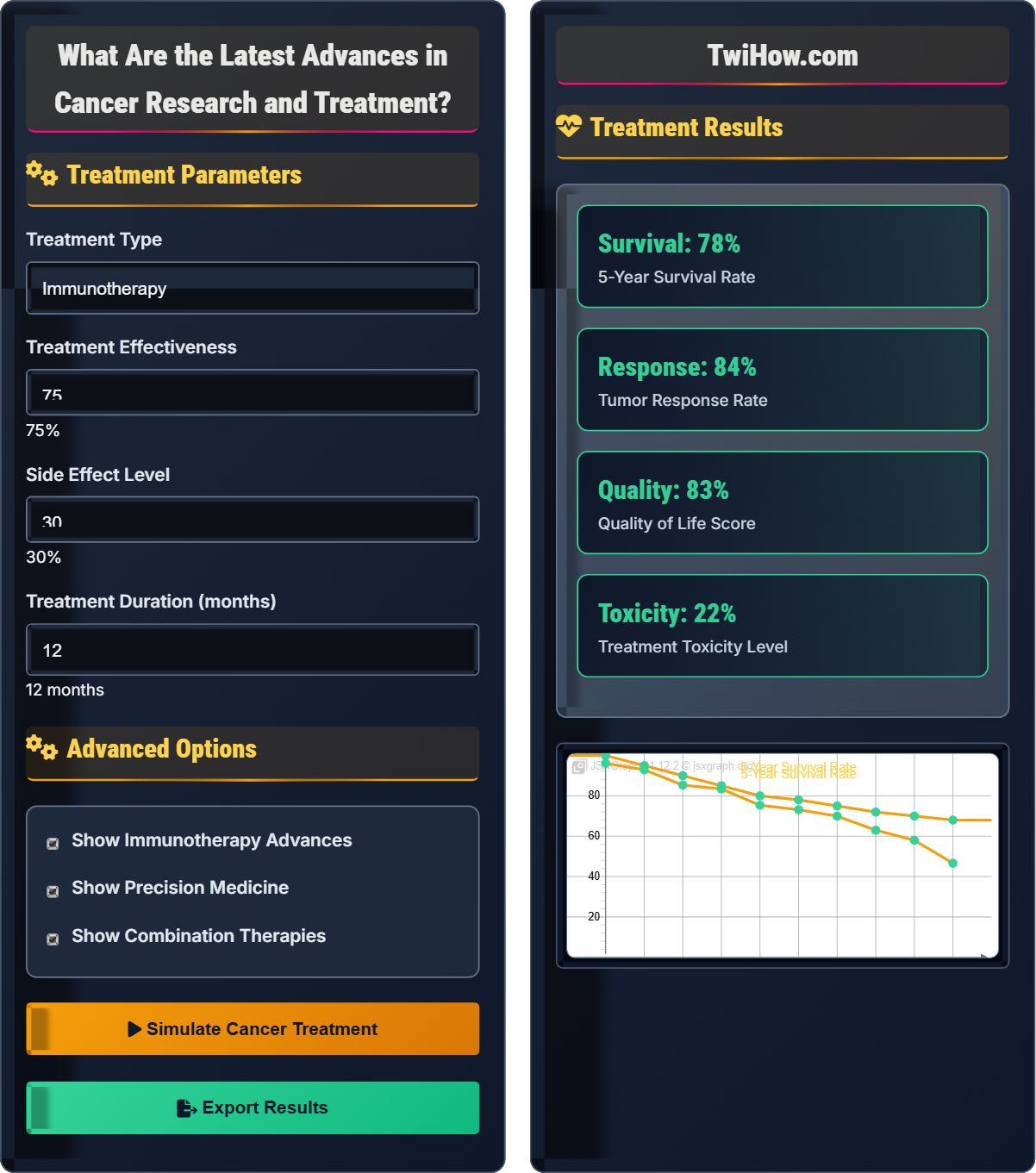
Treatment Parameters
Advanced Options
Treatment Results
| Month | Tumor Size | Side Effects | Quality of Life |
|---|---|---|---|
| 1 | 100% | 15% | 85% |
| 3 | 85% | 20% | 80% |
| 6 | 60% | 25% | 75% |
| 9 | 40% | 28% | 78% |
| 12 | 25% | 25% | 82% |
Immunotherapy: CAR-T cells and checkpoint inhibitors enhance immune response.
Precision Medicine: Genetic profiling guides targeted therapy selection.
Latest Advances in Cancer Research Explained
The field of oncology has experienced revolutionary changes in recent years, moving from one-size-fits-all treatments to personalized, targeted therapies. These advances have transformed cancer from a death sentence to a manageable chronic condition for many patients.
Current advances focus on several key areas:
Where:
- Immunotherapy: Harnessing the immune system to fight cancer
- Precision Medicine: Tailored treatment based on genetic profiles
- Targeted Therapy: Drugs targeting specific cancer mutations
- Innovative Delivery: Nanoparticles, conjugates for targeted drug delivery
Exciting developments in cancer research include:
- Liquid Biopsies: Detecting circulating tumor DNA for early detection and monitoring
- Artificial Intelligence: Analyzing medical images and predicting treatment responses
- Cancer Vaccines: Preventive and therapeutic vaccines for specific cancers
- Epigenetic Therapy: Targeting gene expression without changing DNA sequence
- Metabolic Therapy: Exploiting cancer cell metabolic vulnerabilities
- Radiotherapy Innovations: Proton beam therapy and stereotactic radiosurgery
- Universal Cancer Vaccine: Targeting common cancer antigens
- Personalized Neoantigen Vaccines: Custom vaccines based on individual tumor mutations
- Multi-Modal Approaches: Combining different therapies synergistically
- Early Detection: Advanced screening technologies for early intervention
- Resistance Prevention: Strategies to prevent treatment resistance
Cancer Research Fundamentals
Immunotherapy, targeted therapy, precision medicine, biomarkers, liquid biopsies.
Effectiveness = (Tumor Reduction Rate × Survival Benefit) / Side Effect Severity
Where Effectiveness = treatment benefit-to-risk ratio.
- Personalized treatment based on genetic profile
- Combination therapies often more effective than single agents
- Early detection significantly improves outcomes
Treatment Advances
Checkpoint inhibitors, CAR-T therapy, PARP inhibitors, ADCs, precision medicine.
- Genetic profiling of tumor
- Identification of actionable mutations
- Matching to targeted therapy
- Monitoring and adjustment
- Cost and accessibility of advanced treatments
- Insurance coverage challenges
- Need for ongoing research and development
Cancer Research Learning Quiz
What is the primary mechanism of action for checkpoint inhibitors like pembrolizumab (Keytruda)?
Checkpoint inhibitors work by blocking proteins that normally prevent immune cells from attacking cancer. These proteins (like PD-1 and CTLA-4) act as "brakes" on the immune system. By blocking these checkpoints, the immune system can recognize and attack cancer cells more effectively.
Checkpoint inhibitors do not directly kill cancer cells, replace immune cells, or enhance chemotherapy. Instead, they release the brakes on the immune system, allowing it to fight cancer more effectively.
The answer is B) Blocking proteins that prevent immune activation.
Students should understand that immunotherapy works differently from traditional cancer treatments. Rather than directly targeting cancer cells, checkpoint inhibitors work by enhancing the body's own immune response. This represents a paradigm shift in cancer treatment, focusing on the patient's immune system as the primary weapon against cancer.
Checkpoint Inhibitor: Drug that blocks proteins preventing immune activation
PD-1: Protein that inhibits T-cell activation
CTLA-4: Another checkpoint protein that regulates immune response
• Checkpoint inhibitors enhance immune response
• They work by removing immune system brakes
• Not all patients respond to checkpoint inhibitors
• Think of checkpoint inhibitors as "releasing the brakes"
• They don't directly kill cancer cells
• Response rates vary by cancer type
• Confusing immunotherapy with traditional treatments
• Thinking they directly kill cancer cells
• Not understanding the immune system role
Explain the process of CAR-T cell therapy and its applications in cancer treatment. Include the steps involved and the types of cancers it treats.
CAR-T Cell Therapy Process:
1. Collection: T cells are extracted from the patient's blood through apheresis.
2. Engineering: T cells are genetically modified in the laboratory to express chimeric antigen receptors (CARs) that can recognize specific cancer antigens.
3. Expansion: Modified T cells are multiplied in large numbers in the lab.
4. Infusion: The engineered CAR-T cells are infused back into the patient.
5. Activation: CAR-T cells recognize and attack cancer cells expressing the target antigen.
Applications: Currently approved for certain blood cancers including:
• B-cell acute lymphoblastic leukemia (ALL)
• Diffuse large B-cell lymphoma (DLBCL)
• Mantle cell lymphoma
• Multiple myeloma
CAR-T therapy has shown remarkable success in treating these cancers, with some patients achieving complete remission when other treatments failed.
CAR-T cell therapy represents a revolutionary approach to cancer treatment, essentially turning the patient's own immune cells into cancer-killing machines. Students should understand that this is truly personalized medicine, as the therapy is custom-made for each patient using their own cells.
CAR-T Cells: Genetically modified T cells with chimeric antigen receptors
Apheresis: Process of removing specific blood components
Chimeric Antigen Receptor: Synthetic receptor that recognizes cancer antigens
• CAR-T therapy uses patient's own cells
• Currently limited to certain blood cancers
• Remember: CAR-T = Chimeric Antigen Receptor T cells
• It's personalized cellular therapy
• Has shown remarkable success in blood cancers
• Thinking it's traditional chemotherapy
• Not understanding the personalization aspect
• Confusing with other immunotherapies
A 45-year-old woman with metastatic breast cancer undergoes genomic testing which reveals a BRCA1 mutation and HER2 amplification. Describe the precision medicine approach that would be taken for her treatment and explain how this differs from traditional chemotherapy.
Precision Medicine Approach:
BRCA1 Mutation Treatment: PARP inhibitors (like olaparib) would be used, which specifically target cancer cells with defective DNA repair mechanisms caused by BRCA mutations. These drugs exploit synthetic lethality - cancer cells with BRCA deficiency cannot repair DNA damage when PARP is blocked.
HER2 Amplification Treatment: HER2-targeted therapy (like trastuzumab) would be used to specifically bind to and inhibit the overexpressed HER2 protein, blocking growth signals.
Traditional Chemotherapy: Would use cytotoxic drugs that kill rapidly dividing cells regardless of their genetic makeup, affecting both cancer and normal cells.
Key Differences:
• Precision medicine targets specific genetic abnormalities
• Traditional chemotherapy targets all rapidly dividing cells
• Precision medicine has fewer side effects due to specificity
• Traditional chemotherapy has broader toxicity profile
This approach maximizes efficacy while minimizing harm to healthy cells.
This example illustrates how genomic testing can completely change treatment strategy. Students should understand that precision medicine relies on understanding the molecular basis of each patient's cancer. The BRCA1 mutation example shows synthetic lethality, a key concept in targeted therapy development.
Precision Medicine: Treatment tailored to individual genetic profile
Synthetic Lethality: Killing cells with specific genetic defects
PARP Inhibitor: Drug targeting DNA repair mechanisms
• Genomic testing guides treatment selection
• Targeted therapy is more specific than chemotherapy
• Precision medicine aims to minimize side effects
• Think "right drug for right patient"
• Targeted therapy = specific molecular target
• Precision medicine requires genetic testing
• Not understanding the importance of genetic testing
• Confusing targeted therapy with traditional approaches
• Not appreciating the specificity of precision medicine
Explain how liquid biopsies using circulating tumor DNA (ctDNA) can revolutionize cancer care. Include the advantages over traditional tissue biopsies, potential applications, and current limitations.
How Liquid Biopsies Work: Blood samples are analyzed for ctDNA shed by tumor cells, providing genetic information about the cancer without invasive procedures.
Advantages Over Tissue Biopsies:
• Non-invasive and repeatable
• Can detect minimal residual disease
• Provides real-time monitoring of treatment response
• Can identify resistance mutations early
• May access tumor heterogeneity better than single tissue sample
Applications:
• Early cancer detection
• Monitoring treatment response
• Detecting recurrence
• Identifying actionable mutations
• Monitoring minimal residual disease
Limitations:
• Sensitivity decreases with smaller tumors
• May miss mutations not shed into circulation
• Cost and complexity of analysis
• Not yet validated for all cancer types
• False negatives possible in early-stage disease
Liquid biopsies represent a major advancement in cancer monitoring. Students should understand that this technology could potentially replace many invasive tissue biopsies. The concept of monitoring cancer through blood draws is revolutionary and could make cancer care much more patient-friendly.
Liquid Biopsy: Analysis of blood for cancer biomarkers
Circulating Tumor DNA: DNA fragments from cancer cells in blood
Minimal Residual Disease: Small amounts of remaining cancer after treatment
• Less invasive than tissue biopsies
• Can be done repeatedly
• Still developing technology
• Think "blood test instead of surgery"
• Real-time monitoring capability
• Early detection potential
• Thinking it replaces all tissue biopsies
• Not understanding sensitivity limitations
• Overestimating current capabilities
Which of the following best describes the mechanism of action for antibody-drug conjugates (ADCs) like trastuzumab emtansine (T-DM1)?
Antibody-drug conjugates combine the specificity of monoclonal antibodies with the potency of cytotoxic drugs. The antibody portion specifically recognizes and binds to antigens overexpressed on cancer cells, delivering the attached toxic drug directly to those cells.
The mechanism involves: 1) Antibody binding to cancer-specific antigen, 2) Internalization of the ADC-antigen complex, 3) Release of toxic drug inside the cancer cell, 4) Cell death through the drug's mechanism.
This approach minimizes damage to healthy cells while maximizing drug delivery to cancer cells.
The answer is B) They deliver toxic drugs specifically to cancer cells.
ADCs represent a sophisticated approach to targeted therapy, combining the precision of antibodies with the power of chemotherapy. Students should understand that this is like having a guided missile system for cancer treatment - the antibody acts as the guidance system while the drug is the payload.
Antibody-Drug Conjugate: Targeted therapy combining antibody and cytotoxic drug
Monoclonal Antibody: Laboratory-made antibody targeting specific antigen
Antibody-Dependent Cellular Cytotoxicity: Immune cell-mediated cancer cell killing
• ADCs target specific cancer antigens
• Combine antibody specificity with drug potency
• Reduce systemic toxicity compared to free drugs
• Think of ADCs as "guided missiles" for cancer
• Antibody = guidance system, drug = payload
• Targeted delivery reduces side effects
• Confusing with traditional chemotherapy
• Not understanding the targeting mechanism
• Thinking they work like immunotherapy
FAQ
Q: What's the difference between targeted therapy and immunotherapy?
A: While both represent advances over traditional chemotherapy, they work differently:
Targeted Therapy: Uses drugs that specifically target molecules involved in cancer growth and survival. These drugs attack specific genetic mutations or proteins that cancer cells depend on. Examples include EGFR inhibitors for lung cancer and BRAF inhibitors for melanoma.
Immunotherapy: Works by helping your immune system recognize and destroy cancer cells. Instead of directly attacking cancer, it removes the brakes on your immune system or enhances its ability to fight cancer. Examples include checkpoint inhibitors and CAR-T cell therapy.
Both can be highly effective, and they're sometimes used together for even better results.
Q: How close are we to finding a universal cancer vaccine?
A: While we're not there yet, significant progress is being made:
Current Status: Several universal cancer vaccine approaches are in clinical trials. These target shared tumor antigens that appear across multiple cancer types, such as neoantigens that arise from common mutations.
Challenges: Cancer's ability to mutate and evade the immune system, tumor heterogeneity, and the need to balance efficacy with safety.
Promising Approaches: Personalized neoantigen vaccines based on individual tumor mutations, and vaccines targeting common cancer pathways like p53.
Timeline: Most experts estimate 10-15 years before widely available universal cancer vaccines, though personalized neoantigen vaccines may be available sooner for certain cancer types.