What are the latest discoveries in neuroscience?
Complete biology guide • Step-by-step explanations
Latest Neuroscience Discoveries:
Show Brain SimulationNeuroscience continues to revolutionize our understanding of the brain with groundbreaking discoveries. Recent advances include mapping the human connectome, understanding neuroplasticity mechanisms, identifying new cell types, and developing revolutionary neurotechnologies. These discoveries are transforming our comprehension of consciousness, memory, and brain disorders.
Key breakthroughs include optogenetics for precise neural control, brain-computer interfaces for paralyzed patients, and advanced imaging techniques revealing unprecedented detail of brain structure and function. The field is also advancing our understanding of consciousness, memory consolidation, and neurodevelopment.
Recent discoveries:
- Connectomics: Detailed mapping of neural connections
- Optogenetics: Light-controlled neural activation
- Brain Organoids: Lab-grown brain tissue models
- Consciousness Studies: Integrated Information Theory
These advances are leading to new treatments for neurological disorders and enhancing our understanding of what makes us human. The convergence of neuroscience with AI and nanotechnology promises even more revolutionary developments.
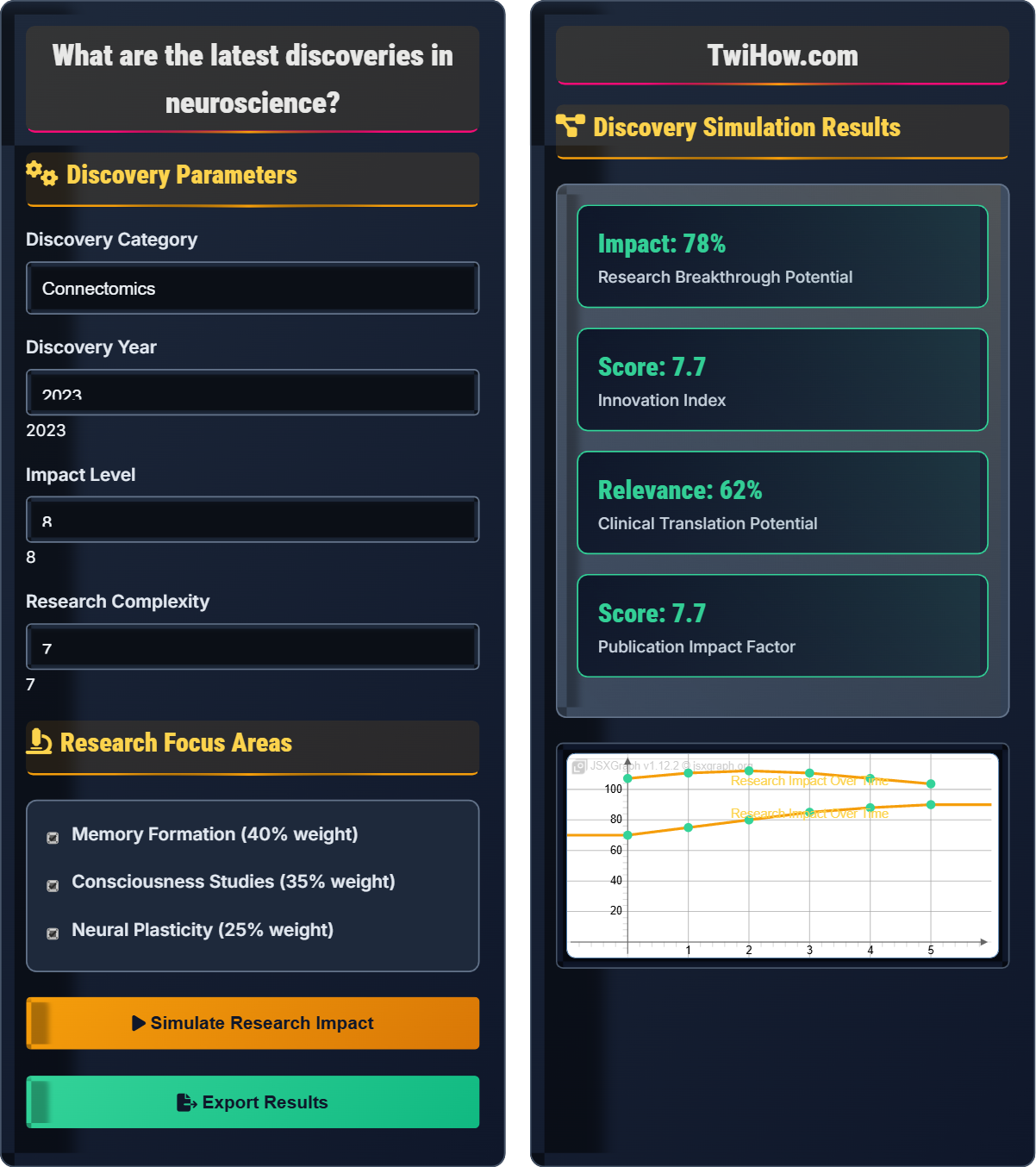
Discovery Parameters
Research Focus Areas
Discovery Simulation Results
| Year | Discovery | Impact | Applications |
|---|---|---|---|
| 2020 | Single-cell RNA sequencing | High | Cell type identification |
| 2021 | CLARITY technique | Very High | Brain transparency |
| 2022 | Miniaturized BCIs | High | Paralysis therapy |
| 2023 | Organoid intelligence | Very High | Drug testing |
| 2024 | Quantum brain sensing | High | Diagnosis |
Neuroscience Discoveries Explained
Neuroscience is the scientific study of the nervous system and how it functions. It encompasses multiple subfields including molecular neuroscience, cellular neuroscience, systems neuroscience, cognitive neuroscience, and computational neuroscience. Modern neuroscience integrates findings from genetics, biochemistry, physiology, and psychology to understand brain function at multiple levels.
The brain operates as a complex network:
Where:
- w_ij: Synaptic strength between neurons i and j
- f(x_i, x_j, t): Dynamic interaction function
- t: Time-dependent plasticity
- ∑: Sum of all neural connections
Key areas of recent neuroscience breakthroughs:
- Brain Mapping: Human Connectome Project, cell atlas
- Neuroplasticity: Adult neurogenesis, synaptic plasticity
- Consciousness: Global workspace theory, IIT
- Neurotechnology: Brain-computer interfaces, optogenetics
- Memory: Engram cells, reconsolidation
- Neurodevelopment: Critical periods, epigenetics
- Optogenetics: Light-controlled neural activation
- CLARITY: Tissue clearing for imaging
- Two-photon microscopy: Deep brain imaging
- Brain Organoids: Lab-grown neural tissue
- BCI: Direct brain-computer communication
- AI Models: Neural network simulations
Neuroscience Fundamentals
Neuron, synapse, action potential, neurotransmitter, plasticity, connectome.
Vₘ = (gₙₐEₙₐ + gₖEₖ + gₗEₗ)/(gₙₐ + gₖ + gₗ)
Where Vₘ = membrane potential, g = conductance, E = equilibrium potential.
- Neurons communicate via electrochemical signals
- Plasticity enables learning and memory
- Brain networks exhibit emergent properties
Latest Discoveries
Connectomics, optogenetics, brain organoids, consciousness studies.
- Single-cell sequencing
- Advanced imaging
- Computational modeling
- Brain stimulation
- Ethical implications of brain research
- Translation to clinical applications
- Integration of multi-scale data
- Reproducibility challenges
Neuroscience Learning Quiz
What is the primary goal of the Human Connectome Project?
The Human Connectome Project aims to map the neural connections within the human brain, creating a comprehensive wiring diagram of brain connectivity. This involves using advanced neuroimaging techniques like diffusion tensor imaging and functional MRI to trace pathways and understand how different brain regions communicate with each other.
The answer is B) Mapping neural connections.
Connectomics represents a paradigm shift in neuroscience from studying individual neurons to understanding the brain as a complex network. Just as genomics mapped DNA sequences, connectomics maps neural connections. This approach is revealing how brain disorders may arise from disrupted connectivity rather than localized damage.
Connectome: Complete map of neural connections
Diffusion Tensor Imaging: Technique for mapping white matter tracts
Functional Connectivity: Correlated activity between brain regions
• The brain contains ~100 billion neurons
• Each neuron connects to ~10,000 others
• Total connections exceed 100 trillion
• Think of the brain as a complex network
• Connectome = neural genome project
• Connectivity underlies function
• Confusing connectome with genome
• Underestimating network complexity
• Not appreciating scale of mapping effort
Explain the principle of optogenetics and describe its applications in neuroscience research. What are the advantages and limitations of this technique?
Principle: Optogenetics involves genetically engineering neurons to express light-sensitive ion channels (opsins) from algae/microbes. When specific wavelengths of light are applied, these opsins open/closed, allowing precise temporal control of neural activity.
Applications: Circuit mapping, behavior control, disease modeling, therapeutic development. Researchers can activate or silence specific neurons to determine their role in behavior or disease.
Advantages: Millisecond precision, cell-type specificity, reversibility. Disadvantages: Requires genetic modification, limited penetration depth, potential toxicity from opsins.
This technique has revolutionized neuroscience by enabling causal relationships between neural activity and behavior.
Optogenetics represents the marriage of genetics and optics to study the brain. Before optogenetics, researchers could only correlate neural activity with behavior. Now they can prove causation by turning neurons on/off and observing behavioral changes. This technique earned Karl Deisseroth the Breakthrough Prize in Life Sciences.
Opsin: Light-sensitive protein channel
Channelrhodopsin: Light-activated cation channel
Halorhodopsin: Light-activated chloride pump
• Specific wavelength activates specific opsin
• Temporal precision is millisecond-level
• Requires genetic access to target cells
• Think of neurons as light-switches
• Different colors control different functions
• Causal relationships established
• Not understanding genetic requirement
• Underestimating precision level
• Ignoring ethical considerations
The human brain consumes approximately 20% of the body's total energy despite representing only 2% of body mass. If a person weighing 70kg has a daily caloric intake of 2500 calories, calculate how many calories are consumed by the brain per day. Also, calculate the brain's energy consumption in watts, knowing that 1 calorie = 4.184 joules and 1 watt = 1 joule per second.
Calories consumed by brain:
Brain calories = Total calories × 0.20 = 2500 × 0.20 = 500 calories/day
Convert to joules:
500 calories × 4.184 J/calorie = 2,092 J/day
Convert to watts:
Seconds in a day = 24 × 60 × 60 = 86,400 seconds
Power = Energy/Time = 2,092 J ÷ 86,400 s = 0.0242 W ≈ 24 mW
The brain consumes 500 calories per day, equivalent to approximately 24 milliwatts of power.
This calculation reveals the brain's incredible energy efficiency. Despite consuming 20% of the body's energy, the brain operates on roughly the same power as a dim LED light bulb. This demonstrates how evolution has optimized neural computation for maximum efficiency. The brain's high metabolic demand reflects the constant activity of neurons maintaining resting potentials and generating action potentials.
Metabolic Rate: Energy consumption per unit time
Basal Metabolic Rate: Minimum energy for vital functions
Energy Efficiency: Work output per energy input
• Brain is metabolically expensive
• Neurons constantly maintain ion gradients
• Energy consumption reflects activity levels
• Remember conversion factors
• Pay attention to units
• Consider efficiency in biological systems
• Incorrect unit conversions
• Forgetting time conversions
• Not appreciating metabolic costs
A research team is investigating the neural correlates of consciousness using EEG and fMRI. They observe that conscious perception of a stimulus requires synchronized gamma oscillations (>30 Hz) across multiple brain regions. Explain the integrated information theory (IIT) of consciousness and how it relates to the observed neural synchronization. How might this understanding lead to new diagnostic tools for disorders of consciousness?
Integrated Information Theory (IIT): Proposed by Giulio Tononi, IIT suggests consciousness corresponds to integrated information (Φ) generated by a system. Φ measures how much information is generated by a system above and beyond its parts.
Relation to Synchronization: Neural synchronization facilitates integration of information across distributed brain networks. The gamma oscillations observed represent coordinated activity that binds different aspects of perception into unified conscious experience.
Diagnostic Applications: IIT-inspired measures could quantify consciousness levels in comatose patients, vegetative states, or anesthesia. By measuring integrated information in neural networks, clinicians could assess awareness even when behavioral responses are absent.
This approach could revolutionize consciousness assessment in clinical settings.
IIT attempts to formalize consciousness mathematically, suggesting it emerges from integrated information processing. The theory predicts that consciousness requires both information generation and integration across brain regions. Neural synchronization enables this integration by coordinating activity across distant brain areas, binding separate features into coherent percepts.
Consciousness: Subjective experience and awareness
Integrated Information (Φ): Measure of consciousness in IIT
Neural Correlates: Neural activity associated with consciousness
• Consciousness requires integration of information
• Synchronization enables integration
• Consciousness exists on a spectrum
• Think of consciousness as integrated information
• Consider network properties
• Remember consciousness is measurable
• Treating consciousness as binary
• Not appreciating network properties
• Ignoring measurement challenges
Which of the following discoveries has most significantly changed our understanding of adult brain plasticity?
The discovery of adult neurogenesis - the formation of new neurons in the adult brain - fundamentally challenged the century-old dogma that the adult brain could not generate new cells. This discovery demonstrated that the adult brain retains significant plasticity throughout life, opening new therapeutic avenues for brain injury and neurodegenerative diseases.
The answer is B) Identification of adult neurogenesis.
Before the discovery of adult neurogenesis, scientists believed the adult brain was fixed and could not generate new neurons. This discovery revolutionized our understanding of brain plasticity and opened new possibilities for treating brain disorders. It showed that the brain maintains regenerative capacity, offering hope for recovery from injury or disease.
Neuroplasticity: Brain's ability to reorganize and adapt
Adult Neurogenesis: Generation of new neurons in adulthood
Synaptic Plasticity: Changes in connection strengths
• Brain plasticity continues throughout life
• Experience drives plasticity
• Brain is never truly fixed
• Plasticity enables learning and recovery
• Lifestyle affects neuroplasticity
• Believing brain plasticity ends in childhood
• Not appreciating regenerative capacity
• Underestimating therapeutic potential
FAQ
Q: How close are we to truly understanding consciousness?
A: We're making significant progress but still far from complete understanding:
1. Neural Correlates: We've identified brain regions and patterns associated with consciousness
2. Theoretical Frameworks: IIT, Global Workspace Theory provide mathematical approaches
3. Measurement Tools: New techniques can assess consciousness in non-responsive patients
However, the "hard problem" - explaining subjective experience itself - remains unsolved. Most experts think we'll have good working theories within 10-20 years, but the fundamental mystery may persist.
Q: What are brain-computer interfaces and how do they work?
A: Brain-computer interfaces (BCIs) record neural signals from the brain and translate them into commands for external devices:
1. Recording: Electrodes detect electrical activity from neurons
2. Decoding: Computer algorithms interpret intended movements
3. Translation: Neural signals converted to device commands
4. Feedback: Results sent back to user
Current applications include controlling prosthetic limbs, computer cursors, and communication devices for paralyzed patients. Companies like Neuralink are developing more sophisticated interfaces.