What are the latest findings in human evolution and ancestry?
Complete biology guide • Step-by-step explanations
Human Evolution Discoveries:
Show Evolution SimulatorHuman evolution is the evolutionary process that led to the emergence of anatomically modern humans. Recent discoveries have revolutionized our understanding of human ancestry, revealing complex migration patterns, interbreeding with archaic humans, and the existence of previously unknown species. Advanced genetic techniques now allow scientists to reconstruct human history with unprecedented detail.
Key findings include the discovery of new hominin species, evidence of gene flow between modern humans and Neanderthals/Denisovans, and the reconstruction of ancient migration routes. The Out-of-Africa model has been refined with evidence of multiple dispersals and admixture events.
Recent discoveries:
- Fossil Finds: Homo naledi, Homo luzonensis, Homo floresiensis
- Genetic Studies: Neanderthal/Denisovan admixture
- Migration Patterns: Multiple out-of-Africa events
- Archaeological Evidence: Advanced tool use in early humans
These findings continue to reshape our understanding of human origins and the complex journey that led to modern humanity.
Evolution Parameters
Migration Factors
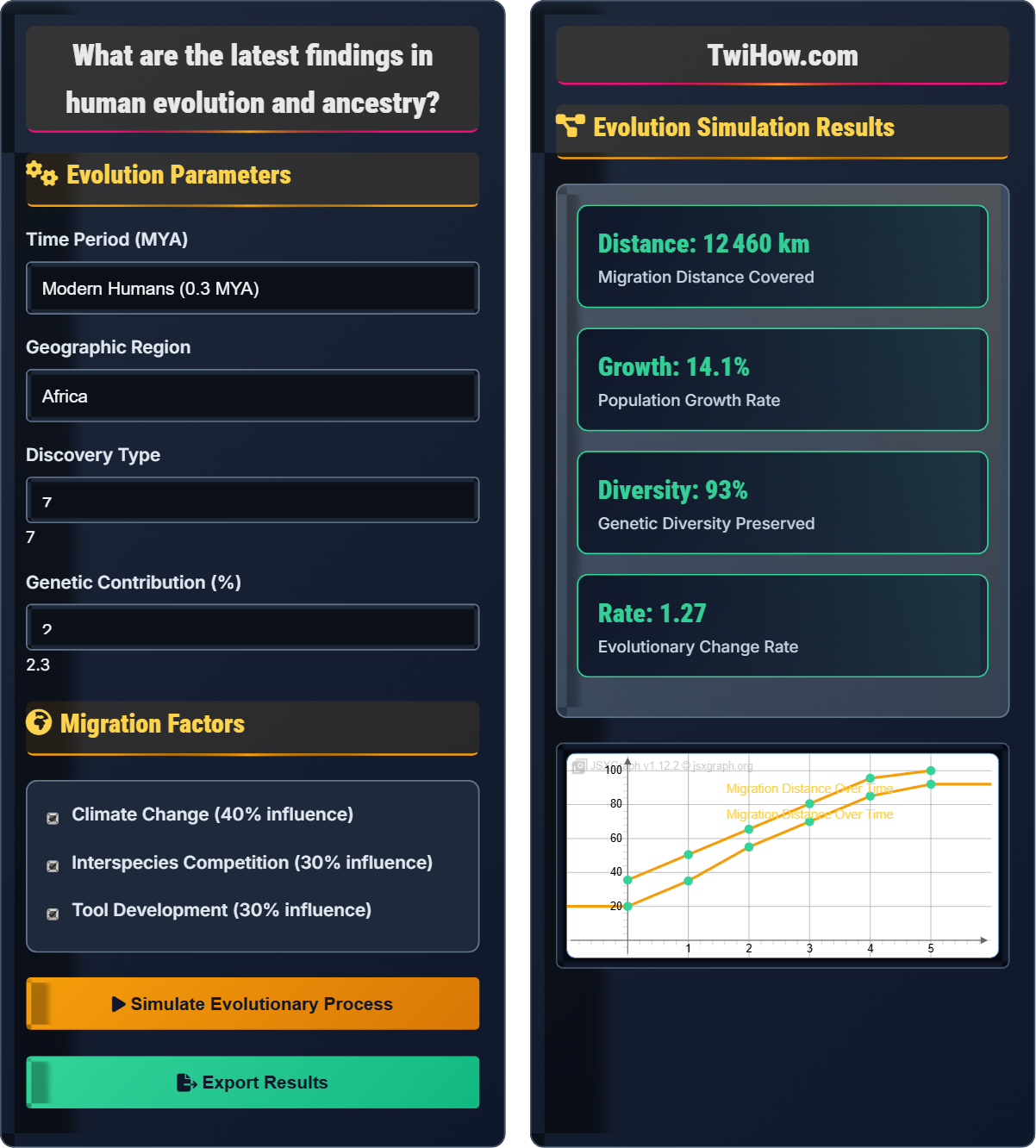
Evolution Simulation Results
| MYA | Species | Location | Key Features |
|---|---|---|---|
| 7.0 | Sahelanthropus tchadensis | Chad | Earliest bipedal |
| 4.4 | Ardipithecus ramidus | Ethiopia | Forest dweller |
| 3.2 | Australopithecus afarensis | Ethiopia | "Lucy", upright walk |
| 2.0 | Homo habilis | Tanzania | First stone tools |
| 1.8 | Homo erectus | Asia/Africa | First migration |
Human Evolution Explained
Human evolution is the evolutionary process in the lineage of Homo sapiens, the species to which modern humans belong. It encompasses the evolutionary history of primates, the emergence of the genus Homo, and the development of anatomically modern humans. The process is studied through fossil records, genetic analysis, and archaeological evidence, revealing a complex story of adaptation, migration, and speciation.
Evolutionary divergence calculation:
Where genetic distance is the number of nucleotide differences per site, and mutation rate is the rate of mutations per site per million years.
Major findings in human evolution research:
- Fossil Finds: Lucy, Turkana Boy, Hobbit (H. floresiensis)
- Genetic Studies: Neanderthal genome, Denisovan DNA
- Migration Patterns: Out-of-Africa, coastal routes
- Archaeological Evidence: Stone tools, art, burial practices
- New Species: H. naledi, H. luzonensis, H. luzonensis
- Interbreeding: Modern humans with archaic humans
- Natural Selection: Favoring beneficial traits
- Genetic Drift: Random changes in gene frequencies
- Gene Flow: Transfer of genes between populations
- Mutation: Source of genetic variation
- Founder Effect: Small populations with limited diversity
- Bottleneck Effect: Population size reduction
Evolution Fundamentals
Hominid, hominin, phylogeny, cladistics, molecular clock, speciation.
Genetic distance = Number of differences / Total sequence length
Used to construct evolutionary trees and estimate divergence times.
- Humans share common ancestors with apes
- Evolution is gradual and continuous
- Migration and adaptation drove diversification
Recent Discoveries
Denisovan DNA, H. naledi, interbreeding, migration patterns.
- Fossil excavation
- Genetic analysis
- Archaeological studies
- Climate modeling
- Fossil record is incomplete
- Genetic evidence supplements fossils
- Migration patterns are complex
- Interbreeding was common
Human Evolution Learning Quiz
According to the current Out-of-Africa model, when did the first major migration of modern humans leave Africa?
The Out-of-Africa model indicates that anatomically modern humans first migrated out of Africa approximately 70,000-100,000 years ago, spreading to Asia, Europe, and eventually the Americas and Australia. This migration coincided with the development of more sophisticated tools and symbolic behavior.
The answer is B) 70,000-100,000 years ago.
The Out-of-Africa model represents our current understanding of human dispersal, refined by genetic evidence showing that all non-African populations share common ancestors who left Africa relatively recently. Earlier migrations by archaic humans (like Homo erectus) occurred much earlier, but the modern human expansion happened later.
Out-of-Africa: Model of human migration from Africa
Anatomically Modern: Humans with modern skeletal features
MYA: Million years ago
• Modern humans originated in Africa
• Multiple migrations occurred
• Genetic evidence supports model
• Remember 70,000-100,000 years ago
• Think of it as "recent" in evolutionary terms
• Consider genetic diversity patterns
• Confusing with earlier migrations
• Not appreciating the timeline
• Forgetting genetic evidence
Explain the evidence for interbreeding between modern humans and Neanderthals. What percentage of Neanderthal DNA is found in modern humans, and what are the implications of this discovery?
Evidence: The complete Neanderthal genome was sequenced from ancient DNA extracted from fossil bones. Comparisons with modern human genomes revealed shared genetic segments that could only result from interbreeding.
Percentage: Non-African modern humans carry 1-4% Neanderthal DNA, with East Asians having slightly higher percentages than Europeans.
Implications: This discovery overturned the idea of strict reproductive isolation between species. Some Neanderthal genes provided adaptive advantages (immune response, altitude adaptation), while others may have contributed to disease susceptibility. It shows that species boundaries were more fluid than previously thought.
This finding revolutionized our understanding of human evolution and the complexity of our ancestral heritage.
The discovery of Neanderthal admixture in modern humans exemplifies how ancient DNA analysis has transformed evolutionary biology. It demonstrates that the traditional view of evolution as a simple branching tree is too simplistic - reticulate evolution (with gene flow) also plays a role in shaping species.
Admixture: Mixing of genetic lineages
Adaptive Advantage: Trait providing survival benefit
Reticulate Evolution: Evolution with gene flow between lineages
• Interbreeding occurred outside Africa
• Percentages vary by population
• Some genes were beneficial
• Remember 1-4% in non-Africans
• East Asians have slightly more
• Ancient DNA is powerful tool
• Thinking no interbreeding occurred
• Confusing percentages
• Not appreciating implications
Scientists have determined that the human-chimpanzee lineage diverged approximately 6 million years ago. If the average rate of molecular evolution (substitutions per site per million years) is 2.5 × 10⁻⁹, calculate the expected genetic distance (number of differences per site) between human and chimpanzee DNA sequences.
Given:
Divergence time = 6 million years
Mutation rate = 2.5 × 10⁻⁹ substitutions per site per million years
Formula:
Genetic distance = 2 × Mutation rate × Divergence time
(Multiplied by 2 because both lineages have been accumulating mutations)
Calculation:
Genetic distance = 2 × (2.5 × 10⁻⁹) × 6
Genetic distance = 30 × 10⁻⁹ = 3 × 10⁻⁸
This means about 3 differences per 100 million sites, or approximately 1% overall genetic difference.
The molecular clock is a fundamental tool in evolutionary biology that uses the rate of genetic change to estimate divergence times. This calculation demonstrates how small mutation rates over long periods can result in significant genetic differences. The molecular clock assumes a relatively constant rate of evolution, though this can vary between genes and lineages.
Molecular Clock: Method to estimate divergence times
Substitution Rate: Rate of genetic changes
Genetic Distance: Measure of sequence differences
• Multiply by 2 for both lineages
• Clock assumes constant rate
• Rates can vary between genes
• Remember to account for both lineages
• Check units are consistent
• Consider rate variations
• Forgetting to multiply by 2
• Unit conversion errors
• Not considering rate variations
Scientists discovered Denisovan DNA in a finger bone found in Siberia and later found that modern Melanesians carry 4-6% Denisovan DNA. Explain how this discovery was made, what it reveals about human migration patterns, and what it tells us about the complexity of human evolution.
Discovery: Scientists extracted DNA from a Denisovan finger bone found in Denisova Cave, Siberia, and sequenced its genome. This revealed a previously unknown human lineage distinct from both modern humans and Neanderthals.
Migration Patterns: The presence of Denisovan DNA in Melanesians (but not in most other populations) suggests that modern humans migrating through Southeast Asia interbred with Denisovans, who had a wide distribution across Asia.
Complexity: This finding shows that human evolution involved multiple lineages with complex interactions, including gene flow between different human populations. It demonstrates that the simple linear model of evolution is inadequate to explain human origins.
The discovery highlights the importance of ancient DNA in revealing hidden aspects of human evolutionary history.
The Denisovan discovery exemplifies how ancient DNA can reveal previously unknown human lineages and their interactions with modern humans. It shows that human evolution was not a simple progression but involved multiple populations with complex relationships. This finding has forced scientists to reconsider models of human evolution.
Denisovans: Previously unknown human lineage
Ancient DNA: DNA from archaeological specimens
Gene Flow: Transfer of genetic material
• Multiple human lineages existed
• Fossil record is incomplete
• Think of evolution as a web
• Ancient DNA reveals hidden history
• Multiple lineages interacted
• Thinking evolution is linear
• Not appreciating complexity
• Forgetting gene flow importance
What is significant about the discovery of Homo naledi in South Africa?
The discovery of Homo naledi in the Rising Star Cave in South Africa is significant because the fossils were found in a remote chamber accessible only through a narrow chute. The lack of other animal remains and the deliberate placement of bodies suggests that H. naledi may have practiced intentional disposal of their dead, a behavior previously thought to be unique to modern humans and Neanderthals.
The answer is B) It showed evidence of deliberate disposal of dead individuals.
The Homo naledi discovery challenges assumptions about the cognitive abilities of early humans. The deliberate disposal of dead individuals suggests complex social behaviors and possibly symbolic thinking. This finding blurs the line between modern human behaviors and those of our ancient relatives, showing that sophisticated behaviors evolved earlier than previously thought.
Homo naledi: Recently discovered human species
Deliberate Disposal: Intentional placement of dead
Symbolic Thinking: Abstract cognitive processes
• Complex behaviors evolved early
• Cognitive abilities not unique to modern humans
• New discoveries challenge old assumptions
• Consider behavioral complexity
• Think about cognitive abilities
• New finds often challenge ideas
• Underestimating early human capabilities
• Thinking complex behaviors are recent
• Not appreciating cognitive complexity
FAQ
Q: Are humans still evolving?
A: Yes, humans are still evolving:
1. Genetic Changes: New mutations continue to arise
2. Selection Pressures: Disease resistance, altitude adaptation
3. Recent Adaptations: Lactose tolerance, malaria resistance
4. Medical Advances: May reduce some selection pressures
5. Environmental Changes: Climate, diet, lifestyle
Evolution continues, though the pace and direction may be changing due to modern conditions.
Q: How do scientists determine the age of fossils?
A: Scientists use multiple dating methods:
1. Relative Dating: Stratigraphic position, fossil succession
2. Absolute Dating: Radiometric methods (carbon-14, potassium-argon)
3. Electron Spin Resonance: Measures trapped electrons
4. Thermoluminescence: Dates heated materials
5. Magnetic Reversals: Correlates with geological record
Multiple methods are often used to confirm dates and provide accurate timelines.