What are the mechanisms of aging and can we influence them?
Complete biology guide • Step-by-step explanations
Aging Mechanisms Overview:
Show Aging SimulatorAging is a complex biological process characterized by progressive deterioration of physiological functions. Multiple interconnected mechanisms drive aging at cellular and organismal levels. Understanding these mechanisms reveals potential intervention points to slow aging and extend healthy lifespan.
Key aging processes include cellular senescence, telomere shortening, DNA damage accumulation, mitochondrial dysfunction, protein aggregation, and chronic inflammation. These processes interact to create a cascade of dysfunction that manifests as age-related diseases and functional decline.
Aging mechanisms:
- Cellular Senescence: Permanent cell cycle arrest
- Telomere Attrition: Chromosome end shortening
- Oxidative Damage: Free radical accumulation
- Epigenetic Alterations: Changes in gene expression
Research has identified promising interventions including caloric restriction, exercise, antioxidant supplementation, and emerging therapies like senolytics. The goal is not just extending lifespan but improving healthspan - the years lived in good health.
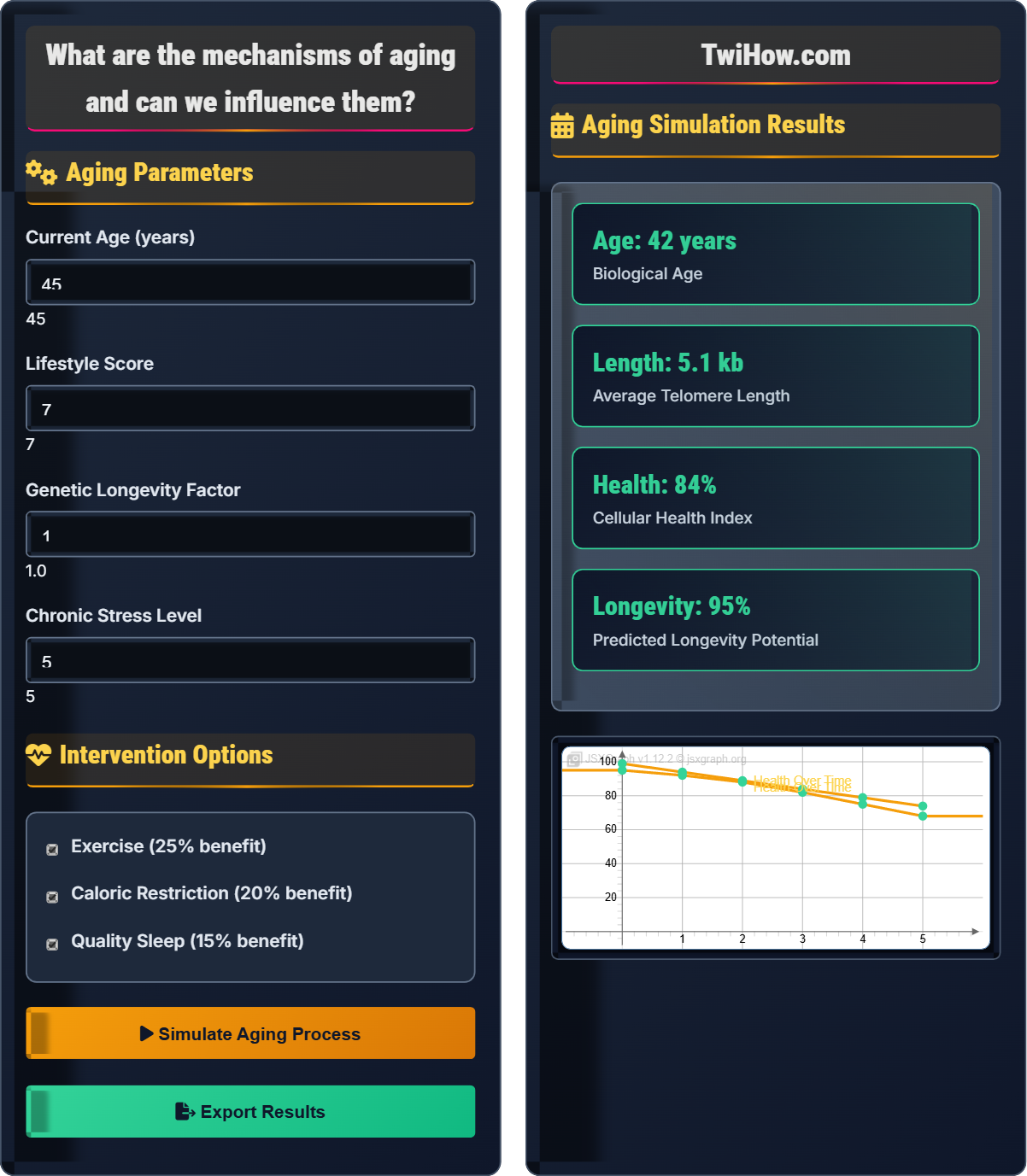
Aging Parameters
Intervention Options
Aging Simulation Results
| Process | Severity | Impact | Intervention |
|---|---|---|---|
| DNA Damage | Medium | High | Antioxidants |
| Telomere Shortening | High | High | Telomerase |
| Cellular Senescence | Medium | Medium | Senolytics |
| Protein Aggregation | Low | Medium | Autophagy |
| Metabolic Decline | Medium | High | CR/Exercise |
Aging Biology Explained
Aging is the time-dependent deterioration of physiological functions and increased susceptibility to death. It results from accumulated damage to cells, tissues, and organs over time. The process involves multiple interconnected pathways including genomic instability, telomere attrition, epigenetic alterations, loss of proteostasis, deregulated nutrient sensing, mitochondrial dysfunction, cellular senescence, stem cell exhaustion, and altered intercellular communication.
The Gompertz law describes age-specific mortality rates:
Where:
- μ(x): Mortality rate at age x
- A: Baseline mortality rate
- B: Rate of aging (mortality doubling rate)
- x: Age
Major theories explaining aging mechanisms:
- Programmed Aging: Genetic clocks and developmental pathways
- Damage Accumulation: Wear and tear, oxidative stress
- Evolutionary Theory: Antagonistic pleiotropy
- Free Radical Theory: Oxidative damage accumulation
- Telomere Theory: Chromosomal end shortening
- Cellular Senescence: Irreversible growth arrest
- Caloric Restriction: Reduces metabolic rate and damage
- Exercise: Enhances repair and regeneration
- Antioxidants: Neutralizes free radicals
- Sirtuins: Activates longevity genes
- Senolytics: Removes senescent cells
- Metformin: Mimics caloric restriction
Aging Fundamentals
Chronological age, biological age, healthspan, lifespan, senescence, homeostasis.
Maximum number of cell divisions before senescence
Approximately 50 divisions in human cells
- Aging involves multiple interconnected processes
- Damage accumulates over time
- Repair mechanisms decline with age
Intervention Strategies
Caloric restriction, exercise, antioxidants, senolytics, gene therapy.
- Lifestyle modifications
- Nutritional interventions
- Pharmacological agents
- Gene therapy
- Safety and efficacy balance
- Individual genetic variation
- Timing of interventions
- Long-term consequences
Aging Biology Learning Quiz
What is the primary characteristic of cellular senescence?
Cellular senescence is characterized by irreversible cell cycle arrest, where cells permanently exit the cell cycle despite having the capacity to divide. This process prevents damaged cells from proliferating and contributing to cancer. Senescent cells remain metabolically active but lose their ability to divide, contributing to aging through accumulated dysfunctional cells.
The answer is B) Irreversible cell cycle arrest.
Cellular senescence represents a double-edged sword in aging. It serves as a tumor suppressor mechanism by preventing damaged cells from dividing, but the accumulation of senescent cells contributes to aging through chronic inflammation and tissue dysfunction. Understanding this balance is crucial for developing anti-aging therapies.
Cellular Senescence: Permanent cell cycle arrest
Hayflick Limit: Maximum number of cell divisions
SASP: Senescence-associated secretory phenotype
• Senescent cells stop dividing permanently
• They remain metabolically active
• SASP causes chronic inflammation
• Remember senescence prevents cancer
• But causes tissue dysfunction
• Senolytics target senescent cells
• Confusing senescence with apoptosis
• Thinking senescent cells die
• Not appreciating dual nature
Explain the role of telomeres in cellular aging and describe the molecular mechanism of telomere shortening during cell division. How does this relate to the Hayflick limit?
Telomere Function: Telomeres are repetitive DNA sequences (TTAGGG) at chromosome ends that protect chromosomes from degradation and fusion. They serve as protective caps that shorten with each cell division.
Shortening Mechanism: The "end replication problem" occurs because DNA polymerase cannot fully replicate the 3' end of linear chromosomes. With each division, telomeres lose 50-200 base pairs.
Hayflick Limit Connection: When telomeres become critically short, cells enter senescence or apoptosis, limiting the number of divisions to approximately 50 in normal human cells. This represents a molecular clock that constrains cellular lifespan.
Telomerase can extend telomeres but is normally inactive in most somatic cells.
Telomere shortening provides a molecular explanation for the Hayflick limit. It acts as a counting mechanism for cell divisions, serving as a biological clock. The end-replication problem highlights a fundamental limitation of DNA replication machinery, explaining why cells have finite lifespans. This mechanism prevents unlimited cell division that could lead to cancer.
Telomeres: Chromosome end protective sequences
End Replication Problem: DNA polymerase limitation
Telomerase: Enzyme that extends telomeres
• Telomeres shorten with each division
• Critical shortening triggers senescence
• Telomerase extends telomeres
• Think of telomeres as shoelace caps
• They get shorter with use
• When too short, cell stops dividing
• Confusing telomeres with centromeres
• Not understanding end replication problem
• Forgetting telomerase role
Studies show that caloric restriction (CR) can extend lifespan by approximately 30% in laboratory mice. If a mouse strain has a normal lifespan of 2.5 years, calculate the expected lifespan extension in months. If the CR diet reduces metabolic rate by 20%, calculate the percentage reduction in daily caloric intake needed to achieve this metabolic slowdown, assuming metabolic rate is proportional to caloric intake.
Lifespan Extension:
Normal lifespan = 2.5 years = 30 months
Extension = 30% of 30 months = 0.30 × 30 = 9 months
Extended lifespan = 30 + 9 = 39 months
Caloric Intake Reduction:
If metabolic rate is proportional to caloric intake, and metabolic rate decreases by 20%, then caloric intake must also decrease by 20%.
Therefore, caloric restriction should be 20% to achieve 20% metabolic rate reduction.
Caloric restriction is one of the most robust interventions for extending lifespan across multiple species. The mechanism involves reduced metabolic rate, decreased ROS production, enhanced DNA repair, and activation of longevity genes like sirtuins. This demonstrates how environmental factors can influence aging processes.
Caloric Restriction: Reduced caloric intake without malnutrition
Metabolic Rate: Rate of energy expenditure
ROS: Reactive oxygen species
• CR extends lifespan across species
• Reduces metabolic damage
• Activates repair mechanisms
• CR is the gold standard for longevity
• Reduces oxidative stress
• Activates longevity pathways
• Confusing starvation with CR
• Not appreciating nutritional balance
• Forgetting species differences
A researcher is studying the free radical theory of aging in human fibroblasts. The theory proposes that reactive oxygen species (ROS) accumulate over time, causing damage to DNA, proteins, and lipids. Explain the sources of ROS in cells, the cellular defense mechanisms against oxidative damage, and how this theory relates to the aging process. What experimental evidence supports this theory?
Sources of ROS: Mitochondrial electron transport chain (primary source), peroxisomes, inflammatory cells, environmental factors.
Defense Mechanisms: Superoxide dismutase (converts superoxide to hydrogen peroxide), catalase (breaks down hydrogen peroxide), glutathione peroxidase (neutralizes peroxides), antioxidant vitamins (C, E, carotenoids).
Role in Aging: Accumulated oxidative damage to macromolecules impairs cellular function and contributes to age-related diseases.
Experimental Evidence: Correlation between metabolic rate and lifespan, accumulation of oxidized proteins with age, longer-lived animals have better antioxidant defenses, dietary antioxidants can extend lifespan in some models.
The free radical theory provides a mechanistic explanation for aging based on accumulated damage. It connects cellular metabolism to aging through oxidative stress. While the theory has been refined over time, the concept of damage accumulation remains central to our understanding of aging. Modern research shows that ROS also serve as signaling molecules, adding complexity to the original theory.
ROS: Reactive oxygen species
Oxidative Stress: Imbalance between ROS and antioxidants
Antioxidants: Compounds that neutralize ROS
• ROS are byproducts of metabolism
• Defense systems decline with age
• Damage accumulates over time
• Think of oxidation as rusting
• Antioxidants prevent damage
• Mitochondria are major ROS source
• Not appreciating ROS signaling roles
• Thinking all ROS are harmful
• Overlooking repair mechanisms
Which of the following best describes the role of sirtuins in aging and longevity?
Sirtuins are a family of NAD+-dependent deacetylases that function as longevity genes. They are activated under conditions of caloric restriction and stress, promoting cellular survival and extending lifespan. Sirtuins regulate DNA repair, metabolism, inflammation, and stress responses, making them key players in aging and longevity.
The answer is B) They are longevity genes activated by caloric restriction.
Sirtuins represent a molecular link between caloric restriction and longevity. They serve as sensors of cellular energy status (via NAD+) and coordinate stress responses and repair mechanisms. The discovery of sirtuins has led to the development of resveratrol and other compounds that activate these proteins, potentially mimicking the benefits of caloric restriction.
Sirtuins: NAD+-dependent protein deacetylases
Resveratrol: Sirtuin-activating compound
NAD+: Coenzyme involved in cellular metabolism
• Sirtuins are activated by CR
• They promote repair mechanisms
• NAD+ levels affect activity
• CR activates sirtuins
• They promote longevity
• NAD+ is cofactor
• Not understanding CR connection
• Confusing with other proteins
• Forgetting NAD+ requirement
FAQ
Q: What's the difference between chronological and biological age?
A: Chronological age is the number of years since birth, while biological age reflects the functional state of your body systems. Two people of the same chronological age can have very different biological ages based on their health, lifestyle, and genetics.
Biological age can be measured through biomarkers like telomere length, DNA methylation patterns, inflammatory markers, and physiological function tests. People can have a biological age younger or older than their chronological age depending on their lifestyle choices.
Q: Can exercise really slow down aging?
A: Yes, regular exercise has profound anti-aging effects:
1. Telomere Protection: Exercise can slow telomere shortening
2. Cardiovascular Health: Maintains heart and blood vessel function
3. Muscle Preservation: Prevents sarcopenia (muscle loss)
4. Brain Health: Promotes neurogenesis and cognitive function
5. Immune Function: Maintains immune system vigor
Studies show regular exercisers have a biological age 5-10 years younger than sedentary peers.