What Is Synthetic Biology and What Can It Create?
Complete biotechnology guide • Step-by-step explanations
Synthetic Biology Fundamentals:
Show Synthetic Biology DesignerSynthetic biology is an interdisciplinary field that combines biology and engineering to design and construct new biological parts, devices, and systems, or to redesign existing natural biological systems for useful purposes. It enables the creation of novel biological functions and organisms.
Key applications:
- Biofuel Production: Engineered organisms producing sustainable fuels
- Pharmaceutical Manufacturing: Biological factories for drug production
- Environmental Remediation: Organisms designed to clean pollutants
- Biocomputing: Living computers using biological components
Synthetic biology utilizes standardized biological parts, genetic circuits, and engineering principles to create predictable biological systems. It represents a shift from studying biology to engineering it.
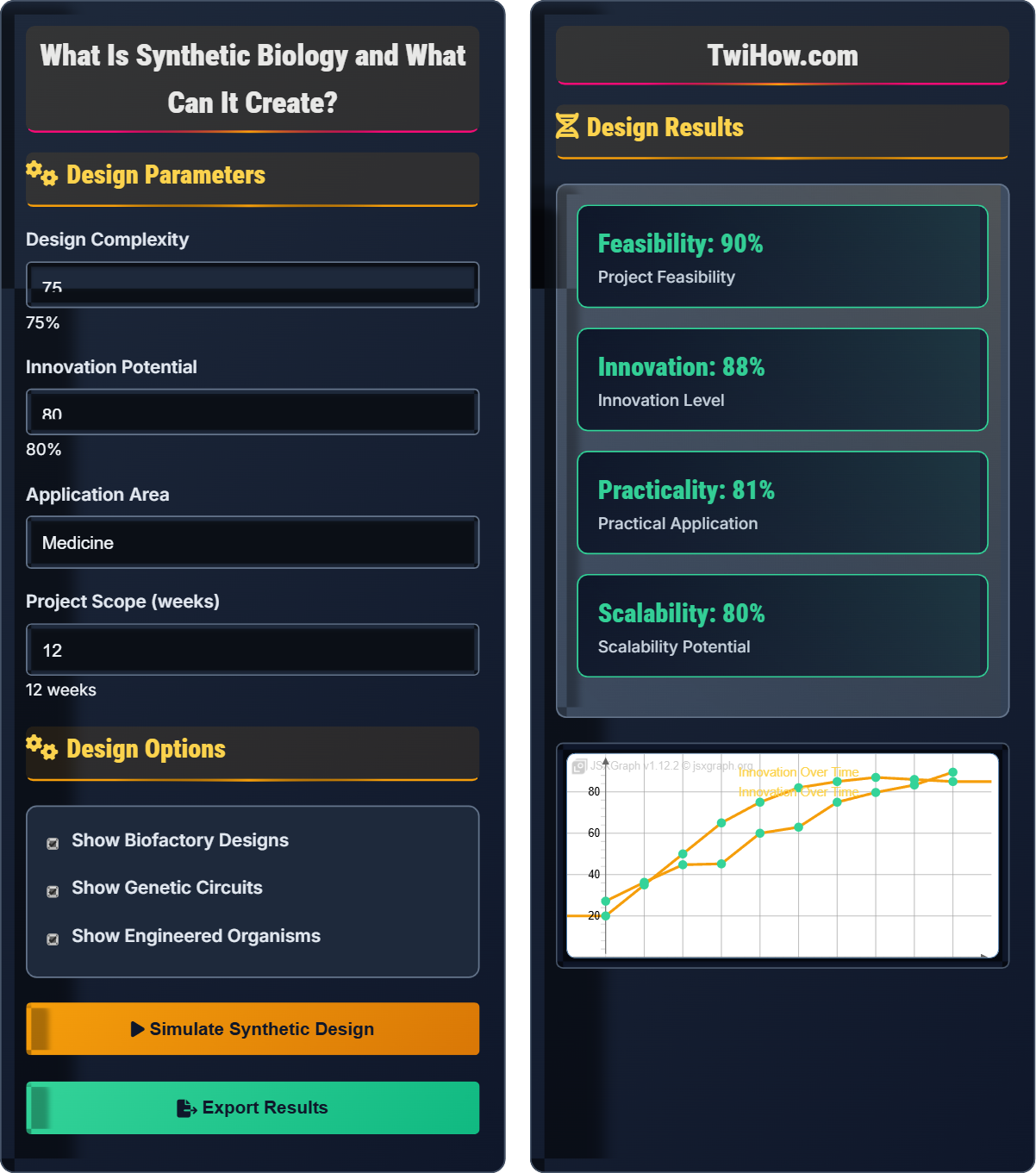
Design Parameters
Design Options
Design Results
| Phase | Progress | Innovation | Practicality |
|---|---|---|---|
| Concept | 20% | 15% | 10% |
| Design | 40% | 30% | 25% |
| Construction | 60% | 45% | 40% |
| Testing | 80% | 60% | 55% |
| Implementation | 90% | 72% | 70% |
Biofactories: Engineered organisms as biological manufacturing systems.
Genetic Circuits: Programmable biological systems with logical functions.
Synthetic Biology Fundamentals Explained
Synthetic biology is an interdisciplinary field that combines principles from biology, engineering, chemistry, and computer science to design and construct new biological parts, devices, and systems. It also involves redesigning existing natural biological systems for useful purposes. Unlike traditional genetic engineering, synthetic biology takes an engineering approach to biology.
Synthetic biology operates on several key principles:
Where:
- Standardization: Creating standardized biological parts (BioBricks)
- Modularity: Building systems from interchangeable components
- Engineering Principles: Design-Build-Test-Learn cycles
- Predictability: Creating predictable biological systems
Synthetic biology has transformative applications across multiple sectors:
- Medicine: Engineered cells for drug production, cancer therapy, diagnostics
- Energy: Biofuels, hydrogen production, carbon capture
- Environment: Bioremediation, pollution cleanup, sustainable materials
- Manufacturing: Sustainable chemicals, pharmaceuticals, materials
- Food: Nutrient enhancement, flavor compounds, sustainable agriculture
- Biocomputing: Biological computers, data storage
- CRISPR/Cas9: Precise genome editing tool
- DNA Synthesis: Automated synthesis of custom DNA sequences
- Metabolic Engineering: Redesigning metabolic pathways
- Genetic Circuits: Programmable biological logic systems
- Directed Evolution: Laboratory evolution of proteins and pathways
- Computational Design: AI and machine learning for biological design
Synthetic Biology Fundamentals
Genetic circuits, BioBricks, chassis organisms, standardization, modularity, predictability.
Design → Build → Test → Learn → Iterate
Where Design = blueprint creation, Build = construction, Test = characterization.
- Standardization enables reproducibility
- Modularity allows for system assembly
- Predictability requires mathematical modeling
Applications
Medicine, energy, environment, manufacturing, food, biocomputing.
- Identify biological problem or opportunity
- Design synthetic solution
- Construct biological system
- Test and validate function
- Scale and deploy application
- Safety and containment protocols
- Regulatory compliance
- Ethical implications
Synthetic Biology Learning Quiz
What are BioBricks in synthetic biology?
BioBricks are standardized biological parts with defined functions that can be combined to build complex biological systems. They are DNA sequences with specific biological functions that follow standardized assembly rules, allowing them to be mixed and matched like electronic components.
The concept of BioBricks enables modular construction of biological systems, similar to how electronic circuits are built from standardized components. This standardization is fundamental to synthetic biology's engineering approach.
The answer is B) Standardized biological parts with defined functions.
BioBricks represent the foundation of synthetic biology's engineering approach. Students should understand that just as electronic engineers use standardized components, synthetic biologists use standardized biological parts. This allows for predictable assembly of complex biological systems.
BioBricks: Standardized biological parts with defined functions
Standardization: Creating uniform biological components
Modularity: Using interchangeable biological parts
• BioBricks enable predictable biological assembly
• Standardization is key to synthetic biology
• Parts follow specific assembly rules
• Think of BioBricks as biological LEGOs
• Standardized = predictable function
• Modular = interchangeable parts
• Confusing BioBricks with physical objects
• Not understanding the standardization concept
• Thinking they're complete organisms
Explain what genetic circuits are in synthetic biology and provide examples of how they function. Include the components and design principles.
Genetic Circuits: Synthetic genetic networks that process signals and perform logical operations within cells, similar to electronic circuits.
Components:
• Promoters: DNA sequences that control gene expression
• Regulators: Proteins that turn genes on/off
• Outputs: Reporter genes or metabolic products
• Inputs: Chemical signals, light, temperature
Examples:
• Toggle Switch: Circuit that can be flipped between two stable states
• Oscillator: Circuit that produces rhythmic pulses
• Logic Gates: Circuits performing AND, OR, NOT operations
Design Principles: Modularity, insulation between components, predictable behavior. These circuits enable programmable cellular behavior and can be used for sensing, computation, and control of biological processes.
Genetic circuits demonstrate synthetic biology's engineering approach by creating biological systems with predictable functions. Students should understand that cells can be programmed like computers using genetic components. This represents a fundamental shift from studying biology to engineering it.
Genetic Circuit: Synthetic network performing logical operations
Promoter: DNA sequence controlling gene expression
Reporter Gene: Gene used to track expression
• Circuits process biological signals
• Components must be insulated
• Predictable behavior is essential
• Think of genetic circuits as biological computers
• Components = biological parts
• Functions = logical operations
• Not understanding the engineering analogy
• Confusing with natural gene regulation
• Thinking they're purely theoretical
A synthetic biology team wants to engineer yeast to produce biodiesel from plant biomass. Describe the synthetic biology approach they would take, including the key genetic modifications needed and the challenges they might face.
Synthetic Biology Approach:
1. Pathway Design: Identify and design the metabolic pathway for converting plant sugars to biodiesel precursors (fatty acids).
2. Gene Selection: Select genes for:
• Sugar transporters for efficient uptake
• Enzymes for breaking down plant polymers
• Fatty acid synthases for lipid production
• Lipid modification enzymes for biodiesel conversion
3. Circuit Construction: Engineer genetic circuits to regulate pathway expression and optimize flux.
4. Chassis Optimization: Modify yeast metabolism to minimize competing pathways.
Challenges:
• Toxicity of intermediate products
• Balancing growth with production
• Ensuring pathway stability
• Scaling up production
• Regulatory and safety concerns
This example illustrates how synthetic biology addresses real-world challenges. Students should understand that engineering biological systems requires considering multiple factors: pathway design, host compatibility, and practical constraints. The biofuel example shows the potential for sustainable energy solutions.
Chassis Organism: Host organism for synthetic systems
Metabolic Engineering: Redesigning metabolic pathways
Pathway Optimization: Improving metabolic efficiency
• Design for host compatibility
• Balance growth with production
• Consider toxicity issues
• Think of metabolic pathways as assembly lines
• Optimize for both efficiency and safety
• Consider scale-up challenges early
• Ignoring host organism constraints
• Not considering toxicity
• Overlooking regulatory issues
Explain how CRISPR/Cas9 technology has revolutionized synthetic biology. Include its mechanism of action, advantages over previous techniques, and specific applications in synthetic biology projects.
CRISPR/Cas9 Mechanism:
• Guide RNA directs Cas9 protein to specific DNA sequence
• Cas9 cuts DNA at target site
• Cell repairs break, introducing desired changes
Advantages:
• High precision and specificity
• Relatively easy to program
• Works in many organisms
• Multiplexed editing possible
• Cost-effective
Applications in Synthetic Biology:
• Precise insertion of synthetic genes
• Knockout of competing pathways
• Addition of regulatory elements
• Creation of genetic circuits
• Engineering of chassis organisms
CRISPR has dramatically accelerated synthetic biology projects by making genetic modifications faster, cheaper, and more precise.
CRISPR represents a technological leap that has enabled synthetic biology to reach new heights. Students should understand that precise genome editing is crucial for constructing reliable biological systems. The technology's programmability makes it ideal for synthetic biology's engineering approach.
CRISPR/Cas9: Precise genome editing system
Guide RNA: Directs Cas9 to target DNA
Multiplexing: Editing multiple sites simultaneously
• High specificity is crucial
• Off-target effects must be minimized
• Programming is key to precision
• CRISPR = molecular scissors
• Guide RNA = GPS for cutting
• Enables precise biological engineering
• Not understanding the precision advantage
• Confusing with older techniques
• Underestimating impact on synthetic biology
Which of the following is NOT commonly used as a chassis organism in synthetic biology?
Chassis organisms are host cells used as platforms for synthetic biology projects. Common chassis organisms include E. coli, yeast (Saccharomyces cerevisiae), and Bacillus subtilis because they are:
• Well-characterized genetically
• Easy to manipulate
• Safe to work with
• Fast-growing
• Cost-effective
Humans are not used as chassis organisms due to ethical, safety, and practical concerns. While human cells can be engineered in laboratories, whole human organisms are not appropriate chassis for synthetic biology applications.
The answer is C) Homo sapiens (humans).
Students must understand that synthetic biology uses well-characterized, safe host organisms as platforms for engineering. The choice of chassis is crucial for project success and safety. This question highlights the ethical boundaries of synthetic biology applications.
Chassis Organism: Host cell for synthetic biology projects
Escherichia coli: Common bacterial chassis
Saccharomyces cerevisiae: Common yeast chassis
• Chassis must be safe and well-characterized
• Ethical boundaries exist in synthetic biology
• Human organisms are not appropriate chassis
• Chassis = biological platform
• Safety and ethics are paramount
• Well-characterized organisms preferred
• Thinking humans can be chassis organisms
• Not understanding safety considerations
• Confusing with medical applications
FAQ
Q: Is synthetic biology the same as genetic engineering?
A: While related, synthetic biology and genetic engineering have key differences:
Traditional Genetic Engineering: Makes targeted modifications to existing biological systems. Often involves inserting single genes into organisms.
Synthetic Biology: Takes an engineering approach to biology. It designs and constructs entirely new biological systems or redesigns existing ones using standardized, modular components. It emphasizes predictability and systematic design.
Synthetic biology builds on genetic engineering but goes further by applying engineering principles like standardization, modularity, and design-build-test cycles. It aims to create biological systems with predictable behaviors.
Q: What are the main ethical concerns with synthetic biology?
A: Several ethical concerns arise with synthetic biology:
Biosafety: Risk of engineered organisms escaping containment and causing ecological harm.
Biosecurity: Potential for creating harmful organisms or biological weapons.
Equity: Benefits of synthetic biology may not be equally distributed globally.
Playing God: Philosophical concerns about creating life or significantly modifying nature.
Patenting Life: Intellectual property issues with engineered organisms.
Regulation: Need for appropriate oversight without stifling innovation.
Researchers and policymakers work to address these concerns through safety protocols, international agreements, and public engagement.