What is the connection between biology and technology (bioinformatics, etc.)?
Complete biology guide • Step-by-step explanations
Biology-Technology Convergence:
Show Bioinformatics SimulatorThe intersection of biology and technology has revolutionized scientific research and medicine through bioinformatics, computational biology, and biotechnology. This convergence enables the analysis of massive biological datasets, prediction of molecular structures, and design of novel therapeutic interventions.
Key intersections include genomic analysis, protein structure prediction, drug discovery, synthetic biology, and personalized medicine. Advanced algorithms process biological data at unprecedented scales, revealing patterns invisible to traditional methods. Machine learning and AI accelerate biological discoveries.
Technology applications:
- Genomic Analysis: DNA sequencing, variant calling, phylogenetics
- Structural Biology: Protein folding, molecular docking
- Systems Biology: Network analysis, pathway modeling
- Biotechnology: Synthetic biology, genetic engineering
This synergy accelerates scientific discovery, enables precision medicine, and opens new frontiers in biological research. The integration continues to expand with emerging technologies like quantum computing and advanced AI.
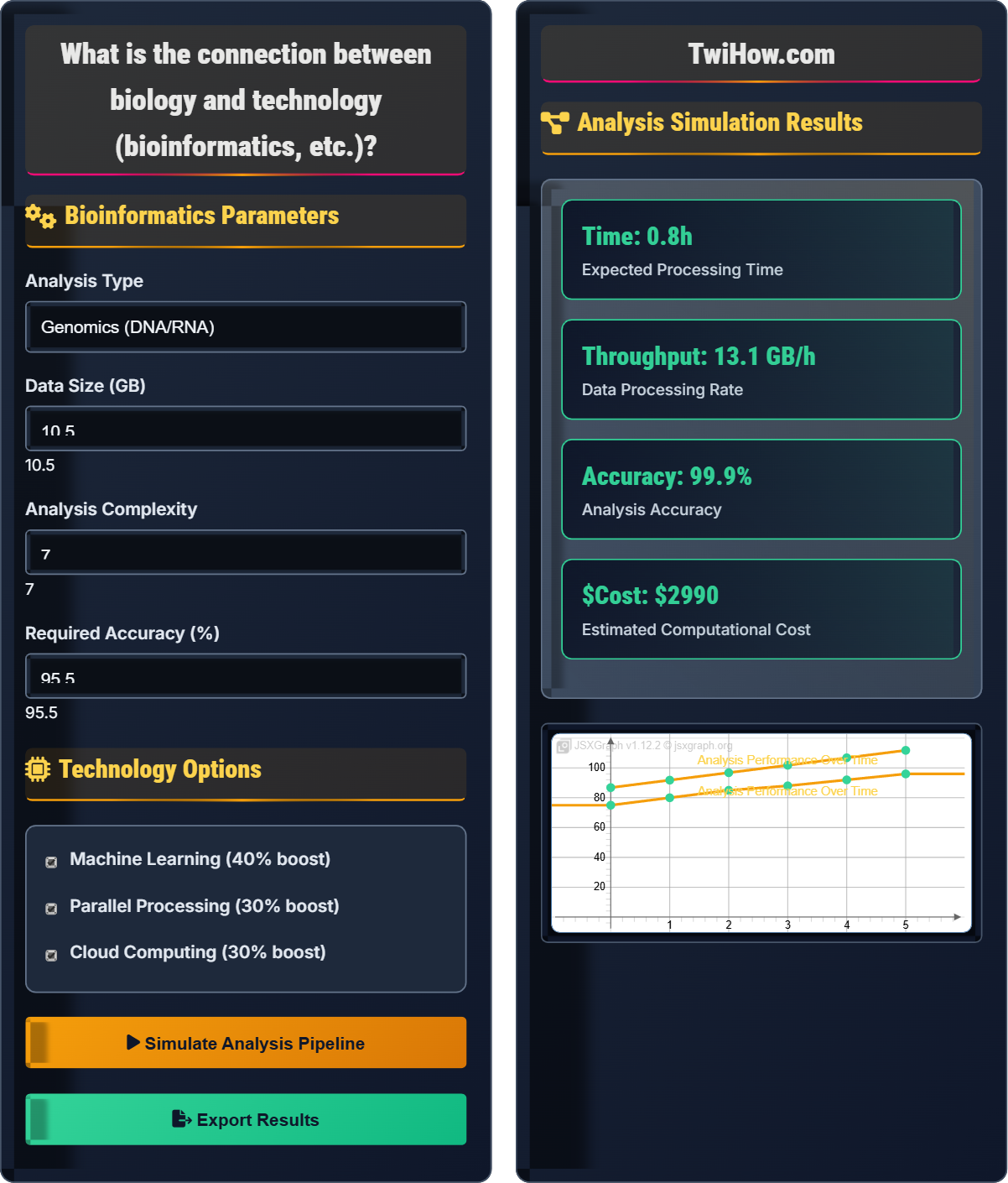
Bioinformatics Parameters
Technology Options
Analysis Simulation Results
| Step | Process | Time (min) | Resource Usage |
|---|---|---|---|
| 1 | Data Preprocessing | 15 | 20% |
| 2 | Alignment | 45 | 60% |
| 3 | Variant Calling | 30 | 40% |
| 4 | Annotation | 25 | 30% |
| 5 | Analysis | 20 | 25% |
Bioinformatics Explained
Bioinformatics is an interdisciplinary field that develops methods and software tools for understanding biological data. It combines biology, computer science, mathematics, and statistics to analyze and interpret biological information, particularly in genomics, proteomics, and other molecular biology domains. Bioinformatics enables researchers to handle the vast amounts of data generated by modern biological techniques.
The Smith-Waterman algorithm for local sequence alignment:
Where:
- s(a_i, b_j): Similarity score for aligned residues
- d: Gap penalty
- Score_{i,j}: Alignment score at position (i,j)
Key areas where technology intersects with biology:
- Genomics: DNA/RNA sequencing, assembly, annotation
- Proteomics: Protein structure prediction, function analysis
- Phylogenetics: Evolutionary tree construction
- Systems Biology: Network modeling, pathway analysis
- Drug Discovery: Molecular docking, virtual screening
- Personalized Medicine: Genomic profiling for treatment
- Machine Learning: Predictive models for biological phenomena
- Deep Learning: Protein folding prediction (AlphaFold)
- Cloud Computing: Distributed analysis of large datasets
- Quantum Computing: Optimization problems in biology
- Blockchain: Secure sharing of genomic data
- CRISPR Technology: Genome editing guided by computational tools
Bioinformatics Fundamentals
Sequence alignment, phylogenetics, databases, algorithms, statistical analysis.
Basic Local Alignment Search Tool
Searches sequence databases to find similar sequences
- Data quality affects analysis results
- Statistical significance is crucial
- Algorithms must be validated
Technology Applications
BLAST, Clustal, MEGA, PyMOL, Galaxy, R/Bioconductor.
- Database querying
- Sequence analysis
- Structure prediction
- Network analysis
- Computational resource requirements
- Data privacy and security
- Reproducibility of analyses
- Standardization of formats
Bioinformatics Learning Quiz
What is the primary purpose of BLAST (Basic Local Alignment Search Tool)?
BLAST (Basic Local Alignment Search Tool) is a bioinformatics tool designed to search sequence databases for sequences similar to a query sequence. It compares nucleotide or protein sequences to sequence databases and calculates the statistical significance of matches, helping researchers identify homologous sequences and infer functional or evolutionary relationships.
The answer is B) To search sequence databases for similar sequences.
BLAST is one of the most fundamental tools in bioinformatics. It uses heuristic algorithms to quickly search large sequence databases. The tool reports matches along with statistical significance values (E-values) that indicate the likelihood of finding a similar match by chance. BLAST has revolutionized comparative biology by making sequence similarity searches accessible and efficient.
BLAST: Basic Local Alignment Search Tool
E-value: Expected number of matches by chance
Homology: Evolutionary relationship between sequences
• Lower E-values indicate better matches
• BLAST uses heuristic algorithms for speed
• Statistical significance matters
• Use appropriate BLAST program for sequence type
• Check E-values and sequence identity
• Consider evolutionary relationships
• Confusing BLAST with structure prediction tools
• Not interpreting E-values properly
• Ignoring statistical significance
Explain the concept of next-generation sequencing (NGS) and describe how it differs from traditional Sanger sequencing. What are the advantages and limitations of NGS technology?
Next-Generation Sequencing (NGS): High-throughput DNA sequencing technology that parallelizes the sequencing process, allowing millions of fragments to be sequenced simultaneously. Unlike Sanger sequencing, which sequences one fragment at a time, NGS sequences many fragments in parallel.
Differences from Sanger: NGS produces shorter reads (50-300bp vs. 800-1000bp), much higher throughput (millions vs. hundreds of reads), and lower cost per base.
Advantages: Massive throughput, lower cost per base, enables whole-genome sequencing. Limitations: Shorter read lengths, higher error rates, requires complex bioinformatics pipelines.
NGS has revolutionized genomics by making large-scale sequencing projects feasible.
NGS represents a technological leap that transformed biology from a hypothesis-driven to a data-driven science. The ability to sequence entire genomes quickly and affordably has enabled personalized medicine, comparative genomics, and population-scale studies. The trade-off between read length and throughput exemplifies the engineering challenges in sequencing technology.
NGS: Next-Generation Sequencing technologies
Read Length: Number of bases sequenced per fragment
Throughput: Amount of sequence generated per run
• Trade-off between read length and throughput
• Quality scores indicate confidence in calls
• Assembly requires overlapping reads
• Consider read length requirements for applications
• Quality scores matter for accuracy
• Coverage depth affects variant detection
• Not understanding coverage requirements
• Ignoring quality scores
• Underestimating bioinformatics needs
A researcher is using BLAST to search for homologous sequences in a database containing 2 million protein sequences. The query sequence is 300 amino acids long. If BLAST can perform 10,000 comparisons per second and each comparison takes 0.001 seconds, calculate the theoretical time required for a complete database search. If the researcher uses a computer cluster that can perform searches in parallel with 100 nodes, how much time would the search take?
Single computer calculation:
Number of comparisons = 2,000,000 sequences
Time per comparison = 0.001 seconds
Total time = 2,000,000 × 0.001 = 2,000 seconds
2,000 seconds ÷ 60 = 33.3 minutes
With 100-node cluster:
Time = Total time ÷ Number of nodes = 2,000 ÷ 100 = 20 seconds
Therefore, the search would take 33.3 minutes on a single computer or 20 seconds with the cluster.
This calculation demonstrates the importance of parallel computing in bioinformatics. As biological databases continue to grow exponentially, computational scalability becomes critical. Modern bioinformatics pipelines leverage distributed computing, cloud platforms, and specialized hardware to handle the ever-increasing data volumes generated by high-throughput technologies.
Parallel Computing: Distributing tasks across multiple processors
Scalability: Ability to handle increasing data volumes
Computational Complexity: Resource requirements of algorithms
• Database size affects search time linearly
• Parallelization reduces time proportionally
• Memory and I/O also matter
• Consider algorithmic complexity
• Leverage parallel computing when possible
• Optimize for your specific use case
• Not accounting for setup overhead
• Ignoring memory limitations
• Forgetting I/O bottlenecks
A bioinformatician is constructing a phylogenetic tree for 8 species based on their cytochrome c protein sequences. The evolutionary distances between species have been calculated as follows: Species A-B: 0.15, A-C: 0.22, B-C: 0.18, A-D: 0.31, B-D: 0.28, C-D: 0.25. Using the neighbor-joining method, explain how the first clustering step would proceed. What would be the distance from the newly formed cluster to another species E if the distances are A-E: 0.35, B-E: 0.32?
Neighbor-Joining Process: Find the pair of taxa with the smallest corrected distance. The correction accounts for the fact that each taxon may have a different evolutionary rate.
Step 1: Calculate corrected distances (Q-matrix values) to find closest neighbors.
For A-B: Q_AB = (n-2)d_AB - Σd_Ak - Σd_Bk
Where n=8, Σd_Ak = sum of distances from A to all others, Σd_Bk = sum from B to all others.
Cluster Formation: The pair with the lowest Q-value joins first. For the distance from the new cluster AB to species E:
d(E,AB) = (d(A,E) + d(B,E) - d(A,B))/2 = (0.35 + 0.32 - 0.15)/2 = 0.26
The distance from cluster AB to species E would be 0.26.
The neighbor-joining method is a popular algorithm for constructing phylogenetic trees because it's computationally efficient and produces biologically meaningful results. The method progressively clusters taxa based on evolutionary distances, correcting for differences in evolutionary rates. This approach has been fundamental in understanding evolutionary relationships and molecular evolution.
Phylogenetic Tree: Diagram showing evolutionary relationships
Evolutionary Distance: Measure of divergence between sequences
Neighbor-Joining: Agglomerative clustering method
• Corrected distances account for rate variation
• Trees represent evolutionary hypotheses
• Consider multiple algorithms for robustness
• Bootstrap values indicate confidence
• Root the tree appropriately
• Not correcting for multiple substitutions
• Misinterpreting tree topology
• Forgetting to test tree reliability
Which machine learning approach has been most successful in predicting protein three-dimensional structures from amino acid sequences?
Deep learning and neural networks have achieved remarkable success in protein structure prediction, most notably with AlphaFold developed by DeepMind. This approach uses deep neural networks to predict the distances between amino acids and the angles of chemical bonds, then uses these predictions to construct accurate 3D models of proteins.
The answer is C) Deep Learning/Neural Networks.
The success of deep learning in protein structure prediction represents a landmark achievement in computational biology. AlphaFold's ability to predict protein structures with atomic-level accuracy has been called one of the greatest breakthroughs in biology. This demonstrates how artificial intelligence can solve fundamental biological problems that have persisted for decades.
AlphaFold: Deep learning system for protein structure prediction
Deep Learning: Neural networks with multiple hidden layers
Protein Folding: Process of achieving 3D structure
• Deep learning excels at pattern recognition
• Biological problems often involve complex patterns
• AI can augment human expertise
• Consider AI as a tool, not replacement
• Validate computational predictions experimentally
• Stay updated on AI advances
• Over-relying on computational predictions
• Not validating results experimentally
• Underestimating AI potential
FAQ
Q: What programming skills are essential for bioinformatics?
A: Essential programming skills for bioinformatics include:
1. Python: Most popular for bioinformatics due to extensive libraries (Biopython, Pandas, NumPy)
2. R: Excellent for statistical analysis and visualization
3. Command Line: Essential for working with large datasets and servers
4. SQL: For managing biological databases
5. Version Control (Git): For reproducible research
Focus on data manipulation, automation, and statistical analysis. Understanding of algorithms and data structures is also important.
Q: How is AI changing drug discovery?
A: AI is revolutionizing drug discovery in several ways:
1. Virtual Screening: AI models predict compound binding to targets
2. De Novo Design: Generating novel molecular structures
3. ADMET Prediction: Predicting absorption, distribution, metabolism
4. Target Identification: Finding new drug targets using omics data
5. Repurposing: Finding new uses for existing drugs
AI is reducing the time and cost of drug development from decades to years.