What is the potential of personalized medicine based on genetics?
Complete biology guide • Step-by-step explanations
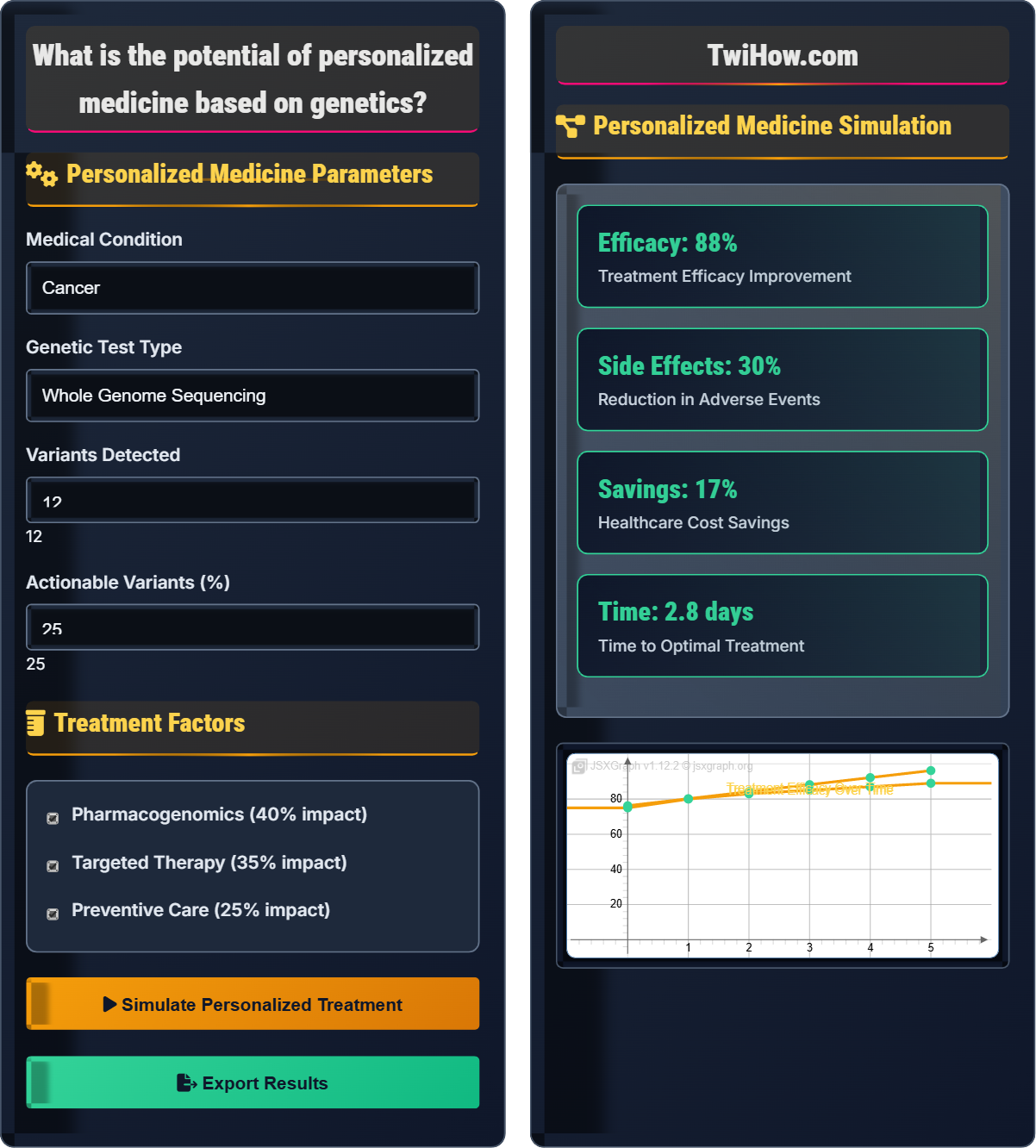
Personalized Medicine Potential:
Show Personalized Medicine SimulatorPersonalized medicine uses individual genetic profiles to tailor medical treatment for optimal outcomes. This approach considers genetic variations that affect drug metabolism, disease susceptibility, and treatment responses. It promises to improve therapeutic efficacy while reducing adverse effects by matching patients with the most appropriate treatments based on their genetic makeup.
Key applications include pharmacogenomics (drug-gene interactions), cancer genomics (tumor-specific mutations), rare disease diagnosis, and preventive medicine. The approach moves beyond the one-size-fits-all model to provide targeted, individualized care based on genomic information.
Applications:
- Pharmacogenomics: Drug metabolism and efficacy
- Targeted Therapy: Cancer treatment based on mutations
- Preventive Care: Risk assessment and early intervention
- Rare Disease Diagnosis: Genetic variant identification
While promising, personalized medicine faces challenges including data privacy, cost, interpretation complexity, and accessibility. The field continues to evolve with advances in sequencing technology and bioinformatics.
Personalized Medicine Parameters
Treatment Factors
Personalized Medicine Simulation
| Gene | Variation | Impact | Therapy |
|---|---|---|---|
| CYP2D6 | PM/Poor Metabolizer | Drug Metabolism | Dose Adjustment |
| BRCA1 | Pathogenic Variant | Cancer Risk | Preventive Surgery |
| HLA-B*57:01 | Positive | Drug Reaction | Avoid Abacavir |
| TPMT | Heterozygous | Thiopurine Toxicity | Dose Reduction |
| UGT1A1 | *28 Allele | Irinotecan Toxicity | Reduced Dosing |
Personalized Medicine Explained
Personalized medicine, also known as precision medicine, is a medical model that proposes the customization of healthcare - with medical decisions, treatments, practices, or products being tailored to the individual patient. It takes into account differences in people's genes, environments, and lifestyles. The approach allows doctors and researchers to predict more accurately which treatment and prevention strategies for a particular disease will work in which groups of people.
Pharmacogenomic response prediction:
Where f(Genotype) represents the functional impact of genetic variants on drug metabolism and efficacy.
Major areas of personalized medicine:
- Pharmacogenomics: Drug metabolism and efficacy prediction
- Oncology: Tumor-specific targeted therapies
- Rare Diseases: Genetic diagnosis and treatment
- Preventive Medicine: Risk assessment and screening
- Immunotherapy: Personalized cancer vaccines
- Transplantation: Matching donors and recipients
- Sequencing: Whole genome, exome, targeted panels
- Arrays: SNP genotyping chips
- CRISPR: Gene editing for therapy
- WGS: Comprehensive genetic analysis
- Phasing: Determining parental origin
- Imputation: Predicting missing variants
Genetic Medicine Fundamentals
Genotype, phenotype, polymorphism, allele, haplotype, penetrance, expressivity.
p² + 2pq + q² = 1
Where p and q are allele frequencies in a population.
- Genotype affects drug response
- Environmental factors modify genetic effects
- Population differences affect variant interpretation
Clinical Applications
Pharmacogenomics, oncogenomics, rare disease diagnosis, carrier screening.
- Preemptive testing
- Targeted testing
- Panel-based screening
- Whole genome analysis
- Cost-effectiveness analysis
- Data privacy and security
- Interpretation challenges
- Regulatory requirements
Personalized Medicine Learning Quiz
What does the CYP2D6 gene primarily encode for?
The CYP2D6 gene encodes a member of the cytochrome P450 family of enzymes, which are responsible for metabolizing many commonly prescribed drugs. Variations in this gene affect how individuals process medications, leading to poor, intermediate, extensive, or ultrarapid metabolizer phenotypes that influence drug efficacy and safety.
The answer is B) Cytochrome P450 drug metabolizing enzyme.
CYP2D6 is one of the most important pharmacogenomic genes, affecting the metabolism of about 25% of commonly prescribed drugs. Understanding CYP2D6 status helps clinicians adjust doses and select appropriate medications to optimize therapeutic outcomes and minimize adverse effects.
CYP2D6: Cytochrome P450 2D6 enzyme
Metabolizer Phenotype: Classification based on enzyme activity
Pharmacogenomics: Study of genetic variation affecting drug response
• CYP2D6 affects many common drugs
• Phenotype determines drug metabolism
• Dosing should consider genotype
• Remember CYP2D6 for drug metabolism
• Poor metabolizers need lower doses
• Ultrarapid metabolizers may need higher doses
• Confusing with other CYP enzymes
• Not understanding phenotype implications
• Forgetting to adjust dosing
Explain how genetic testing is used in cancer treatment and give specific examples of targeted therapies based on genetic mutations.
Genetic Testing in Cancer: Tumor genetic profiling identifies mutations that drive cancer growth. This information guides treatment selection by identifying actionable mutations that can be targeted with specific therapies.
Examples of Targeted Therapies: EGFR inhibitors for lung cancer with EGFR mutations, HER2 inhibitors for breast cancer with HER2 amplification, BRAF inhibitors for melanoma with BRAF mutations, PARP inhibitors for BRCA-mutated cancers.
Benefits: Improved efficacy, reduced side effects compared to chemotherapy, potential for combination therapies targeting multiple pathways.
This approach represents a shift from cancer classification by tissue type to molecular classification based on genetic drivers.
Cancer genomics exemplifies personalized medicine by matching specific genetic alterations with targeted therapies. This approach has revolutionized cancer treatment, moving away from the traditional "one-size-fits-all" chemotherapy model to precision medicine based on tumor genetics.
Targeted Therapy: Treatment targeting specific molecular alterations
Actionable Mutation: Genetic alteration with therapeutic implications
Companion Diagnostics: Tests guiding therapy selection
• Match mutation to therapy
• Resistance can develop
• Tumor heterogeneity matters
• Think "mutation → therapy" matching
• Consider resistance mechanisms
• Tumor genetics may differ from germline
• Not considering tumor heterogeneity
• Forgetting resistance development
• Confusing germline with somatic mutations
A genetic test costs $500 and can identify patients who would have severe adverse reactions to a medication that costs $100 per month. If 2% of patients have the genetic variant causing the reaction and the average cost of treating an adverse reaction is $15,000, calculate the cost savings per patient tested. How many patients need to be tested to break even?
Cost per patient tested: $500
Patients with variant: 2% = 0.02
Cost avoided per patient with variant: $15,000
Expected savings per patient tested: 0.02 × $15,000 = $300
Net cost per patient: $500 - $300 = $200
Break-even calculation: To break even, savings must equal testing cost.
Let x = number of patients tested
0.02x × $15,000 = x × $500
$300x = $500x (This shows testing is not cost-effective based on reaction prevention alone)
However, additional benefits include improved efficacy and other clinical outcomes.
This calculation demonstrates the economic considerations in personalized medicine. While the simple cost model may not show immediate savings, personalized medicine provides value through improved outcomes, reduced hospitalizations, and better quality of life. Economic models must consider broader healthcare benefits.
Cost-Benefit Analysis: Economic evaluation of interventions
Break-Even Point: Where costs equal benefits
Health Economics: Economic analysis of health interventions
• Consider all costs and benefits
• Long-term outcomes matter
• Quality-adjusted life years important
• Think beyond direct costs
• Consider quality of life
• Long-term benefits matter
• Only considering immediate costs
• Not accounting for indirect benefits
• Forgetting long-term outcomes
A patient presents with an undiagnosed condition characterized by developmental delay, seizures, and facial dysmorphisms. Traditional testing has been inconclusive. Explain how whole exome sequencing (WES) could be used to diagnose this condition. What are the advantages and limitations of this approach, and how might it change treatment options?
WES Approach: Sequences all protein-coding regions (~1-2% of genome) to identify disease-causing variants. In this case, it would look for variants in genes associated with neurodevelopmental disorders.
Advantages: Comprehensive gene coverage, identifies novel mutations, provides definitive diagnosis, enables genetic counseling, may identify treatable conditions.
Limitations: Does not capture non-coding regions, uncertain significance variants, complex inheritance patterns, cost, interpretation challenges.
Treatment Impact: Enables targeted therapies, genetic counseling, family planning, prognosis refinement, and enrollment in research studies.
WES can provide answers for families after years of diagnostic odyssey.
Genomic sequencing for rare diseases exemplifies the power of personalized medicine. Many rare diseases have genetic causes that can be identified through comprehensive genetic testing, providing families with answers and enabling appropriate medical management. This represents a shift from symptom-based to mechanism-based medicine.
Diagnostic Odyssey: Long journey to diagnosis
Uncertain Significance: Variant with unclear clinical impact
Exome: Protein-coding regions of genome
• Many rare diseases are genetic
• Diagnosis enables appropriate care
• Think of genetics for undiagnosed conditions
• Family history is important
• Interpretation is key challenge
• Not considering genetic causes
• Forgetting interpretation complexity
• Underestimating family impact
What is the primary purpose of HLA-B*57:01 testing before prescribing abacavir?
HLA-B*57:01 testing is performed before initiating abacavir therapy because patients with this genetic variant have a significantly increased risk of developing a severe, potentially fatal hypersensitivity reaction. The test identifies patients who should avoid this medication entirely, preventing life-threatening adverse events.
The answer is B) To prevent severe hypersensitivity reactions.
HLA-B*57:01 testing exemplifies how genetic testing can prevent serious adverse drug reactions. This is one of the most successful implementations of pharmacogenomics in clinical practice, demonstrating how genetic information can improve patient safety. The association is so strong that testing is now mandatory before abacavir prescription.
HLA: Human leukocyte antigen system
Hypersensitivity: Severe allergic-type reaction
Abacavir: HIV antiretroviral medication
• HLA-B*57:01 strongly predicts reaction
• Testing prevents serious adverse events
• Mandatory before abacavir use
• HLA typing prevents reactions
• Strongest PGx association
• Zero tolerance for testing failure
• Not understanding severity of reaction
• Thinking it's about efficacy
• Forgetting mandatory testing
FAQ
Q: What's the difference between genetic testing and genomic testing?
A: Genetic Testing: Usually refers to testing for specific, known mutations in particular genes (like BRCA1/2 for breast cancer).
Genomic Testing: Broader term including whole genome/exome sequencing, looking at the entire genetic code.
Genetic testing is more targeted, while genomic testing is more comprehensive. Both provide information for personalized medicine but at different scales.
Q: How do physicians integrate genetic information into clinical practice?
A: Physicians integrate genetic information through:
1. Decision Support: Clinical decision tools and guidelines
2. Education: Training on interpretation and application
3. Collaboration: Working with genetic counselors
4. Pharmacogenomics: Dosing and drug selection
5. Family History: Risk assessment and screening
Implementation requires systems support, education, and integration into electronic health records.