ESC
Pluripotent
Complete biology guide • Step-by-step explanations
Regenerative medicine harnesses the power of stem cells to repair, replace, or regenerate damaged tissues and organs. Stem cells are unique cells with the ability to self-renew and differentiate into specialized cell types. This field holds unprecedented promise for treating previously incurable conditions like spinal cord injuries, heart disease, diabetes, and degenerative disorders.
Stem cell therapies involve using different types of stem cells - embryonic, induced pluripotent, adult, and mesenchymal - each with unique properties and applications. Tissue engineering combines cells, scaffolds, and growth factors to create functional replacement tissues. The potential extends to organ bioengineering, personalized medicine, and gene therapy.
Key regenerative concepts:
The field continues to evolve with breakthrough technologies like CRISPR gene editing, 3D bioprinting, and organoid culture systems. Ethical considerations and safety protocols remain central to translating laboratory discoveries into clinical applications.
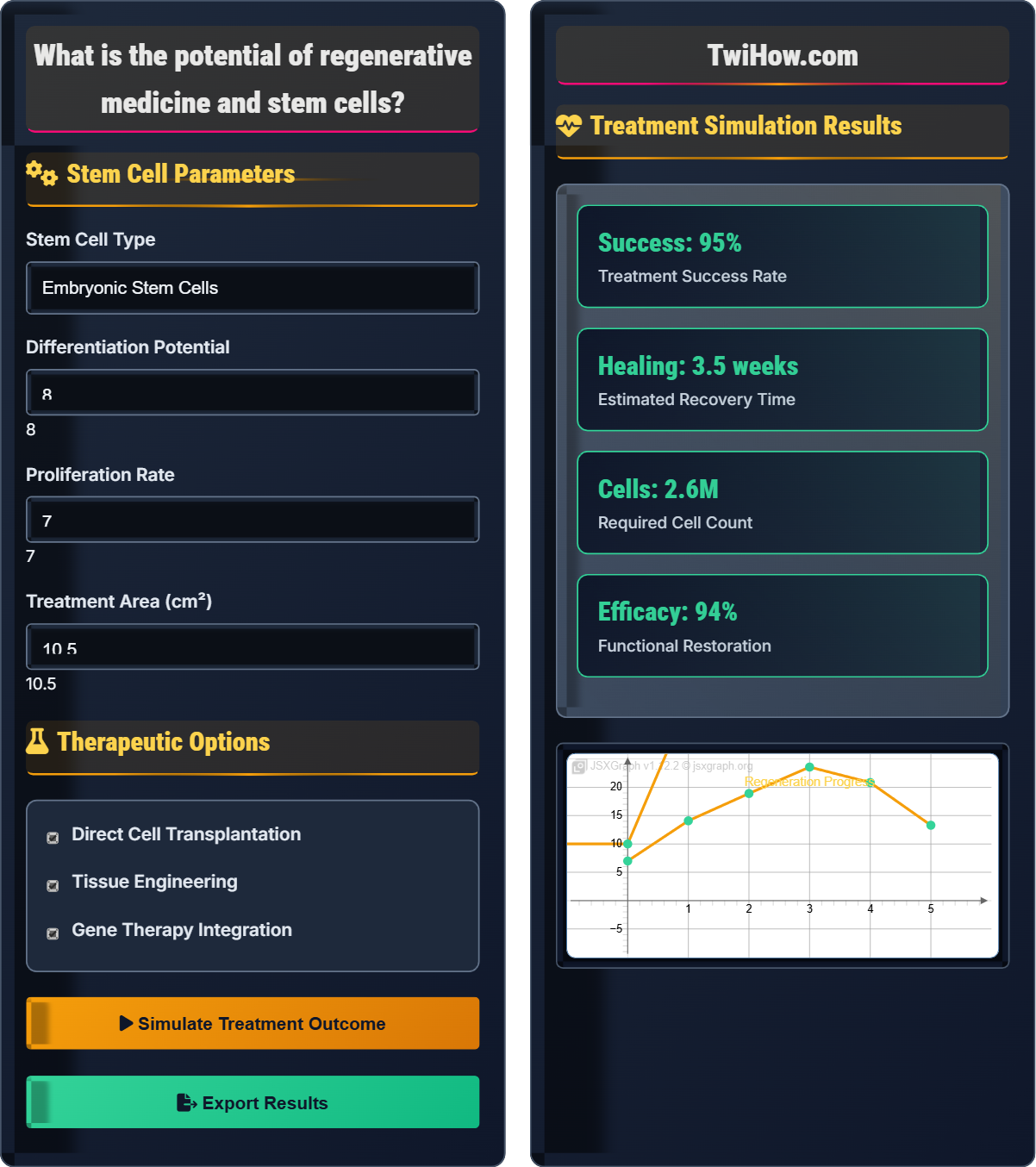
| Week | Regeneration Stage | Function Restored (%) | Cell Activity |
|---|---|---|---|
| 1 | Inflammation Control | 15% | High |
| 2 | Cell Proliferation | 35% | Very High |
| 3 | Tissue Formation | 60% | Medium |
| 4 | Maturation | 85% | Low |
| 5 | Full Function | 95% | Baseline |
Regenerative medicine is a branch of medicine that develops and uses biological methods to study and engineer the growth of new, healthy cells, tissues, and organs to replace diseased or injured ones. It combines stem cell biology, tissue engineering, gene therapy, and molecular medicine to repair or replace damaged tissues and organs.
Stem cells have varying differentiation potentials:
Where:
Key areas where regenerative medicine is transforming treatment:
Stem cells, potency, differentiation, self-renewal, niche, plasticity.
Self-Renewal = Asymmetric Division (1 stem → 1 stem + 1 differentiated)
Differentiation = Symmetric Division (1 stem → 2 differentiated)
Bone marrow transplant, cartilage repair, skin grafting, cardiac patches.
Which type of stem cell has the highest differentiation potential?
Stem cell potency follows a hierarchical order: Totipotent > Pluripotent > Multipotent > Oligopotent > Unipotent. Totipotent cells (like zygotes and early blastomeres) can form both the embryo and extraembryonic tissues, making them the most potent. They can develop into an entire organism with all cell types.
The answer is C) Totipotent stem cells.
Understanding stem cell potency is fundamental to regenerative medicine. The higher the potency, the greater the therapeutic potential but also the greater the safety concerns. Totipotent cells are the most versatile but also carry the highest risk of forming teratomas. This hierarchy helps researchers choose the appropriate cell type for specific therapeutic applications.
Totipotent: Can form entire organism (zygote, blastomeres)
Pluripotent: Can form all three germ layers (ESC, iPSC)
Multipotent: Can form multiple related cell types (MSC)
• Higher potency increases therapeutic potential
• Higher potency increases safety risks
• Potency decreases as development progresses
• Remember: ToTiMuOlUn (Totipotent→Unipotent)
• Match potency to therapeutic need
• Consider safety vs. efficacy trade-offs
• Confusing potency with quantity
• Assuming higher potency is always better
• Not considering safety implications
Explain the process of creating induced pluripotent stem cells (iPSCs) and discuss their advantages and disadvantages compared to embryonic stem cells.
iPSC Creation Process: Somatic cells (like skin fibroblasts) are reprogrammed by introducing four key transcription factors: Oct4, Sox2, Klf4, and c-Myc (OSKM factors). These factors reset the cell's epigenetic state, returning it to a pluripotent state similar to embryonic stem cells.
Advantages: Patient-specific cells avoiding immune rejection, ethically uncontroversial, can model genetic diseases, renewable cell source.
Disadvantages: Risk of insertional mutagenesis from viral vectors, incomplete reprogramming, potential residual memory of original cell type, slower generation process.
Comparison: Both iPSCs and ESCs are pluripotent, but iPSCs avoid ethical concerns of embryo destruction while ESCs have more consistent differentiation potential.
iPSC technology revolutionized regenerative medicine by providing patient-specific pluripotent cells without ethical concerns. The Yamanaka factors demonstrate that cell identity is not fixed and can be reversed. This discovery earned Shinya Yamanaka the Nobel Prize in 2012. iPSCs bridge the gap between ethical concerns and therapeutic potential.
iPSCs: Induced pluripotent stem cells from somatic cells
Yamanaka Factors: OSKM transcription factors for reprogramming
Epigenetic Reprogramming: Resetting gene expression patterns
• Four factors required for reprogramming
• Epigenetic changes reverse cellular identity
• Remember OSKM for reprogramming factors
• iPSCs solve ethical issues with ESCs
• Epigenetics can override genetics
• Confusing iPSCs with ESCs
• Underestimating safety concerns
• Not considering reprogramming efficiency
A research team is designing a clinical trial for a mesenchymal stem cell therapy targeting knee osteoarthritis. The cells will be harvested from the patient's bone marrow, expanded in culture, and injected into the affected joint. Calculate the minimum number of cells needed if the treatment requires 10 million cells per cm³ of damaged cartilage, the average lesion size is 2.5 cm² with 3mm depth, and they want to prepare 20% excess for quality control. What is the total cell count required?
Calculate volume of damaged cartilage:
Volume = Area × Depth = 2.5 cm² × 0.3 cm = 0.75 cm³
Calculate required cell count:
Required cells = Volume × Cell density = 0.75 cm³ × 10 million cells/cm³ = 7.5 million cells
Add 20% excess:
Total cells = Required cells × 1.20 = 7.5 million × 1.20 = 9 million cells
Therefore, 9 million mesenchymal stem cells are required for the treatment.
This problem demonstrates the practical considerations in stem cell therapy dosing. The calculation involves geometric measurements of the target area and therapeutic cell density requirements. Adding excess cells accounts for potential losses during processing and ensures adequate therapeutic dose. Clinical trial design must consider both efficacy and safety margins.
Cell Density: Number of cells per unit volume/tissue
Therapeutic Dose: Minimum effective cell count
Quality Control Margin: Excess prepared for safety
• Measure target area/volume accurately
• Use validated cell density values
• Include safety margins in calculations
• Convert units consistently
• Always include safety margins
• Consider cell viability in calculations
• Incorrect unit conversions
• Forgetting safety margins
• Not accounting for cell viability
A bioengineering team is developing a skin substitute for burn victims using keratinocytes and fibroblasts. They need to seed cells onto a collagen scaffold measuring 10cm x 10cm with 80% porosity. The keratinocytes need 50,000 cells/cm² on the surface, and fibroblasts need 20,000 cells/cm² in the interior. Calculate the total number of each cell type required.
Keratinocyte Calculation (surface seeding):
Surface area = 10cm × 10cm = 100 cm²
Keratinocytes needed = 100 cm² × 50,000 cells/cm² = 5 million cells
Fibroblast Calculation (interior seeding):
Effective volume = 100 cm² × thickness × porosity
Assuming 1mm thickness: Volume = 100 cm² × 0.1 cm = 10 cm³
Effective volume for seeding = 10 cm³ × 0.80 = 8 cm³
Fibroblasts needed = 8 cm³ × 20,000 cells/cm³ = 160,000 cells
Therefore: 5 million keratinocytes and 160,000 fibroblasts are required.
Tissue engineering requires precise cell seeding strategies for different cell types. Epithelial cells (keratinocytes) are typically seeded on surfaces to form barriers, while stromal cells (fibroblasts) are embedded in scaffolds to provide structural support. Porosity affects the effective volume available for cell seeding and must be accounted for in calculations.
Scaffold Porosity: Percentage of void space in material
Cell Seeding: Process of placing cells in scaffold
Effective Volume: Actual space available for cells
• Account for scaffold porosity
• Match cell density to function
• Consider spatial distribution
• Calculate surface vs. volume separately
• Consider cell function when determining density
• Account for scaffold characteristics
• Not accounting for porosity
• Confusing surface and volume densities
• Ignoring cell function in calculations
Which of the following is the primary safety concern when using pluripotent stem cells in regenerative medicine?
Pluripotent stem cells (both ESCs and iPSCs) retain the ability to form all three germ layers and can potentially develop into teratomas - benign tumors containing tissues from all three germ layers. This occurs because some transplanted cells may not fully differentiate and retain their pluripotent characteristics, leading to uncontrolled growth and tumor formation.
The answer is B) Teratoma formation.
Safety is paramount in stem cell therapy, particularly with pluripotent cells. Teratoma formation represents the dark side of pluripotency - the very characteristic that makes these cells therapeutically valuable (their ability to differentiate) also poses significant safety risks. Extensive preclinical testing and differentiation protocols are required to minimize this risk before clinical application.
Teratoma: Benign tumor with tissues from all three germ layers
Pluripotency: Ability to form all cell types
Differentiation Protocol: Procedures to ensure full maturation
• Pluripotent cells require full differentiation
• Extensive safety testing required
• Long-term monitoring essential
• Match cell type to safety profile
• Always test for pluripotency markers post-differentiation
• Consider alternative cell sources when possible
• Underestimating teratoma risk
• Not completing differentiation protocols
• Inadequate safety monitoring
Q: How close are we to having lab-grown organs available for transplantation?
A: While we've made significant progress, fully functional lab-grown organs for transplantation are still years away. Current achievements include:
1. Simple Organs: Bladders, tracheas, and skin have been successfully transplanted
2. Organoids: Miniature organs grown in labs for research and drug testing
3. Decellularized Scaffolds: Animal organs stripped of cells and repopulated with human cells
Major challenges include vascularization (creating blood vessels), innervation (connecting nerves), and ensuring long-term functionality. Most experts estimate 10-20 years for complex organs like hearts or kidneys.
Q: What's the difference between stem cell therapy and gene therapy?
A: While both are regenerative medicine approaches, they differ in their mechanisms:
Stem Cell Therapy: Involves transplanting healthy cells to replace damaged ones. The cells themselves provide the therapeutic effect by integrating into tissues and restoring function.
Gene Therapy: Involves delivering genetic material to modify existing cells' function. Instead of replacing cells, it corrects genetic defects or adds new functions to existing cells.
They can be combined: genetically modified stem cells receive genes that correct defects before transplantation. This hybrid approach maximizes therapeutic potential.