What Is the Role of Epigenetics in Health and Disease?
Complete genetics guide • Step-by-step explanations
Epigenetics Fundamentals:
Show Epigenetic SimulatorEpigenetics refers to heritable changes in gene expression that occur without alterations to the underlying DNA sequence. These modifications, including DNA methylation and histone modifications, regulate gene activity and play crucial roles in development, aging, and disease susceptibility.
Key mechanisms:
- DNA Methylation: Addition of methyl groups to cytosine residues
- Histone Modification: Chemical changes to histone proteins
- Chromatin Remodeling: Structural changes affecting gene accessibility
- Non-coding RNAs: Regulatory RNA molecules
Epigenetic changes can be influenced by environmental factors and lifestyle choices, offering opportunities for prevention and treatment of diseases.
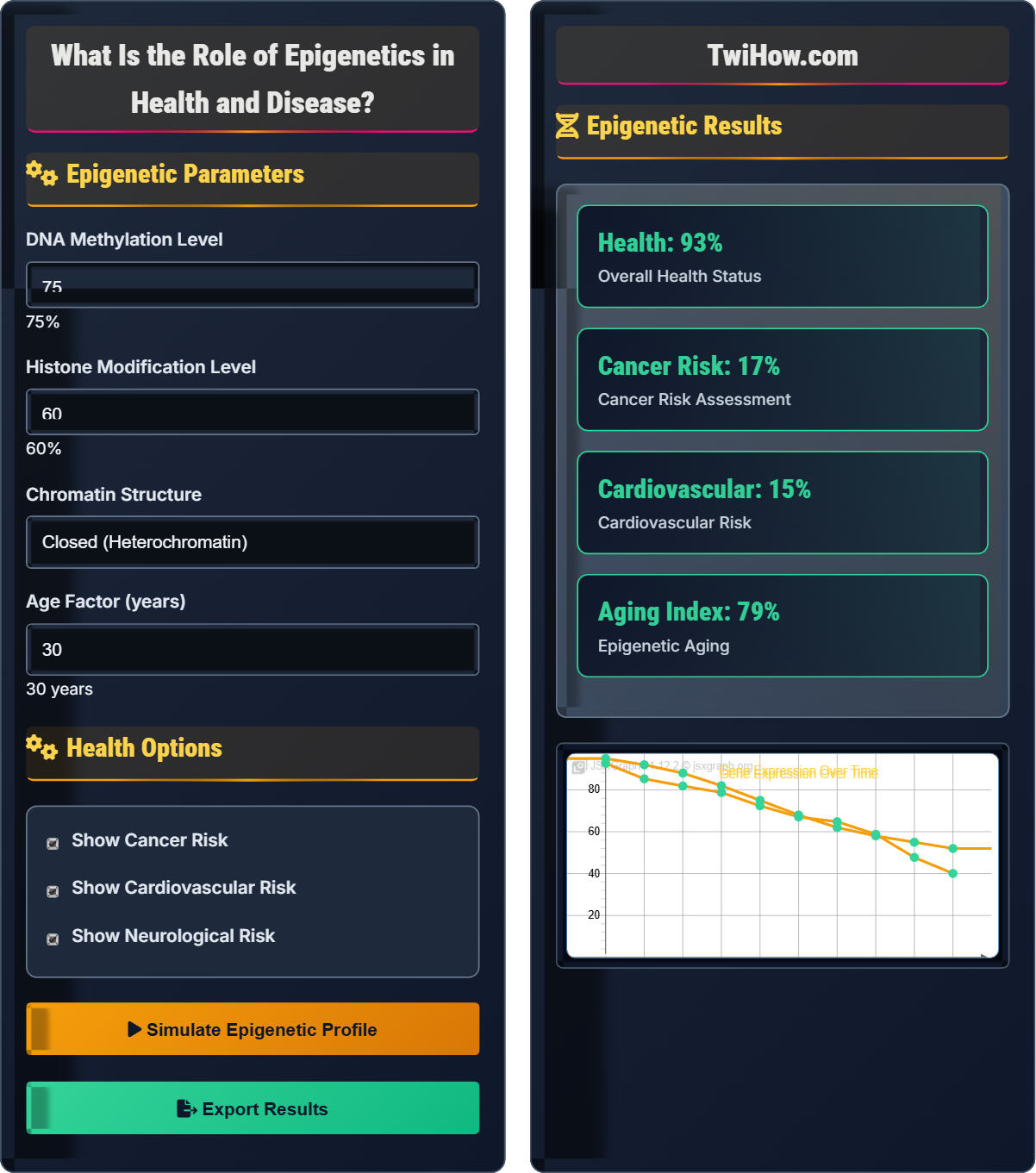
Epigenetic Parameters
Health Options
Epigenetic Results
| Age (years) | Methylation | Expression | Health Score |
|---|---|---|---|
| 10 | 30% | 85% | 95% |
| 20 | 45% | 78% | 92% |
| 30 | 60% | 72% | 88% |
| 40 | 68% | 65% | 82% |
| 50 | 75% | 58% | 75% |
DNA Methylation: Adds methyl groups to cytosine, typically silencing gene expression.
Histone Modification: Chemical changes to histone proteins affect chromatin accessibility.
Epigenetics in Health and Disease Explained
Epigenetics refers to heritable changes in gene expression that occur without alterations to the underlying DNA sequence. These modifications regulate gene activity and can be influenced by environmental factors, lifestyle choices, and age. Unlike genetic mutations, epigenetic changes are potentially reversible, making them attractive targets for therapeutic interventions.
Epigenetic regulation involves several key mechanisms:
Where:
- DNA Methylation: Addition of methyl groups to cytosine residues
- Histone Modification: Chemical changes to histone proteins
- Chromatin Remodeling: Structural changes affecting gene accessibility
- Non-coding RNAs: Regulatory RNA molecules
Epigenetic dysregulation is associated with numerous health conditions:
- Cancer: Aberrant methylation of tumor suppressor genes
- Cardiovascular Disease: Epigenetic changes in inflammatory pathways
- Neurological Disorders: Epigenetic modifications in brain development
- Autoimmune Diseases: Altered immune system regulation
- Metabolic Disorders: Changes in insulin sensitivity and glucose metabolism
- Aging: Progressive accumulation of epigenetic changes
- DNA Methyltransferase Inhibitors: Reactivate silenced tumor suppressor genes
- Histone Deacetylase Inhibitors: Restore gene expression patterns
- Chromatin Remodeling Agents: Reverse pathological epigenetic states
- Lifestyle Interventions: Diet, exercise, stress management
- Environmental Modifications: Reducing exposure to epigenetic disruptors
- Epigenetic Editing: Precise modification of epigenetic marks
Epigenetic Mechanisms
DNA methylation, histone modification, chromatin remodeling, non-coding RNAs.
Gene Expression = f(DNA Methylation, Histone State, Chromatin Structure)
Where Expression = transcriptional activity level.
- Epigenetic changes don't alter DNA sequence
- Changes can be heritable through cell division
- Environmental factors influence epigenetic state
Health and Disease
Cancer, cardiovascular disease, neurological disorders, autoimmune diseases.
- Environmental exposure triggers epigenetic changes
- Gene expression patterns are altered
- Protein function is affected
- Cellular dysfunction occurs
- Disease phenotype develops
- Epigenetic changes can be reversed
- Early intervention may prevent disease
- Therapeutic opportunities exist
Epigenetics Learning Quiz
What is the primary effect of DNA methylation on gene expression?
DNA methylation typically decreases gene expression by adding methyl groups to cytosine residues in CpG dinucleotides. This modification recruits proteins that compact chromatin structure, making DNA less accessible to transcription machinery.
The mechanism involves methyl-binding proteins that recruit histone deacetylases and other repressive complexes, leading to heterochromatin formation and gene silencing.
The answer is B) Decreases gene expression.
Students should understand that DNA methylation is a key mechanism for gene silencing. The addition of methyl groups doesn't change the DNA sequence but alters how accessible the DNA is to transcription factors and RNA polymerase. This is a fundamental concept in epigenetic regulation.
DNA Methylation: Addition of methyl groups to cytosine
CpG Islands: Regions rich in cytosine-guanine pairs
Heterochromatin: Tightly packed, transcriptionally inactive chromatin
• Methylation usually silences genes
• Doesn't change DNA sequence
• Creates heritable gene expression patterns
• Think of methylation as "turning off" genes
• Methyl groups = methyl = mute = silence
• Compact chromatin = less accessible = less expression
• Thinking methylation increases expression
• Confusing with genetic mutations
• Not understanding heritability
Explain the role of histone modifications in epigenetic regulation, including the types of modifications and their effects on gene expression.
Histone Modifications: Chemical changes to histone proteins that alter chromatin structure and gene expression.
Types of Modifications:
• Acetylation: Addition of acetyl groups to lysine residues
• Methylation: Addition of methyl groups to lysine/arginine
• Phosphorylation: Addition of phosphate groups
• Ubiquitination: Addition of ubiquitin proteins
Effects on Expression:
• Acetylation: Generally increases expression by loosening chromatin
• Methylation: Can increase or decrease expression depending on location
• Phosphorylation: Often associated with chromatin condensation
Mechanism: Modifications alter the charge of histones, affecting their interaction with DNA and recruiting effector proteins that influence transcription.
Histone modifications are crucial for fine-tuning gene expression. Students should understand that these modifications create a "histone code" that determines chromatin state. The same modification can have different effects depending on which histone and which amino acid is modified.
Histones: DNA-packaging proteins
Histone Code: Pattern of modifications determining gene expression
Chromatin Accessibility: How easily DNA can be accessed by transcription machinery
• Modifications affect chromatin structure
• Same modification can have different effects
• Context determines outcome
• Acetylation = ACID = Active expression
• Methylation = MIXED effects depending on context
• Think of histones as volume controls
• Thinking all modifications have same effect
• Not understanding the context dependency
• Confusing with DNA modifications
Explain how epigenetic silencing of tumor suppressor genes contributes to cancer development. Include the specific mechanisms involved and potential therapeutic approaches to reverse this process.
Epigenetic Silencing Mechanisms:
1. DNA Hypermethylation: Tumor suppressor gene promoters become heavily methylated, leading to gene silencing. This is a common mechanism for inactivating genes like p16, BRCA1, and MLH1.
2. Histone Modifications: Repressive histone marks (like H3K27me3) are added to tumor suppressor gene regions, creating heterochromatin.
3. Chromatin Compaction: Silenced genes become packaged in tightly wound heterochromatin.
Cancer Development: Loss of tumor suppressor function allows uncontrolled cell growth and division.
Therapeutic Approaches:
• DNA Methyltransferase Inhibitors: Drugs like azacitidine can reactivate silenced genes
• Histone Deacetylase Inhibitors: Restore acetylation and gene expression
• Combination Therapies: Target multiple epigenetic mechanisms simultaneously
This example shows how epigenetic changes can contribute to cancer without altering DNA sequence. Students should understand that epigenetic silencing is a key mechanism of tumor suppressor inactivation. The therapeutic potential lies in the reversibility of epigenetic changes, unlike genetic mutations.
Tumor Suppressor Gene: Gene that prevents uncontrolled cell growth
Hypermethylation: Excessive DNA methylation
Heterochromatin: Transcriptionally inactive chromatin
• Epigenetic silencing is reversible
• Tumor suppressors prevent cancer
• Therapeutic potential exists
• Tumor suppressors = brake pedals on cell growth
• Silencing = brake failure = cancer
• Reversible = treatable
• Confusing with oncogenes
• Thinking epigenetic changes are irreversible
• Not understanding the therapeutic potential
Describe how environmental factors like diet, stress, and toxins can influence epigenetic marks. Include specific examples of environmental factors that affect DNA methylation and histone modifications, and explain how these changes can be transmitted across generations.
Environmental Influences:
Diet: Folate, vitamin B12, and methionine provide methyl groups for DNA methylation. Caloric restriction can affect histone modifications.
Stress: Chronic stress alters DNA methylation patterns in stress-response genes, particularly in the hippocampus and hypothalamus.
Toxins: Heavy metals, pesticides, and air pollutants can disrupt epigenetic machinery.
Specific Examples:
• BPA (Bisphenol A): Alters DNA methylation patterns
• Maternal Nutrition: Affects offspring epigenetic programming
• Smoking: Causes DNA methylation changes in lung tissue
Transgenerational Transmission: Epigenetic changes can be passed to offspring through gametes, though the mechanism is complex and not all changes are stably inherited. This explains how environmental exposures can affect future generations.
This demonstrates the interface between environment and genetics through epigenetics. Students should understand that lifestyle choices can have lasting effects on gene expression patterns. The transgenerational aspect shows how environmental impacts can extend beyond the exposed individual.
Transgenerational: Passed to offspring across generations
Environmental Epigenetics: Study of environment-gene expression interactions
Epigenetic Programming: Establishment of gene expression patterns
• Environment affects epigenetics
• Changes can be inherited
• Lifestyle has epigenetic consequences
• Think of epigenetics as "gene expression switchboard"
• Environment can flip switches
• Effects can last generations
• Not understanding the environmental connection
• Thinking epigenetics is only genetic
• Underestimating transgenerational effects
Which of the following is NOT a current approach to epigenetic therapy?
Gene editing to correct DNA sequence (like CRISPR) is NOT an epigenetic therapy because it changes the actual DNA sequence rather than the epigenetic marks that regulate gene expression.
True epigenetic therapies target:
• DNA methyltransferase inhibitors: Reactivate silenced genes
• Histone deacetylase inhibitors: Restore gene expression
• Chromatin remodeling agents: Alter chromatin structure
These approaches modify gene expression without changing the DNA sequence, which is the essence of epigenetic therapy.
The answer is C) Gene editing to correct DNA sequence.
Students must distinguish between genetic and epigenetic therapies. Epigenetic therapies work by modifying gene expression patterns without altering DNA sequence. Gene editing changes the actual genetic code, which is fundamentally different from epigenetic modifications.
Epigenetic Therapy: Treatment targeting gene expression regulation
Genetic Therapy: Treatment targeting DNA sequence
Reversible Changes: Epigenetic modifications
• Epigenetic therapy doesn't change DNA sequence
• Changes are potentially reversible
• Gene editing is not epigenetic therapy
• Epigenetic = expression regulation
• Genetic = DNA sequence change
• Epigenetic = potentially reversible
• Confusing genetic with epigenetic therapies
• Thinking all gene-targeted therapies are epigenetic
• Not understanding the sequence distinction
FAQ
Q: Can lifestyle changes really affect my genes?
A: Yes, lifestyle changes can affect how your genes are expressed through epigenetic modifications:
Diet: Nutrients like folate and vitamin B12 provide methyl groups needed for DNA methylation. Mediterranean diets can positively affect gene expression patterns.
Exercise: Physical activity changes DNA methylation in muscle and fat tissue, affecting metabolism and inflammation.
Stress Management: Meditation and stress reduction can alter methylation patterns in stress-response genes.
Sleep: Quality sleep affects epigenetic regulation of circadian rhythm genes.
Importantly, these changes don't alter your DNA sequence but can significantly affect how your genes function, potentially reducing disease risk.
Q: What's the difference between genetic and epigenetic factors in disease?
A: The key differences are:
Genetic Factors: Changes in DNA sequence (mutations, deletions, insertions). These are permanent and usually inherited. Examples include cystic fibrosis or Huntington's disease.
Epigenetic Factors: Changes in gene expression without altering DNA sequence. These can be influenced by environment and lifestyle, and may be reversible. Examples include cancer development through tumor suppressor silencing.
Therapeutic Implications: Genetic diseases often require gene therapy or protein replacement. Epigenetic diseases may be treated with epigenetic drugs that reverse the modifications.
Most diseases involve both genetic and epigenetic components working together.