What is the role of model organisms in biological research?
Complete biology guide • Step-by-step explanations
Model Organisms in Research:
Show Model Organism SimulatorModel organisms are non-human species used in scientific research to understand biological processes. These organisms share fundamental cellular and molecular mechanisms with humans, making them valuable tools for studying genetics, development, disease, and evolution. Researchers use model organisms to conduct experiments that would be unethical or impractical in humans.
Common model organisms include mice, fruit flies, zebrafish, nematodes, and yeast. Each offers specific advantages like short generation times, genetic tractability, and well-characterized genomes. The knowledge gained from these organisms is often extrapolated to understand human biology and disease.
Research applications:
- Genetic Research: Gene function and regulation
- Disease Modeling: Cancer, neurological disorders
- Developmental Biology: Embryonic development
- Drug Discovery: Therapeutic testing
The use of model organisms has led to numerous breakthrough discoveries and Nobel Prizes, establishing fundamental principles of biology that apply across species.
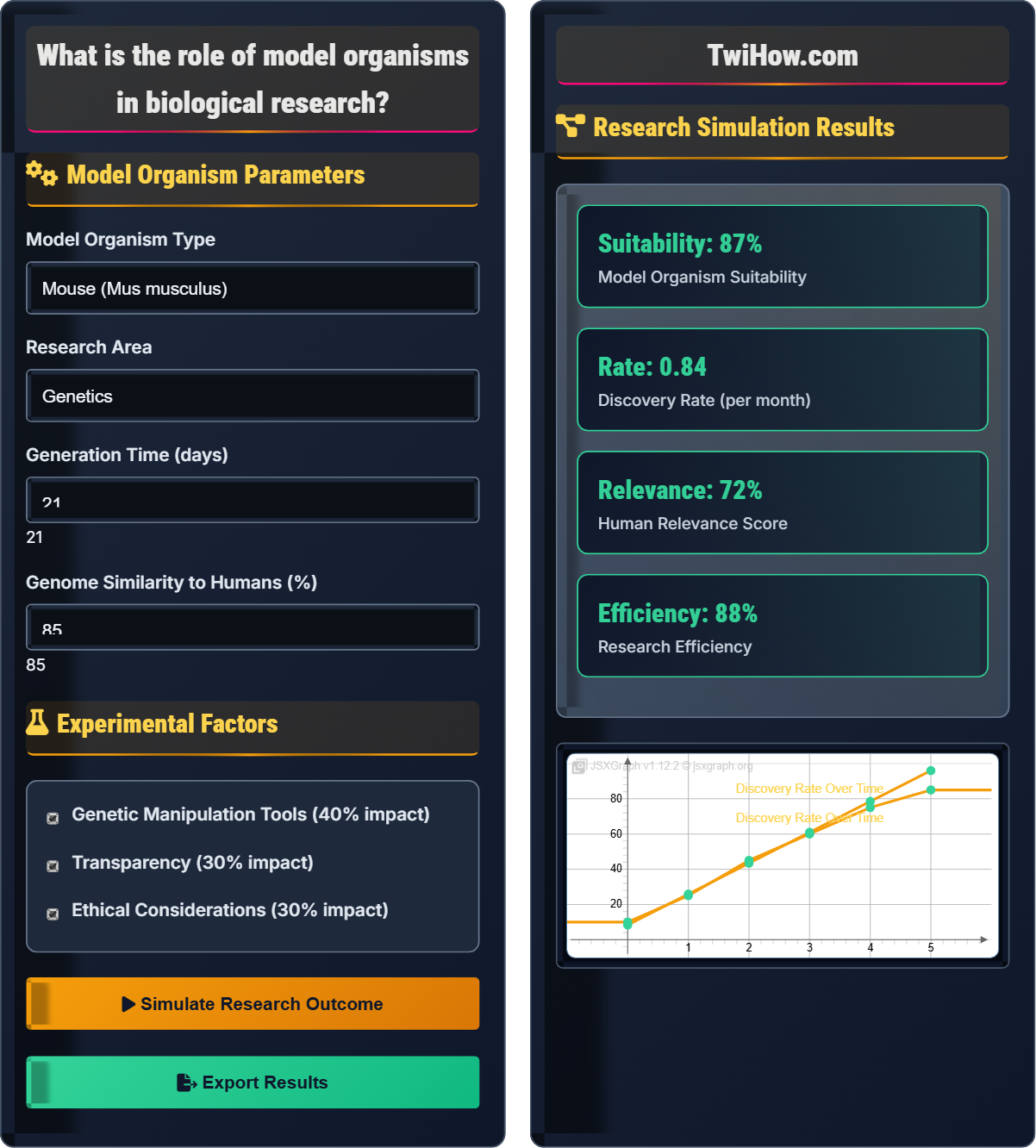
Model Organism Parameters
Experimental Factors
Research Simulation Results
| Organism | Generation Time | Genome Similarity | Best Use Case |
|---|---|---|---|
| Mouse | ~60 days | ~98% | Disease modeling |
| Fruit Fly | ~10 days | ~60% | Genetics, Development |
| Zebrafish | ~3 months | ~70% | Development, Behavior |
| Yeast | ~2 hours | ~35% | Cellular processes |
| Worm | ~3 days | ~45% | Development, Aging |
Model Organisms Explained
Model organisms are non-human species used in scientific research to understand biological processes that are conserved across species. These organisms share fundamental cellular and molecular mechanisms with humans, making them valuable tools for studying genetics, development, disease, and evolution. The knowledge gained from model organisms is often extrapolated to understand human biology and disease mechanisms.
Selection criteria for model organisms:
Where higher values indicate better suitability for research.
Key model organisms and their applications:
- Mice: Disease modeling, drug testing, genetics
- Fruit Flies: Genetics, development, behavior
- Zebrafish: Development, neuroscience, toxicology
- C. elegans: Development, aging, neural circuits
- Yeast: Cell biology, genetics, protein production
- E. coli: Molecular biology, protein expression
- Short Generation Times: Rapid experimental cycles
- Genetic Tractability: Easy manipulation of genes
- Large Offspring: Statistical significance
- Cost-Effective: Lower research costs
- Controlled Environment: Standardized conditions
- Ethical Feasibility: Acceptable experimental procedures
Model Organism Fundamentals
Model organism, genetic conservation, homologous genes, phenotypic analysis.
Sequence similarity > 30% often indicates functional conservation
Higher similarity suggests greater relevance to human biology
- Conservation indicates functional similarity
- Simple models reveal fundamental processes
- Complex models better predict human outcomes
Research Applications
Genetics, development, disease modeling, drug discovery, evolution.
- Forward genetics
- Reverse genetics
- Phenotypic screening
- Gene expression analysis
- Species-specific differences
- Experimental reproducibility
- Statistical power
- Ethical standards
Model Organisms Learning Quiz
Why has Drosophila melanogaster (fruit fly) been such a successful model organism in genetics research?
Drosophila has been extremely successful as a model organism because it combines several advantageous features: short generation time (~10 days), large numbers of offspring per mating, well-characterized genetics, and approximately 60% genetic similarity to humans. These features make it ideal for genetic screens and inheritance studies.
The answer is B) It has a short generation time, large number of offspring, and well-characterized genetics.
Successful model organisms typically combine multiple favorable characteristics. Drosophila exemplifies this with its rapid lifecycle allowing many generations to be studied quickly, large brood sizes providing statistical power, and well-understood genetics making it easy to identify and study specific genes. These advantages have led to numerous Nobel Prize-winning discoveries.
Generation Time: Time from birth to reproductive maturity
Genetic Tractability: Ease of genetic manipulation
Statistical Power: Ability to detect significant differences
• Multiple advantages make successful models
• Rapid reproduction enables genetic studies
• Large numbers provide statistical power
• Remember Drosophila for genetic studies
• Short generation time is key advantage
• Large numbers improve statistics
• Confusing genome similarity percentages
• Not appreciating statistical advantages
• Forgetting generation time importance
Explain why mice are considered the premier mammalian model organism for biomedical research. What advantages do they offer, and what limitations should researchers be aware of?
Advantages: Mice share ~98% genetic similarity with humans, have similar organ systems and physiology, and are amenable to genetic manipulation (knockout, knockin, conditional mutants). They have relatively short generation times (~60 days) and large litters, allowing for controlled genetic studies.
Limitations: Differences in metabolism, immune responses, and drug processing compared to humans. Some human diseases don't recapitulate in mice. Cost and regulatory requirements are higher than simpler models.
Applications: Disease modeling, drug testing, immunology, cancer research, neuroscience. Despite limitations, mice remain the gold standard for mammalian research due to their genetic and physiological similarity to humans.
Mice represent the compromise between biological relevance and experimental tractability for mammalian research. Their close evolutionary relationship to humans makes them superior for studying mammalian-specific processes, but researchers must be aware of species differences that can limit translatability of results to human medicine.
Knockout Mouse: Gene deleted to study function
Knockin Mouse: Gene inserted or replaced
Conditional Mutant: Gene deletion in specific tissues
• High genetic similarity to humans
• Mammalian physiology is similar
• Species differences still exist
• Mice are gold standard for mammals
• Consider species differences
• Good for drug testing
• Assuming mouse results always apply to humans
• Not considering metabolic differences
• Forgetting regulatory requirements
A researcher is studying heart development in zebrafish. Zebrafish embryos develop transparently and form a functional heart by 48 hours post-fertilization. If the researcher has 200 fertilized eggs and the typical survival rate is 80% to 48 hours, calculate how many fish will have developed functional hearts. If the researcher wants to study 100 fish with functional hearts, how many eggs should they start with to account for the survival rate?
Calculation 1 - Fish with functional hearts:
Starting eggs = 200
Survival rate = 80% = 0.80
Fish with functional hearts = 200 × 0.80 = 160 fish
Calculation 2 - Eggs needed for 100 fish:
Desired fish = 100
Survival rate = 0.80
Eggs needed = Desired fish ÷ Survival rate = 100 ÷ 0.80 = 125 eggs
Therefore, 160 fish will have functional hearts from 200 eggs, and 125 eggs are needed to obtain 100 fish with functional hearts.
This calculation demonstrates the practical considerations in designing experiments with model organisms. Researchers must account for survival rates and other losses when planning experiments. Zebrafish are particularly valuable for developmental studies because their transparent embryos allow real-time observation of organ formation, making them excellent for studying developmental processes.
Survival Rate: Proportion surviving to experimental endpoint
Transparent Embryos: Allow real-time observation
Developmental Window: Critical time for observation
• Always account for survival rates
• Plan experiments with adequate numbers
• Consider developmental timing
• Factor survival rates into planning
• Zebrafish great for development
• Transparent embryos are advantage
• Not accounting for survival losses
• Forgetting to plan for adequate numbers
• Missing developmental windows
A researcher is studying aging in C. elegans, which has a typical lifespan of 2-3 weeks under standard laboratory conditions. The researcher wants to identify genes that affect lifespan. Explain why C. elegans is an excellent model for aging research, what experimental approaches might be used, and what limitations researchers should consider when interpreting results for human aging.
Advantages: C. elegans has a short lifespan (2-3 weeks), simple anatomy (959 somatic cells), transparent body, well-mapped nervous system, and fully sequenced genome. It's easy to maintain in large numbers and genetically manipulate.
Experimental Approaches: RNAi screens, mutagenesis, transgenic lines, lifespan assays, stress resistance tests, behavioral analysis.
Limitations: Fundamental differences in aging mechanisms between worms and humans, simpler physiology, different cellular organization. However, many conserved pathways (like insulin/IGF-1 signaling) have been discovered in worms and validated in mammals.
Results should be validated in more complex models before applying to humans.
C. elegans exemplifies how simple model organisms can reveal fundamental biological processes. Despite its simplicity, it shares many conserved pathways with humans. The discovery of key aging genes in worms has led to important insights into human aging, though researchers must be cautious about direct extrapolation due to biological differences.
RNAi: RNA interference for gene silencing
Insulin/IGF-1 Pathway: Conserved aging pathway
Somatic Cells: Non-reproductive body cells
• Simple models can reveal fundamental processes
• Consider species differences
• C. elegans great for aging studies
• Short lifespan enables quick studies
• Validate in mammals eventually
• Assuming worm results directly apply to humans
• Not considering physiological differences
• Forgetting to validate in complex models
What makes Saccharomyces cerevisiae (baker's yeast) an excellent model organism for studying cellular processes?
Yeast is an excellent model organism because, despite being unicellular, it shares many fundamental cellular processes with human cells, including DNA replication, transcription, translation, protein folding, and cellular signaling pathways. It grows rapidly (every 2 hours), is easy to culture, and can be readily genetically manipulated.
The answer is B) It shares many cellular processes with humans despite being unicellular.
Yeast demonstrates that simple organisms can reveal fundamental cellular processes conserved across evolution. Many discoveries in yeast, such as cell cycle regulation and protein folding mechanisms, have been validated in higher organisms. This shows how studying basic processes in simple systems can yield insights applicable to complex organisms.
Unicellular: Single-celled organism
Cellular Processes: Basic functions shared by cells
Conserved: Maintained through evolution
• Simple organisms can model complex processes
• Fundamental processes are conserved
• Rapid reproduction enables studies
• Yeast great for cellular processes
• Fundamental mechanisms conserved
• Fast growth enables experiments
• Underestimating simple model value
• Not appreciating conservation
• Forgetting cellular complexity
FAQ
Q: Why not just study humans directly instead of using model organisms?
A: Direct human experimentation is ethically impossible for many types of research:
1. Genetic Manipulation: Cannot randomly mutate human genes
2. Controlled Conditions: Cannot control human environment
3. Generation Time: Humans take 20+ years to mature
4. Ethics: Many experiments would harm humans
5. Statistical Power: Need large numbers for significance
Model organisms allow controlled experiments that would be impossible in humans while still providing relevant biological insights.
Q: How do scientists know that findings in model organisms apply to humans?
A: Scientists use several approaches to validate findings:
1. Evolutionary Conservation: Many genes and pathways are conserved
2. Comparative Studies: Similar results across multiple models
3. Human Cell Lines: Test findings in human cells
4. Clinical Studies: Translate to human trials
5. Genetic Evidence: Human genetic variants support findings
Many fundamental discoveries in model organisms have been validated in humans, confirming their predictive value.