What resources help with learning biology and staying updated on discoveries?
Complete biology guide • Step-by-step explanations
Biology Learning Resources:
Show Resource FinderEffective biology learning and discovery tracking requires a combination of foundational resources, current information sources, and interactive tools. The best approaches combine traditional textbooks with modern digital resources, peer-reviewed journals with accessible science communication, and formal education with community engagement.
Modern learners have unprecedented access to high-quality biology resources, from interactive simulations to open-access research publications. The key is selecting the right resources for your learning style and goals while staying current with new discoveries through reputable channels.
Essential resource categories:
- Textbooks & References: Foundational knowledge and comprehensive coverage
- Online Platforms: Interactive learning and multimedia content
- Research Journals: Latest discoveries and peer-reviewed findings
- Mobile Apps: On-the-go learning and practice tools
Creating a balanced resource portfolio maximizes learning effectiveness and keeps you informed about the latest developments in biological science.
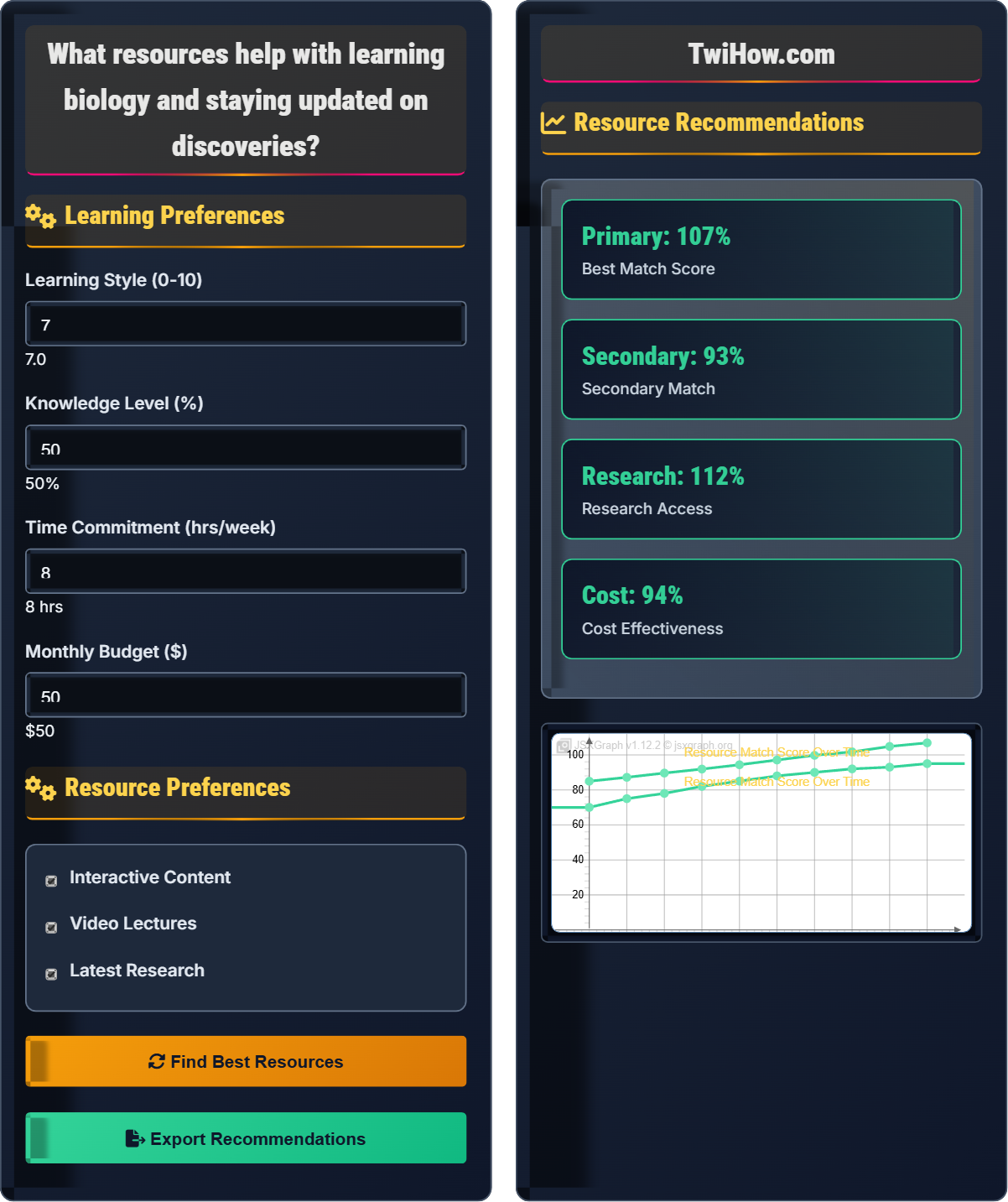
Learning Preferences
Resource Preferences
Resource Recommendations
| Resource | Type | Match | Cost |
|---|---|---|---|
| Khan Academy Biology | Online Course | 95% | Free |
| Coursera Biology Courses | Online Course | 90% | $49/month |
| Nature Reviews Genetics | Journal | 85% | $29/month |
| Anki Biology Cards | App | 80% | Free |
Based on your preferences:
- Interactive Online Courses
- Video-Based Learning
- Research Journals
- Mobile Learning Apps
Recommended access strategies:
- University library access
- Open access journals
- Free trial periods
- Student discounts
Biology Learning Resources Explained
Biology learning resources encompass a wide range of materials and tools designed to facilitate the understanding of biological concepts, from basic cellular processes to complex ecosystem interactions. These resources vary in format, depth, and accessibility to accommodate different learning styles and knowledge levels.
The effectiveness of biology learning resources can be modeled as a combination of key factors:
Where:
- Content Quality: Accuracy, depth, and pedagogical value of material
- Accessibility: Ease of access and use for different audiences
- Interactivity: Engagement level and hands-on learning opportunities
- Currency: Timeliness and relevance of information
Key categories of biology learning resources:
- Textbooks: Comprehensive coverage of topics with structured learning
- Online Courses: Interactive learning with multimedia content
- Research Journals: Latest discoveries and peer-reviewed findings
- Mobile Apps: On-the-go learning and practice tools
- Virtual Labs: Simulated experiments and interactive experiences
- Podcasts: Audio content for learning during commutes or exercise
- Newsletter Subscriptions: Subscribe to science newsletters and updates
- Social Media Follows: Follow reputable scientists and institutions
- Conference Participation: Attend webinars and virtual conferences
- Research Alerts: Set up alerts for specific topics in databases
- Professional Networks: Join biology societies and online communities
- Podcast Series: Listen to science communication shows
Learning Resources Fundamentals
Textbooks, online courses, research journals, mobile apps, virtual labs, podcasts, open access.
LE = f(CQ, A, I, Cu)
Where LE = learning effectiveness, CQ = content quality, A = accessibility, I = interactivity, Cu = currency.
- Combine multiple resource types
- Verify source credibility
- Update resources regularly
Applications
Academic learning, professional development, research updates, science communication, continuing education.
- Create a resource portfolio
- Set up discovery systems
- Participate in communities
- Track new developments
- Information overload management
- Source verification
- Time management
- Cost considerations
Resource Learning Quiz
What does "open access" mean in the context of scientific journals?
Open access means that scientific research is freely available to anyone without requiring a subscription or payment. This model removes barriers to accessing scholarly research, allowing broader dissemination of knowledge. Open access journals often charge authors or their institutions to cover publication costs, rather than charging readers for access.
The answer is A) Anyone can access the journal without subscription fees.
Open access represents a significant shift in scientific publishing that democratizes access to research. Understanding this model is important for students and researchers who want to access the latest discoveries without expensive subscriptions. Open access promotes scientific collaboration and accelerates discovery by making research freely available.
Open Access: Free, unrestricted online access to scholarly research
Paywall: Subscription requirement to access content
Gold Open Access: Immediate open access upon publication
• Open access removes financial barriers
• Quality is maintained through peer review
• Search for open access versions of paywalled articles
• Use PubMed Central for free biology research
• Check institutional repositories
• Confusing open access with quality
• Not knowing where to find open access journals
• Assuming all online journals are open access
Explain the benefits and limitations of virtual laboratories for biology education. Include specific examples of what can and cannot be achieved with virtual vs. physical labs.
Benefits of Virtual Labs: 1) Safety - no risk of handling dangerous chemicals or organisms, 2) Cost-effectiveness - no equipment or supply costs, 3) Accessibility - available anytime, anywhere, 4) Repeat experiments - unlimited attempts without material costs, 5) Visualization - ability to see microscopic processes in detail.
Limitations: 1) Lack of tactile experience, 2) No real-world troubleshooting skills, 3) Limited to programmed scenarios, 4) Missing authentic laboratory environment, 5) Reduced fine motor skill development.
Examples of Achievable Tasks: Microscopy observation, DNA extraction simulation, population dynamics modeling, enzyme kinetics experiments.
Examples of Unachievable Tasks: Pipetting accuracy, sterile technique mastery, handling of live organisms, real chemical reactions, equipment calibration.
Virtual labs serve as excellent supplements to physical laboratories, particularly for introductory concepts and safety training. However, they cannot completely replace hands-on experience. The most effective approach combines virtual preparation with actual laboratory work, allowing students to familiarize themselves with procedures before attempting them in person.
Virtual Lab: Computer simulation of laboratory environment and procedures
Hands-on Lab: Actual physical laboratory experience with real equipment
Hybrid Learning: Combination of virtual and physical laboratory experiences
• Virtual labs complement but don't replace physical labs
• Safety training can be virtual
• Technical skills require physical practice
• Use virtual labs for preparation and review
• Combine with physical lab experience
• Take detailed notes in both settings
• Replacing all physical labs with virtual ones
• Not taking virtual labs seriously
• Confusing simulation with reality
You're a college student studying biology with a tight budget but strong motivation to excel. You have 10 hours per week to dedicate to supplementary learning beyond your coursework. Design an optimal resource portfolio that maximizes your learning while staying within a $20 monthly budget. Consider your needs for foundational knowledge, current research, and exam preparation.
Optimal Resource Portfolio:
Foundational Learning (4 hours/week): Khan Academy Biology (Free) - comprehensive coverage of basic concepts
Current Research (2 hours/week): PLOS Biology (Open Access) - peer-reviewed research in readable format
Practice & Review (3 hours/week): Anki flashcards with biology decks (Free) - spaced repetition for memorization
Current Events (1 hour/week): Science News magazine (Free online version) - latest discoveries and applications
Remaining Budget: $20 for occasional access to premium courses like Coursera specializations when needed for specific topics.
Total Cost: $0-$20 depending on premium course usage.
This resource portfolio demonstrates how to maximize learning effectiveness while managing constraints. The combination of free foundational resources with selective premium purchases allows for comprehensive learning while maintaining financial responsibility. The time allocation ensures consistent exposure to different aspects of biology learning.
Resource Portfolio: Strategic combination of learning resources
Spaced Repetition: Learning technique that optimizes memory retention
Open Educational Resources: Freely accessible teaching materials
• Balance free and paid resources
• Prioritize foundational knowledge
• Allocate time consistently
• Start with free resources first
• Use library access for paid content
• Take advantage of free trials
• Buying resources without trying free alternatives
• Not allocating time for practice
• Ignoring current research
You want to stay updated on CRISPR gene editing developments as they happen. Design a system using multiple resources to track this fast-moving field, including alerts, reading schedules, and verification methods.
Tracking System:
1) Primary Sources: Set up alerts for "CRISPR" in PubMed, Google Scholar, and Nature/Science journals
2) Secondary Sources: Subscribe to STAT News, The Scientist, and ScienceDaily CRISPR sections
3) Social Media: Follow key CRISPR researchers on Twitter (Jennifer Doudna, Feng Zhang, etc.)
4) Reading Schedule: 30 minutes daily for headlines, 2 hours weekly for in-depth articles
5) Verification: Cross-reference claims across multiple sources, check for peer review, look for expert commentary
6) Organization: Use tools like Zotero to save and categorize important papers
Weekly Review: Compile interesting developments and note questions for deeper investigation.
Staying current in rapidly evolving fields requires systematic approaches that balance comprehensiveness with manageability. The key is using multiple sources at different levels (primary research, expert commentary, media reports) to get comprehensive coverage while maintaining verification through cross-referencing.
Research Alert: Automated notification system for new publications
Primary Source: Original research publication
Secondary Source: Commentary or summary of primary research
• Use multiple source types
• Verify information through cross-referencing
• Maintain consistent reading schedule
• Set up email alerts for key terms
• Use RSS feeds for consistent updates
• Keep a research log for tracking developments
• Relying on single sources only
• Not verifying sensational claims
• Information overload without organization
Which of the following is the best way to verify the accuracy of a biology news article?
The most reliable way to verify a biology news article is to locate and examine the original research paper. Reading the abstract provides insight into the study's methods, results, and conclusions, allowing you to compare with how the media reported the findings. This helps identify any exaggerations, misinterpretations, or omissions in the news coverage.
The answer is B) Find the original research paper and read the abstract.
Verification is a critical skill in the information age. Popular media often simplifies or sensationalizes research findings. By returning to primary sources, readers can understand the actual scope and limitations of research, preventing misinterpretation of scientific findings. This practice builds research literacy and critical thinking skills.
Primary Source: Original research publication
Abstract: Summary of research study contents
Media Translation: Conversion of research into popular format
• Verify through original sources
• Read beyond headlines
• Consider study limitations
• Use PubMed to find original research
• Look for study sample sizes
• Check if study was peer-reviewed
• Trusting headlines without verification
• Sharing unverified information
• Confusing correlation with causation
FAQ
Q: What are the best free resources for learning biology at an advanced level?
A: Excellent free resources for advanced biology include:
Course Materials: MIT OpenCourseWare, Stanford Online, and edX offer university-level biology courses with lectures, readings, and assignments.
Research Access: PubMed Central (PMC) provides free access to millions of biomedical papers; arXiv has preprints in quantitative biology.
Interactive Tools: HHMI BioInteractive offers virtual labs, animations, and data explorations; PhET simulations for biological processes.
Textbooks: OpenStax Biology textbook is peer-reviewed and comprehensive; many universities post lecture notes online.
Specialized Resources: RCSB Protein Data Bank for molecular structures; NCBI databases for genomics.
Many universities also offer free access to their library databases for alumni or through institutional partnerships.
Q: How can I efficiently stay updated with research in my specific field of biology?
A: Effective strategies for staying current include:
Automated Alerts: Set up search alerts in PubMed, Google Scholar, and Web of Science for your key topics and authors.
Journal Clubs: Participate in or organize journal clubs with colleagues to discuss recent papers.
Social Media: Follow key researchers and institutions on Twitter; join LinkedIn groups in your field.
Conferences: Attend virtual conferences and webinars; many now offer recorded sessions.
Preprint Servers: Monitor bioRxiv and medRxiv for the latest unpublished research.
Collaboration Networks: Maintain connections with colleagues who share relevant papers.
I recommend dedicating 30-60 minutes daily to scanning titles and abstracts, then deeper reading for 2-3 important papers weekly.