How to Engage in Citizen Science for Environmental Monitoring
Complete guide • Step-by-step instructions
Citizen Science Engagement:
Find Environmental ProjectsCitizen science enables ordinary people to participate in meaningful scientific research and environmental monitoring. Through volunteer-based data collection, analysis, and interpretation, citizens contribute valuable information to scientific studies and conservation efforts. Popular environmental monitoring activities include air quality measurement, water testing, biodiversity surveys, climate observations, and pollution tracking.
Key benefits of citizen science:
- Scientific Contribution: Provides large-scale data that professional scientists couldn't collect alone
- Environmental Awareness: Increases public understanding of environmental issues
- Community Engagement: Builds local environmental stewardship
- Education: Offers hands-on learning opportunities
- Policy Influence: Supports evidence-based environmental decision-making
Getting started requires identifying your interests, finding appropriate projects, learning protocols, and committing to consistent data collection.
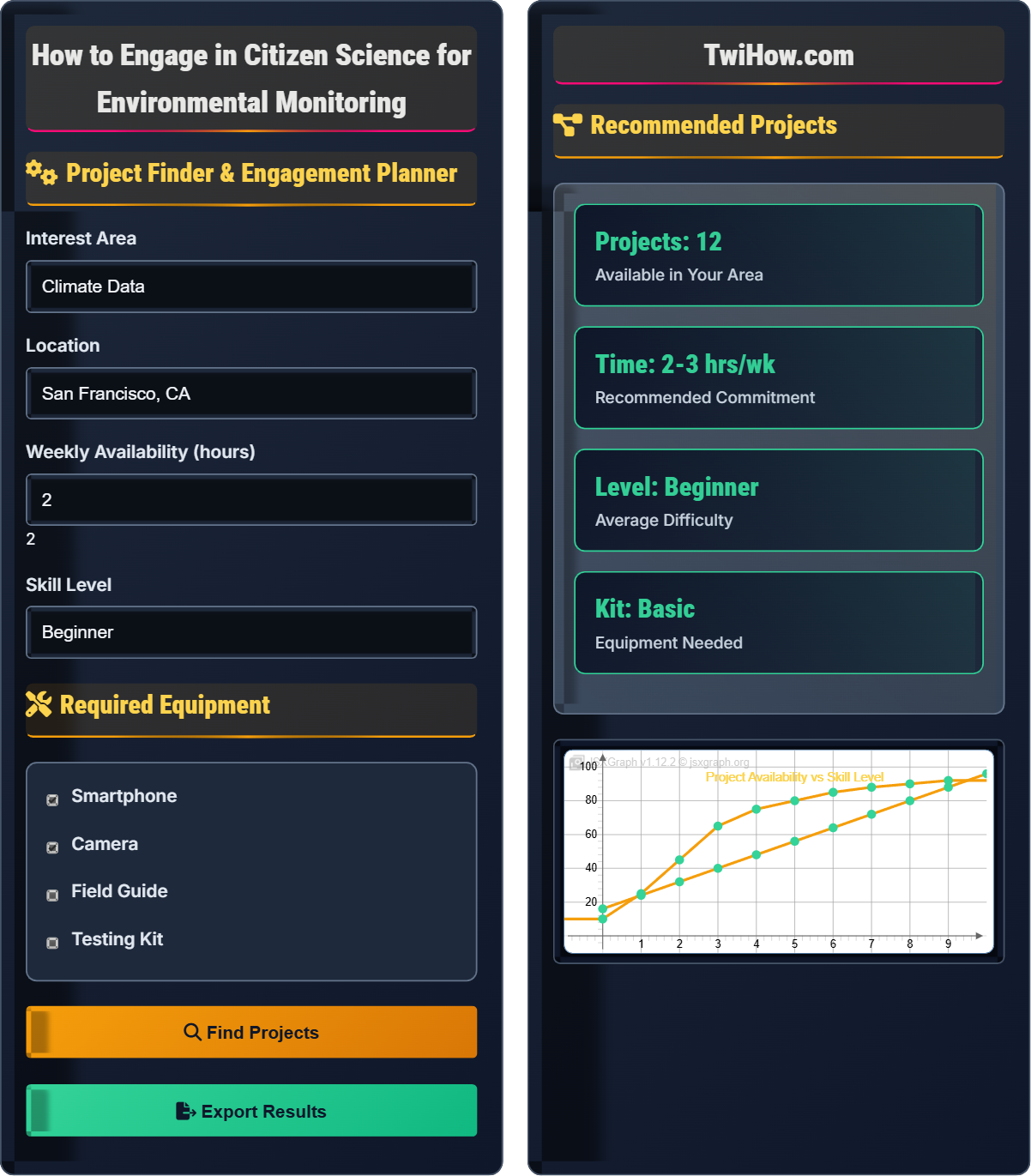
Project Finder & Engagement Planner
Required Equipment
Recommended Projects
| Project | Type | Difficulty | Time |
|---|---|---|---|
| CoCoRaHS | Climate | Beginner | 10 min/day |
| iNaturalist | Biodiversity | Beginner | As needed |
| Project BudBurst | Climate | Beginner | 15 min/wk |
| Stream Tracker | Water | Intermediate | 2 hrs/wk |
Citizen Science for Environmental Monitoring Explained
Choosing an appropriate citizen science project involves matching your interests, skills, and available time. Consider these factors:
- Topic Interest: Select a subject that genuinely interests you (birds, water quality, climate, etc.)
- Time Commitment: Ensure the project fits your schedule (daily, weekly, seasonal)
- Skill Level: Start with beginner-friendly projects and advance gradually
- Location Requirements: Consider accessibility and travel time to monitoring sites
- Equipment Needs: Verify you have or can obtain necessary equipment
- Training Requirements: Assess if you can complete required training modules
Popular environmental monitoring projects include iNaturalist for biodiversity, CoCoRaHS for precipitation, and GLOBE Observer for climate observations.
Following standardized protocols ensures data quality and scientific validity:
Key protocol elements include:
- Standardized Methods: Following exact procedures for measurements
- Calibration: Regularly calibrating instruments against known standards
- Documentation: Recording environmental conditions and methodology
- Replication: Taking multiple measurements when required
- Validation: Cross-referencing with expert identifications
- Consistency: Maintaining the same methodology over time
Protocols ensure that data collected by volunteers can be used in scientific research and policy decisions.
Water quality monitoring projects involve measuring various parameters:
- pH Levels: Using pH strips or digital meters to measure acidity
- Dissolved Oxygen: Critical for aquatic life health
- Turbidity: Clarity of water indicating sediment levels
- Temperature: Affects dissolved oxygen and aquatic organisms
- Nitrates and Phosphates: Indicators of nutrient pollution
- Bacterial Counts: Coliform bacteria indicating contamination
Projects like Stream Tracker and Water Quality Portal provide training and standardized protocols for consistent data collection.
Climate and air quality monitoring projects include:
- Precipitation Measurement: Daily rainfall recording through CoCoRaHS
- Cloud Observations: Reporting cloud types and coverage for NASA GLOBE Observer
- Temperature Logging: Recording daily maximum and minimum temperatures
- Phenology Tracking: Monitoring seasonal changes in plant and animal behavior
- Particulate Matter: Measuring air pollution levels
- Weather Documentation: Recording severe weather events and conditions
Project Categories
Water quality, air quality, biodiversity, climate, soil health, pollution tracking.
Reliability = (Training + Protocols + Consistency) ÷ (Variability + Error Rate)
Higher values indicate more scientifically valuable data.
- Follow protocols exactly as specified
- Document all environmental conditions
- Calibrate instruments regularly
Getting Started
Training, equipment, protocols, registration, documentation, consistency.
- Complete training thoroughly
- Start with simple projects
- Join online communities
- Stay consistent
- Document everything
- Time commitment sustainability
- Equipment costs and maintenance
- Seasonal availability
- Data sharing policies
Citizen Science Environmental Monitoring Quiz
What is the most important factor to consider when selecting a citizen science project?
The most important factor is selecting a project that aligns with your interests and fits your available time commitment. While all factors matter, sustainability is key to successful citizen science participation. If you choose a project that matches your interests, you're more likely to stay engaged long-term. Similarly, if the time commitment is realistic for your schedule, you'll be able to maintain consistent data collection, which is crucial for scientific validity.
While project popularity and institutional prestige may indicate quality, they don't guarantee that the project will work for your specific situation and interests.
The answer is C) The alignment with your interests and availability.
Success in citizen science depends on sustained participation over time. Volunteers who choose projects aligned with their interests and capabilities are more likely to contribute high-quality data consistently. This principle applies to all forms of voluntary participation in scientific research. The key is finding the right balance between personal motivation and practical constraints.
Citizen Science: Scientific research conducted in whole or part by amateur scientists
Data Quality: Accuracy, reliability, and scientific validity of collected data
Protocol Adherence: Following standardized procedures exactly as specified
• Sustainable participation requires realistic time commitments
Explain why following standardized protocols is crucial in citizen science projects and describe the consequences of not adhering to protocols.
Importance of Standardized Protocols:
- Scientific Validity: Standardized methods ensure that data can be used in scientific research and published studies
- Comparability: Data collected by different volunteers can be compared and combined for analysis
- Reproducibility: Other researchers can replicate studies using the same methods
- Quality Assurance: Protocols include built-in checks and balances to minimize errors
- Statistical Power: Consistent methods across many participants increase the reliability of results
Consequences of Protocol Violations:
- Data Rejection: Inconsistent data may be excluded from analysis
- Invalid Results: Poor data quality can lead to incorrect scientific conclusions
- Wasted Effort: Hours of data collection become worthless if not properly collected
- Project Reputation: Poor data quality can damage the credibility of the entire project
- Policy Impact: Inaccurate data can lead to poor environmental decisions
- Resource Waste: Time and funding invested in data collection is wasted
Following protocols ensures that citizen science contributions are meaningful and can contribute to real scientific understanding and environmental protection.
Scientific research requires rigorous methods to ensure that conclusions are valid and reliable. In citizen science, volunteers must follow the same standards as professional researchers to maintain data integrity. The protocols represent decades of scientific methodology refinement, and deviations can compromise the entire dataset. This is why training and protocol adherence are emphasized in citizen science projects.
Protocol: Standardized procedure for data collection
Data Integrity: Accuracy and consistency of collected data
Statistical Power: Ability of a study to detect meaningful differences
• Follow protocols exactly as written
You're participating in a stream monitoring project that requires weekly pH measurements. The protocol specifies using pH strips at the same time each week (10 AM), holding the strip in the water for exactly 10 seconds, and comparing colors under natural light. During your first month, you recorded pH values of 7.2, 7.5, 8.1, and 7.8. However, you realize you weren't following the timing protocol exactly and sometimes measured at different times of day. Calculate the potential error introduced by inconsistent timing and explain how to correct your approach.
Potential Error Analysis:
- Observed range: 7.2 to 8.1 (0.9 pH units variation)
- Expected natural variation: Typically ±0.2 pH units for stable streams
- Estimated error from inconsistent timing: 0.5-0.7 pH units
- True variation: Likely 0.2-0.4 pH units
Timing Effects:
- Diurnal Variation: pH naturally fluctuates throughout the day due to photosynthesis and respiration cycles
- Temperature Effects: Water temperature affects pH readings
- Biological Activity: Algae and plant activity vary with light and temperature
Correction Strategy:
- Establish Consistent Schedule: Measure at exactly 10 AM each week
- Record Environmental Conditions: Note weather, temperature, and recent precipitation Retest Initial Readings: Repeat measurements following proper protocol
- Document Protocol Adherence: Keep detailed notes about timing and conditions
- Communicate with Project Leaders: Report protocol inconsistencies for guidance
Consistent timing is crucial for detecting real environmental changes rather than measurement artifacts.
This example illustrates how seemingly minor protocol variations can significantly affect data quality. Environmental parameters like pH have natural diurnal cycles, and measurements taken at different times of day will show artificial variation. This masks real trends and makes it impossible to detect actual environmental changes. Standardized timing ensures that all measurements are comparable and that observed changes reflect actual environmental conditions rather than methodological differences.
Diurnal Cycle: Daily pattern of environmental changes
Protocol Deviation: Departure from standardized procedures
Measurement Artifact: Observed change due to measurement method, not actual change
• Timing consistency is crucial for environmental measurements
Your neighborhood has noticed increased air pollution, and you want to organize a citizen science project to monitor air quality. Develop a strategy to recruit participants, select appropriate monitoring methods, ensure data quality, and communicate findings to local authorities. Consider the challenges of maintaining long-term participation and dealing with potential political resistance.
Recruitment Strategy:
- Community Meetings: Present the project at neighborhood associations and environmental groups
- Social Media: Use Facebook groups, Nextdoor, and local community pages
- Local Partnerships: Collaborate with schools, libraries, and environmental organizations
- Simple Messaging: Emphasize the direct impact on family health and community environment
- Minimal Commitment: Start with simple, short-term activities to build confidence
Monitoring Methods:
- Particulate Matter: Use validated low-cost sensors for PM2.5 and PM10
- Visual Observations: Record smog visibility, odors, and unusual conditions
- Mobile Monitoring: Conduct measurements along different routes to map pollution
- Photographic Evidence: Document visible pollution and its sources
- Standard Protocols: Partner with established citizen science organizations
Data Quality Assurance:
- Training Sessions: Provide comprehensive training on equipment use and protocols
- Calibration Checks: Regularly compare sensors with reference instruments
- Quality Control: Implement peer review and data validation procedures
- Expert Collaboration: Work with university researchers for validation
- Documentation: Maintain detailed logs of all measurements and conditions
Communication Strategy:
- Professional Presentation: Create polished reports with clear data visualizations
- Multiple Channels: Present to city council, environmental agencies, and media
- Community Support: Demonstrate widespread community concern
- Constructive Solutions: Propose specific, feasible mitigation measures
- Ongoing Engagement: Maintain regular communication with authorities
Addressing political resistance requires patience, professionalism, and persistence while building broad community support.
This scenario demonstrates the complexity of translating citizen science into environmental action. Successful community-based monitoring requires not just good science but also effective community organizing, communication, and political engagement. The key is building trust, maintaining scientific rigor, and presenting findings in ways that resonate with decision-makers while empowering community members.
Community-Based Monitoring: Environmental monitoring led by local residents
Environmental Justice: Fair treatment of all people regarding environmental policies
Stakeholder Engagement: Involving all interested parties in the process
• Maintain scientific rigor while being community-focused
Which technology tools are most effective for citizen science data collection and submission?
Mobile apps with GPS integration and real-time submission are most effective for citizen science data collection. These tools offer several advantages:
- GPS Integration: Automatically records precise location data
- Real-Time Submission: Reduces data loss and ensures timely reporting
- Automated Protocols: Guides users through proper procedures step-by-step
- Photo Integration: Allows immediate documentation of observations
- Quality Control: Built-in validation checks and error prevention
- Offline Capability: Functions in areas with limited connectivity
- Data Validation: Immediate feedback on data quality and completeness
Examples include iNaturalist, eBird, CoCoRaHS Mobile, and GLOBE Observer apps. These tools significantly improve data quality and user engagement compared to traditional methods.
The answer is B) Mobile apps with GPS integration and real-time submission.
Modern citizen science has been revolutionized by mobile technology, which addresses many traditional barriers to participation. Smartphones provide multiple sensors (GPS, camera, accelerometer) that enhance data collection capabilities while simplifying the process for volunteers. The immediate feedback and validation provided by apps help ensure data quality while making the experience more engaging for participants.
Mobile App: Software application designed for smartphones and tablets
GPS Integration: Automatic recording of geographic coordinates
Real-Time Submission: Immediate data transmission to central database
• Leverage available technology to improve data quality
FAQ
Q: How can I ensure my data is scientifically valid and accepted by researchers?
A: Ensuring scientific validity requires attention to several key factors:
Training: Complete all required training modules and pass certification tests
Protocols: Follow standardized procedures exactly as specified, never improvising
Documentation: Record all environmental conditions and potential confounding factors
Consistency: Use the same methods, equipment, and timing whenever possible
Calibration: Regularly calibrate instruments against known standards
Quality Control: Participate in inter-comparison exercises when available
Reporting: Submit data promptly and include all required metadata
Many projects provide training and ongoing support to help volunteers achieve high data quality standards.
Q: How can I incorporate citizen science into my environmental education curriculum?
A: Citizen science provides excellent opportunities for hands-on environmental education:
Project Selection: Choose projects appropriate for student age and skill level, such as GLOBE Observer for climate or eBird for biodiversity.
Learning Objectives: Align projects with curriculum standards and learning goals.
Scientific Method: Use projects to teach hypothesis formation, data collection, and analysis.
Real-World Connection: Students see how their contributions matter to actual research.
Technology Integration: Utilize mobile apps and digital tools to enhance engagement.
Data Analysis: Have students analyze their own data and compare with others.
Communication Skills: Encourage students to present findings to authentic audiences.
This approach makes abstract environmental concepts tangible and meaningful for students.