How to Support Wildlife Conservation Efforts
Complete guide • Step-by-step explanations
Wildlife Conservation Support:
Calculate Your ImpactSupporting wildlife conservation involves multiple approaches including financial contributions, volunteering, sustainable living practices, advocacy, and education. Effective conservation requires protecting habitats, supporting research, reducing human-wildlife conflicts, and addressing root causes of biodiversity loss. Individual actions, when multiplied across millions of people, can create significant positive impacts for wildlife populations and ecosystems.
Key conservation support strategies:
- Financial Support: Donations to reputable organizations, adoption programs, wildlife trusts
- Volunteer Engagement: Field work, data collection, education programs
- Sustainable Living: Reducing consumption, eco-friendly choices, responsible tourism
- Advocacy: Policy support, raising awareness, political engagement
- Education: Learning and teaching others about conservation
- Habitat Protection: Supporting protected areas and habitat restoration
Every individual can make a meaningful contribution to wildlife conservation regardless of financial means or available time.
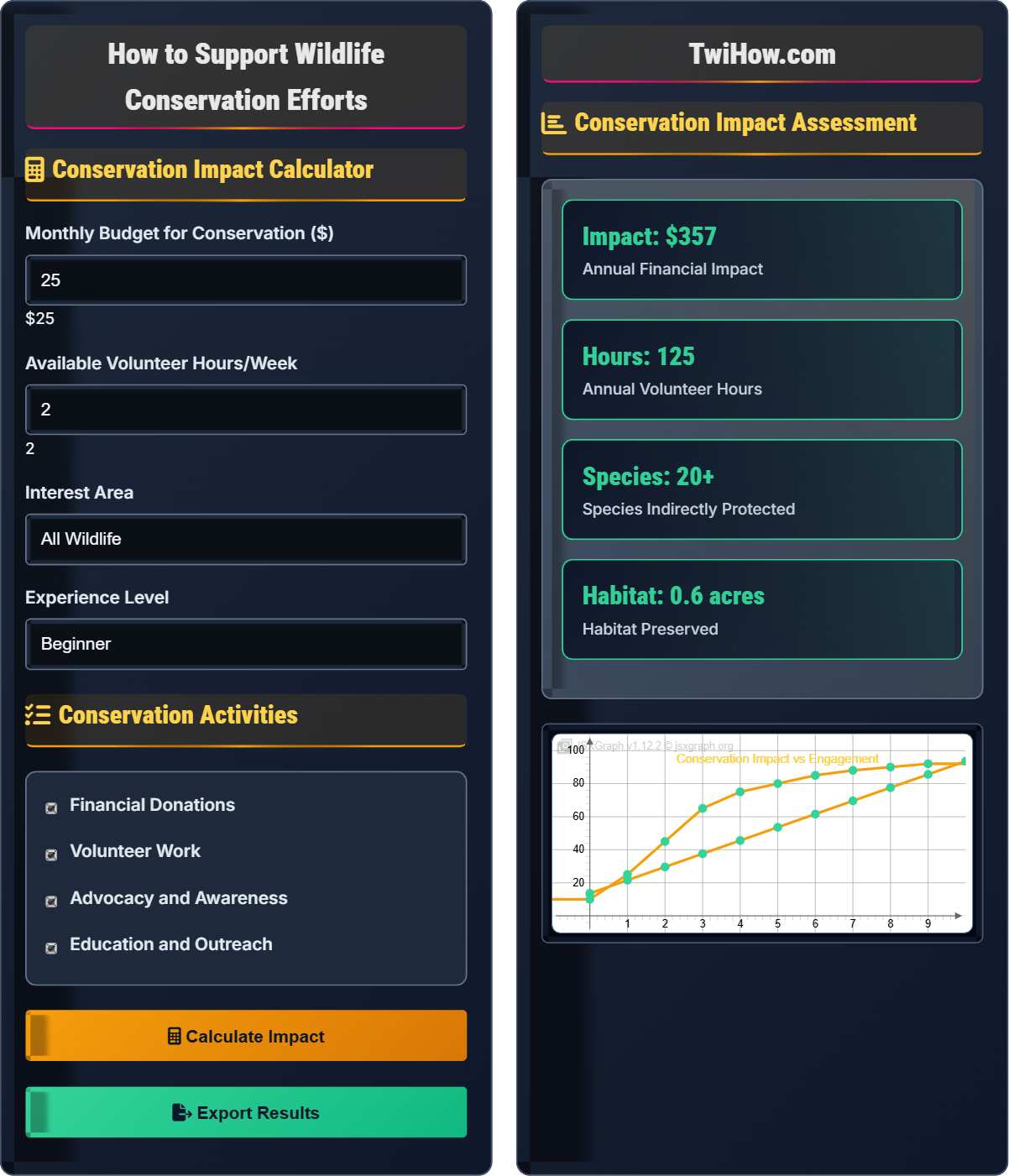
Conservation Impact Calculator
Conservation Activities
Conservation Impact Assessment
| Action | Impact | Time Required | Difficulty |
|---|---|---|---|
| Monthly Donations | High | 10 min | Easy |
| Local Volunteering | Medium | 2 hrs/week | Medium |
| Advocacy | Medium | 1 hr/week | Easy |
| Education | Low | 30 min/month | Easy |
Wildlife Conservation Support Explained
Financial contributions are essential for conservation organizations to fund critical programs:
- Direct Donations: One-time or recurring gifts to conservation organizations
- Species Adoption: Symbolic adoptions that support specific conservation programs
- Wildlife Trusts: Long-term funding for habitat protection and research
- Corporate Partnerships: Supporting businesses with conservation missions
- Legacy Giving: Including conservation in estate planning
- Matching Gifts: Leveraging employer donation matching programs
Even small donations, when aggregated, can fund significant conservation projects. A $25 monthly donation equals $300 annually, which can support habitat restoration for multiple species.
Volunteer involvement provides critical support for conservation programs:
Volunteer opportunities include:
- Field Surveys: Species monitoring, population counts, habitat assessments
- Habitat Restoration: Planting, invasive species removal, trail maintenance
- Education Programs: Leading tours, workshops, and community outreach
- Data Collection: Citizen science projects, research assistance
- Administrative Support: Office work, fundraising, event organization
- Specialized Skills: Photography, technology, legal, or medical expertise
Volunteering not only supports conservation directly but also builds community engagement and awareness.
Personal consumption choices significantly impact wildlife conservation:
- Responsible Tourism: Choose eco-friendly accommodations and tour operators
- Sustainable Seafood: Follow guidelines from organizations like Monterey Bay Aquarium
- Conflict-Free Products: Avoid palm oil, timber, and minerals from critical habitats
- Reduce Consumption: Minimize overall resource use and waste
- Native Plants: Use native species in landscaping to support local wildlife
- Responsible Pet Ownership: Prevent pets from harming wildlife
These choices reduce demand for products that harm wildlife while supporting sustainable alternatives.
Education amplifies conservation impact by creating informed advocates:
- Self-Education: Learn about local and global conservation issues
- Community Outreach: Organize presentations and workshops
- School Programs: Engage youth in conservation activities
- Social Media: Share accurate conservation information
- Storytelling: Share personal experiences with wildlife
- Partnerships: Collaborate with educators and organizations
Conservation Action Categories
Donations, adoptions, trusts, grants, corporate partnerships, legacy giving.
Conservation Impact = (Financial Support + Time Commitment + Advocacy Efforts) × Awareness Multiplication
Higher values indicate greater conservation effectiveness.
- Every action contributes to conservation
- Consistency is more valuable than intensity
- Local actions have global impact
Getting Started
Research, choose focus area, identify organizations, start small, expand involvement.
- Assess your resources and interests
- Research reputable organizations
- Start with small, manageable commitments
- Build skills and knowledge
- Expand involvement gradually
- Track and evaluate impact
- Verify organizational credibility
- Align activities with personal values
- Consider long-term sustainability
- Balance multiple conservation approaches
Wildlife Conservation Support Quiz
Which of the following is the most effective way to ensure your financial contribution supports wildlife conservation?
The most effective approach is to research organization effectiveness and transparency. Key factors to consider include:
- Financial Transparency: Review annual reports and financial statements
- Program Effectiveness: Look for measurable conservation outcomes
- Administrative Costs: Ensure most funds go to conservation programs
- Certification: Check for ratings from Charity Navigator or GuideStar
- Specific Mission: Ensure alignment with your conservation priorities
- Accountability: Organizations that report results and impact
While any donation helps, informed giving ensures maximum impact for wildlife conservation.
The answer is B) Research organization effectiveness and transparency.
This question emphasizes the importance of due diligence in charitable giving. Conservation organizations vary widely in their effectiveness, financial management, and impact. By researching organizations before donating, supporters can ensure their contributions have the greatest possible impact on wildlife conservation. This approach also helps identify organizations that align with personal values and conservation priorities.
Overhead Ratio: Percentage of funds spent on administrative costs
Charity Navigator: Organization rating and transparency platform
Outcome Measurement: Quantifiable results from conservation programs
• Verify financial transparency before donating
Describe different types of volunteer opportunities available for wildlife conservation and explain how to choose the right opportunity based on skills, interests, and time availability.
Field-Based Opportunities:
- Wildlife Surveys: Species counting, tracking, and monitoring (requires physical fitness and patience)
- Habitat Restoration: Planting, invasive species removal, trail maintenance (physical work, outdoor exposure)
- Research Assistance: Data collection, tagging, specimen preparation (scientific interest, attention to detail)
- Rescue Operations: Wildlife rehabilitation, emergency response (medical training helpful)
Office/Administrative Opportunities:
- Fundraising: Event organization, grant writing, donor relations (communication skills)
- Education: Leading tours, workshops, creating educational materials (teaching skills)
- Technology: Website development, data management, GIS mapping (technical skills)
- Legal/Policy: Research, advocacy, lobbying support (legal or political interest)
How to Choose Based on Skills:
- Physical Capabilities: Match activities to fitness level and comfort with outdoor work
- Professional Skills: Leverage career skills for conservation benefit
- Learning Preferences: Choose activities that match learning style
- Time Commitment: Match frequency to availability and schedule
- Impact Goals: Align activities with desired conservation outcomes
- Personal Interests: Choose activities that maintain long-term engagement
Start with short-term commitments to explore different opportunities before making longer-term commitments.
Volunteer opportunities in conservation span a wide range of activities, from physically demanding field work to desk-based administrative tasks. The key to successful volunteering is matching opportunities to personal capabilities, interests, and availability. This ensures both volunteer satisfaction and effective conservation outcomes. Many organizations provide training to help volunteers develop necessary skills.
Citizen Science: Volunteer-based scientific research and data collection
Conservation Volunteer: Person contributing unpaid time to conservation efforts
Field Work: Conservation activities conducted in natural environments
• Match activities to physical capabilities
A conservation advocate writes to their representative about a proposed wildlife protection bill. If the representative receives 100 similar letters from constituents, calculate the potential impact on the representative's voting decision. Assume that each constituent letter increases the likelihood of supporting the bill by 0.5%, and the representative's initial support probability is 60%.
Initial Support Probability: 60%
Impact per Constituent Letter: 0.5%
Number of Letters: 100
Total Impact from Letters: 100 letters × 0.5% = 50%
New Support Probability: 60% + 50% = 110%
Adjusted Probability: 100% (capped at maximum)
Realistic Assessment: While the mathematical calculation suggests 100% support, real-world factors include:
- Diminishing Returns: Additional letters beyond a threshold may have reduced impact
- Opposition Voices: Counter-advocacy may influence the representative
- Political Considerations: Party loyalty, re-election concerns, other pressures
- Information Quality: Well-researched letters are more persuasive than generic appeals
Effective Advocacy Strategy:
- Personal Stories: Share personal connections to the issue
- Local Impact: Emphasize effects on the representative's district
- Professional Perspective: Highlight economic or scientific rationale
- Coalition Building: Coordinate with other constituents for maximum impact
Individual advocacy, when coordinated with others, can significantly influence policy decisions.
This example illustrates the mathematical concept of cumulative advocacy impact while acknowledging real-world complexities. The calculation shows how individual voices, when aggregated, can have substantial influence on political decisions. However, the "capped" result demonstrates that other factors also influence political decisions, making advocacy a complex but important conservation tool.
Constituent: Voter in an elected official's district
Advocacy: Public support for a particular cause or policy
Political Influence: Effect of public opinion on elected officials' decisions
• Individual voices matter when aggregated
A family wants to reduce their impact on wildlife through sustainable lifestyle choices. They currently consume 100 units of products per month, with 40% coming from sources that harm wildlife habitats. Develop a strategy to reduce their harmful consumption by 60% over 6 months while maintaining quality of life. Calculate the environmental impact reduction.
Current Situation:
- Total monthly consumption: 100 units
- Harmful products: 40% of 100 = 40 units
- Sustainable products: 60% of 100 = 60 units
Target Reduction:
- 60% reduction in harmful consumption: 40 units × 0.60 = 24 units
- Remaining harmful consumption: 40 - 24 = 16 units
- New sustainable consumption: 60 + 24 = 84 units
- New sustainable percentage: 84% (from original 60%)
6-Month Implementation Strategy:
Month 1-2: Research and identify sustainable alternatives
- Research sustainable seafood guides
- Identify conflict-free palm oil products
- Find certified sustainable wood and paper
Month 3-4: Gradual substitution
- Replace 10 units of harmful products
- Focus on high-impact items first
- Learn about sustainable alternatives
Month 5-6: Complete transition
- Replace remaining 14 units
- Establish new purchasing habits
- Share experiences with others
Environmental Impact Reduction:
- Reduction in harmful consumption: 24 units
- Assuming each unit represents habitat impact: 24% reduction in habitat harm
- Increased sustainable consumption: 24 units
- Support for sustainable practices: 40% increase
Maintenance Strategies:
- Continue education about sustainable products
- Regular review of purchasing decisions
- Share knowledge with friends and family
- Support businesses with strong sustainability practices
This example demonstrates how individual consumption choices aggregate to create significant environmental impacts. The gradual approach recognizes that sustainable lifestyle changes require time to develop and maintain. The 6-month timeline allows for research, experimentation, and habit formation. The calculation shows that even modest changes can create meaningful reductions in environmental impact.
Consumer Impact: Environmental effect of purchasing decisions
Sustainable Consumption: Purchasing that minimizes environmental harm
Market Signals: How consumer choices influence producer behavior
• Small changes can have large impacts
Which approach is most effective for creating lasting conservation awareness in others?
Providing hands-on experiences with wildlife is the most effective approach for creating lasting conservation awareness. This approach works because:
- Emotional Connection: Direct experiences create personal connections to wildlife
- Memorable Impact: Experiences are more memorable than abstract information
- Empathy Development: Personal encounters foster empathy and care
- Behavioral Change: Experiences are more likely to inspire action
- Positive Association: Creates positive feelings about conservation
- Personal Relevance: Makes conservation personally meaningful
Types of Effective Experiences:
- Guided nature walks and wildlife observation
- Volunteer opportunities in conservation projects
- Wildlife photography or art activities
- Community conservation events
- Interactive educational programs
- Supporting local wildlife rehabilitation
While statistics and success stories are valuable, direct experiences create the strongest foundation for lasting conservation awareness.
The answer is C) Providing hands-on experiences with wildlife.
This question highlights the importance of experiential learning in conservation education. While facts and figures provide important context, personal experiences create emotional connections that drive long-term behavioral change. The hands-on approach engages multiple senses and creates memorable moments that can inspire lifelong conservation values. This principle applies to both children and adults.
Experiential Learning: Learning through direct experience and reflection
Conservation Awareness: Understanding of conservation issues and solutions
Environmental Identity: Personal connection to environmental values
• Experiences create stronger connections than information alone
FAQ
Q: How can someone with limited financial resources still make a meaningful impact on wildlife conservation?
A: There are many ways to support conservation without significant financial contributions:
Volunteer Time:
1. Local Organizations: Many groups need volunteers for office work, events, and field activities
2. Citizen Science: Participate in wildlife surveys, bird counts, and data collection
3. Community Outreach: Help with education programs and awareness campaigns
4. Skill Sharing: Offer professional skills like photography, writing, or technology
Advocacy Actions:
• Political Engagement: Contact representatives, attend hearings, vote for conservation candidates
• Public Awareness: Share information on social media and in your community
• Boycotts: Choose not to support businesses that harm wildlife
• Consumer Choices: Make sustainable purchasing decisions
Education and Outreach:
• Teach Others: Share knowledge with friends, family, and community
• School Visits: Volunteer to speak about conservation in classrooms
• Writing: Blog, write articles, or create educational content
• Storytelling: Share personal experiences with wildlife
Every action, regardless of financial cost, contributes to the conservation movement.
Q: What are some simple ways students can get involved in wildlife conservation?
A: Students can engage in conservation through many age-appropriate activities:
School-Based Activities:
• Environmental Clubs: Start or join a conservation-focused club
• Service Projects: Organize habitat restoration or clean-up events
• Fundraisers: Raise money for conservation organizations
• Presentations: Create and deliver conservation presentations
Personal Actions:
• Reduce Waste: Practice the 3 R's - Reduce, Reuse, Recycle
• Native Plants: Use native species in school or home landscaping
• Sustainable Choices: Make eco-friendly purchasing decisions
• Minimize Impact: Reduce energy and water consumption
Community Engagement:
• Volunteer: Participate in local conservation projects
• Advocacy: Write to local newspapers about conservation issues
• Education: Teach peers and family about conservation
• Outdoor Activities: Participate in nature walks and wildlife observation
Students have unique opportunities to influence both their peers and families.