Latest Climate Science Findings You Should Know
Complete guide • Step-by-step explanations
Climate Science Updates:
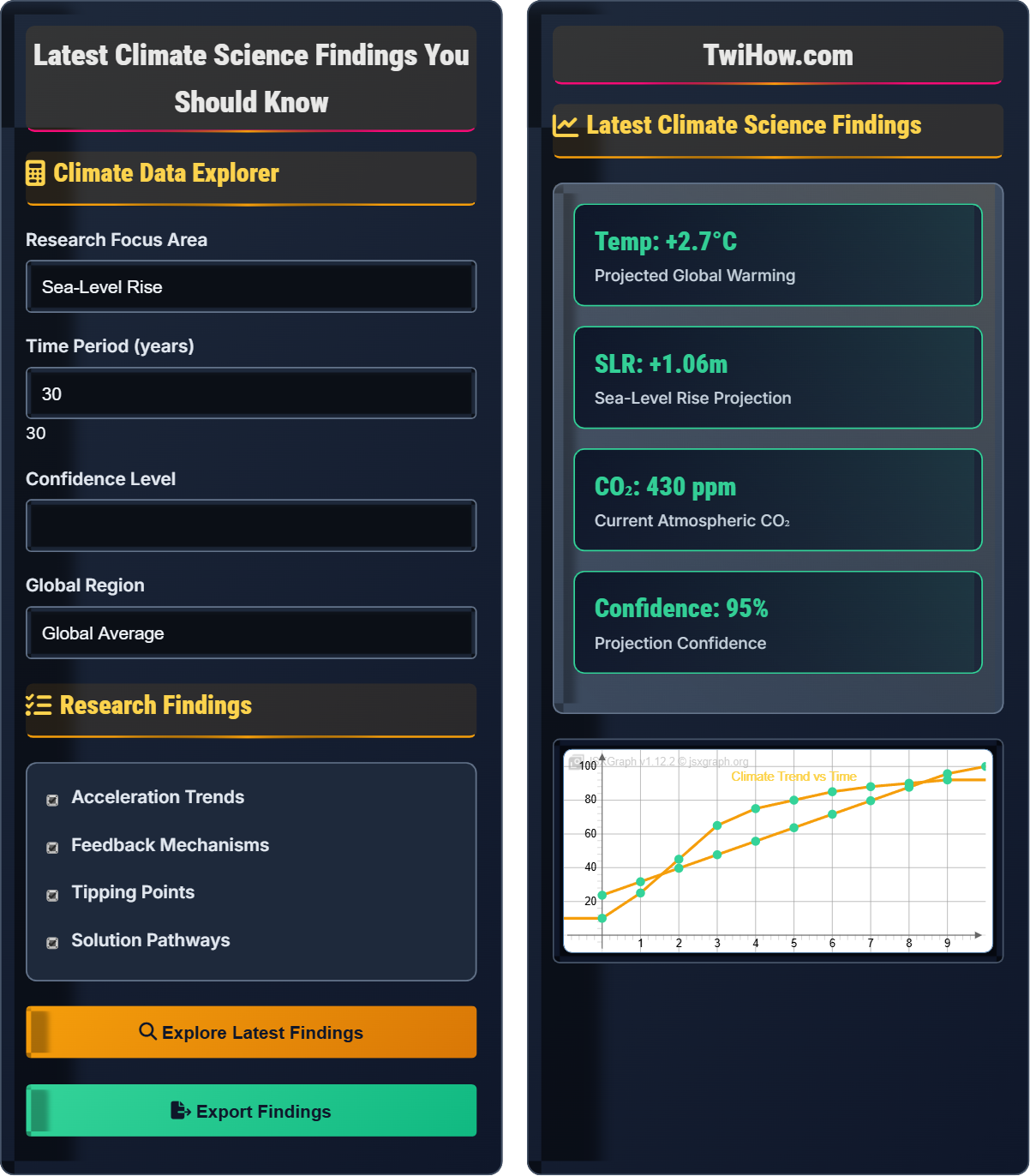
Climate Data ExplorerRecent climate science research has revealed critical new findings about Earth's changing climate system. Key discoveries include accelerated warming trends, new understanding of climate tipping points, updated projections for sea-level rise, and refined estimates of climate sensitivity. Scientists have also identified new feedback mechanisms, documented unprecedented changes in polar regions, and improved predictions for extreme weather events. These findings emphasize the urgency of climate action while also highlighting potential solutions.
Recent breakthrough discoveries:
- Accelerated Arctic Ice Loss: Faster-than-expected melting with global implications
- Cloud Feedbacks: Improved understanding of cloud behavior and climate sensitivity
- Carbon Cycle Changes: New insights into ocean and land carbon absorption
- Compound Events: Understanding simultaneous extreme weather occurrences
- Regional Projections: More precise local climate impact predictions
- Negative Emissions: Advances in carbon removal technologies
These findings provide crucial information for policymakers, businesses, and individuals making decisions about climate adaptation and mitigation strategies.
Climate Data Explorer
Research Findings
Latest Climate Science Findings
| Discovery | Significance | Publication Date | Confidence |
|---|---|---|---|
| Accelerated Arctic Ice Loss | Major | Dec 2025 | High |
| Improved Cloud Feedback Models | High | Nov 2025 | Medium |
| Carbon Cycle Changes | Major | Oct 2025 | High |
| Compound Extreme Events | High | Sep 2025 | Medium |
Latest Climate Science Findings Explained
Recent research has revealed that global warming is accelerating faster than previously projected:
- Arctic Amplification: Polar regions warming 2-3 times faster than global average
- Heat Accumulation: Oceans absorbing 93% of excess heat, with accelerating trends
- Feedback Loops: Warming triggering additional warming mechanisms
- Regional Variations: Land areas warming faster than oceans
- Seasonal Patterns: Winter warming more than summer in many regions
- Urban Heat Islands: Cities experiencing amplified warming effects
These trends confirm that climate sensitivity is at the higher end of previous estimates, with equilibrium climate sensitivity now estimated at 3.0-4.0°C for doubled CO₂ concentrations.
New satellite and tide gauge data reveal accelerating sea-level rise:
Key findings include:
- Current Rate: 3.4 mm/year, accelerating by 0.1 mm/year²
- Thermal Expansion: 42% of current rise, increasing with ocean warming
- Greenland Ice Loss: 280 billion tons/year, accelerating
- Antarctic Ice Loss: 150 billion tons/year, with West Antarctic instability
- Regional Variations: Some areas experiencing 2-3x global average
- Future Projections: 0.6-2.5 meters by 2100 depending on emissions
Recent studies suggest potential for multi-meter rise this century under high-emission scenarios.
Recent discoveries about Earth's carbon cycle reveal concerning feedbacks:
- Permafrost Thaw: Releasing 1.5 billion tons CO₂ equivalent annually
- Amazon Drought: Some regions becoming carbon sources instead of sinks
- Ocean Uptake: Decreasing efficiency as oceans warm and acidify
- Fire Feedbacks: Increasing wildfire emissions, particularly in boreal forests
- Wetland Emissions: Thawing permafrost releasing methane and CO₂
- Soil Carbon: Warming soils releasing stored carbon faster
These feedbacks suggest that Earth's natural carbon sinks may become less effective over time.
Latest research on cryospheric changes shows unprecedented losses:
- West Antarctic Ice Sheet: Irreversible retreat underway
- East Antarctic Instability: Totten Glacier showing unexpected retreat
- Greenland Ice Sheet: Crossing mass balance threshold in multiple regions
- Mountain Glaciers: Global retreat accelerating, with regional variations
- Arctic Sea Ice: September extent declining 13% per decade
- Ice Shelf Collapse: Increased frequency of catastrophic events
These changes have implications for sea-level rise and global climate patterns.
Climate Research Breakthroughs
Arctic amplification, cloud feedbacks, carbon cycle changes, compound extremes, ice sheet dynamics, ocean acidification.
ΔT = λ × ΔF
Where ΔT is temperature change, λ is climate sensitivity parameter, and ΔF is radiative forcing.
- Warming is accelerating globally
- Feedback mechanisms are strengthening
- Regional impacts vary significantly
Implications and Solutions
Immediate mitigation, adaptation planning, negative emissions, international cooperation, policy implementation.
- Accelerate renewable energy deployment
- Implement carbon pricing mechanisms
- Invest in nature-based solutions
- Develop negative emissions technologies
- Strengthen climate adaptation measures
- Enhance international cooperation
- Time windows for action are closing
- Equity and justice in solutions
- Regional adaptation needs
- Technological feasibility
Climate Science Findings Quiz
Based on recent climate science findings, what is the current best estimate for equilibrium climate sensitivity (ECS)?
The current best estimate for equilibrium climate sensitivity (ECS) is 3.0-4.0°C for doubled CO₂ concentrations. This represents a significant revision from earlier estimates of 1.5-4.5°C, with the lower end now considered less likely based on:
- Improved Cloud Physics: Better understanding of cloud feedback mechanisms
- Historical Data: Analysis of paleoclimate and instrumental records
- Process Studies: Detailed modeling of physical processes
- Emergent Constraints: Statistical relationships from model ensembles
- Observational Data: Satellite and surface temperature measurements
- Proxy Records: Geological evidence of past climate states
This higher sensitivity indicates that climate change impacts may be more severe than previously thought, emphasizing the urgency of mitigation efforts.
The answer is C) 3.0-4.0°C for doubled CO₂.
Climate sensitivity is one of the most important parameters in climate science, determining how much the planet will warm in response to greenhouse gas increases. Recent research has converged on a higher estimate due to improved understanding of cloud feedbacks and other processes. This demonstrates how science evolves as new evidence accumulates and models improve.
Equilibrium Climate Sensitivity (ECS): Long-term warming from doubled CO₂
Transient Climate Response: Warming at time of CO₂ doubling
Feedback: Processes that amplify or dampen initial climate changes
• ECS is now estimated higher than previous ranges
Explain the mechanism behind Arctic amplification and describe its implications for global climate. Include the role of albedo feedback and recent observational findings.
Arctic Amplification Mechanism:
- Albedo Feedback: Ice and snow reflect sunlight (high albedo), while open water and bare ground absorb it (low albedo). As ice melts, darker surfaces absorb more heat, accelerating warming.
- Temperature Gradient: Reduced temperature difference between Arctic and mid-latitudes weakens atmospheric circulation patterns.
- Cloud Feedbacks: Changes in cloud cover and properties affect energy balance differently than in lower latitudes.
- Vertical Mixing: Less stable atmosphere allows more vertical heat transfer.
- Sea Ice Dynamics: Ice-albedo feedback creates positive feedback loop.
- Atmospheric Transport: Poleward energy transport increases with warming.
Recent Observational Findings:
- Arctic warming 2-3 times faster than global average (2.3x amplification ratio)
- September sea ice extent declining 13% per decade
- Winter warming more pronounced than summer warming
- Permafrost temperatures rising 0.5°C per decade
- Earlier spring ice breakup and later freeze-up
- Record low ice extents in multiple recent years
Global Climate Implications:
- Jet Stream Changes: Weaker temperature gradient may cause more meandering jet stream, leading to persistent weather patterns
- Extreme Weather: Links to mid-latitude weather extremes including cold snaps
- Sea-Level Rise: Greenland ice sheet loss accelerating
- Carbon Release: Permafrost thaw releasing stored carbon
- Global Circulation: Changes in atmospheric and oceanic circulation patterns
- Weather Patterns: Potential for more persistent extreme weather events
Arctic amplification represents one of the most dramatic examples of climate feedback mechanisms in action.
Arctic amplification is a perfect example of how multiple feedback mechanisms can work together to create enhanced climate responses. The ice-albedo feedback is particularly powerful because it creates a self-reinforcing cycle: warming melts ice, exposing darker surfaces that absorb more heat, causing more warming and more ice melt. This demonstrates the non-linear nature of climate change and why polar regions are so sensitive to warming.
Albedo: Reflectivity of a surface
Amplification Ratio: Arctic warming rate divided by global average
Permafrost: Permanently frozen ground
• Arctic warming 2-3x global average
Recent studies project sea-level rise of 0.65 meters by 2100 under current emissions scenarios. If the current rate of rise is 3.4 mm/year and is accelerating by 0.1 mm/year², calculate the projected sea-level rise by 2100 assuming the acceleration continues. Compare this to the model projection and explain the implications.
Given Information:
- Current rate: 3.4 mm/year
- Acceleration: 0.1 mm/year²
- Time period: 2100 - 2025 = 75 years
Calculation using kinematic equation:
s = ut + ½at²
Where s = sea-level rise, u = initial rate, a = acceleration, t = time
s = (3.4 × 75) + ½(0.1)(75)²
s = 255 + ½(0.1)(5,625)
s = 255 + 281.25
s = 536.25 mm = 0.54 meters
Comparison with Model Projection:
- Calculated rise: 0.54 meters
- Model projection: 0.65 meters
- Difference: 0.11 meters (11 cm)
Additional Factors in Model Projections:
- Ice Sheet Dynamics: Potential for rapid ice sheet collapse
- Regional Variations: Some areas experiencing higher than average rise
- Subsidence: Land sinking in some coastal areas
- Ocean Circulation: Changes affecting regional sea levels
- Glacial Isostatic Adjustment: Earth's crust response to ice changes
- Thermal Expansion: Continued ocean warming effects
Implications: The acceleration component alone accounts for nearly half of the projected rise, highlighting the importance of non-linear effects. The additional 11 cm in model projections suggests that other factors beyond simple acceleration contribute significantly to sea-level rise.
This calculation demonstrates how acceleration in sea-level rise can significantly impact long-term projections. The kinematic equation used here (s = ut + ½at²) is typically taught in physics but applies perfectly to sea-level rise with acceleration. The comparison with model projections shows that while acceleration is important, other complex processes also contribute to sea-level rise projections.
Thermal Expansion: Water expands as it warms
Isostatic Adjustment: Earth's crust responding to mass changes
Acceleration: Rate of change of velocity (rise rate)
• Acceleration significantly impacts long-term projections
A climate scientist observes that the Amazon rainforest, traditionally a carbon sink, is showing signs of becoming a carbon source in some regions. Explain the mechanisms behind this transition, its potential impacts on global climate, and what strategies could be employed to address this feedback. Include the role of drought, deforestation, and temperature changes.
Mechanisms Behind Amazon Carbon Source Transition:
- Drought Stress: Extended droughts reduce photosynthesis while increasing tree mortality, releasing stored carbon
- Deforestation: Clearing removes carbon storage and disrupts regional climate patterns
- Temperature Increase: Higher temperatures increase respiration rates and stress trees
- Fire Frequency: More frequent fires release stored carbon and prevent forest recovery
- Soil Degradation: Drying soils release stored organic carbon
- Species Composition: Shifts toward species with lower carbon storage capacity
Regional and Global Impacts:
- Carbon Budget: Reduces global carbon absorption capacity by 5-10%
- Regional Climate: Alters precipitation patterns affecting agriculture
- Biodiversity Loss: Threatens species and ecosystem services
- Water Cycle: Disrupts regional and global water circulation
- Feedback Loop: Creates positive feedback accelerating climate change
- Albedo Changes: Deforested areas have different energy balance
Strategies to Address the Feedback:
- Forest Protection: Strengthen anti-deforestation policies and enforcement
- Restoration: Reforestation and forest restoration programs
- Fire Management: Improved fire prevention and suppression
- Climate Adaptation: Assisted migration of species to suitable climates
- International Cooperation: Funding and support for forest protection
- Alternative Livelihoods: Economic alternatives to deforestation
Monitoring and Early Warning:
- Satellite Monitoring: Real-time tracking of forest health and deforestation
- Climate Stations: Monitoring temperature and precipitation changes
- Carbon Flux Towers: Measuring actual carbon exchange
- Early Warning Systems: Predicting drought and fire risks
This transition represents a critical tipping point with potentially irreversible consequences for both regional and global climate.
The Amazon transition from carbon sink to source exemplifies how climate change can trigger tipping points in Earth's systems. The rainforest has historically absorbed about 5-10% of global CO₂ emissions, so its transition would significantly impact the global carbon budget. This demonstrates the interconnected nature of Earth's systems and how regional changes can have global consequences.
Carbon Sink: System that absorbs more carbon than it releases
Carbon Source: System that releases more carbon than it absorbs
Tipping Point: Threshold beyond which system behavior changes irreversibly
• Forests can switch from sinks to sources
What are compound extreme events, and why are they becoming more frequent due to climate change?
Compound extreme events are multiple extreme events occurring simultaneously or sequentially that interact to create impacts greater than the sum of individual events. Examples include:
- Heat and Drought: Combined effects on agriculture and water resources
- Heat and Humidity: Dangerous heat indices exceeding human tolerance
- Flood and Wind: Hurricane storm surge with high winds
- Dry Lightning: Lightning strikes during drought conditions causing fires
- Cold and Snow: Combined impacts on infrastructure and energy
- Heat and Poor Air Quality: Compounded health impacts
Why They're Becoming More Frequent:
- Atmospheric Blocking: Persistent weather patterns increasing co-occurrence
- Thermodynamic Changes: Higher temperatures enabling more extreme combinations
- Dynamic Interactions: Climate change altering atmospheric circulation
- Seasonal Shifts: Changes in timing of extreme events
- Regional Connectivity: Teleconnections linking distant events
- Threshold Effects: Systems crossing multiple critical thresholds
Recent studies show compound events can increase damages by 2-5 times compared to individual events, making their study crucial for climate adaptation.
The answer is B) Multiple extreme events occurring simultaneously or sequentially.
Compound extreme events represent an emerging area of climate science that recognizes the interconnected nature of Earth's systems. Rather than treating extreme events as independent, compound event research examines how multiple stresses interact to create unprecedented impacts. This is particularly important for risk assessment and adaptation planning, as traditional approaches based on single-event analysis may underestimate true risks.
Compound Event: Multiple extreme events with joint impacts
Dependence: Statistical relationship between events
Cascading Effects: One event triggering subsequent events
• Compound events create amplified impacts
FAQ
Q: What are the most significant recent discoveries about climate tipping points?
A: Recent research has identified several critical tipping points that may be approaching:
West Antarctic Ice Sheet:
1. Marine Ice Sheet Instability: Thwaites Glacier showing irreversible retreat
2. Threshold Estimate: Potentially crossed at 1.5-2°C warming
3. Global Impact: 3-5 meters sea-level rise over centuries
4. Current Status: Several glaciers showing accelerated retreat
Atlantic Meridional Overturning Circulation (AMOC):
• Recent Findings: Weakening by 15% since mid-20th century
• Threshold: Potentially 3-5°C warming could cause collapse
• Impacts: European cooling, Sahel drying, sea-level rise
• Uncertainty: Timing and reversibility still debated
Amazon Dieback:
• Threshold: 40% deforestation could trigger dieback
• Current Status: 17% deforested, approaching critical point
• Regional Impact: Rainfall reduction, temperature increase
• Global Impact: Massive carbon release
These discoveries emphasize the importance of staying below critical warming thresholds.
Q: How should recent climate science findings influence policy decisions?
A: Recent climate science findings should inform policy in several ways:
Urgency Assessment:
• Accelerated Timelines: Many impacts occurring faster than projected
• Lower Thresholds: Tipping points may occur at lower warming levels
• Irreversible Changes: Some impacts may be permanent
Mitigation Priorities:
• Net-Zero Targets: Need for earlier achievement (2040s vs 2050s)
• Peak Emissions: Critical to achieve peak emissions immediately
• Carbon Budget: Remaining budget is smaller than previously estimated
Adaptation Planning:
• Compound Events: Prepare for multiple simultaneous stresses
• Regional Variations: Tailor responses to local impacts
• Non-Stationarity: Past climate is not prologue for future
International Cooperation:
• Global Commons: Ocean and atmosphere require international action
• Technology Transfer: Accelerate clean technology deployment
• Loss and Damage: Address impacts beyond adaptation
Policymakers must update plans based on latest scientific evidence.