Environmental Impact of Meat and Dairy Production
Complete guide • Step-by-step explanations
Production Impact Assessment:
Calculate Environmental FootprintMeat and dairy production has significant environmental impacts including greenhouse gas emissions, water consumption, land use, deforestation, and biodiversity loss. Livestock farming accounts for approximately 14.5% of global greenhouse gas emissions, with cattle being the largest contributors. The environmental footprint varies significantly by animal type, with beef having the highest impact followed by lamb, pork, chicken, and dairy products.
Key environmental impacts:
- Greenhouse Gas Emissions: Methane from digestion, nitrous oxide from manure, and CO₂ from feed production
- Water Usage: Significant water requirements for animal hydration, feed crops, and processing
- Land Use: Extensive grazing and cropland for feed production
- Deforestation: Conversion of forests to pasture and feed crops
- Biodiversity Loss: Habitat destruction and species displacement
Reducing meat and dairy consumption, particularly beef, can significantly decrease environmental impact while maintaining nutritional adequacy.
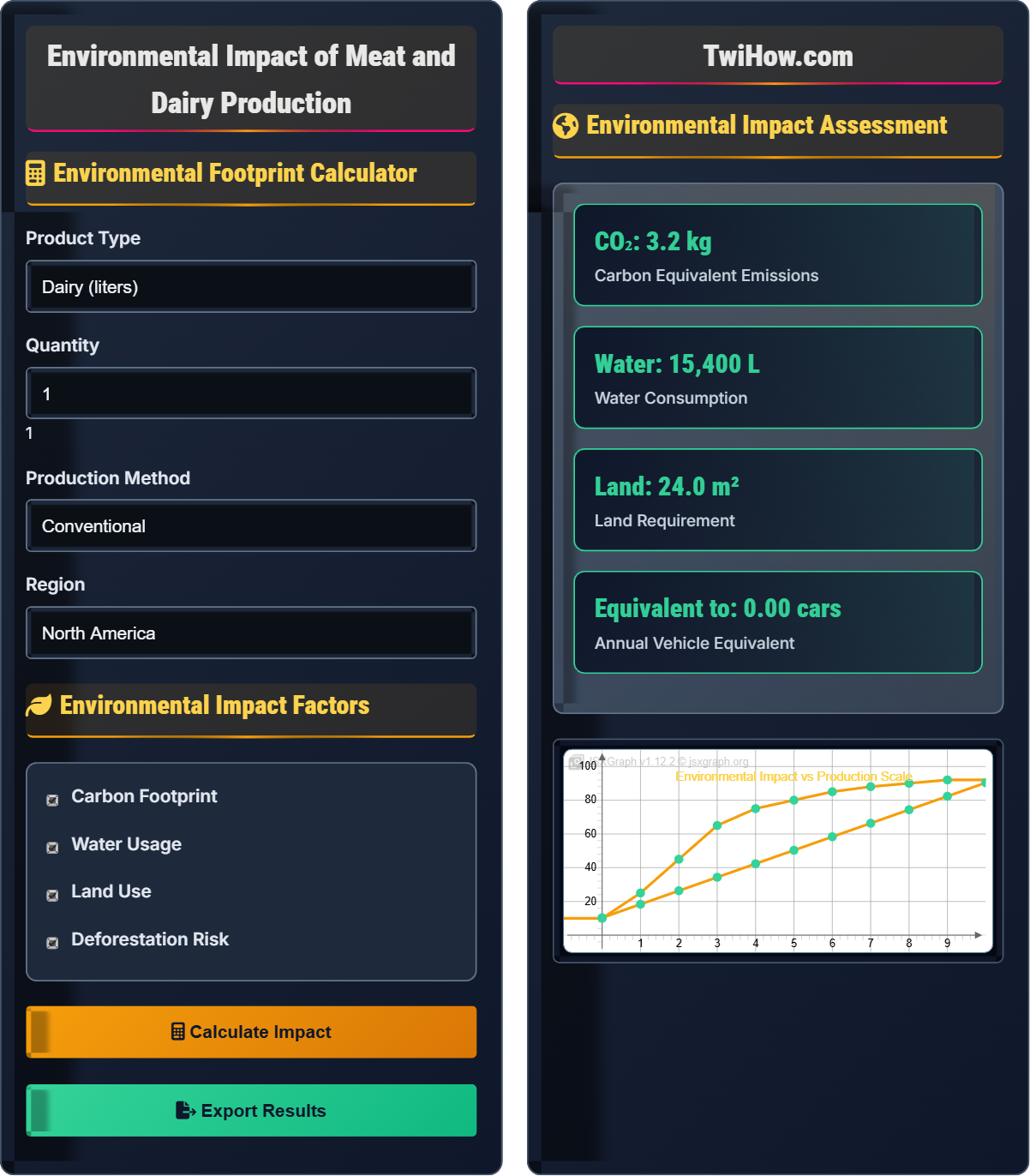
Environmental Footprint Calculator
Environmental Impact Factors
Environmental Impact Assessment
| Impact Type | Amount | Global Average | Comparison |
|---|---|---|---|
| CO₂ Emissions | 27.0 kg | 15.0 kg | High |
| Water Usage | 15,400 L | 10,000 L | High |
| Land Use | 24.0 m² | 15.0 m² | High |
| Deforestation Risk | Medium | Medium | Similar |
Meat and Dairy Environmental Impact Explained
Livestock farming contributes approximately 14.5% of global greenhouse gas emissions. The primary sources include:
- Methane (CH₄): Produced during ruminant digestion (enteric fermentation) and from manure decomposition
- Nitrous Oxide (N₂O): Released from nitrogen-rich manure and synthetic fertilizers used for feed crops
- Carbon Dioxide (CO₂): Emitted from deforestation, fossil fuel use in farming operations, and feed production
Beef production generates the highest emissions per kilogram of product (27-105 kg CO₂ eq/kg), followed by lamb (24-39 kg CO₂ eq/kg), pork (4.1-12.1 kg CO₂ eq/kg), and chicken (3.7-6.9 kg CO₂ eq/kg).
Meat and dairy production requires substantial water resources through direct animal consumption and indirect use for feed crops. The water footprint varies significantly by product:
Water usage per kilogram of product:
- Beef: 15,400 liters/kg
- Lamb: 10,400 liters/kg
- Pork: 5,990 liters/kg
- Chicken: 4,325 liters/kg
- Dairy: 1,020 liters/liter
The water footprint includes "green water" (rainfall), "blue water" (surface and groundwater), and "grey water" (water needed to dilute pollution).
Livestock farming contributes to water pollution through:
- Nitrogen and Phosphorus Runoff: From manure and fertilizers, causing eutrophication in waterways
- Antibiotic Resistance: Antibiotics used in livestock farming enter water systems
- Pathogen Contamination: Bacteria from animal waste affecting water quality
- Chemical Contamination: Pesticides and herbicides used for feed crops
These pollutants contribute to dead zones in aquatic ecosystems and affect drinking water quality.
Livestock farming affects biodiversity through multiple pathways:
- Habitat Loss: Conversion of natural ecosystems to pasture and feed crops
- Species Displacement: Native wildlife displaced by livestock operations
- Overgrazing: Degradation of grasslands and desertification
- Wildlife Conflicts: Predators killed to protect livestock
- Invasive Species: Introduction of non-native species for farming
- Genetic Diversity: Reduction in genetic diversity of domesticated animals
Environmental Comparison
Beef > Lamb > Pork > Chicken > Dairy > Eggs in terms of environmental impact.
Total Environmental Impact = (GHG Emissions + Water Usage + Land Use) ÷ Nutritional Value
Lower values indicate more environmentally efficient protein sources.
- Beef has the highest environmental impact per kg
- Production method significantly affects impact
- Regional variations influence environmental outcomes
Sustainable Alternatives
Plant-based proteins, regenerative agriculture, alternative proteins, sustainable farming practices.
- Reduce beef consumption
- Choose grass-fed and organic options
- Support regenerative farming
- Try plant-based alternatives
- Buy local and seasonal
- Nutritional adequacy of alternatives
- Economic feasibility
- Cultural acceptability
- Scalability of solutions
Meat and Dairy Environmental Impact Quiz
Which type of livestock product has the highest greenhouse gas emissions per kilogram of product?
Beef has the highest greenhouse gas emissions per kilogram of product, ranging from 27-105 kg CO₂ equivalent per kg. This is primarily due to:
- Methane Emissions: Cattle produce methane during digestion (enteric fermentation)
- Feed Requirements: Cattle require more feed per kg of product compared to other livestock
- Longer Lifecycle: Cattle take longer to reach market weight than other animals
- Manure Emissions: Large quantities of methane and nitrous oxide from cattle manure
Chicken has the lowest emissions among conventional meats, while lamb typically ranks second highest after beef.
The answer is B) Beef.
Understanding the relative environmental impacts of different animal products is crucial for making informed dietary choices. The significant differences in emissions are largely due to the biological characteristics of different animals and their feed conversion efficiencies. Ruminants like cattle and sheep produce methane as part of their digestive process, which is a potent greenhouse gas with 25 times the warming potential of CO₂ over a 100-year period.
CO₂ Equivalent: Measure of greenhouse gas emissions in terms of CO₂ impact
Enteric Fermentation: Digestive process in ruminants that produces methane
Feed Conversion Ratio: Amount of feed required to produce one unit of product
• Beef has the highest environmental impact among animal products
Calculate and explain the water footprint of producing 1 kg of beef compared to 1 kg of chicken. What are the main reasons for the difference in water requirements?
Water Footprint Comparison:
- Beef: 15,400 liters/kg (average)
- Chicken: 4,325 liters/kg (average)
- Ratio: Beef requires approximately 3.6 times more water than chicken
Main Reasons for Difference:
- Feed Requirements: Cattle require significantly more feed per kg of product due to lower feed conversion efficiency. Cattle convert about 7-10 kg of feed into 1 kg of meat, while chickens convert about 2 kg of feed into 1 kg of meat.
- Feed Crop Water: The majority of water used in livestock production goes toward growing feed crops. Different feed crops have varying water requirements.
- Lifecycle Duration: Cattle take 18-24 months to reach market weight, while chickens reach market weight in 6-8 weeks.
- Metabolic Differences: Ruminants have slower growth rates and less efficient metabolism compared to poultry.
- Water for Animals: Larger animals require more water for drinking and maintenance.
The water footprint includes three components: green water (rainfall), blue water (surface and groundwater), and grey water (water needed to assimilate pollution).
The water footprint concept is crucial for understanding the environmental impact of food production. It includes not just the direct water consumed by animals, but the much larger amount needed to grow their feed. This indirect water use often exceeds direct consumption by orders of magnitude. The comparison between beef and chicken illustrates how dramatically different animal products vary in their environmental requirements.
Water Footprint: Total volume of freshwater used to produce goods and services
Feed Conversion Ratio: Amount of feed required to produce one unit of animal product
Green Water: Rainfall incorporated into products
• Most water use in livestock production is for feed crops
Agricultural economists estimate that 77% of global agricultural land is used for livestock production, yet livestock provides only 18% of global calorie intake and 37% of protein. If a country allocates 1 million hectares to livestock farming, calculate the potential land savings if half of the beef consumption were replaced with plant-based protein alternatives that require 1/20th the land per gram of protein. Assume beef production uses 100 m² per kg and plant proteins use 5 m² per kg.
Current Situation:
- Total land allocated: 1,000,000 hectares (10 billion m²)
- Assume 50% of land for beef production: 5 billion m²
- Beef land requirement: 100 m² per kg
- Current beef production: 5 billion m² ÷ 100 m²/kg = 50 million kg
Scenario Analysis:
- Half beef consumption replaced: 25 million kg of beef eliminated
- Land freed from beef production: 25 million kg × 100 m²/kg = 2.5 billion m²
- Plant protein land requirement: 5 m² per kg
- Land needed for equivalent plant protein: 25 million kg × 5 m²/kg = 125 million m²
Land Savings Calculation:
- Land freed from beef: 2.5 billion m²
- Land needed for plant protein: 125 million m²
- Net land savings: 2.5 billion - 125 million = 2.375 billion m²
- Percentage savings: (2.375 billion ÷ 5 billion) × 100% = 47.5%
Replacing half of beef consumption with plant-based alternatives would save approximately 237,500 hectares of land while maintaining the same protein intake. This demonstrates the dramatic difference in land use efficiency between animal and plant protein production.
This calculation illustrates the inefficiency of livestock farming as a means of converting plant calories into animal calories. The "ecological pyramid" principle shows that energy is lost at each trophic level, making animal agriculture inherently less efficient. When we feed plants directly to humans instead of feeding them to animals first, we can feed more people with less land. This is why even modest reductions in animal product consumption can have significant environmental benefits.
Ecological Pyramid: Energy loss at each trophic level in food webs
Feed-to-Meat Ratio: Amount of feed required to produce one unit of meat
Carrying Capacity: Maximum population size an environment can sustain
• Animal agriculture is less efficient than direct plant consumption
Amazon deforestation in Brazil is estimated to be 80% driven by cattle ranching. If Brazil loses 10,000 km² of rainforest annually and 8,000 km² is attributed to cattle ranching, calculate the CO₂ release from deforestation and compare it to the CO₂ emissions from the cattle that would graze on that land. Assume deforestation releases 200 tons CO₂ per hectare and cattle emit 20 kg CO₂ equivalent per kg of meat produced. How many kilograms of beef would need to be produced to equal the CO₂ released from deforestation?
CO₂ Release from Deforestation:
- Forest area lost to cattle: 8,000 km² = 800,000 hectares
- CO₂ released per hectare: 200 tons
- Total CO₂ released: 800,000 hectares × 200 tons/hectare = 160 million tons CO₂
- CO₂ released in kg: 160 million tons × 1,000 kg/ton = 160 trillion kg CO₂
Equivalent Beef Production:
- Cattle emissions: 20 kg CO₂ equivalent per kg of beef
- Beef needed to equal deforestation CO₂: 160 trillion kg ÷ 20 kg/kg = 8 trillion kg of beef
- Beef needed in tons: 8 trillion kg ÷ 1,000 kg/ton = 8 billion tons
Contextual Analysis:
- Brazil produces approximately 10 million tons of beef annually
- At current production rates, it would take 800 years of Brazilian beef production to equal the annual deforestation CO₂ release
- This demonstrates that deforestation for cattle ranching creates far greater emissions than the cattle themselves
The CO₂ released from deforestation (160 billion kg) far exceeds the emissions from the cattle that would graze on that land, highlighting the devastating climate impact of converting forests to pasture.
This calculation reveals the massive carbon debt created by deforestation for livestock farming. Forests store enormous amounts of carbon in biomass and soil, and when cleared, this carbon is released as CO₂. The comparison shows that the emissions from deforestation often dwarf the emissions from the livestock that eventually occupy the cleared land. This is why tropical deforestation for cattle ranching is particularly problematic from a climate perspective.
Carbon Debt: CO₂ released from deforestation that must be offset by forest regrowth
Carbon Storage: Amount of carbon stored in living biomass and soil
Tropical Deforestation: Clearing of tropical forests for agriculture
• Deforestation creates massive carbon debt
How do different production methods (conventional, grass-fed, organic) affect the environmental impact of meat production?
Grass-fed beef typically has higher emissions and land use than conventional grain-fed beef. This is because:
- Longer Lifecycle: Grass-fed cattle take longer to reach market weight (typically 18-24 months vs. 12-16 months for grain-fed)
- Lower Feed Conversion: Grass is less digestible than grain, leading to lower growth efficiency
- Increased Methane Production: Grass-fed cattle may produce more methane per kg of meat due to longer growth periods
- Greater Land Requirements: Pasture-based systems require more land per kg of meat produced
However, grass-fed systems may have other benefits like improved animal welfare, soil health, and biodiversity in certain contexts. Organic production typically has similar or slightly higher environmental impacts than conventional due to lower yields, though it avoids synthetic pesticides and fertilizers.
The answer is C) Grass-fed beef typically has higher emissions and land use than conventional beef.
There's a common misconception that grass-fed beef is more environmentally friendly than conventional beef. While grass-fed systems may have some benefits for animal welfare and soil health, the environmental impact is often higher due to the longer lifecycle and lower efficiency. This illustrates the complexity of environmental trade-offs in food production and the importance of looking at quantitative data rather than assumptions.
Feed Conversion Efficiency: Amount of feed required to produce one unit of meat
Lifecycle Duration: Time from birth to market weight
Yield Gap: Difference between potential and actual production
• Grass-fed beef typically has higher environmental impact than grain-fed
FAQ
Q: How much would reducing meat consumption impact the environment, and what are the most impactful changes I can make?
A: Reducing meat consumption, especially beef, can have significant environmental benefits:
Individual Impact: A study found that switching to a vegetarian diet could reduce an individual's food-related emissions by 63%, while eliminating beef alone could reduce emissions by 29%.
Most Impactful Changes:
1. Reduce Beef Consumption: Even small reductions in beef consumption have a large environmental impact
2. Choose Chicken Over Beef: Chicken has about 1/4 the emissions of beef
3. Reduce Food Waste: Wasted food represents wasted resources
4. Buy Local and Seasonal: Reduces transportation emissions
5. Choose Plant-Based Proteins: Legumes, nuts, and grains have much lower environmental impacts
Even modest changes like "Meatless Monday" or replacing beef with chicken can make a meaningful difference at scale.
Q: What are the environmental benefits and challenges of alternative protein sources like lab-grown meat and plant-based alternatives?
A: Alternative proteins offer both opportunities and challenges:
Lab-Grown Meat Benefits:
• Eliminates methane emissions from livestock
• Reduces land and water use
• Eliminates animal welfare concerns
Lab-Grown Meat Challenges:
• Currently requires significant energy for cell culture processes
• High production costs and scalability challenges
• Regulatory approval and consumer acceptance
Plant-Based Alternatives Benefits:
• Much lower environmental impact than animal products
• Lower production costs
• Established regulatory framework
Plant-Based Challenges:
• Taste and texture may not match traditional meat
• Some processing may be required
• May require more complex ingredients
Both alternatives have potential to significantly reduce environmental impacts, though they face different technological and market challenges.