How Do I Inspire the Next Generation of Space Enthusiasts?
Complete inspiration guide • Activities, education & engagement
Space Inspiration:
Show Inspiration SimulatorInspiring the next generation of space enthusiasts requires a multifaceted approach that combines hands-on experiences, storytelling, role models, and accessible educational resources. Whether you're a teacher, parent, mentor, or community leader, you can ignite passion for space science through engaging activities, real-world connections, and by showing young minds that space exploration is both achievable and exciting.
Successful space inspiration involves connecting abstract concepts to tangible experiences, celebrating diverse role models in space science, and creating opportunities for students to see themselves in space-related careers. The goal is to foster curiosity, critical thinking, and a lifelong love of learning about our universe.
Key strategies include:
- Hands-On Activities: Build rockets, telescopes, and space experiments
- Real-World Connections: Link space science to daily life
- Role Models: Showcase diverse space professionals
- Accessible Resources: Free apps, websites, and tools
With the right approach, anyone can spark a passion for space that lasts a lifetime.
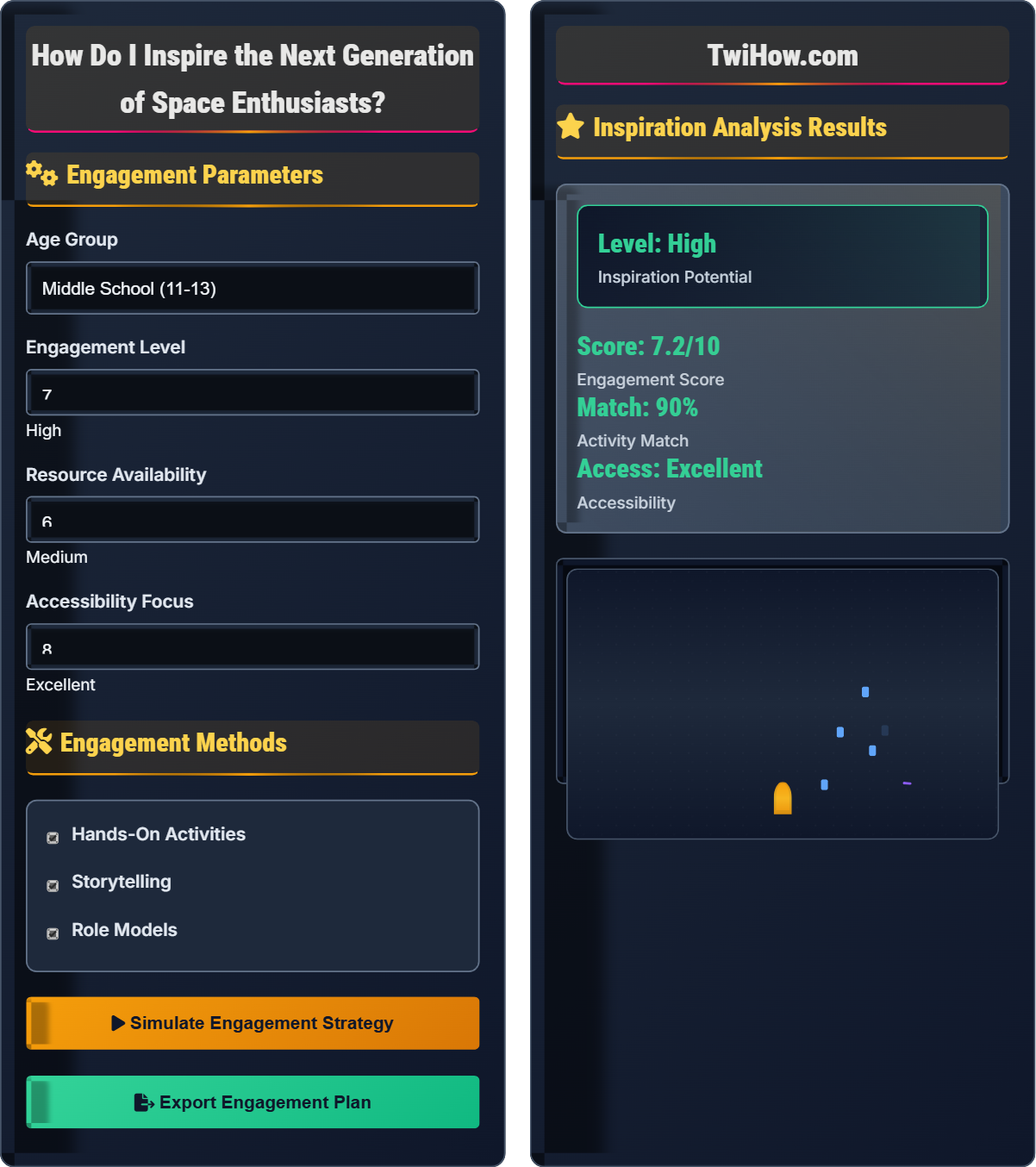
Engagement Parameters
Engagement Methods
Inspiration Analysis Results
| Activity | Age Suitability | Engagement | Difficulty |
|---|---|---|---|
| Build Model Rockets | Middle-High | 9/10 | Medium |
| Stargazing Nights | All Ages | 8/10 | Easy |
| Space Apps Challenge | High-College | 9/10 | Hard |
| Planetarium Visits | All Ages | 8/10 | Easy |
Free Resources
- NASA Kids Club: Games and activities for children
- Stellarium: Free planetarium software
- ISS Live: Real-time space station data
- Space Apps Challenge: Global hackathon
Space Inspiration and Engagement Strategies Explained
Effective space inspiration follows a structured approach:
- Curiosity: Spark initial interest with wonder and amazement
- Connection: Link space concepts to familiar experiences
- Exploration: Provide hands-on experiences and activities
- Role Models: Showcase diverse professionals in space careers
- Opportunity: Create pathways for continued engagement
The effectiveness of inspiration can be modeled as:
Where:
- E: Engagement level
- C: Curiosity factor (how intriguing the topic is)
- R: Relevance to daily life
- A: Accessibility of resources
- D: Diversity of role models
- T: Tangibility of experiences
This formula helps prioritize engagement strategies.
Diverse role models are crucial for inspiration:
- Gender Diversity: Showcase women in space science
- Ethnic Diversity: Highlight underrepresented groups
- Career Diversity: Engineers, scientists, astronauts, technicians
- Background Diversity: Non-traditional paths to space careers
- Age Diversity: Young professionals and veterans
Different learning styles require varied approaches:
- Visual Learners: Videos, images, infographics
- Hands-On Learners: Experiments, building projects
- Auditory Learners: Podcasts, lectures, discussions
- Reading/Writing: Articles, reports, journals
- Social Learners: Group projects, competitions
Engagement Strategies
Hands-on activities, storytelling, role models, real-world connections, accessibility.
Impact = (Engagement × Accessibility × Relevance) / Barrier
Maximize engagement while minimizing barriers to participation.
- Start with wonder and curiosity
- Connect to real-world applications
- Provide diverse role models
- Offer multiple pathways to participation
Activity Resources
Free apps, online tools, physical materials, virtual experiences, community programs.
- Introduction to concepts
- Hands-on exploration
- Real-world application
- Advanced challenges
- Career guidance
- Free and accessible resources preferred
- Age-appropriate complexity
- Cultural sensitivity
- Technical accessibility
Inspiration Activities
Age: Middle-High School | Materials: Cardboard, engine, fins
Building and launching model rockets provides hands-on experience with physics principles like thrust, drag, and gravity. Students learn about engineering, design, and safety while experiencing the thrill of space flight. This activity combines science, technology, engineering, and mathematics in an engaging way.
Age: All Ages | Materials: Telescopes, star charts, binoculars
Organizing stargazing nights allows participants to observe celestial objects directly. Using telescopes, binoculars, or even the naked eye, people can see planets, star clusters, and nebulae. These events create memorable experiences and foster appreciation for astronomy.
Age: High School-College | Materials: Computers, internet, NASA data
The NASA International Space Apps Challenge is a global hackathon where participants solve real-world problems using NASA data. Teams work on challenges related to Earth, space, and human exploration. This event encourages innovation, collaboration, and problem-solving skills.
Age: All Ages | Materials: VR headsets, space apps
Virtual reality provides immersive experiences of space environments. Students can virtually walk on Mars, explore the International Space Station, or travel through the solar system. VR makes abstract concepts tangible and memorable.
Age: Elementary-High School | Materials: Books, videos, presentations
Storytelling connects space science to human experience. Sharing stories of space missions, astronauts, and discoveries makes science relatable. Creating stories about space exploration encourages creativity and imagination while teaching scientific concepts.
Diverse Role Models
Examples: Mae Jemison, Sally Ride, Kalpana Chawla, Jessica Meir
Highlighting women in space science shows young girls that they can pursue STEM careers. These role models demonstrate that space exploration is for everyone, regardless of gender. Their stories inspire confidence and show diverse pathways to success.
Examples: Various countries' space agencies and astronauts
Showcasing international space programs demonstrates that space exploration is a global endeavor. Students see that people from many cultures contribute to our understanding of space, promoting inclusivity and global cooperation.
Examples: Artists, journalists, entrepreneurs in space industry
Space careers aren't limited to engineers and scientists. Artists create visualizations, journalists communicate discoveries, and entrepreneurs build new space companies. Showing diverse career paths helps students see themselves in space-related fields.
Space Inspiration Learning Quiz
Which activity would be most appropriate for elementary school students (ages 6-10)?
For elementary school students, simple crafts and storytelling are most appropriate. At ages 6-10, children have shorter attention spans and simpler cognitive abilities. Activities should focus on wonder, basic concepts, and fun experiences. Simple crafts like making paper rockets or drawing solar systems, combined with storytelling about space adventures, engage young minds effectively while introducing basic concepts.
The answer is B) Simple space crafts and storytelling.
This question emphasizes the importance of age-appropriate activities in education. Elementary students learn best through concrete experiences and imaginative play. Abstract concepts and complex activities can overwhelm young learners, while simple, engaging activities build foundational interest and understanding.
Age-Appropriate: Suitable for developmental stage
Cognitive Abilities: Mental capacity for learning
Attention Span: Length of focused attention
• Match complexity to developmental stage
• Use concrete experiences for young learners
• Build foundational interest first
• Start with wonder and amazement
• Use simple materials and concepts
• Combine hands-on with storytelling
• Underestimating the importance of simplicity
• Using overly complex activities for young children
• Forgetting that wonder is the first step to learning
Explain why diverse role models are important for inspiring space enthusiasm. How can educators effectively showcase different types of role models?
Importance of Diverse Role Models: Diverse role models help students see themselves in space careers. When students see people who look like them, share their background, or come from similar circumstances succeeding in space science, they're more likely to believe they can do it too.
Types of Role Models:
• Gender diversity: Women astronauts and scientists
• Ethnic diversity: Professionals from underrepresented groups
• Career diversity: Engineers, scientists, technicians, artists
• Background diversity: Non-traditional paths to space careers
Effective Showcasing: Share stories, invite speakers, show videos, highlight different career paths, emphasize that space careers come in many forms beyond astronauts.
This question highlights the psychological importance of representation in education. Students need to see people like themselves succeeding to believe they can achieve similar success. Diverse role models break stereotypes and expand students' perceptions of who belongs in space science.
Representation: Seeing people like yourself in a field
Role Model: Person whose behavior is emulated
Identity Formation: Developing sense of self
• Show diversity in all aspects
• Emphasize that space careers vary widely
• Use multiple types of role models
• Share personal stories and challenges
• Show the variety of space careers
• Only showcasing astronauts as role models
• Not representing diverse backgrounds
• Forgetting that role models can be diverse in many ways
A middle school teacher wants to engage 120 students in space science. She has a budget of $200 and access to a computer lab. Calculate the cost per student and recommend activities that would maximize engagement while staying within budget. Assume the engagement formula: E = (R × A × D) / C, where R=Relevance, A=Accessibility, D=Diversity, and C=Cost.
Cost per student:
$200 ÷ 120 students = $1.67 per student
Recommended activities:
• Free online planetarium software (Stellarium) - $0
• NASA's online resources and virtual tours - $0
• Paper rocket building (materials $50) - $0.42 per student
• Guest speaker via video call (donation-based) - $0
Strategy: Focus on free digital resources and simple hands-on activities. Use NASA's free materials, online simulations, and simple craft projects. The low cost per student allows for multiple activities that maximize engagement through diversity of experiences.
This problem demonstrates how to maximize engagement with limited resources. The key is to leverage free digital resources while incorporating hands-on activities. The engagement formula shows that accessibility (free/digital) and diversity (multiple activities) can compensate for cost constraints.
Cost-Effective: Maximum value for minimum cost
Resource Optimization: Best use of available resources
Engagement Formula: Model for calculating effectiveness
• Leverage free online resources
• Combine digital and hands-on activities
• Focus on accessibility and diversity
• Use NASA's free educational resources
• Combine multiple activity types
• Partner with local organizations for speakers
• Not utilizing free online resources
• Focusing only on expensive activities
• Forgetting that engagement can be maximized with low-cost options
You're organizing a space camp for students with different abilities and backgrounds. Evaluate how to make activities accessible to students with visual impairments, hearing difficulties, and mobility challenges. What adaptations would you make?
For Students with Visual Impairments:
• 3D models of planets and spacecraft
• Audio descriptions of visual content
• Tactile maps of solar system
• Verbal instructions and descriptions
For Students with Hearing Difficulties:
• Visual presentations with captions
• Written instructions
• Sign language interpreter if needed
• Text-based communication tools
For Students with Mobility Challenges:
• Accessible locations and equipment
• Modified hands-on activities
• Virtual reality experiences as alternatives
• Assistive technology for activities
Universal Design: Create activities that are inherently accessible to all students.
This question addresses the critical importance of accessibility in education. Universal design principles ensure that activities can be enjoyed by all students regardless of their abilities. This approach benefits everyone and ensures that no student is excluded from space science education.
Accessibility: Design for all users regardless of abilities
Universal Design: Design that works for everyone
Assistive Technology: Tools that aid users with disabilities
• Design for inclusion from the beginning
• Consider all types of disabilities
• Use multiple sensory channels
• Plan for accessibility during initial design
• Use multiple senses and learning modalities
• Consult with accessibility experts
• Not considering accessibility until after design
• Assuming one-size-fits-all approach
• Forgetting that accessible design benefits everyone
Which approach would best accommodate different learning styles when teaching about space exploration?
Using hands-on activities, videos, and group discussions accommodates different learning styles. Visual learners benefit from videos and demonstrations, kinesthetic learners from hands-on activities, auditory learners from discussions, and social learners from group interactions. This multi-modal approach ensures that all students can engage with space science regardless of their preferred learning style.
The answer is B) Hands-on activities, videos, and group discussions.
This question highlights the importance of differentiated instruction in education. Students have different learning preferences and abilities. A multi-modal approach ensures that all students can access the material in ways that work best for them, leading to better engagement and understanding.
Learning Styles: Preferred ways of receiving and processing information
Differentiated Instruction: Adapting teaching to different learning needs
Multi-Modal Approach: Using multiple methods of instruction
• Accommodate different learning preferences
• Use multiple instructional methods
• Engage multiple senses
• Offer multiple ways to learn the same concept
• Combine visual, auditory, and kinesthetic elements
• Allow for both individual and group learning
• Using only one teaching method
• Not considering different learning preferences
• Assuming all students learn the same way
FAQ
Q: What are the most effective ways to inspire students with limited science backgrounds?
A: Start with wonder and curiosity rather than complex concepts. Use storytelling, hands-on activities, and visual demonstrations. Focus on the amazing aspects of space that don't require prior knowledge - like the vastness of the universe, the beauty of nebulae, or the excitement of exploration. Make connections to everyday experiences and use analogies that students can relate to. Begin with simple activities and gradually increase complexity as interest develops.
Q: How can I encourage my child's interest in space if I don't know much about it myself?
A: You don't need to be an expert to inspire your child! Explore together by going stargazing, visiting planetariums, watching space documentaries, or using free apps like NASA's. Encourage questions and look up answers together. Share the excitement of discovery. Visit science museums, attend public astronomy events, and let your child teach you what they learn. Your enthusiasm and support are more important than your knowledge.
Q: What resources are available for free space education activities?
A: NASA offers extensive free educational resources including lesson plans, videos, and activities at nasa.gov/education. Stellarium is free planetarium software. Many planetariums and science centers offer free or low-cost programs. The International Astronomical Union has educational resources. Local astronomy clubs often provide free stargazing events. The European Space Agency also provides free educational materials. Many universities offer free online space courses.