How Do I Understand Complex Astronomical Concepts Without a Physics Background?
Complete astronomy guide • From basics to advanced concepts
Astronomy Learning Journey:
Show Concept SimulatorLearning astronomy without a physics background is absolutely possible! The key is to start with visual analogies, simple concepts, and gradual progression. Astronomy is largely about observation and patterns, making it accessible through careful visualization and conceptual understanding. By focusing on the "why" behind phenomena rather than complex mathematics, anyone can appreciate the wonders of the universe.
Begin with familiar concepts like seasons, day/night cycles, and moon phases, then progress to more complex ideas like stellar evolution, galaxies, and cosmology. Use visual tools, interactive simulations, and real-world analogies to make abstract concepts tangible. The universe follows patterns and principles that can be understood through observation and logical thinking.
Effective learning approaches include:
- Visual Learning: Diagrams, videos, and interactive tools
- Analogy Building: Relating complex concepts to everyday experiences
- Gradual Progression: Building from simple to complex concepts
- Pattern Recognition: Identifying repeating cycles and structures
With patience and the right approach, anyone can develop a deep appreciation for astronomical phenomena.
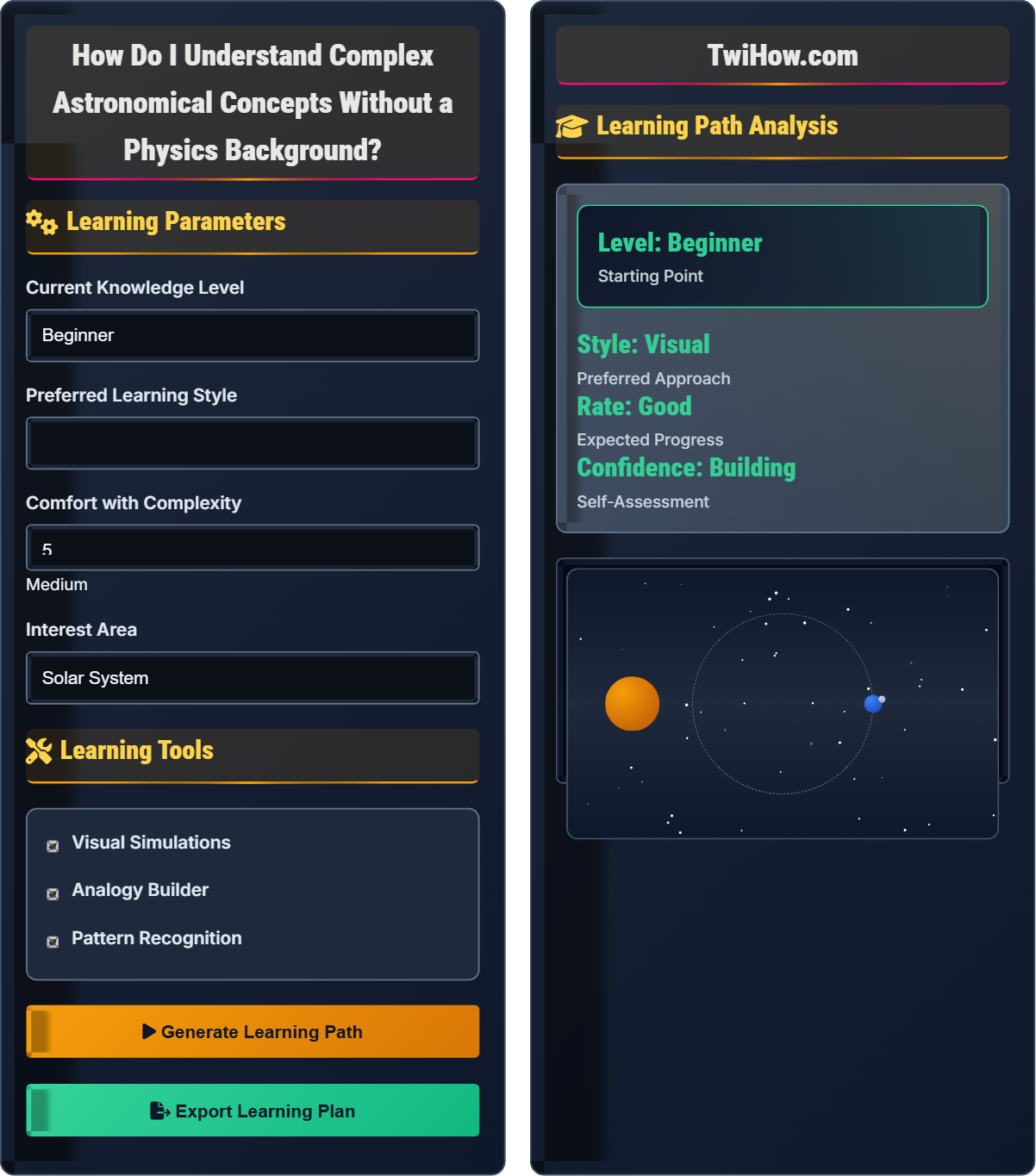
Learning Parameters
Learning Tools
Learning Path Analysis
| Stage | Concept | Time | Approach |
|---|---|---|---|
| 1 | Basic Sky Observations | 2 weeks | Visual |
| 2 | Solar System Basics | 3 weeks | Analogies |
| 3 | Stellar Evolution | 4 weeks | Patterns |
| 4 | Galaxies & Cosmology | 6 weeks | Visual |
Recommended Tools
- Stellarium: Free planetarium software
- NASA's Eyes: Interactive solar system viewer
- Universe Sandbox: Physics simulation software
- Star Charts: Mobile apps for sky identification
Astronomy Learning and Conceptual Understanding Explained
Learning astronomy without a physics background starts with developing intuition for cosmic phenomena:
- Visual Learning: Use diagrams, animations, and real observations
- Analogies: Relate complex concepts to familiar experiences
- Pattern Recognition: Identify repeating cycles and structures
- Scale Understanding: Grasp relative sizes and distances
- Gradual Progression: Build from simple to complex concepts
Conceptual understanding can be built using:
Where:
- Foundation: Basic concepts and facts
- Connections: Relationships between concepts
- Practice: Application and reinforcement
This approach emphasizes building understanding through layered connections.
Fundamental concepts that form the foundation of astronomical understanding:
- Scale: Relative sizes, distances, and time periods
- Motion: Orbits, rotations, and celestial mechanics
- Light: How we observe and understand distant objects
- Change: Evolution of stars, planets, and galaxies
- Patterns: Cycles, structures, and classifications
Proven strategies for understanding astronomy concepts:
- Start Local: Begin with Earth-Moon-Sun system
- Use Analogies: Compare cosmic phenomena to everyday experiences
- Visualize: Draw diagrams and mental pictures
- Connect Concepts: Link related phenomena together
- Practice Observation: Look at the sky regularly
Learning Approaches
Visual learning, analogies, hands-on activities, pattern recognition, progressive complexity.
Relative Scale = (Actual Size / Reference Size) × Visualization Factor
Helps comprehend astronomical distances and sizes through familiar references.
- Start with observable phenomena
- Build connections between concepts
- Use multiple senses and representations
- Practice regularly to reinforce learning
Conceptual Building Blocks
Observation, measurement, classification, patterns, scale, motion, change.
- Basic observations (day/night, seasons)
- Solar system mechanics (orbits, gravity)
- Stellar properties (life cycles, classification)
- Galactic structures (formation, evolution)
- Cosmology (universe structure, history)
- Master foundations before advancing
- Make connections between levels
- Verify understanding through application
- Seek multiple perspectives on concepts
Learning Stages and Approaches
Focus: Developing awareness of celestial patterns
Begin by observing the sky regularly. Notice how the Sun, Moon, and stars move across the sky. Pay attention to seasonal changes, moon phases, and the changing positions of constellations. This builds foundational awareness of celestial motions without requiring any physics knowledge.
Focus: Identifying and understanding recurring patterns
Learn to recognize patterns in celestial movements. Understand how the Earth's rotation causes day/night cycles, how its orbit creates seasons, and how the Moon's phases repeat monthly. These patterns form the basis for understanding more complex phenomena.
Focus: Linking related phenomena and concepts
Connect Earth's tilt to seasonal changes, relate the Sun's energy to weather and climate, and understand how gravity affects planetary motion. This stage involves seeing relationships between different astronomical phenomena.
Focus: Grasping the underlying physical processes
While avoiding complex mathematics, understand the physical principles that govern astronomical phenomena. Learn about energy, gravity, light, and matter in the context of space. This provides deeper insight into why things happen as they do.
Powerful Astronomical Analogies
Just as ice skaters spin faster when they pull their arms in, planets move faster in their orbits when they're closer to the Sun. This demonstrates conservation of angular momentum - a principle that works the same way in space as on the ice rink.
Think of stars as light bulbs at different distances. A nearby dim bulb can appear brighter than a distant bright bulb. This explains why some stars look brighter than others - they're not necessarily more luminous, just closer to us.
Imagine holding an umbrella tilted while walking in rain. The side facing forward gets more rain, just as the Earth's tilted axis means different hemispheres receive more direct sunlight at different times of year, creating seasons.
Stars are like candles burning fuel. Massive stars burn brightly but briefly, like candles with lots of wax burning fast. Smaller stars burn dimly but for much longer, like candles with little wax burning slowly.
Astronomy Learning Quiz
If the Earth were the size of a marble (1 cm diameter), how far away would the Sun be at the same scale?
The actual distance from Earth to Sun is about 150 million kilometers, while Earth's diameter is about 12,742 km. The ratio of distance to diameter is about 11,700 to 1. So if Earth were 1 cm, the Sun would be 11,700 cm away, which is about 117 meters - closest to option C. This demonstrates the vast emptiness of space and helps visualize the scale of our solar system.
The answer is C) 100 meters.
This question helps develop scale intuition for astronomical distances. The key insight is that space is incredibly empty - even in our own solar system, objects are relatively tiny compared to the distances between them. Understanding scale is fundamental to astronomy and helps appreciate the challenges of space exploration.
Astronomical Unit: Average Earth-Sun distance (150 million km)
Scale Model: Representation preserving relative proportions
Scale Factor: Ratio between model and actual sizes
• Space is mostly empty even in solar systems
• Distances vastly exceed object sizes
• Scale models help visualize cosmic proportions
• Use familiar objects as scale references
• Remember: astronomical distances are huge
• Scale models reveal the true emptiness of space
• Underestimating the vastness of space
• Thinking planets are close together
• Not appreciating the scale of astronomical distances
Explain why we have seasons on Earth. Use an analogy to make the concept clear without relying on complex physics.
Season Explanation: Seasons are caused by Earth's axial tilt of 23.5 degrees, not by changes in Earth's distance from the Sun. When the Northern Hemisphere is tilted toward the Sun, it receives more direct sunlight and experiences summer, while the Southern Hemisphere receives less direct sunlight and experiences winter.
Analogy: Imagine holding a flashlight (the Sun) and a globe (Earth). If you shine the flashlight straight down onto the globe, the top part gets more concentrated light (summer), while the bottom gets less concentrated light (winter). As you rotate the globe while keeping the flashlight angle constant, the seasons change.
Key Point: The hemisphere tilted toward the Sun receives more direct sunlight per square meter, making it warmer, regardless of Earth's distance from the Sun.
This question addresses one of the most common misconceptions in astronomy. Many people think seasons are caused by Earth's changing distance from the Sun, but it's actually due to the tilt of Earth's axis. The flashlight and globe analogy makes this visual and intuitive without requiring knowledge of physics.
Axial Tilt: Angle between Earth's rotational axis and perpendicular
Direct Sunlight: Light hitting surface at right angles
Indirect Sunlight: Light hitting surface at oblique angles
• Seasons are caused by axial tilt, not distance
• Hemispheres experience opposite seasons
• Earth's distance from Sun doesn't cause seasons
• Remember: tilt causes season changes
• Use the flashlight analogy to visualize
• Think about concentration of light on surface
• Thinking seasons are due to distance changes
• Not understanding the role of axial tilt
• Forgetting that hemispheres experience opposite seasons
Star A is twice as luminous as Star B, but Star A is four times farther away than Star B. Which star appears brighter in our sky? Use the inverse square law for light intensity: I = L / d², where I is apparent brightness, L is luminosity, and d is distance.
Given:
Let L_B = luminosity of Star B, so L_A = 2L_B
Let d_B = distance to Star B, so d_A = 4d_B
Calculations:
I_B = L_B / d_B²
I_A = L_A / d_A² = (2L_B) / (4d_B)² = (2L_B) / (16d_B²) = L_B / (8d_B²)
Comparison:
I_B = L_B / d_B²
I_A = L_B / (8d_B²) = (1/8) × I_B
Therefore, Star B appears 8 times brighter than Star A, even though Star A is twice as luminous!
This problem demonstrates how distance dramatically affects apparent brightness. Even though Star A is more luminous, its greater distance makes it appear dimmer. The inverse square law shows that brightness decreases rapidly with distance. This explains why we don't see very distant stars that might be extremely luminous.
Luminosity: Actual energy output of a star
Apparent Brightness: How bright a star looks from Earth
Inverse Square Law: Brightness decreases with distance squared
• Distance affects brightness more than luminosity
• Inverse square law: brightness ∝ 1/distance²
• Distant bright stars may be invisible to us
• Distance has a squared effect on brightness
• A nearby dim star can appear brighter than a distant bright star
• Remember: we see apparent brightness, not luminosity
• Forgetting the squared relationship in inverse square law
• Thinking luminous stars always appear bright
• Not considering the effect of distance
Explain why we see different phases of the Moon. Use an analogy to make the concept clear, and describe how the Moon's position relative to Earth and Sun creates these phases.
Moon Phase Explanation: The Moon doesn't produce its own light - it reflects sunlight. As the Moon orbits Earth, the angle between the Sun, Earth, and Moon changes, causing us to see different portions of the illuminated half of the Moon.
Analogy: Imagine a baseball (Moon) orbiting around you (Earth) with a flashlight (Sun) shining on it. As you walk in a circle around the room, the part of the baseball that's lit up changes depending on your viewing angle. Sometimes you see the fully lit side (full moon), sometimes only part of it (crescent), and sometimes none of it (new moon).
Phase Sequence: New Moon → Waxing Crescent → First Quarter → Waxing Gibbous → Full Moon → Waning Gibbous → Last Quarter → Waning Crescent → New Moon (approximately 29.5 days).
This question demonstrates how understanding perspective and geometry can explain astronomical phenomena. The baseball and flashlight analogy makes the concept visual and tactile. Students often think the Earth's shadow causes moon phases, but it's actually the changing viewing angle of the illuminated side.
Waxing: Growing larger (more illuminated)
Waning: Growing smaller (less illuminated)
Synodic Month: Time between new moons (29.5 days)
• Moon phases are due to changing viewing angle
• Not caused by Earth's shadow
• Takes about 29.5 days for complete cycle
• Use the baseball-flashlight analogy
• Remember: Moon always has one side lit by Sun
• Think about which part we can see from Earth
• Thinking Earth's shadow causes phases
• Not understanding the geometry involved
• Confusing rotation with revolution
Why do astronauts float inside the International Space Station?
Astronauts float because both they and the ISS are in free fall around Earth. The ISS is constantly falling toward Earth due to gravity, but it's also moving horizontally so fast that it keeps missing Earth - like being on an endless roller coaster drop. This creates weightlessness. Gravity is still present at ISS altitude (about 90% of Earth's surface gravity), but both the station and astronauts are falling at the same rate.
The answer is B) The ISS is moving so fast it falls around Earth.
This addresses one of the most common misconceptions about space. Students often think there's no gravity in space, but the reality is that objects in orbit are constantly falling. The key insight is that they're falling at the same rate as their spacecraft, creating the sensation of weightlessness. This is a perfect example of how understanding motion can explain seemingly mysterious phenomena.
Free Fall: Motion under gravity alone
Orbit: Falling while moving sideways fast enough to miss the planet
Weightlessness: Condition of apparent zero gravity
• Gravity exists everywhere in space
• Orbit is continuous free fall
• Weightlessness occurs when falling at same rate as surroundings
• Think of orbit as "falling around" Earth
• Remember: gravity is still present in orbit
• Astronauts and spacecraft fall together
• Thinking there's no gravity in space
• Not understanding orbital mechanics
• Confusing weightlessness with zero gravity
FAQ
Q: Do I need to learn physics to understand astronomy?
A: You don't need to master physics to understand and appreciate astronomy! Many astronomical concepts can be understood through observation, patterns, and analogies. While physics provides the underlying explanations, you can grasp the "what" and "how" of astronomical phenomena through visual learning and conceptual understanding. Start with observable patterns like seasons, moon phases, and planetary motions. As you progress, you can gradually incorporate more physics concepts if desired. The key is building intuition first, then adding quantitative understanding.
Q: How can I help my child learn astronomy without a science background myself?
A: You can learn alongside your child! Start with simple observations: watch the Moon's phases, identify constellations, and notice seasonal changes. Use apps like Star Walk or SkySafari to identify objects. Visit planetariums and astronomy museums. Read books together, watch documentaries, and use online resources. The key is curiosity and regular observation. You don't need to know everything - encourage questions and explore answers together. Many online resources explain concepts simply and visually, making astronomy accessible to everyone.
Q: What's the best way to start learning astronomy if I'm intimidated by science?
A: Start with what you can see! Go outside and look up. Begin with obvious phenomena: the Sun's path across the sky, moon phases, and seasonal changes. Use your smartphone's compass to notice directions. Download a stargazing app and start identifying bright stars and planets. Join a local astronomy club where you can look through telescopes. Astronomy is largely visual and observational - you're simply describing what you see. The mathematics and physics can come later if you wish. Focus on wonder and curiosity first.