How Do Planetary Scientists Study Worlds We Can't Visit Directly?
Complete planetary science guide • Remote sensing & analysis
Planetary Science Methods:
Show Planetary SimulatorPlanetary scientists employ sophisticated remote sensing techniques to study distant worlds without physically visiting them. Through advanced telescopes, spectroscopy, and mathematical modeling, researchers can determine the composition, atmosphere, geology, and even potential habitability of planets, moons, and other celestial bodies across the solar system and beyond.
Key methods include analyzing light spectra to identify chemical compositions, measuring gravitational effects to determine mass and density, observing surface features and atmospheric phenomena, and using mathematical models to interpret observational data. These techniques have revealed fascinating details about exoplanets, the geology of Mars, the subsurface oceans of Europa, and the complex atmospheres of gas giants.
Major research areas include:
- Telescopic Observations: Ground and space-based telescope studies
- Spectroscopic Analysis: Identifying chemical compositions from light signatures
- Gravitational Measurements: Determining mass and internal structure
- Photometric Studies: Analyzing brightness variations and albedo
Modern planetary science combines cutting-edge technology with theoretical physics to unlock the secrets of distant worlds.
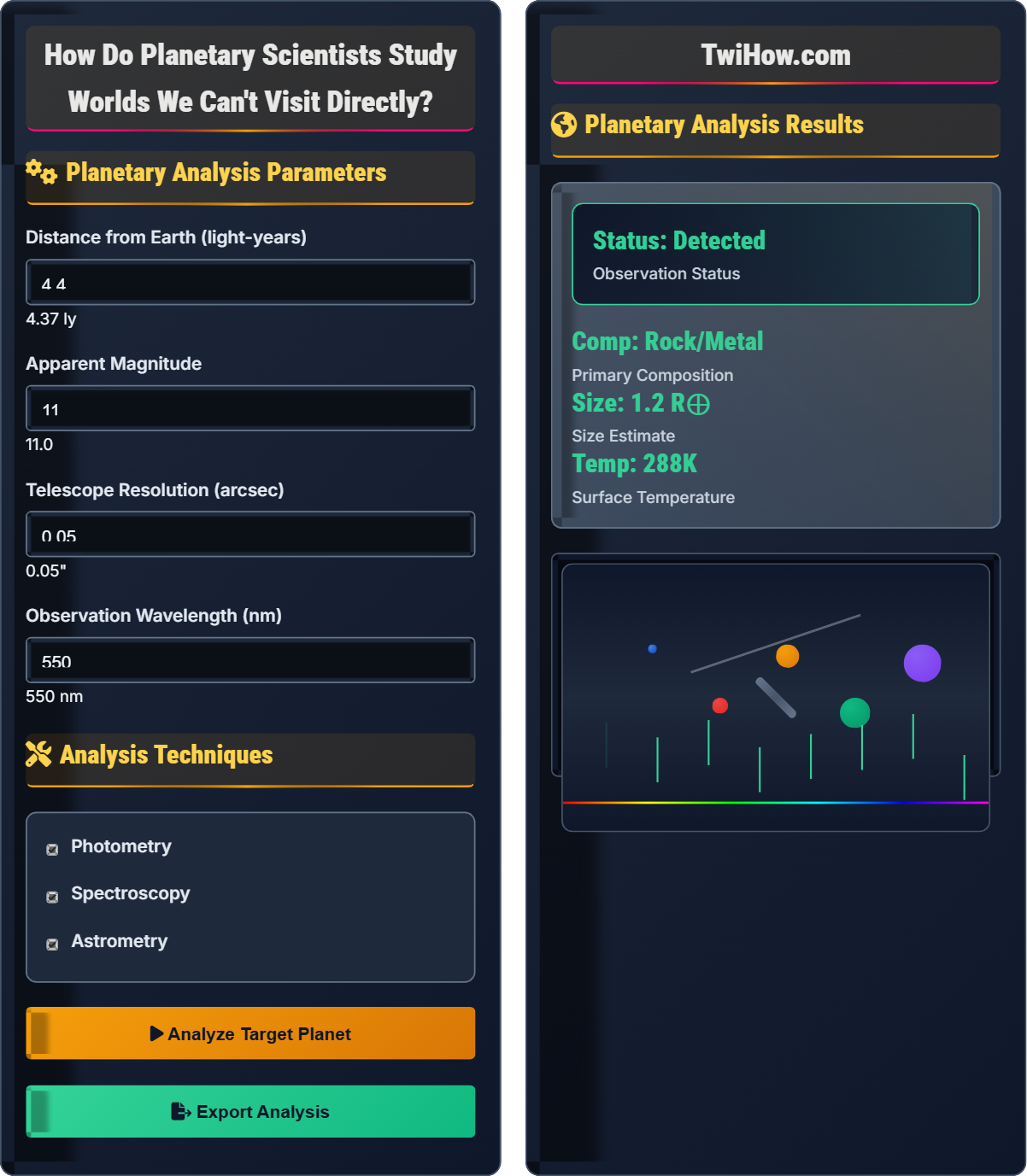
Planetary Analysis Parameters
Analysis Techniques
Planetary Analysis Results
| Method | Application | Resolution | Success Rate |
|---|---|---|---|
| Photometry | Brightness variations | 0.05" | High |
| Spectroscopy | Chemical composition | Spectral lines | Very High |
| Astrometry | Position/Orbit | Microarcseconds | High |
| Occultation | Size/Density | High | Medium |
Key Scientific Findings
- Atmospheric Composition: Water vapor detected
- Surface Properties: Rocky with possible liquid water
- Orbital Characteristics: Stable orbit in habitable zone
- Physical Properties: Similar to Earth in size and temperature
Planetary Remote Sensing and Analysis Explained
Planetary scientists use several sophisticated methods to study distant worlds:
- Photometry: Measuring brightness variations to determine rotation periods and surface properties
- Spectroscopy: Analyzing light spectra to identify chemical compositions
- Imaging: Capturing detailed photographs with advanced telescopes
- Radar: Probing surface topography and subsurface features
- Gravitational Studies: Measuring orbital perturbations to determine mass
The distance to celestial objects can be calculated using the distance modulus relationship:
Where:
- m: Apparent magnitude (observed brightness)
- M: Absolute magnitude (intrinsic brightness)
- d: Distance in parsecs
This formula allows scientists to determine distances to planets and stars based on their observed and intrinsic brightness.
Planets emit thermal radiation according to their temperature, following Planck's law:
By analyzing the thermal emission spectrum, scientists can determine the planet's surface temperature and emissivity characteristics.
- Bλ(T): Spectral radiance at wavelength λ
- h: Planck's constant
- c: Speed of light
- k: Boltzmann constant
- T: Temperature in Kelvin
When a planet passes in front of its host star (transit), it blocks a small fraction of starlight:
- Depth of transit: (Rp/R*)² where Rp = planet radius, R* = star radius
- Density determination: Combines radius from transit with mass from radial velocity
- Atmospheric analysis: Additional absorption during transit reveals atmospheric composition
This method has been crucial for discovering and characterizing thousands of exoplanets.
Remote Sensing Methods
Spectroscopy, photometry, astrometry, radiometry, Doppler shift, atmospheric transmission.
Δλ/λ = v/c
Used to measure radial velocity changes for mass determination of orbiting bodies.
- Resolution is inversely proportional to telescope aperture
- Spectral resolution depends on instrument quality
- Atmospheric windows limit observable wavelengths
- Signal-to-noise ratio affects detection capability
Major Instruments & Techniques
Space telescopes, ground-based telescopes, interferometers, spectrometers, photometers.
- θ = 1.22λ/D (Rayleigh criterion)
- λ = wavelength of observation
- D = telescope diameter
- θ = angular resolution limit
- Atmospheric turbulence limits ground-based resolution
- Space telescopes avoid atmospheric interference
- Adaptive optics correct for atmospheric distortion
- Interferometry combines multiple telescopes for better resolution
Key Planetary Science Instruments
Function: Corrects for atmospheric turbulence in real-time using deformable mirrors
Allows ground-based telescopes to achieve near-diffraction-limited resolution by compensating for the blurring effects of Earth's atmosphere. Essential for high-resolution planetary observations.
Function: Split light into component wavelengths for analysis
High-resolution spectrographs can detect subtle absorption lines that reveal atmospheric composition, temperature, pressure, and even wind speeds on distant planets.
Function: Block starlight to reveal nearby planets
Essential for direct imaging of exoplanets by suppressing the overwhelming glare of their host stars, allowing faint planetary companions to be detected.
Planetary Science Learning Quiz
How do scientists determine the atmospheric composition of an exoplanet using only light from its host star?
During a planetary transit, when an exoplanet passes in front of its host star, some of the starlight passes through the planet's atmosphere before reaching Earth. Different molecules in the atmosphere absorb specific wavelengths of light, creating characteristic absorption lines in the star's spectrum. By comparing the star's spectrum during transit to its normal spectrum, scientists can identify which wavelengths were absorbed and determine the atmospheric composition.
The answer is B) By analyzing absorption lines during planetary transit.
This question highlights the clever indirect methods used in planetary science. Rather than visiting the planet, scientists use the star as a backlight and analyze how the planet's atmosphere modifies the starlight. This demonstrates the power of spectroscopy and the importance of fortuitous alignments in astronomical observations.
Transit: When a planet passes in front of its host star
Absorption Lines: Dark lines in spectrum where light is absorbed
Spectroscopy: Analysis of light by wavelength to identify materials
• Each molecule has unique spectral fingerprint
• Transit must be precisely aligned for detection
• Larger planets produce stronger signals
• Think of atmosphere as a filter modifying starlight
• Remember: transit alignment is crucial for this method
• Different molecules absorb at different wavelengths
• Thinking direct sampling is possible for distant planets
• Forgetting the importance of transit geometry
• Confusing emission with absorption spectroscopy
Explain the radial velocity method for detecting exoplanets. How does it work, what can it determine, and what are its limitations?
Radial Velocity Method: Also known as the Doppler spectroscopy method, this technique detects the wobble of a star caused by the gravitational pull of an orbiting planet.
How it Works: As a planet orbits its star, both the planet and star orbit their common center of mass. This causes the star to move slightly toward and away from Earth during each orbit. The motion creates a Doppler shift in the star's spectral lines - blueshifted when approaching and redshifted when receding.
What Can Be Determined: Minimum planetary mass (M sin i), orbital period, eccentricity, and semi-major axis. The amplitude of the velocity variation indicates the planet's gravitational influence.
Limitations: Only measures the component of motion along the line of sight, so the true mass is uncertain. Works best for massive planets close to their stars. Requires high-precision spectrographs and long-term monitoring.
This method demonstrates Newton's third law - for every action, there's an equal and opposite reaction. The planet's gravitational pull causes the star to move, even though the star is much more massive. This subtle motion is detectable through precision spectroscopy and has been instrumental in discovering hundreds of exoplanets.
Radial Velocity: Motion along the line of sight
Doppler Shift: Change in wavelength due to relative motion
Minimum Mass: M sin i due to inclination uncertainty
• Star and planet orbit their common center of mass
• Only radial motion is measurable
• Precision required is ~1 m/s for Earth-like planets
• Imagine the star wobbling as the planet orbits
• Remember: we only see the line-of-sight component
• More massive planets cause larger wobbles
• Thinking the star moves in a circle around the planet
A planet transits its host star, causing a brightness decrease of 1%. If the star's radius is 1.2 times that of the Sun (R☉ = 6.96×10⁸ m), calculate the planet's radius. Use the relationship: fractional brightness decrease = (Rp/R*)².
Given:
Fractional brightness decrease = 1% = 0.01
Star radius R* = 1.2 × R☉ = 1.2 × 6.96×10⁸ m = 8.352×10⁸ m
Using the relationship:
Fractional brightness decrease = (Rp/R*)²
0.01 = (Rp/R*)²
√0.01 = Rp/R*
0.1 = Rp/R*
Rp = 0.1 × R*
Rp = 0.1 × 8.352×10⁸ m
Rp = 8.352×10⁷ m
To express in Earth radii (RE = 6.371×10⁶ m):
Rp = (8.352×10⁷) / (6.371×10⁶) = 13.1 RE
Therefore, the planet's radius is approximately 13.1 Earth radii.
This problem demonstrates how the geometric relationship between the planet and star determines the observed brightness change during transit. The fractional decrease in brightness is proportional to the ratio of the planet's area to the star's area, which is the square of the radius ratio. This allows direct measurement of the planet's size relative to its host star.
Transit Depth: Fractional decrease in brightness during transit
Geometric Probability: Depends on orbital inclination
Radius Ratio: Determines transit depth (Rp/R*)²
• Transit depth = (Rp/R*)² (geometric relationship)
• Only works for aligned orbits
• Star radius must be known independently
• Remember: area ratios are squared radius ratios
• Check units consistency in calculations
• Larger planets cause deeper transits
• Forgetting to take the square root of the brightness ratio
• Not accounting for the star's known radius
• Confusing linear and area relationships
Astronomers observe a hot Jupiter exoplanet and notice that the transit depth varies with wavelength. At visible wavelengths, the depth is 1.5%, but at infrared wavelengths, it increases to 1.7%. Explain what this wavelength-dependent variation tells us about the planet's atmosphere and how scientists use this information.
Wavelength-Dependent Transit Depth: The increase in transit depth at infrared wavelengths indicates that the planet's atmosphere is absorbing more strongly at those wavelengths. This absorption is caused by specific molecules in the atmosphere.
Atmospheric Information: The variation in transit depth with wavelength creates a transmission spectrum. By comparing the observed spectrum to theoretical models, scientists can identify which molecules are present in the atmosphere. Common absorbers include water vapor, methane, carbon dioxide, and carbon monoxide.
Scientific Application: This technique, called transmission spectroscopy, allows scientists to map the atmospheric composition, temperature profile, and cloud/haze properties of exoplanets. The fact that the transit depth changes indicates the presence of an atmosphere with wavelength-dependent opacity.
Physical Interpretation: The atmosphere acts like a filter, absorbing different amounts of starlight at different wavelengths, revealing its molecular composition.
This example shows how subtle variations in observational data can reveal rich information about planetary atmospheres. The wavelength-dependent transit depth is a powerful diagnostic tool that transforms photometric observations into compositional analysis. It demonstrates how planetary scientists extract detailed information from what initially appears to be simple brightness measurements.
Transmission Spectroscopy: Measuring light filtered through atmosphere
Hot Jupiter: Gas giant close to its star
Atmospheric Opacity: Wavelength-dependent absorption
• Different molecules absorb at specific wavelengths
• Transmission spectrum reveals atmospheric composition
• Requires precise photometry at multiple wavelengths
• Think of atmosphere as a molecular filter
• Remember: absorption varies with wavelength
• Precision measurements reveal atmospheric details
• Thinking transit depth is always constant
• Not understanding wavelength dependence of absorption
• Forgetting that atmosphere affects observed signal
Which combination of techniques provides the most comprehensive characterization of an exoplanet?
Combining photometry and spectroscopy provides the most comprehensive characterization of an exoplanet. Photometry can determine the planet's size (via transit depth), orbital period, and temperature (via phase variations). Spectroscopy can reveal atmospheric composition, temperature, and pressure profiles. Together, these techniques can determine the planet's radius, mass (from radial velocity components), density, composition, and atmospheric properties. This combination has been used successfully by missions like Kepler and Hubble to characterize thousands of exoplanets.
The answer is B) Photometry + spectroscopy.
This question emphasizes the importance of combining multiple observational techniques to build a complete picture of distant worlds. Each method has its strengths and limitations, but together they provide complementary information that leads to comprehensive planetary characterization. This approach exemplifies the interdisciplinary nature of planetary science.
Comprehensive Characterization: Complete physical and chemical description
Multi-Wavelength Observations: Using different parts of spectrum
Complementary Techniques: Methods providing different information
• Different techniques reveal different properties
• Combination provides complete picture
• Single method has limitations
• Think of each technique as providing puzzle pieces
• Multiple methods overcome individual limitations
• Comprehensive characterization requires multiple approaches
• Thinking single technique can reveal everything
• Not appreciating the value of combined methods
• Underestimating the complexity of planetary characterization
FAQ
Q: How can we tell the difference between a planet and a star when looking through a telescope?
A: From Earth, planets appear as steady disks of light while stars twinkle due to atmospheric turbulence. Planets move against the background of stars over time (retrograde motion), and they show phases like the Moon. Through telescopes, planets reveal surface features, moons, and atmospheric details, while stars remain point sources. Additionally, planets reflect sunlight (they're much cooler than stars), so their light has different spectral characteristics. For distant exoplanets, we detect them indirectly through methods like transits, radial velocity, or direct imaging with special techniques to block starlight.
Q: What can we learn about a planet's interior without visiting it?
A: We can infer internal structure from several remote measurements. Density calculated from mass (from orbital effects) and radius (from transits) gives clues about composition. Gravitational field measurements reveal internal mass distribution. Magnetic field detection indicates a molten core. Asteroid impacts and seismic activity can be inferred from surface features. For exoplanets, tidal heating effects and orbital characteristics provide information about internal structure. Mathematical models of planetary formation and evolution, constrained by observable parameters, help predict internal composition and structure.
Q: How do scientists know the age of distant planets?
A: We estimate planetary ages by dating their host stars. Stars form in groups with similar ages, so we can use stellar evolution models and observations of stellar properties (rotation, chromospheric activity, lithium abundance) to estimate stellar age. For planets in star clusters, we can use the cluster's age. In our solar system, meteorites provide age constraints through radioactive dating. For isolated exoplanets, age estimates are less precise and often rely on stellar age or kinematic associations with star-forming regions.