How Do Space Agencies Prioritize Missions and Allocate Resources?
Complete mission planning guide • Prioritization, budgeting & strategy
Mission Prioritization:
Show Prioritization SimulatorSpace agencies like NASA, ESA, and JAXA use sophisticated processes to prioritize missions and allocate resources among competing objectives. The decision-making involves balancing scientific merit, technical feasibility, budget constraints, political considerations, and public interest. Agencies employ peer review panels, strategic planning documents, and cost-benefit analyses to make informed decisions about which missions to fund and develop.
Key factors include scientific impact potential, technical readiness, cost-effectiveness, international partnerships, and alignment with strategic goals. The process involves multiple review stages, from initial concept evaluation to final selection, with continuous reassessment as missions progress through development phases.
Major considerations include:
- Scientific Merit: Potential for groundbreaking discoveries
- Technical Feasibility: Engineering challenges and solutions
- Budget Constraints: Available funding and cost estimates
- Strategic Alignment: Fit with long-term objectives
These systematic approaches ensure optimal use of limited resources while advancing space exploration and scientific knowledge.
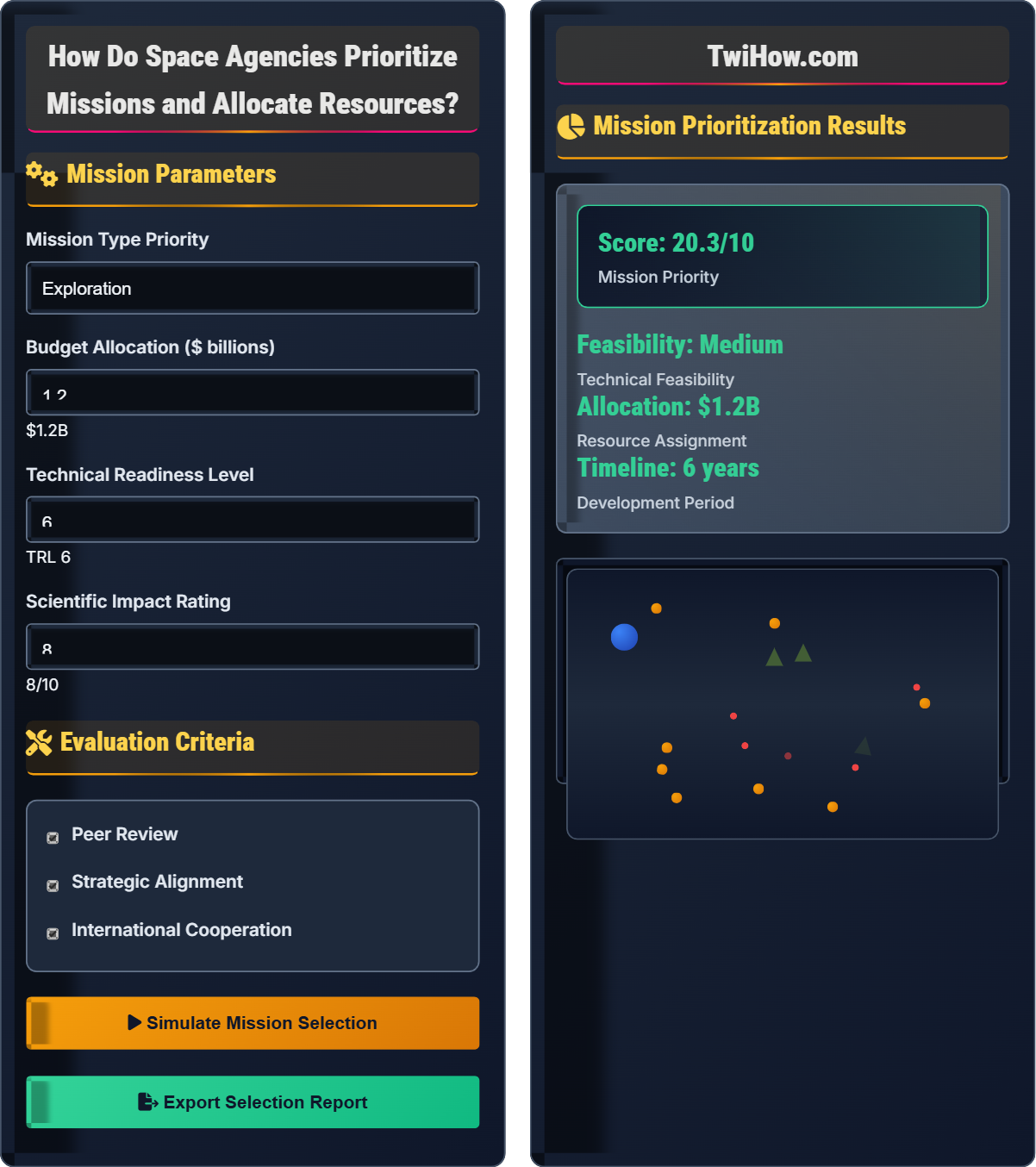
Mission Parameters
Evaluation Criteria
Mission Prioritization Results
| Factor | Weight | Score | Contribution |
|---|---|---|---|
| Scientific Impact | 30% | 8/10 | 2.4 |
| Technical Feasibility | 25% | 7/10 | 1.75 |
| Cost Effectiveness | 20% | 9/10 | 1.8 |
| Strategic Alignment | 15% | 8/10 | 1.2 |
| Public Interest | 10% | 6/10 | 0.6 |
Resource Allocation Breakdown
- Development: 60% of budget
- Operations: 25% of budget
- Infrastructure: 10% of budget
- Contingency: 5% of budget
Mission Prioritization and Resource Allocation Explained
Space agencies use systematic processes to evaluate and prioritize missions:
- Concept Studies: Initial feasibility assessments
- Peer Review: Scientific community evaluation
- Technical Reviews: Engineering feasibility checks
- Cost Analysis: Budget and resource requirements
- Strategic Alignment: Fit with long-term goals
Mission priority scores are calculated using weighted factors:
Where:
- Factor_Score: Rating for each evaluation criterion
- Weight: Importance of each factor (summing to 100%)
This formula provides objective comparisons between competing missions.
Missions are evaluated on multiple dimensions:
- Scientific Impact: Potential for new discoveries and knowledge
- Technical Feasibility: Engineering challenges and solutions
- Cost Effectiveness: Scientific return per dollar invested
- Strategic Alignment: Fit with long-term objectives
- International Cooperation: Partnership opportunities
- Public Engagement: Educational and outreach value
Agencies follow established principles for budget allocation:
- Diversification: Spread investments across mission types
- Balance: Mix of small, medium, and large missions
- Continuity: Maintain long-term programs
- Flexibility: Reserve funds for unexpected opportunities
- Efficiency: Maximize scientific output per dollar
Evaluation Criteria
Scientific merit, technical readiness, cost-effectiveness, strategic alignment, international cooperation.
CBR = Scientific Value / Mission Cost
Used to compare missions with different scientific objectives and budgets.
- Scientific merit is primary consideration
- Technical feasibility is essential
- Cost must be justified by return
- Strategic alignment guides selection
Resource Allocation
Development, operations, infrastructure, contingency, international partnerships.
- Identify total available budget
- Allocate by mission size and type
- Reserve contingency funds
- Account for operations costs
- Adjust for international contributions
- Balance between mission types
- Maintain program continuity
- Reserve flexibility for new opportunities
- Consider international partnerships
Mission Prioritization Process
Method: Independent expert evaluation
Mission proposals undergo rigorous peer review by scientists and engineers from outside the proposing institution. Review panels evaluate proposals based on scientific merit, technical feasibility, and relevance to agency goals. This process ensures objectivity and maintains high scientific standards across all missions.
Method: Decadal surveys and roadmaps
Agencies develop long-term strategic plans through decadal surveys and roadmap exercises. These documents, created by the scientific community, prioritize research areas and recommend mission priorities for the next 10 years. They guide funding decisions and ensure balanced investment across different scientific disciplines.
Method: Quantitative evaluation of return on investment
Missions are evaluated based on their scientific return relative to their cost. Agencies use cost-benefit analysis to compare missions with different objectives and price points. This ensures optimal allocation of limited budgets while maximizing scientific output.
Method: Collaborative mission planning
Space agencies increasingly collaborate on missions to share costs and expertise. International partnerships allow for more ambitious missions than any single agency could afford. Agencies evaluate missions based on potential for international cooperation and shared resources.
Mission Prioritization Learning Quiz
Why is peer review important in mission selection?
Peer review ensures that mission proposals are evaluated objectively by independent experts in the field. This process prevents conflicts of interest, maintains scientific standards, and ensures that the best missions are selected based on merit rather than institutional politics. External reviewers provide unbiased assessment of scientific value and technical feasibility.
The answer is B) It ensures objective evaluation by independent experts.
This question highlights the importance of scientific integrity in mission selection. Peer review is a cornerstone of scientific methodology that ensures objectivity and quality control. It demonstrates how space agencies maintain credibility and make decisions based on scientific merit rather than other factors.
Peer Review: Evaluation by independent experts in the same field
Objectivity: Impartial evaluation without bias
Scientific Merit: Quality and potential of research proposal
• External reviewers provide unbiased assessment
• Scientific merit is primary consideration
• Conflict of interest must be avoided
• Think of peer review as quality control
• External evaluation ensures objectivity
• Scientific standards are maintained through review
• Thinking peer review is only about cost savings
• Not understanding the importance of objectivity
• Forgetting that review maintains scientific standards
Explain the role of decadal surveys in mission prioritization. How do they influence resource allocation and long-term planning?
Decadal Surveys: Comprehensive planning documents created by the National Academy of Sciences every 10 years. They survey the scientific community to identify the most important research priorities for the next decade.
Process: Leading scientists in each discipline contribute to panels that evaluate research priorities and recommend mission concepts. The final report ranks missions by scientific importance and feasibility.
Influence on Allocation: Agencies like NASA use these surveys to guide budget requests and mission selections. They provide justification for funding requests to Congress and help prioritize competing missions.
Long-term Impact: Surveys ensure balanced investment across different scientific disciplines and prevent any single area from dominating resources. They also help agencies plan for future capabilities needed to achieve scientific goals.
This question demonstrates how scientific communities participate in strategic planning. Decadal surveys represent a systematic approach to prioritization that balances competing interests and ensures comprehensive coverage of scientific opportunities. They illustrate the democratic nature of scientific planning.
Decadal Survey: 10-year strategic planning document
Scientific Community: Active researchers in specific field
Research Priorities: Most important scientific questions
• Surveys represent consensus of scientific community
• Agencies use them to guide resource allocation
• Ensure balanced investment across disciplines
• Think of surveys as scientific community's wishlist
• Agencies use them for political justification
• Balance prevents any area from dominating
• Thinking surveys are only agency-generated
• Not understanding the community involvement
• Forgetting the political role of surveys
Mission A costs $500 million and is expected to produce 250 scientific papers, while Mission B costs $1.2 billion and is expected to produce 400 scientific papers. Calculate the cost per paper for each mission and determine which has better cost-effectiveness. Express your answer in dollars per paper.
Mission A:
Cost per paper = $500,000,000 ÷ 250 papers = $2,000,000 per paper
Mission B:
Cost per paper = $1,200,000,000 ÷ 400 papers = $3,000,000 per paper
Comparison:
Mission A is more cost-effective at $2,000,000 per paper compared to Mission B's $3,000,000 per paper. Mission A produces scientific papers at a 33% lower cost than Mission B.
This problem demonstrates how agencies evaluate cost-effectiveness when comparing missions with different objectives and budgets. The calculation shows that smaller missions can sometimes provide better value than larger ones, even if the larger missions have higher total scientific output.
Cost-Effectiveness: Scientific return per dollar spent
Cost-Benefit Analysis: Quantitative comparison of value
Scientific Papers: Measure of research output
• Divide total cost by total output
• Lower cost per unit is more effective
• Consider both quantity and quality of output
• Always divide cost by output for effectiveness
• Compare same units (dollars per paper)
• Consider multiple measures of success
• Dividing output by cost instead of cost by output
• Not comparing the same units
• Forgetting to consider the difference in mission scale
A space agency is considering two missions: Mission X (solely domestic, $2 billion) and Mission Y (international partnership, $1.5 billion domestic contribution, $2.5 billion total cost). Evaluate the advantages and disadvantages of each approach and recommend which factor should influence the decision.
Mission X Advantages:
• Full control over mission design and operations
• Domestic industry benefits exclusively
• Simplified management and communication
Mission X Disadvantages:
• Higher total cost burden
• Limited to domestic capabilities
• No shared risk
Mission Y Advantages:
• Reduced financial burden per partner
• Access to international expertise
• Shared development costs and risks
Mission Y Disadvantages:
• Shared control and decision-making
• Coordination complexity
• Potential for schedule delays
Recommendation: Decision should factor in strategic goals, available budget, and required capabilities. International cooperation often enables more ambitious missions.
This problem illustrates the trade-offs agencies face when deciding between domestic and international missions. International cooperation can enable more ambitious projects but introduces complexity. The decision requires balancing scientific goals, budget constraints, and strategic considerations.
International Cooperation: Joint missions between space agencies
Cost Sharing: Distributing mission costs among partners
Shared Control: Joint decision-making authority
• Consider both financial and strategic factors
• Evaluate risk-sharing benefits
• Assess coordination challenges
• International cooperation can enable bigger missions
• Balance benefits against complexity
• Consider long-term relationship value
• Only considering cost factors
• Not evaluating strategic benefits
• Forgetting to consider coordination challenges
What does a Technology Readiness Level (TRL) of 6 mean for a mission proposal?
TRL 6 means the technology has been demonstrated in a relevant environment, typically in a space environment or a high-fidelity simulation. This level indicates that the technology has been tested in conditions similar to its intended operational environment. TRL 6 is often the minimum level required for mission formulation, as it demonstrates that the technology will work in space.
The answer is C) The technology has been demonstrated in relevant environment.
This question addresses the critical importance of technology readiness in mission planning. TRLs provide a standardized way to assess technology maturity and risk. Higher TRLs indicate lower technical risk and greater mission probability of success. Agencies use TRLs to make informed decisions about mission readiness.
Technology Readiness Level: Standardized assessment of technology maturity
TRL 6: Technology demonstrated in relevant environment
Technical Risk: Likelihood of technical failure
• Higher TRLs indicate lower risk
• TRL 6 is often minimum for mission formulation
• Demonstrated in relevant environment
• TRLs provide standardized risk assessment
• Higher numbers mean more readiness
• Relevant environment means space-like conditions
• Confusing TRL with complexity level
• Not understanding the progression of TRLs
• Thinking TRL 6 means space-tested
FAQ
Q: How do space agencies decide which missions get funded when budgets are limited?
A: Agencies use a multi-tiered evaluation process. First, missions are evaluated by peer review panels for scientific merit and technical feasibility. Then, they're ranked based on strategic importance and cost-effectiveness. Finally, leadership considers budget constraints and selects the highest-ranked missions that fit within available funding. Agencies also maintain portfolios of different mission sizes to spread risk and maintain progress across multiple fronts.
Q: What role does public interest play in mission selection?
A: Public interest is an important factor in mission selection, though it's not the primary consideration. Missions that capture public imagination often receive higher priority because they justify funding to taxpayers and Congress. Public interest also drives educational and outreach opportunities. However, scientific merit and technical feasibility remain the primary drivers. The most successful missions often combine compelling science with public appeal.
Q: How do international partnerships affect mission prioritization?
A: International partnerships can significantly influence mission prioritization. Collaborative missions often enable more ambitious projects than individual agencies could afford alone. Partnerships also promote diplomatic relations and share costs and risks. However, they require coordination among different agencies with potentially different priorities. Agencies must balance national interests with international cooperation benefits when making prioritization decisions.