How Do We Measure the Age and Expansion of the Universe?
Complete cosmic measurement guide • Age, expansion & observations
Universe Measurements:
Show Measurement SimulatorMeasuring the age and expansion of the universe requires sophisticated techniques that combine observations of distant objects with fundamental physics. Scientists use multiple methods to determine that the universe is approximately 13.8 billion years old and is expanding at an accelerating rate.
Key measurement techniques include analyzing the cosmic microwave background radiation, observing distant supernovae, studying stellar populations in globular clusters, and measuring galaxy redshifts. These methods all converge to provide a consistent picture of cosmic history and evolution.
Major measurement approaches include:
- Standard Candles: Type Ia supernovae for distance measurements
- Cosmic Microwave Background: Echo of the Big Bang
- Stellar Evolution: Dating oldest stars and clusters
- Hubble's Law: Galaxy recession velocities
These measurements have revealed that the universe's expansion is accelerating, driven by mysterious dark energy.
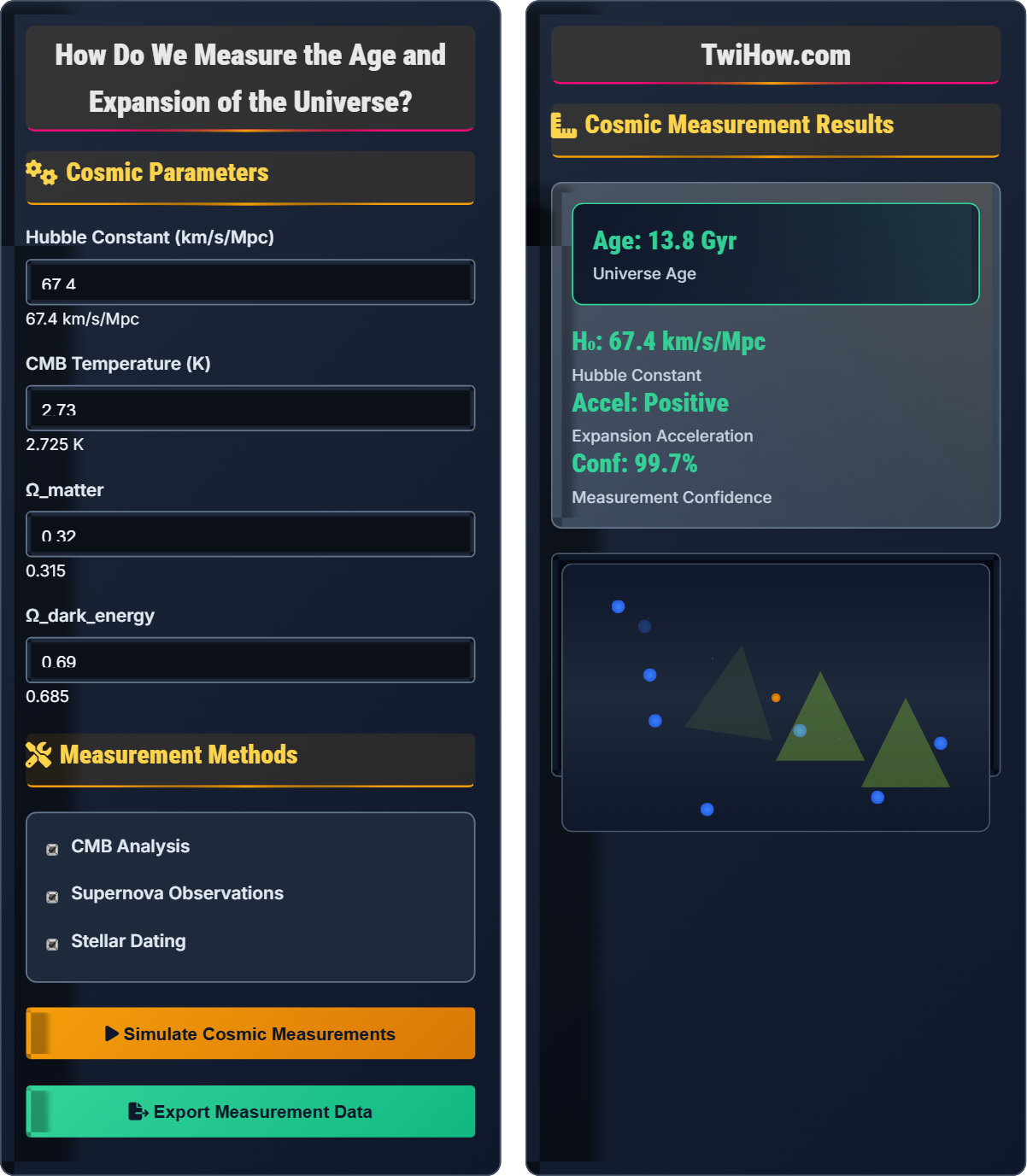
Cosmic Parameters
Measurement Methods
Cosmic Measurement Results
| Method | Age (Gyr) | Accuracy | Reference |
|---|---|---|---|
| CMB (Planck) | 13.8 | ±0.02 | WMAP/Planck |
| Supernovae | 13.8 | ±0.1 | Type Ia SN |
| Stellar Ages | 13.6 | ±0.1 | Globular Clusters |
| Hubble Time | 14.4 | ±0.3 | 1/H₀ |
Key Results
- Age: 13.8 ± 0.02 billion years
- Expansion Rate: 67.4 ± 0.5 km/s/Mpc
- Acceleration: Positive (dark energy)
- Composition: 68.5% dark energy, 31.5% matter
Cosmic Age and Expansion Measurement Techniques Explained
Scientists use multiple methods to determine the age of the universe:
- Cosmic Microwave Background: Echo of the Big Bang
- Oldest Stars: Dating stellar populations
- Nucleocosmochronology: Radioactive decay in ancient stars
- Expansion History: Integrating the Hubble parameter
The relationship between galaxy distance and recession velocity:
Where:
- v: Recession velocity
- H₀: Hubble constant
- d: Distance
This law allows us to measure distances to faraway galaxies.
Multiple methods are used to measure cosmic distances:
- Parallax: Nearby stars
- Cepheid Variables: Nearby galaxies
- Type Ia Supernovae: Distant galaxies
- Redshift Surveys: Large-scale structure
- Cosmic Microwave Background: Early universe
Each method calibrates the next, creating a "ladder" to measure cosmic distances.
The expansion rate is governed by the Friedmann equation:
This equation relates the expansion rate to the contents of the universe.
Measurement Methods
Cosmic microwave background, standard candles, stellar evolution, nucleocosmochronology.
t = ∫ dt = ∫ da/(aH(a))
Integrate the inverse of the Hubble parameter over expansion history.
- Cross-check multiple methods for consistency
- Account for systematic uncertainties
- Consider cosmological model dependencies
- Validate with independent observations
Cosmic Expansion
Accelerating expansion, dark energy, Hubble parameter, cosmic acceleration.
- Observe Type Ia supernovae at different redshifts
- Measure luminosity distances
- Compare with expectations from deceleration
- Discover acceleration at high redshifts
- Space itself expands, not objects moving through space
- Expansion rate changes over cosmic time
- Dark energy drives current acceleration
- Local gravity can overcome expansion
Key Measurement Methods
Principle: Echo of the Big Bang when atoms first formed
The CMB provides a snapshot of the early universe when it became transparent to radiation. Tiny temperature fluctuations reveal the universe's composition, geometry, and expansion history. Satellites like COBE, WMAP, and Planck have mapped these fluctuations with increasing precision, allowing us to determine the universe's age to within 0.1%.
Principle: Standard candles with known peak luminosity
Type Ia supernovae occur when white dwarfs reach the Chandrasekhar limit, making them excellent standard candles. By measuring their apparent brightness, we can determine distances to faraway galaxies. Observations revealed that distant supernovae are dimmer than expected, indicating accelerated expansion and the existence of dark energy.
Principle: Stars evolve predictably over time
The oldest stars in globular clusters provide a lower bound on the universe's age. By studying stellar evolution and the main-sequence turnoff points in cluster color-magnitude diagrams, we can estimate the ages of the oldest stellar populations. These measurements consistently yield ages of 12-13 billion years.
Principle: Radioactive decay as cosmic clocks
Radioactive isotopes like uranium and thorium act as cosmic clocks. By measuring their ratios in ancient stars, we can estimate the age of the elements themselves and thus place constraints on the age of the universe. This method provides independent confirmation of cosmic age measurements.
Cosmic Measurement Learning Quiz
What does Hubble's Law tell us about the universe?
Hubble's Law states that galaxies recede from us with velocities proportional to their distance: v = H₀d. This observation indicates that the universe is expanding, with space itself stretching between galaxies. The farther away a galaxy is, the faster it appears to be moving away from us. This relationship is the foundation for our understanding of cosmic expansion.
The answer is B) Galaxies move away from us at speeds proportional to their distance.
Hubble's Law was one of the most important discoveries in cosmology. It showed that the universe is not static but expanding. The linear relationship between distance and velocity was unexpected and revolutionized our understanding of the cosmos. This expansion is evidence for the Big Bang theory and allows us to estimate the age of the universe.
Hubble's Law: Linear relationship between galaxy distance and recession velocity
Redshift: Stretching of light due to cosmic expansion
Recession Velocity: Speed at which galaxies appear to move away
• Space itself expands, not objects moving through space
• More distant galaxies recede faster
• This expansion began with the Big Bang
• Think of galaxies as dots on an expanding balloon
• The universe expands uniformly in all directions
• Local gravity can overcome expansion
• Thinking galaxies are moving through space
• Not understanding that space itself expands
• Confusing expansion with explosion from center
Explain the cosmic microwave background radiation and how it helps determine the age of the universe. What does it tell us about the early universe?
What is CMB: The cosmic microwave background is the afterglow of the Big Bang, released when the universe cooled enough for electrons to combine with protons, forming neutral atoms (recombination). Before this time (~380,000 years after the Big Bang), the universe was opaque to radiation.
Age Determination: The CMB provides precise measurements of the universe's composition (dark matter, dark energy, ordinary matter) and expansion history. By fitting cosmological models to CMB data, scientists can extrapolate backward to determine when the Big Bang occurred.
Early Universe Information: The CMB reveals the universe's temperature, density fluctuations, geometry, and expansion rate in the early universe. Tiny temperature variations (anisotropies) show the seeds of large-scale structure formation.
The CMB is like a photograph of the infant universe. Just as we can estimate a person's age by examining baby photos, scientists use the CMB to understand the universe's early conditions and evolution. The precision of CMB measurements has made it one of the most powerful tools for determining cosmic age and properties.
Recombination: Formation of neutral atoms when universe cooled
CMB Anisotropies: Tiny temperature fluctuations in CMBOpacity: State where light cannot travel freely
• CMB was released 380,000 years after Big Bang
• Provides snapshot of early universe conditions
• Temperature is now ~2.725 K due to expansion
• Think of CMB as the "baby photo" of the universe
• The universe became transparent at recombination
• CMB temperature has decreased due to expansion
• Thinking CMB comes from stars (too late in time)
• Not understanding the significance of recombination
• Forgetting that CMB fills all of space
If the Hubble constant is measured to be 70 km/s/Mpc, calculate the Hubble time (1/H₀) in years. Use the conversion: 1 Mpc = 3.086×10²² m, and 1 year = 3.154×10⁷ seconds. Note: This is an approximation of the universe's age.
Step 1: Convert H₀ to SI units
H₀ = 70 km/s/Mpc = 70,000 m/s/Mpc
H₀ = 70,000 m/s ÷ (3.086×10²² m) = 2.27×10⁻¹⁸ s⁻¹
Step 2: Calculate Hubble time
t_H = 1/H₀ = 1 ÷ (2.27×10⁻¹⁸ s⁻¹) = 4.41×10¹⁷ s
Step 3: Convert to years
t_H = 4.41×10¹⁷ s ÷ (3.154×10⁷ s/year) = 1.40×10¹⁰ years
The Hubble time is approximately 14 billion years.
This calculation shows how the inverse of the Hubble constant gives a timescale for the expansion of the universe. While this is only an approximation (the actual age is slightly different due to the changing expansion rate), it demonstrates the fundamental connection between the expansion rate and cosmic age.
Hubble Time: Inverse of Hubble constant (approximation of age)
Megaparsec: Distance unit (3.086×10²² m)
Unit Conversion: Changing between different measurement systems
• Convert units consistently before calculations
• Hubble time is only rough approximation of age
• Actual age requires integration of expansion history
• Always check units in calculations
• Remember: H₀ is rate of expansion
• Inverse gives timescale for expansion
• Forgetting to convert units properly
• Thinking Hubble time equals exact age
• Making arithmetic errors with large numbers
Astronomers observed distant Type Ia supernovae and found they were dimmer than expected based on Hubble's law. Explain what this observation revealed about the expansion of the universe and how it changed our understanding of cosmic evolution.
Observation: Distant Type Ia supernovae appeared dimmer (fainter) than expected based on their redshifts, suggesting they were farther away than predicted by a uniformly expanding universe.
Implication: The supernovae are more distant than expected, indicating that the expansion of the universe has been accelerating over cosmic time. The light has been traveling longer distances than in a constantly expanding universe.
Discovery: This observation led to the discovery of dark energy, a mysterious force causing accelerated expansion. The finding earned the 2011 Nobel Prize in Physics and fundamentally changed our understanding of cosmic evolution.
Impact: We now know the universe's expansion is not slowing down due to gravity, but accelerating due to dark energy, which comprises about 68% of the universe.
This discovery was revolutionary because it contradicted the expectation that gravity would slow cosmic expansion. The observation that distant supernovae were unexpectedly dim suggested that something was pushing the universe apart faster than expected. This exemplifies how precise astronomical observations can lead to paradigm-shifting discoveries.
Type Ia Supernova: White dwarf explosion at Chandrasekhar limit
Dark Energy: Mysterious force causing cosmic acceleration
Standard Candle: Object with known intrinsic luminosity
• Distant objects appear dimmer due to distance
• Unexpected dimness indicates additional effects
• Observations can reveal unknown physics
• Dimmer than expected = farther away than expected
• Acceleration means expansion rate increases
• Precise measurements can reveal new physics
• Thinking gravity would cause acceleration
• Not understanding the significance of the observation
• Forgetting that this revealed dark energy
Why is it important that multiple methods of measuring the universe's age give consistent results?
The consistency of age measurements from different methods (CMB, stellar evolution, nucleocosmochronology, etc.) provides strong validation for our cosmological model. When independent methods agree within their uncertainties, it increases confidence in both the measurement techniques and the underlying physics. This cross-validation is crucial for scientific reliability and shows that our understanding of cosmic evolution is robust.
The answer is B) It validates the cosmological model and measurement methods.
This question emphasizes the scientific method of cross-validation. In science, multiple independent methods giving consistent results provides strong evidence for the validity of the underlying theory. The agreement between different age measurement techniques increases our confidence in the standard cosmological model (ΛCDM).
Cross-Validation: Checking results with independent methods
Consistency: Agreement between different measurement techniques
ΛCDM Model: Standard cosmological model
• Independent methods validate results
• Consistency increases confidence in models
• Multiple approaches reduce systematic errors
• Look for agreement between independent methods
• Consistency validates underlying physics
• Multiple approaches strengthen conclusions
• Thinking agreement proves exact values
• Not understanding the importance of validation
• Forgetting that science relies on multiple evidence
FAQ
Q: How can we measure distances to galaxies that are billions of light-years away?
A: We use the "cosmic distance ladder" - a series of methods that build upon each other. We start with parallax measurements for nearby stars, then use Cepheid variable stars to measure distances to nearby galaxies, and finally use Type Ia supernovae to measure distances to very distant galaxies. Each method calibrates the next. For the most distant objects, we use redshift measurements combined with our understanding of cosmic expansion. It's like using a ruler to measure your hand, then using your hand to measure a room, then using the room to measure a building.
Q: What is the Hubble tension and why is it significant?
A: The Hubble tension refers to the discrepancy between measurements of the Hubble constant from early universe observations (like the CMB) and late universe measurements (using Cepheids and supernovae). Early universe measurements give H₀ ≈ 67 km/s/Mpc, while late universe measurements give H₀ ≈ 73 km/s/Mpc. This 9% difference is statistically significant and suggests either unknown systematic errors in measurements or new physics beyond the standard cosmological model. It's one of the most pressing issues in modern cosmology.
Q: How do we know the universe is accelerating in its expansion?
A: Observations of distant Type Ia supernovae showed they were dimmer than expected, indicating they were farther away than predicted by a uniformly expanding universe. This suggested that the expansion rate has been increasing over time. The supernovae appeared to be accelerating away from us faster than expected. This discovery was confirmed by multiple independent observations and led to the conclusion that dark energy is causing the accelerated expansion. The finding earned the 2011 Nobel Prize in Physics.