How Do We Prepare for the Challenges of Living on Mars?
Complete Mars colonization guide • Survival, habitats & terraforming
Mars Colonization:
Show Mars SimulatorLiving on Mars presents unprecedented challenges that require innovative solutions across multiple disciplines. The Red Planet's harsh environment includes a thin atmosphere (less than 1% of Earth's), extreme cold (average -60°C), toxic CO₂-rich air, high radiation levels, and dust storms that can last for months. Successful Mars colonization requires advanced life support systems, sustainable food production, reliable power generation, and protection from environmental hazards.
Key preparation strategies include developing closed-loop life support systems, creating sustainable habitats, establishing in-situ resource utilization (ISRU), and implementing radiation shielding. Scientists and engineers are working on solutions like 3D-printed habitats using Martian soil, hydroponic farming systems, and nuclear power generation to support long-term human presence.
Major challenges include:
- Life Support: Providing breathable air, water, and food
- Radiation Protection: Shielding from cosmic radiation and solar particles
- Resource Utilization: Using Martian materials for construction and life support
- Psychological Factors: Managing isolation and confinement stress
Preparing for Mars colonization requires international cooperation, sustained funding, and continued technological advancement to make human settlement on the Red Planet a reality.
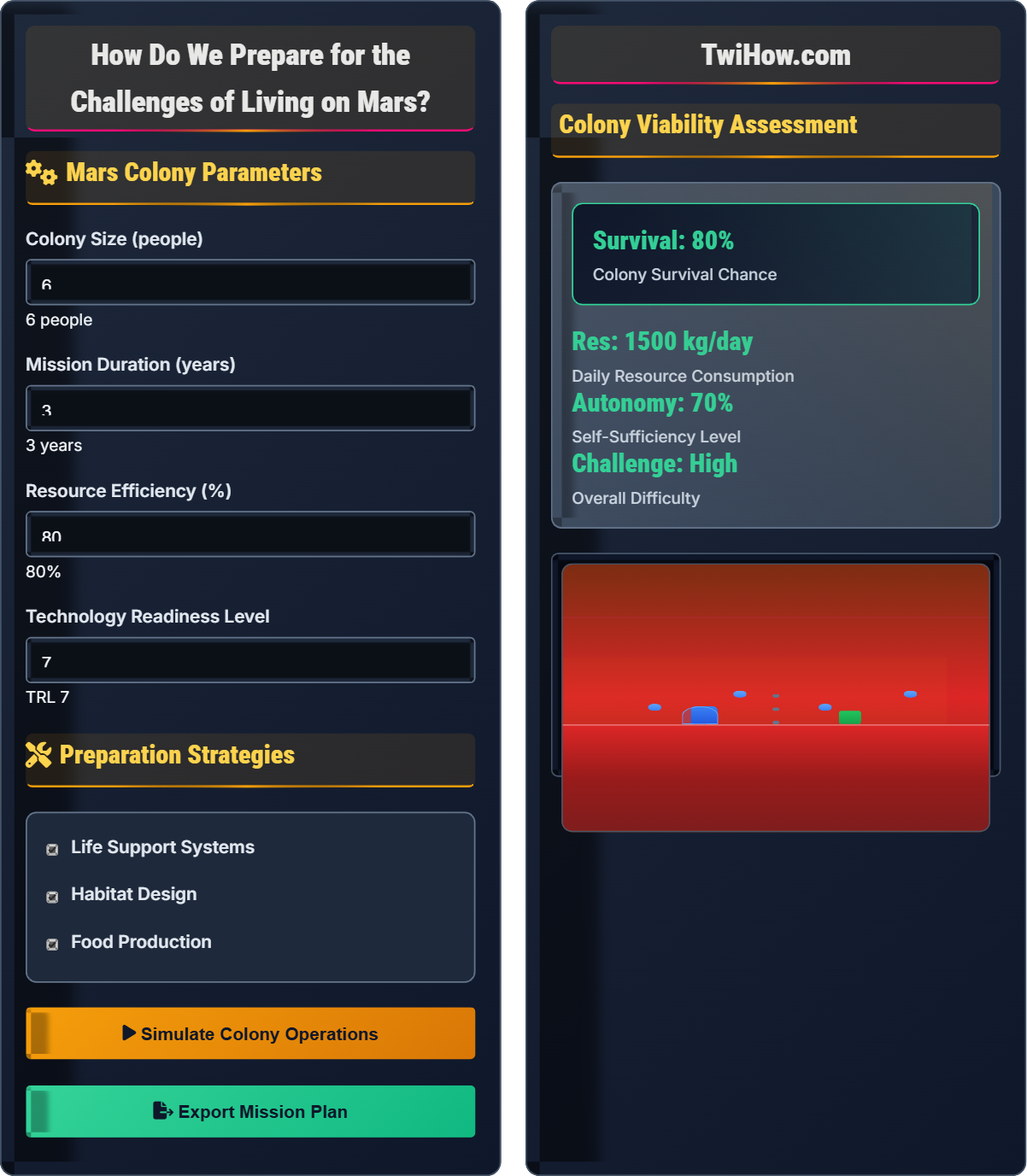
Mars Colony Parameters
Preparation Strategies
Colony Viability Assessment
| Challenge | Severity | Impact | Mitigation |
|---|---|---|---|
| Thin Atmosphere | Critical | Pressure | Pressurized Habitats |
| Radiation | Critical | Health | Shielding |
| Temperature | High | Equipment | Heating Systems |
| Dust Storms | Medium | Power | Backup Systems |
Key Solutions
- Life Support: Closed-loop air/water recycling
- Shelter: Underground or shielded habitats
- Food: Hydroponic gardens and protein sources
- Power: Nuclear reactors and solar arrays
Mars Colonization and Survival Strategies Explained
Mars presents numerous challenges for human habitation:
- Atmosphere: 95% CO₂, 1% Earth's atmospheric pressure
- Temperature: Average -60°C, ranging from -140°C to 20°C
- Radiation: No magnetic field, high cosmic radiation
- Water: Frozen underground, limited accessible supply
- Dust Storms: Planet-wide storms lasting months
The daily resource requirements for Mars colonists can be calculated as:
Where:
- R_daily: Total daily resource requirements
- N_crew: Number of crew members
- R_individual: Resources per person per day
- F_safety: Safety factor (typically 1.2-1.5)
This formula helps determine the minimum supplies needed for Mars missions.
Food production on Mars must account for the caloric needs of colonists:
- Caloric Needs: ~2,500 calories per person per day
- Protein Sources: Plants, insects, lab-grown meat
- Hydroponic Systems: Soil-free cultivation in controlled environments
- Waste Recycling: Converting organic waste back to nutrients
- Seed Banks: Preserving genetic diversity of crops
Efficient food production is crucial for long-term sustainability.
Mars lacks Earth's magnetic field and thick atmosphere, exposing inhabitants to high radiation:
- Habitat Shielding: Thick walls, regolith barriers
- Underground Construction: Natural protection from soil
- Water Walls: Water provides effective radiation shielding
- Storm Shelters: Protected areas during solar events
- Personal Dosimetry: Monitoring radiation exposure
Life Support Systems
Oxygen generation, water recycling, waste management, temperature control, atmospheric regulation.
2H₂O → 2H₂ + O₂
Electrolysis of water produces oxygen for breathing and hydrogen for fuel.
- 100% recycling is essential for sustainability
- Backup systems are critical for safety
- Energy consumption must be minimized
- System redundancy is required
Habitat Design
Pressure containment, radiation shielding, thermal regulation, structural integrity, modularity.
- Minimum 100 m³ per person for comfort
- Additional space for equipment and storage
- Emergency areas and storm shelters
- Recreational and exercise facilities
- Underground or buried for radiation protection
- Modular design for expansion
- Easy maintenance and repair access
- Fire suppression and emergency systems
Mars Preparation Solutions
Methods: Extracting ice from Martian soil, atmospheric water extraction, closed-loop recycling
Water is essential for drinking, oxygen production, agriculture, and temperature regulation. Mars has abundant water ice, but it's mixed with perchlorates that must be removed. Advanced recycling systems must achieve 99%+ efficiency to minimize resupply needs.
Options: Nuclear reactors, solar panels, fuel cells
Mars receives only 43% of Earth's solar energy, and dust storms can last months. Nuclear power provides reliable baseload energy, while solar arrays must be large and regularly cleaned. Power systems must be redundant and capable of supporting all life support functions.
Approach: Hydroponics, aeroponics, aquaponics in controlled environments
Local food production reduces dependency on Earth resupply. Crops must be high-nutrition, fast-growing, and resilient. Growing food also provides psychological benefits and helps recycle air and water. LED lighting systems optimized for plant growth are essential.
Resources: Martian soil for construction, atmosphere for propellant production
ISRU is critical for reducing Earth dependency. Martian regolith can be processed for construction materials using 3D printing. The atmosphere (95% CO₂) can be converted to oxygen and fuel using MOXIE-like systems. Local resources reduce launch mass and enable sustainable operations.
Mars Colonization Learning Quiz
Why is Mars' atmospheric pressure a critical challenge for human survival?
Mars' atmospheric pressure is only about 0.6% of Earth's sea-level pressure, which is far below the Armstrong limit (6.3 kPa) where bodily fluids would boil. Humans cannot breathe in this environment and would die from pressure-related injuries within minutes. This requires completely sealed, pressurized habitats and spacesuits. The thin atmosphere also provides minimal protection from radiation and makes liquid water impossible on the surface.
The answer is B) It's 1% of Earth's pressure, requiring pressurized habitats.
This question highlights the fundamental challenge that Mars' atmosphere is not just different from Earth's, but actively hostile to human life. Students should understand that atmospheric pressure affects not just breathing, but also the boiling point of liquids in the human body. This illustrates why Mars colonization requires completely enclosed environments unlike any place humans have lived before.
Atmospheric Pressure: Force exerted by atmospheric gases
Armstrong Limit: Pressure where bodily fluids boil
Pressurized Habitat: Sealed environment maintaining Earth-like pressure
• Humans need 101.3 kPa pressure to survive
• Mars pressure is 0.6 kPa (100x less)
• Any breach in pressure is immediately fatal
• Remember: Mars pressure is 1% of Earth's
• Think of the pressure difference as a vacuum
• Understand why spacesuits and habitats are essential
• Underestimating the severity of low pressure
• Thinking a simple mask would suffice
• Confusing pressure with atmospheric composition
Explain the radiation challenges on Mars and the strategies needed to protect human colonists. How does this differ from Earth-based radiation protection?
Radiation Challenges: Mars lacks both a global magnetic field and thick atmosphere to deflect cosmic radiation and solar particles. This results in radiation levels 2-5 times higher than on the International Space Station and 50-100 times higher than on Earth's surface.
Protection Strategies:
1. Habitat Shielding: Using thick materials like Martian regolith, water, or specialized polymers
2. Underground Construction: Building habitats below the surface for natural shielding
3. Storm Shelters: Protected areas for use during solar particle events
4. Personal Monitoring: Continuous dosimetry to track exposure
Differences from Earth: On Earth, the magnetic field and atmosphere provide natural protection. On Mars, humans must rely entirely on artificial shielding, making every aspect of habitat design critical for radiation safety.
This question emphasizes that Mars lacks Earth's natural radiation protection systems. Students should understand that radiation protection on Mars is not optional but essential for survival. The strategies required are fundamentally different from Earth-based radiation protection, which typically involves short-term exposure limits rather than continuous, comprehensive shielding.
Galactic Cosmic Radiation: High-energy particles from space
Solar Particle Events: Radiation from solar flares
Effective Dose: Radiation exposure corrected for biological effects
• Mars has no magnetic field protection
• Think of Mars as having no radiation protection
• Remember: shielding must be comprehensive, not temporary
• Consider materials like regolith as natural shielding
• Underestimating the continuous nature of radiation exposure
• Thinking Earth-based radiation protection applies to Mars
• Not considering the need for emergency shelter
A Mars colony has 6 crew members and a mission duration of 3 years. Each person requires 0.87 kg of oxygen per day. Calculate the total oxygen requirement for the mission, including a 20% safety margin. If the colony can produce 50% of its oxygen needs through recycling, how much oxygen must be stored or produced on Mars?
Step 1: Calculate total oxygen requirement without safety margin
Oxygen per day = 6 crew × 0.87 kg/day = 5.22 kg/day
Total days = 3 years × 365 days/year = 1,095 days
Total oxygen = 5.22 kg/day × 1,095 days = 5,716 kg
Step 2: Add 20% safety margin
Total with safety = 5,716 kg × 1.20 = 6,859 kg
Step 3: Calculate oxygen that must be stored/produced
If 50% is recycled, 50% must be supplied externally or produced locally
Oxygen to store/produce = 6,859 kg × 0.50 = 3,430 kg
The colony must store or produce 3,430 kg of oxygen for the mission.
This problem demonstrates the critical calculations involved in Mars mission planning. Students must consider not just basic needs but also safety margins and recycling efficiency. The calculation shows how even with recycling, substantial amounts of resources must be managed for long-duration missions, highlighting the importance of ISRU and efficient recycling systems.
ISRU: In-Situ Resource Utilization (using local resources)
Safety Margin: Extra resources for contingencies
Recycling Efficiency: Percentage of resources reused
• Multiply crew size by daily requirement
• Always include safety margins for Mars missions
• Consider recycling efficiency in planning
• Calculate per-person requirements first
• Convert time periods consistently
• Remember that recycling reduces but doesn't eliminate needs
• Forgetting to multiply by crew size
• Not including safety margins
• Misunderstanding recycling efficiency
Mars experiences planet-wide dust storms that can last for months, blocking sunlight and covering solar panels. Describe the impact on a Mars colony's power systems and the strategies needed to maintain operations during these events.
Impact on Power Systems: Dust storms can reduce solar energy availability to near zero for months. Fine dust particles coat solar panels, reducing efficiency even after storms end. The reduced light also affects plant growth in agricultural systems.
Required Strategies:
1. Primary Power Source: Nuclear reactors providing reliable baseload power
2. Energy Storage: Large battery banks or fuel cell systems
3. Conservation Protocols: Reduced power usage during storms
4. Panel Cleaning Systems: Automated systems to remove dust
5. Redundancy: Multiple power generation methods
Operational Changes: Colonists must adapt to reduced power availability, potentially limiting non-essential activities until the storm passes. Emergency protocols ensure life support continues during extended power limitations.
This question illustrates how Mars' environmental conditions create challenges that don't exist on Earth. Students should understand that Mars weather events can persist for months, requiring completely different operational strategies. The solution emphasizes the need for diversified power systems and emergency preparedness, showing how Mars colonization requires planning for worst-case scenarios.
Dust Storm: Planet-wide weather event on Mars lasting weeks-months
Baseload Power: Continuous power supply regardless of conditions
Power Conservation: Reducing usage during emergencies
• Mars storms can last months, not days
• Solar power is unreliable due to dust
• Nuclear power provides reliability
• Think of Mars weather as more extreme than Earth
• Consider how long-duration events affect planning
• Remember: redundancy is essential for survival
• Underestimating the duration of Mars storms
• Not considering the impact on solar power
• Forgetting the need for backup systems
Which of the following is NOT a significant psychological challenge for Mars colonists?
While all listed factors are psychological challenges, constant noise from life support systems is not typically considered a primary psychological challenge for Mars colonists. While equipment does generate some noise, modern life support systems are designed to operate quietly. The main psychological challenges include isolation from Earth (communication delay of up to 24 minutes each way), confined spaces for years, lack of privacy in small crews, monotony, separation from loved ones, and the stress of living in a dangerous environment where any mistake could be fatal.
The answer is C) Constant noise from life support systems.
This question addresses the human factors of Mars colonization, which are as important as technical challenges. Students should understand that psychological well-being is crucial for mission success. While noise is a consideration, it's typically well-managed in modern spacecraft and habitats, unlike the more fundamental challenges of isolation, confinement, and interpersonal dynamics.
Isolation: Separation from familiar social contacts
Confinement: Restricted living space for extended periods
Crew Dynamics: Interpersonal relationships in small groups
• Psychological health affects mission success
• Isolation and confinement are major stressors
• Crew selection and training are critical
• Consider the unique stressors of Mars environment
• Think about how Earth analogs inform our understanding
• Remember: human factors are as important as technical ones
• Overlooking the importance of psychological factors
• Not understanding the severity of isolation
• Assuming technical challenges are the only obstacles
FAQ
Q: How will people grow food on Mars when the soil is toxic?
A: Martian soil contains perchlorates, which are toxic to humans and plants. However, food can be grown using hydroponic or aeroponic systems that don't require soil. Alternatively, Martian soil can be treated to remove perchlorates through washing and chemical processes. Greenhouses with controlled environments using artificial lighting will be essential. Crops like potatoes, tomatoes, lettuce, and soybeans have been tested in Mars-analog conditions and show promise for cultivation in controlled environments.
Q: What power sources will be used on Mars?
A: Mars colonies will likely use a hybrid power system. Nuclear reactors provide reliable baseload power unaffected by dust storms or night cycles. Solar panels can supplement power during good weather conditions. Fuel cells using hydrogen and oxygen (generated from water) can provide backup power. Batteries will store energy for short-term needs. The combination ensures continuous power availability despite Mars' challenging environment. Nuclear power is particularly important given Mars' weak solar irradiance and frequent dust storms.
Q: How will low gravity affect human health on Mars?
A: Mars gravity is 38% of Earth's, which causes bone density loss, muscle atrophy, cardiovascular deconditioning, and fluid shifts. Astronauts will need rigorous exercise regimens using specialized equipment like treadmills with harnesses, resistance machines, and cycling systems. Artificial gravity through rotating sections of habitats could help. Countermeasures will include pharmaceutical treatments, compression garments, and nutritional supplements. Long-term adaptation may occur, but the effects will require continuous management throughout the stay and re-adaptation upon return to Earth.