How Do We Study the Sun and Its Effects on Earth?
Complete solar science guide • Observations, phenomena & impacts
Solar Science Fundamentals:
Show Solar SimulatorSolar science encompasses the study of our nearest star, the Sun, and its profound influence on Earth and the solar system. Scientists use a variety of instruments and methods to observe solar phenomena including sunspots, solar flares, and coronal mass ejections. These observations help us understand space weather and its effects on our planet's magnetic field, atmosphere, and technology.
The Sun emits electromagnetic radiation across the entire spectrum, from radio waves to gamma rays, along with a continuous stream of charged particles called the solar wind. Variations in solar activity can disrupt satellite communications, GPS systems, power grids, and create beautiful auroras.
Key research areas include:
- Solar Observations: Ground and space-based telescopes with specialized filters
- Space Weather: Monitoring and predicting solar storms
- Solar Phenomena: Studying sunspots, flares, and coronal mass ejections
- Earth-Sun Connection: Understanding magnetic field interactions
Modern solar research combines traditional optical observations with advanced space missions and sophisticated instruments to decode the Sun's behavior and protect our technology-dependent civilization.
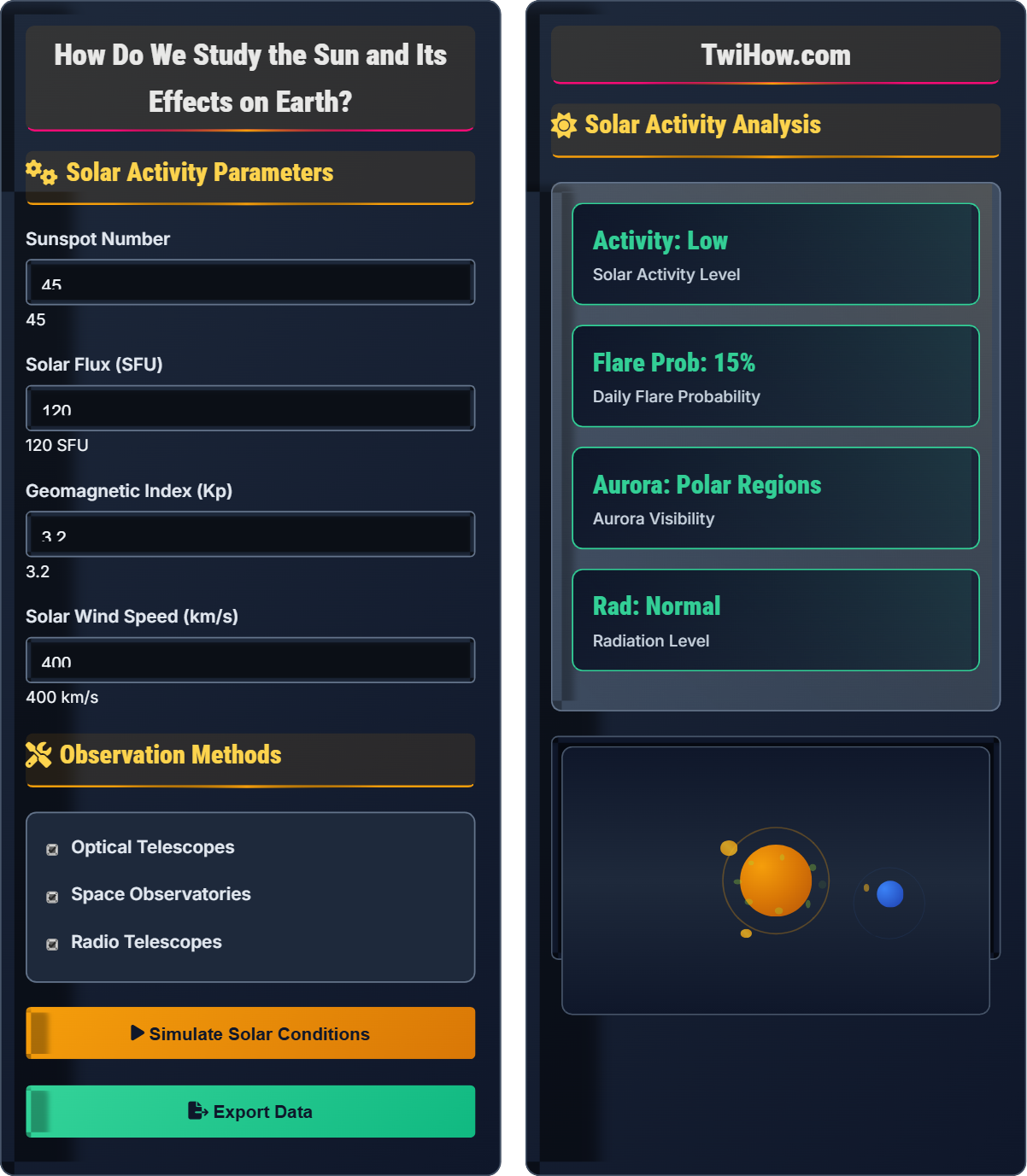
Solar Activity Parameters
Observation Methods
Solar Activity Analysis
| Phenomenon | Frequency | Intensity | Earth Impact |
|---|---|---|---|
| Sunspots | Daily | Low | None |
| Flares | Weekly | Minor | Radio Blackouts |
| CMEs | Monthly | Low | Minor Storms |
| Wind Streams | Continuous | Normal | None |
Earth Impact Assessment
- Technology: Minor GPS fluctuations expected
- Communications: Possible HF radio disruptions
- Power Grids: Stable operation
- Auroras: Visible in northern latitudes
Solar Science and Earth Effects Explained
The Sun is a massive ball of plasma composed primarily of hydrogen (74%) and helium (24%), with trace amounts of heavier elements. It generates energy through nuclear fusion in its core, converting hydrogen into helium and releasing enormous amounts of energy. The Sun's structure consists of several layers:
- Core: Where nuclear fusion occurs (15 million °C)
- Radiative Zone: Energy transfers via radiation
- Convective Zone: Energy transfers via convection currents
- Photosphere: Visible surface layer
- Chromosphere: Thin layer above photosphere
- Corona: Outermost layer, visible during eclipses
The Sun emits electromagnetic radiation across the entire spectrum, following Planck's law of black-body radiation. The solar constant, representing the amount of solar energy received at Earth's distance, is approximately 1361 W/m². The energy transport equation for radiation is:
Where:
- F: Radiant flux (energy per unit area)
- σ: Stefan-Boltzmann constant (5.67×10⁻⁸ W·m⁻²·K⁻⁴)
- T: Temperature in Kelvin
This equation helps scientists understand how stellar energy output relates to temperature.
The solar wind is a continuous flow of charged particles (plasma) ejected from the Sun's corona. This wind interacts with Earth's magnetosphere, creating the following phenomena:
- Bow Shock: Boundary where solar wind slows down
- Magnetopause: Boundary of Earth's magnetic field
- Magnetotail: Extended region away from the Sun
- Van Allen Belts: Trapped radiation zones
During solar storms, this interaction intensifies, causing geomagnetic disturbances.
Scientists classify solar phenomena based on their characteristics:
- Sunspots: Dark regions caused by strong magnetic fields
- Solar Flares: Sudden bursts of electromagnetic radiation (classified A, B, C, M, X)
- Coronal Mass Ejections (CMEs): Large expulsions of plasma and magnetic field
- Coronal Holes: Areas of open magnetic field lines
- Solar Prominences: Cool plasma structures extending from the Sun
Solar Research Methods
Spectroscopy, helioseismology, magnetometry, radiometry, space-based observation.
λ = c / f
Where λ = wavelength, c = speed of light, f = frequency. This allows analysis of solar composition.
- Solar activity follows an 11-year cycle
- Strong magnetic fields correlate with solar activity
- Higher solar activity increases space weather effects
- Multi-wavelength observations reveal different solar layers
Solar Effects on Earth
Space weather, atmospheric effects, technological impacts, biological considerations.
- G1 (Minor): Weak power grid fluctuations
- G2 (Moderate): Power grid voltage alarms
- G3 (Strong): Power system voltage corrections
- G4 (Severe): Wide-area power outages possible
- G5 (Extreme): Widespread power system collapse
- Satellite operations are vulnerable to radiation
- GPS signals can be disrupted by solar activity
- Auroras occur at higher latitudes during storms
- HF radio communications are affected by ionospheric changes
Key Solar Research Facilities
Launched: 2010 | Operational: Continuous high-resolution imaging of the Sun
Provides multi-wavelength images of the Sun every 12 seconds, revolutionizing our understanding of solar dynamics and space weather prediction.
Launched: 1995 | Operational: 24/7 solar monitoring
Has provided over 25 years of continuous solar observations, discovering thousands of comets and monitoring solar wind conditions.
Launched: 2018 | Operational: Touching the Sun
First spacecraft to fly through the solar corona, providing unprecedented close-up measurements of solar wind and magnetic fields.
Solar Science Learning Quiz
Which part of the Sun is responsible for the light we see?
The photosphere is the visible surface layer of the Sun from which most of the Sun's light and heat emanate. Although energy is generated in the core through nuclear fusion, it takes thousands of years for photons to travel from the core to the photosphere. The photosphere is the deepest layer we can observe directly in visible light, appearing as the bright disk of the Sun. The temperature of the photosphere is approximately 5,778 K.
The answer is B) Photosphere.
This question tests understanding of solar structure and observational astronomy. Students often think that the core, where fusion occurs, is what we see. However, the core is completely opaque, and the energy generated there travels outward through radiation and convection zones before reaching the photosphere. This illustrates the difference between where energy is generated versus where it's observed from.
Photosphere: Visible surface layer of the Sun
Opacity: Property of matter that prevents light transmission
Nuclear Fusion: Process combining atomic nuclei under extreme pressure and temperature
• Energy takes thousands of years to travel from core to surface
• We can only directly observe the photosphere in visible light
• Different solar layers emit at different wavelengths
• Remember: "photo" means light, so photosphere is the light-emitting layer
• Think of the Sun as an onion with distinct layers
• Each layer has different temperatures and properties
• Confusing the core with the visible surface
• Forgetting that the Sun has multiple observable layers
• Thinking all solar energy comes from the surface
Describe the 11-year solar cycle, including its causes, characteristics, and effects on space weather. How do scientists measure and predict solar activity?
Solar Cycle: An approximately 11-year period during which the Sun's magnetic field reverses polarity, resulting in variations in solar activity including sunspots, flares, and coronal mass ejections.
Causes: The solar dynamo mechanism, where differential rotation (equator rotates faster than poles) and convective motions in the Sun's interior twist and strengthen magnetic field lines, eventually leading to magnetic reconnection and the formation of sunspots.
Characteristics: Sunspot numbers increase during solar maximum and decrease during solar minimum. The cycle also affects solar irradiance, with about 0.1% variation between maximum and minimum.
Effects: Increased space weather activity during solar maximum, affecting satellite operations, radio communications, and power grids. More frequent auroral displays during active periods.
Measurement: Scientists use the Wolf Sunspot Number, solar flux measurements, and space-based instruments to monitor activity. Predictions involve statistical models and understanding of the solar dynamo.
The solar cycle demonstrates how internal stellar dynamics create observable periodic behavior. The differential rotation of the Sun (equatorial regions rotate faster than polar regions) causes magnetic field lines to become twisted and tangled, storing energy that's released through solar phenomena. This illustrates the connection between internal stellar physics and observable phenomena.
Solar Dynamo: Mechanism generating the Sun's magnetic field
Wolf Sunspot Number: Measure of solar activity based on sunspot counts
Differential Rotation: Different rotation rates at different latitudes
• Solar cycle affects both quantity and intensity of solar phenomena
• Magnetic field reversal occurs every 11 years
• Total solar cycle including magnetic reversal is 22 years
• Remember: 11-year cycle is half the full magnetic cycle
• Think of magnetic field lines as rubber bands getting twisted
• Solar maxima correspond to increased space weather activity
• Confusing 11-year cycle with 22-year magnetic cycle
• Thinking solar output is constant
• Underestimating the impact of solar variability on space weather
If the solar constant is 1361 W/m² at Earth's distance (1 AU), calculate the solar irradiance at Mars, which is 1.52 AU from the Sun. Use the inverse square law for radiation intensity.
Given:
Solar constant at Earth (Io) = 1361 W/m²
Earth's distance (do) = 1 AU
Mars' distance (d) = 1.52 AU
Formula: I = Io × (do/d)²
Calculation:
I = 1361 × (1/1.52)²
I = 1361 × (0.658)²
I = 1361 × 0.433
I = 589 W/m²
Therefore, the solar irradiance at Mars is approximately 589 W/m².
This problem demonstrates the inverse square law, which states that radiation intensity decreases proportionally to the square of the distance from the source. As distance doubles, intensity decreases to one-fourth. This principle is fundamental to understanding how stellar energy distributes across space and affects planetary climates.
Solar Constant: Solar irradiance at 1 AU distance
Inverse Square Law: Intensity ∝ 1/distance²
Astronomical Unit (AU): Average Earth-Sun distance (~150 million km)
• Radiation intensity decreases with distance squared
• This affects planetary temperatures and atmospheres
• Applies to all electromagnetic radiation sources
• Remember: double distance = quarter intensity
• Use ratios rather than absolute distances
• Check that your answer is physically reasonable
• Forgetting to square the distance ratio
• Using linear instead of inverse square relationship
• Incorrectly setting up the distance ratio
A major solar flare erupts on the Sun's surface. Describe the sequence of events from the eruption to potential impacts on Earth. Include timing estimates and the different types of solar emissions that reach Earth.
Sequence of Events:
1. Initial Eruption: Solar flare releases electromagnetic radiation (X-rays, UV, visible light)
2. Electromagnetic Radiation Arrival (8 minutes): Reaches Earth almost instantly, causing immediate ionospheric changes and HF radio blackouts
3. Solar Energetic Particles (20-90 minutes): High-energy protons arrive, potentially affecting astronauts and satellite electronics
4. Coronal Mass Ejection (1-3 days): Large cloud of plasma and magnetic field reaches Earth, causing geomagnetic storms
Earth Impacts:
• Radio communication disruptions (immediate)
• GPS signal degradation (minutes to hours)
• Power grid fluctuations (hours after CME arrival)
• Enhanced aurora visibility (during geomagnetic storm)
Scientists monitor these events using spacecraft positioned at L1 Lagrange point (SOHO, DSCOVR) to provide advance warning.
This problem illustrates the multi-modal nature of solar eruptions and their differential arrival times at Earth. It demonstrates why space weather forecasting is complex, involving different physical processes occurring on different timescales. The electromagnetic effects are nearly instantaneous, while the plasma effects take hours to days.
Coronal Mass Ejection (CME): Large expulsion of plasma and magnetic field
Ionosphere: Layer of Earth's atmosphere affected by solar radiation
Geomagnetic Storm: Temporary disturbance of Earth's magnetosphere
• Electromagnetic radiation travels at light speed (8 min to Earth)
• Plasma takes hours to days to reach Earth
• Different components have different Earth impacts
• Think of solar eruptions as multi-stage events
• Consider the different speeds of various emissions
• Remember that timing is crucial for space weather prediction
• Assuming all solar effects arrive simultaneously
• Forgetting the speed difference between radiation and particles
• Not considering the different impacts of each emission type
Why do scientists use space-based solar observatories in addition to ground-based telescopes?
Earth's atmosphere absorbs or scatters many wavelengths of electromagnetic radiation, particularly X-rays, ultraviolet, and some infrared radiation. Space-based observatories can observe these wavelengths that are blocked by the atmosphere, providing a complete picture of solar emissions. Additionally, space telescopes avoid atmospheric distortion, providing clearer images, and can observe the Sun continuously without day/night interruptions.
The answer is B) Earth's atmosphere blocks certain wavelengths.
This question addresses a fundamental concept in astronomy: atmospheric windows. The Earth's atmosphere is only transparent to certain ranges of the electromagnetic spectrum (optical and radio windows), blocking others. For solar physics, this means that observations of the Sun's corona, X-ray emissions, and certain UV wavelengths are only possible from space.
Atmospheric Window: Wavelength ranges that pass through Earth's atmosphere
Electromagnetic Spectrum: Complete range of electromagnetic radiation
Coronal Observations: Studies of the Sun's outer atmosphere
• Atmosphere blocks X-rays, most UV, and some IR radiation
• Optical and radio observations possible from ground
• Space observations provide complete spectral coverage
• Remember: atmosphere is not transparent to all wavelengths
• Think of the atmosphere as a filter with specific properties
• Consider why certain observations require space-based platforms
• Thinking atmosphere is transparent to all radiation
• Not understanding the concept of atmospheric windows
• Assuming cost is the primary driver for space missions
FAQ
Q: How do solar flares affect our daily lives?
A: Solar flares can significantly impact our technology-dependent society. When a strong flare erupts, it releases electromagnetic radiation that reaches Earth in about 8 minutes, disrupting radio communications and GPS signals. The associated coronal mass ejection can arrive 1-3 days later, causing geomagnetic storms that may affect power grids, satellite operations, and increase radiation exposure for astronauts and aircraft passengers flying polar routes. While most flares have minimal impact, extreme events like the 1859 Carrington Event could today cause widespread power outages and satellite failures.
Q: What instruments are used to study the Sun's corona?
A: The Sun's corona is studied using specialized instruments called coronagraphs, which block out the bright solar disk to reveal the faint corona. Space missions like SOHO carry LASCO (Large Angle Spectroscopic Coronagraph) instruments. The Parker Solar Probe has flown directly through the corona, taking in-situ measurements. During total solar eclipses, ground-based coronagraphs and regular telescopes can observe the corona. These instruments detect visible light, X-rays, and extreme ultraviolet emissions from the corona, revealing its structure, temperature, and magnetic field configuration.
Q: How does solar activity affect aviation safety?
A: Solar activity affects aviation primarily through increased radiation exposure and communication disruptions. During solar storms, passengers and crew on polar flights receive higher doses of cosmic radiation. Solar flares can cause radio blackouts, affecting high-frequency communications over polar regions. GNSS (GPS) signals may be degraded, affecting navigation accuracy. Airlines monitor space weather conditions and may reroute polar flights during severe storms. The radiation dose during a single flight is small, but cumulative exposure is a concern for frequent flyers and crew members.