What Are the Latest Findings About Our Solar System's Formation?
Complete solar system formation guide • Origins, evolution & discoveries
Solar System Formation:
Show Formation SimulatorOur understanding of solar system formation has been revolutionized by recent discoveries from space missions, advanced telescopic observations, and detailed meteorite analysis. The traditional model of a slow, gradual formation process has been updated with evidence of rapid accretion, early differentiation, and complex migration patterns of planetary embryos.
Key findings include the discovery of chondrules that formed in millisecond timescales, evidence of water delivery from the outer solar system, and the realization that Jupiter and Saturn underwent significant orbital migration. These discoveries have reshaped our understanding of how our cosmic neighborhood formed and evolved.
Recent breakthroughs include:
- Isotopic Analysis: Precise dating of early solar system materials
- Planet Migration: Jupiter and Saturn's early orbital movements
- Water Delivery: How Earth received its water from asteroids
- Chronology: Timeline of planetary formation and differentiation
These findings continue to refine our models of planetary system formation throughout the galaxy.
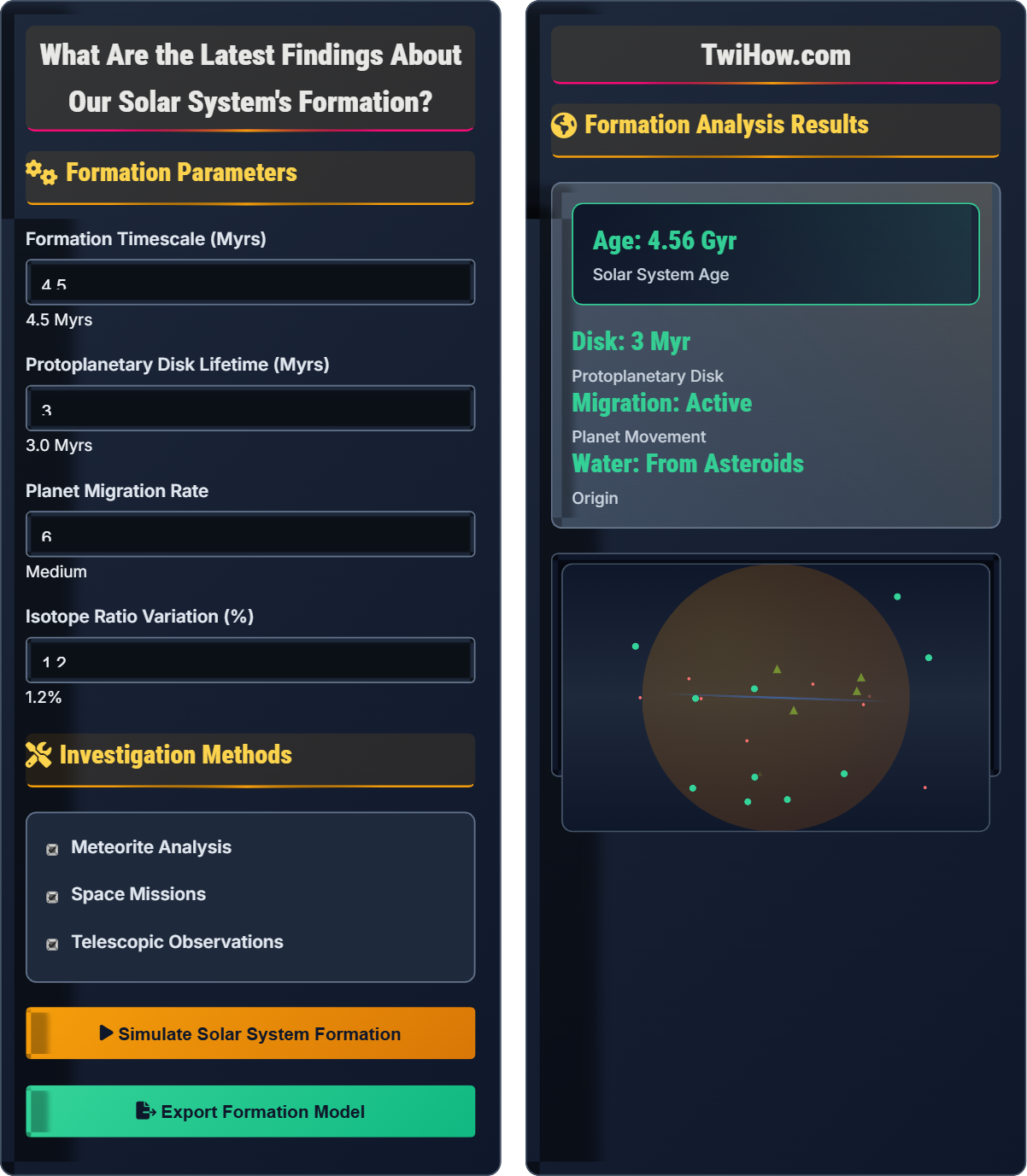
Formation Parameters
Investigation Methods
Formation Analysis Results
| Event | Time (Myr) | Significance | Method |
|---|---|---|---|
| Solar Nebula Collapse | 0 | Star Formation | Isotopes |
| Planetesimal Formation | 0.1 | Building Blocks | Meteorites |
| Planet Formation | 1-10 | Main Process | Models |
| Water Delivery | 50-100 | Life Essential | Geochemistry |
Key Processes
- Gravitational Collapse: Solar nebula condensation
- Accretion: Particle aggregation into planets
- Differentiation: Internal structure formation
- Migration: Orbital position changes
Solar System Formation and Latest Discoveries Explained
The solar system formed from a collapsing cloud of gas and dust approximately 4.56 billion years ago:
- Gravitational Collapse: A molecular cloud collapsed under its own gravity
- Angular Momentum: Rotation caused flattening into a disk
- Heating: Compression heated the center to form the Sun
- Cooling: Outer regions cooled to allow solid particle formation
- Accretion: Particles collided and stuck together to form planets
The timescale for planet formation can be estimated using:
Where:
- t_form: Formation timescale
- R: Orbital distance
- G: Gravitational constant
- M_central: Central star mass
This shows that formation timescale increases with distance from the star.
New findings have revolutionized our understanding:
- Chondrule Formation: Millisecond timescale heating events
- Isotopic Anomalies: Evidence of presolar material mixing
- Planet Migration: Early orbital position changes
- Water Delivery: Asteroid belt as water source
- Chronology: Precise timing of formation events
Radioactive isotopes provide precise timing for early solar system events:
- Aluminum-26: Half-life of 0.73 Myr (early solar system clock)
- Iodine-129: Half-life of 16 Myr (volatile element timing)
- Hafnium-182: Half-life of 9 Myr (core formation timing)
- Iron-60: Evidence of nearby supernova injection
These "cosmic clocks" help determine when different processes occurred.
Latest Discoveries
Chondrule formation, planet migration, water delivery, isotopic anomalies, chronology.
N(t) = N₀e^(-λt)
Used to calculate the age of meteoritic materials based on radioactive decay.
- Chondrules formed rapidly in heating events
- Planets migrated significantly from initial positions
- Water delivered by asteroid impacts
- Presolar materials mixed into early solar system
Investigation Methods
Meteorite analysis, space missions, telescopic observations, laboratory experiments.
- Collect pristine meteorite samples
- Separate mineral phases
- Measure isotope ratios using mass spectrometry
- Calculate formation ages using decay equations
- Compare with other samples to build chronology
- Contamination must be avoided in sample analysis
- Multiple isotopic systems provide cross-verification
- Space missions provide direct geological context
- Telescopic observations reveal formation processes in other systems
Solar System Formation Timeline
Key Recent Discoveries
Discovery: Chondrules formed in millisecond timescales
Recent studies using high-precision isotope analysis show that chondrules - the millimeter-sized spheres found in primitive meteorites - formed in extremely rapid heating events. These flash-melting episodes lasted only milliseconds to hours, followed by rapid cooling. This challenges the traditional view of gradual accretion and suggests violent, energetic processes in the early solar system.
Discovery: Jupiter and Saturn underwent significant orbital migration
Analysis of meteorite compositions reveals that the giant planets moved significantly from their initial formation locations. Jupiter likely formed at 3.5 AU and migrated inward, then outward during the early solar system. This "Grand Tack" model explains the structure of the asteroid belt and the distribution of inner planets.
Discovery: Earth's water came from asteroid impacts
Comparisons of hydrogen isotope ratios in Earth's oceans with meteorites show that water-rich asteroids from the outer asteroid belt were the primary source of Earth's water. This occurred during the Late Heavy Bombardment period, approximately 4.4-4.3 billion years ago.
Discovery: Presolar materials mixed into early solar system
Analysis of meteorites reveals that the early solar system contained materials inherited from the molecular cloud that formed our Sun. These presolar grains provide direct evidence of stellar nucleosynthesis and mixing processes that occurred before the solar nebula formed.
Solar System Formation Learning Quiz
What recent discovery about chondrules has changed our understanding of early solar system processes?
Recent high-precision isotope analysis has revealed that chondrules formed in extremely rapid heating events lasting only milliseconds to hours, followed by rapid cooling. This "flash-melting" process occurred in the early solar system and challenges the traditional view of gradual, slow accretion. These violent processes suggest the early solar system was more energetic and dynamic than previously thought.
The answer is B) They formed in rapid heating events lasting milliseconds.
This discovery highlights how new analytical techniques can revolutionize our understanding of ancient processes. The rapid formation of chondrules indicates that the early solar system experienced sudden, energetic events rather than gentle, gradual processes. This shows how scientific understanding evolves with better tools and methods.
Chondrules: Millimeter-sized spherical rocks in primitive meteorites
Flash Melting: Rapid heating and cooling process
Isotope Analysis: Measuring different atomic variants to determine age
• Chondrules formed in millisecond timescales
• These events were violent and energetic
• Rapid formation challenges gradual accretion models
• Think of chondrules as evidence of violent early events
• Remember: rapid processes can be preserved in rocks
• New techniques reveal new aspects of ancient events
• Thinking chondrules formed slowly
• Not understanding the significance of rapid formation
• Forgetting that violent processes can be preserved
Explain the "Grand Tack" model of Jupiter's migration and how it affected the formation of our solar system. What evidence supports this theory?
Grand Tack Model: Jupiter formed at approximately 3.5 AU from the Sun and migrated inward to about 1.5 AU, then reversed direction and moved outward to its current location at 5.2 AU.
Process: Jupiter's inward migration was driven by gravitational interactions with the protoplanetary disk. When Saturn reached sufficient mass, the two planets entered a 3:2 orbital resonance, causing them to migrate outward together.
Effects: This migration explains the structure of the asteroid belt (scattered asteroids to create the current distribution), the small size of Mars (Jupiter's gravity prevented Mars from growing larger), and the water delivery to Earth (asteroids scattered inward during migration).
Evidence: Analysis of meteorite compositions shows different isotopic signatures between inner and outer solar system materials, supporting the mixing that occurred during planetary migration.
This discovery shows that planets didn't form in their current positions but moved significantly during the early solar system. The Grand Tack model explains many observed features of our solar system that were previously puzzling. It demonstrates how gravitational interactions between planets and the protoplanetary disk can cause dramatic orbital changes.
Grand Tack: Jupiter's inward and outward migration model
Orbital Resonance: Gravitational relationship between planets
Protoplanetary Disk: Gas and dust disk around young star
• Planets migrated from initial formation locations
• Gravitational interactions caused orbital changes
• Migration explains current solar system structure
• Think of planets as mobile objects, not fixed positions
• Gravitational interactions can cause dramatic changes
• Migration explains otherwise puzzling observations
• Thinking planets formed in current positions
• Not understanding gravitational effects on orbits
• Forgetting that migration explains solar system features
A CAI (Calcium-Aluminum Inclusion) in a meteorite has an Aluminum-26/Aluminum-27 ratio of 5×10⁻⁵ at the time of formation. The current ratio is 1×10⁻⁵. If the half-life of Aluminum-26 is 0.73 million years, calculate the age of the CAI using the decay equation N = N₀e^(-λt). First, calculate the decay constant λ = ln(2)/half-life.
Step 1: Calculate decay constant
λ = ln(2) / half-life = 0.693 / 0.73 Myr = 0.949 Myr⁻¹
Step 2: Set up decay equation
N/N₀ = e^(-λt)
(1×10⁻⁵) / (5×10⁻⁵) = e^(-λt)
0.2 = e^(-λt)
Step 3: Solve for time
ln(0.2) = -λt
-1.609 = -0.949t
t = 1.69 Myr
The CAI is approximately 1.69 million years old.
This calculation demonstrates how radioactive isotopes serve as cosmic clocks. CAIs are the oldest known solar system materials, and their precise dating helps establish the timeline for early solar system events. The rapid decay of Aluminum-26 makes it ideal for dating early, brief processes.
CAI: Calcium-Aluminum Inclusion (oldest solar system material)
Decay Constant: Rate of radioactive decay
Half-Life: Time for half of isotope to decay
• Radioactive decay follows exponential law
• Short-lived isotopes date early events precisely
• Isotope ratios change predictably over time
• Calculate decay constant first
• Use ratio of current to original amount
• Check that calculated age makes physical sense
• Forgetting to calculate decay constant
• Using wrong formula for exponential decay
• Making arithmetic errors with small numbers
Astronomers have determined that Earth's water came primarily from asteroid impacts during the Late Heavy Bombardment. Explain how scientists identified the source of Earth's water using isotope analysis, and discuss the implications of this discovery for understanding planetary formation and the potential for life elsewhere.
Identification Method: Scientists compared the deuterium-to-hydrogen (D/H) ratios in Earth's oceans with those in various types of meteorites and comets. Carbonaceous chondrites (water-rich asteroids from the outer asteroid belt) have D/H ratios that closely match Earth's oceans.
Process: During the Late Heavy Bombardment (4.4-4.3 Gyr ago), water-rich asteroids from the outer asteroid belt were scattered inward by planetary migrations and impacted Earth, delivering the majority of our planet's water.
Implications: This discovery suggests that water delivery may be a common process in planetary systems. It indicates that planets in the habitable zone may receive water from similar processes, increasing the potential for life elsewhere. It also shows that volatile delivery is a critical step in planetary habitability.
This example demonstrates how isotope geochemistry can trace the origins of planetary materials. The fact that Earth's water came from asteroids rather than comets or from within Earth has profound implications for understanding how planets acquire the ingredients necessary for life. It shows how early solar system dynamics affected planetary composition.
D/H Ratio: Deuterium to hydrogen isotope ratio
Carbonaceous Chondrites: Water-rich meteorites
Late Heavy Bombardment: Period of intense impacts
• Isotope ratios are unique signatures of origin
• Water delivery was critical for Earth's habitability
• Planetary migration affected composition distribution
• Isotope ratios act like chemical fingerprints
• Early solar system dynamics affected planet composition
• Water delivery is essential for habitability
• Thinking Earth's water formed with the planet
• Not understanding the significance of isotope ratios
• Forgetting that early solar system was dynamic
What do presolar grains in meteorites tell us about the early solar system?
Presolar grains are microscopic particles that formed in other stars before our solar system existed. They survived incorporation into the solar nebula and are found in primitive meteorites. These grains have anomalous isotope compositions that differ from solar system average values, proving that the solar system formed from recycled material from previous generations of stars. This shows that our cosmic neighborhood contains matter from many different stellar sources.
The answer is A) The solar system formed from recycled stellar material.
This discovery demonstrates that our solar system is not unique but part of the continuous cycle of stellar birth and death in the galaxy. The presolar grains act as time capsules, preserving information about stellar nucleosynthesis and the conditions in the molecular cloud that gave birth to our Sun. This connects our solar system to the broader galactic ecosystem.
Presolar Grains: Stardust from other stars preserved in meteorites
Stellar Nucleosynthesis: Element formation in stars
Recycled Material: Matter from previous stellar generations
• Solar system contains material from previous stars
• Presolar grains preserve ancient stellar information
• Our solar system is part of galactic recycling
• We are literally made of stardust
• Presolar grains are cosmic time capsules
• Solar system formed from recycled galactic material
• Thinking solar system formed from pristine material
• Not understanding stellar nucleosynthesis
• Forgetting that stars recycle galactic matter
FAQ
Q: How do we know the solar system is 4.56 billion years old?
A: We determine the age of the solar system by dating the oldest known materials: calcium-aluminum inclusions (CAIs) found in primitive meteorites. These formed within the first 100,000 years of solar system history. Using radioactive isotopes like aluminum-26 and lead-lead dating methods, scientists consistently find that these materials are 4.567 billion years old. Since these are the oldest materials we know of, this represents the formation age of our solar system.
Q: Did the planets form in their current positions?
A: No, recent discoveries show that planets migrated significantly from their initial formation locations. Jupiter likely formed at 3.5 AU from the Sun and moved inward before reversing course and moving outward to its current position. This "Grand Tack" model explains many features of our solar system, including the small size of Mars and the structure of the asteroid belt. Planetary migration was a common process in the early solar system.
Q: How did Earth get its water?
A: Earth's water was delivered primarily by asteroids during the Late Heavy Bombardment period, about 4.4-4.3 billion years ago. Analysis of hydrogen isotope ratios shows that carbonaceous chondrites (water-rich asteroids from the outer asteroid belt) match Earth's ocean composition. This means that while Earth formed dry in the hot inner solar system, water-rich asteroids from the cooler outer regions were scattered inward by planetary migrations and delivered water to our planet.