What Are the Most Exciting Upcoming Space Missions?
Complete mission guide • Exploration, science & discovery
Upcoming Missions:
Show Mission TrackerThe coming decade promises an unprecedented surge in space exploration with ambitious missions planned by space agencies worldwide and private companies. From returning humans to the Moon through NASA's Artemis program to launching the next generation of space telescopes, we stand at the threshold of revolutionary discoveries and technological achievements.
Key upcoming missions include Mars sample return efforts, lunar exploration initiatives, advanced space telescopes, and commercial space ventures. These missions will advance our understanding of the cosmos, search for signs of life, and potentially establish humanity's presence beyond Earth.
Major focus areas include:
- Lunar Exploration: Artemis program and international moon bases
- Mars Missions: Sample return and human preparation
- Deep Space: Advanced telescopes and outer planet exploration
- Commercial Ventures: Private space station and tourism
These missions represent humanity's next giant leap in space exploration and scientific discovery.
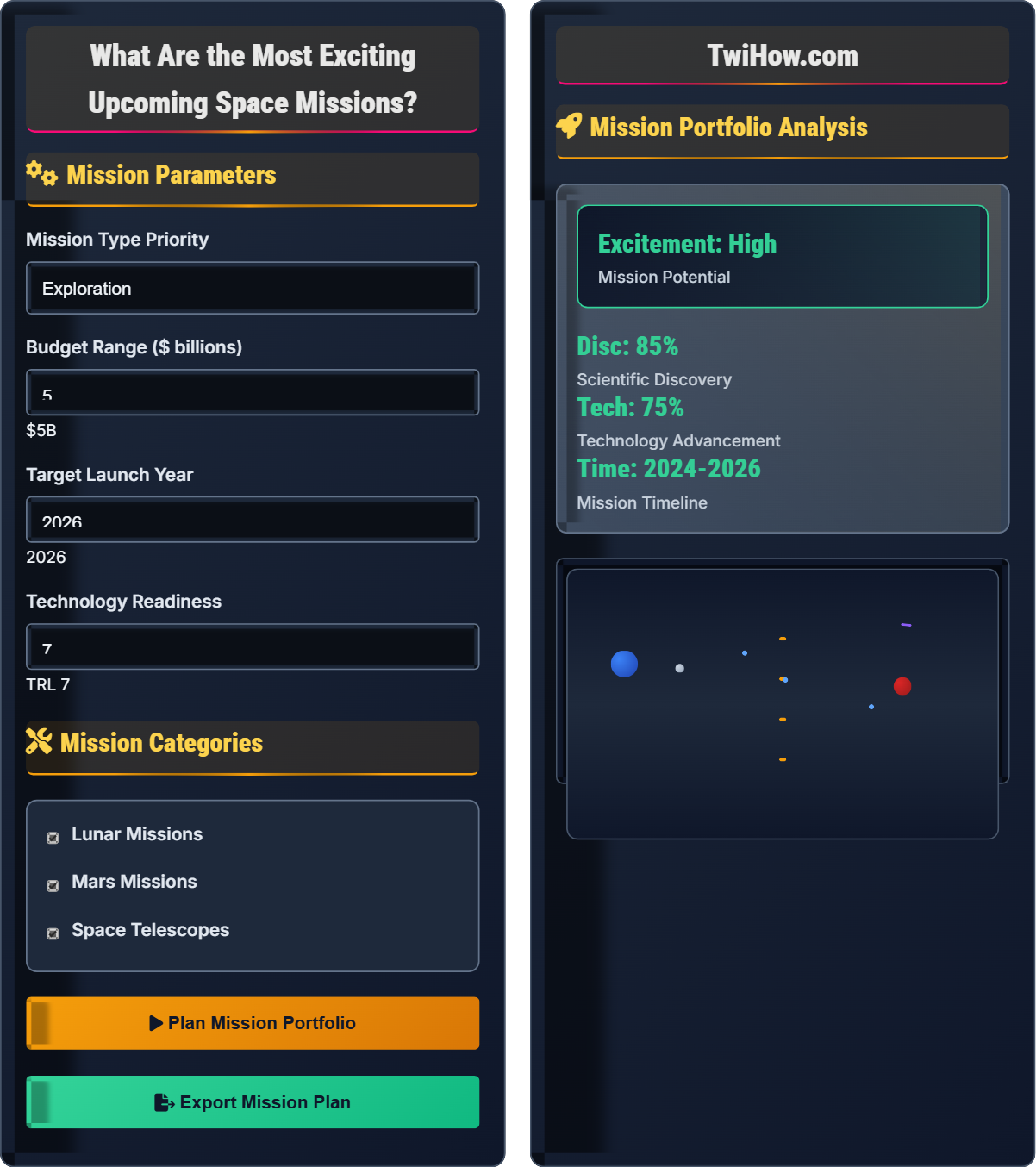
Mission Parameters
Mission Categories
Mission Portfolio Analysis
| Mission | Agency | Target | Year |
|---|---|---|---|
| Artemis III | NASA | Moon | 2026 |
| Mars Sample Return | NASA/ESA | Mars | 2028 |
| Roman Space Telescope | NASA | Deep Space | 2027 |
| Europa Clipper | NASA | Jupiter | 2024 |
Key Milestones
- 2024-2025: Europa Clipper, Psyche mission
- 2026-2027: Artemis III, Roman Space Telescope
- 2028-2030: Mars Sample Return, Lunar Gateway
- 2030+: Human Mars missions, megaconstellations
Upcoming Space Missions and Exploration Plans Explained
The upcoming decade features missions across multiple categories:
- Lunar Missions: Returning humans to the Moon and establishing permanent bases
- Mars Missions: Sample return, human preparation, and exploration
- Deep Space: Advanced telescopes and outer planet exploration
- Commercial Missions: Private space stations and tourism
- International Collaborations: Joint missions between space agencies
The probability of mission success can be estimated using:
Where:
- TRL: Technology Readiness Level (1-9 scale)
- Budget_adequacy: Funding sufficiency factor
- Tech_readiness: Overall system readiness
This formula helps assess the likelihood of mission success based on preparation factors.
Key scientific goals of upcoming missions include:
- Search for Life: Investigating potentially habitable worlds
- Origins of the Universe: Studying cosmic evolution and dark matter
- Planetary Science: Understanding planetary formation and evolution
- Technological Demonstration: Testing new capabilities in space
- Human Exploration: Preparing for sustainable space presence
Many upcoming missions involve international partnerships:
- NASA-ESA Collaboration: Mars Sample Return mission
- Artemis Accords: International lunar exploration framework
- Joint Missions: Shared costs and expertise
- Data Sharing: Open scientific collaboration
- Technology Exchange: Shared innovation and development
Major Upcoming Missions
Artemis Program, Mars Sample Return, JWST successors, lunar gateway, commercial space stations.
Total Cost = Development + Manufacturing + Launch + Operations + Data Analysis
Used to estimate comprehensive mission budgets across all phases.
- Technology readiness is critical for success
- International collaboration reduces costs and risks
- Long-term planning is essential for complex missions
- Contingency planning is necessary for space operations
Mission Priorities
Exploration, science, technology demonstration, human spaceflight, commercial applications.
- Scientific merit and discovery potential
- Technical feasibility and risk assessment
- Cost-benefit analysis
- International cooperation opportunities
- Alignment with strategic objectives
- Scientific return must justify mission costs
- Technology advancement enables future missions
- International partnerships enhance capabilities
- Public engagement and education are important
Featured Upcoming Missions
Agency: NASA | Target: Moon | Years: 2024-2030
The Artemis program aims to return humans to the Moon, including the first woman and next man. It includes establishing a sustainable lunar presence, building a lunar Gateway station, and preparing for future Mars missions. Artemis III will land astronauts on the lunar surface by 2026.
Agency: NASA/ESA | Target: Mars | Years: 2028-2033
A joint mission between NASA and ESA to return samples collected by the Perseverance rover to Earth. This mission involves multiple spacecraft: a sample retrieval lander, a Mars Ascent Vehicle, and an Earth Return Orbiter. It represents one of the most complex interplanetary missions ever attempted.
Agency: NASA | Target: Deep Space | Year: 2027
The Roman Space Telescope will survey the cosmos with a field of view 100 times larger than Hubble. It will study dark energy, exoplanets, and the structure of the universe. Named after NASA's first chief astronomer, it will revolutionize our understanding of cosmic evolution.
Agency: NASA | Target: Jupiter's Moon Europa | Year: 2024 (launch)
This mission will investigate whether Jupiter's moon Europa has conditions suitable for life. Europa is believed to harbor a subsurface ocean beneath its icy crust. The spacecraft will conduct detailed reconnaissance and assess the moon's habitability.
Agency: SpaceX | Target: Moon, Mars | Years: 2026+
SpaceX's Starship system promises to revolutionize space travel with its massive payload capacity. Planned missions include lunar landings for NASA's Artemis program and eventual Mars colonization. The fully reusable system could dramatically reduce the cost of space access.
Upcoming Missions Learning Quiz
What is the primary goal of NASA's Artemis program?
The Artemis program is NASA's initiative to return humans to the Moon by the mid-2020s, including the first woman and the next man. The program aims to establish a sustainable lunar presence, build a lunar Gateway station, and use the Moon as a stepping stone for future Mars missions. Artemis III specifically plans to land astronauts on the lunar surface by 2026.
The answer is B) Return humans to the Moon.
This question tests knowledge of NASA's current flagship program. The Artemis program represents a major shift in NASA's priorities since the Apollo era, emphasizing sustainability and international cooperation. Students should understand that this program is not just about reaching the Moon, but establishing a long-term presence there.
Artemis Program: NASA's lunar exploration program
Lunar Gateway: Space station orbiting the Moon
Sustainable Presence: Long-term human habitation
• Artemis aims to return humans to the Moon by 2026
• Includes the first woman and next man
• Serves as preparation for Mars missions
• Remember: Artemis is the lunar program
• Think of it as the successor to Apollo
• Focus on sustainability and international cooperation
• Confusing Artemis with Mars missions
• Thinking it's only about the first landing
• Not understanding the long-term goals
Explain the Mars Sample Return mission, including its participants, objectives, and technical challenges. Why is this mission considered one of the most complex ever attempted?
Participants: A joint mission between NASA and the European Space Agency (ESA), with contributions from multiple contractors and institutions.
Objectives: To return samples collected by the Perseverance rover to Earth for detailed laboratory analysis. These samples may contain evidence of past microbial life on Mars.
Technical Challenges: The mission requires multiple spacecraft: a sample retrieval lander, a Mars Ascent Vehicle to launch samples from the surface, and an Earth Return Orbiter to capture and return the samples. Each component must function perfectly, and the mission involves complex autonomous operations on Mars.
Complexity: This is the first mission to attempt sample return from another planet, requiring precision landing, surface operations, launch from another planet, and orbital rendezvous with extreme precision. The mission involves multiple launches and complex coordination between different spacecraft.
This mission demonstrates the complexity of interplanetary operations and the need for international cooperation. Students should understand that Mars Sample Return represents a major technological achievement that could answer fundamental questions about life beyond Earth. The mission requires unprecedented precision in autonomous operations.
Sample Return: Bringing extraterrestrial materials to Earth
Mars Ascent Vehicle: Rocket to launch from Mars surface
Orbital Rendezvous: Meeting spacecraft in orbit
• Requires international cooperation
• Multiple spacecraft must coordinate perfectly
• Autonomous operations are essential
• Think of it as a relay race between multiple spacecraft
• Each step must succeed for the mission to work
• Consider the precision required for Mars operations
• Underestimating the complexity of planetary launches
• Not understanding the international nature of the mission
• Forgetting the scientific importance of sample return
A space mission has the following timeline: Concept development (1 year), Preliminary design (2 years), Detailed design (1.5 years), Construction (2.5 years), Testing (1 year), and Launch operations (0.5 years). If the mission is scheduled to launch in 2028, when did concept development begin? If the mission is delayed by 15% due to technical challenges, what will be the new launch year?
Step 1: Calculate total mission duration
Total duration = 1 + 2 + 1.5 + 2.5 + 1 + 0.5 = 8.5 years
Step 2: Determine concept start date
If launch is in 2028, concept development began in: 2028 - 8.5 = 2019.5
So concept development began in mid-2019.
Step 3: Calculate new timeline with 15% delay
Delay = 8.5 years × 0.15 = 1.275 years
New total duration = 8.5 + 1.275 = 9.775 years
New launch year = 2019.5 + 9.775 = 2029.275
The new launch year will be 2029.
This problem demonstrates the long timelines involved in space missions and how delays can significantly impact schedules. Students should understand that space missions require years of planning and development, and even small percentage delays can result in substantial schedule shifts. This illustrates the importance of accurate project management in space programs.
Mission Timeline: Chronological sequence of mission phases
Concept Development: Initial planning and feasibility
Project Management: Coordinating mission activities
• Space missions have long development cycles
• Delays compound over time
• Schedule accuracy is crucial for success
• Add up all mission phases to get total duration
• Work backwards from launch date to find start date
• Remember: small percentage delays mean large time shifts
• Forgetting to include all mission phases
• Not understanding the compounding effect of delays
• Making arithmetic errors in timeline calculations
Two space agencies want to collaborate on a mission that costs $8 billion. Agency A can contribute $5 billion and Agency B can contribute $4 billion. They need to decide how to share costs, responsibilities, and scientific data. Evaluate the potential challenges and benefits of this international partnership, and propose a fair allocation of resources and responsibilities.
Benefits of Partnership:
• Combined funding exceeds individual capabilities ($9B total vs $8B needed)
• Shared expertise and technology
• Risk distribution across agencies
• Enhanced scientific return through diverse perspectives
Challenges:
• Different technical standards and requirements
• Communication and coordination difficulties
• Political and budgetary dependencies
• Intellectual property and data sharing agreements
Proposed Allocation:
Based on contribution ratio (5:4), Agency A gets 56% of responsibilities and data rights, while Agency B gets 44%. However, critical mission elements like launch services might be assigned to the agency with greater expertise rather than funding contribution.
This problem highlights the real-world complexities of international space cooperation. Students should understand that while partnerships offer significant benefits, they also introduce challenges that must be carefully managed. The allocation of resources and responsibilities often involves diplomatic considerations beyond pure financial contributions.
International Collaboration: Joint projects between space agencies
Data Sharing: Distribution of scientific results
Resource Allocation: Division of costs and responsibilities
• Partnerships require formal agreements
• Technical compatibility is essential
• Political considerations affect scientific missions
• Consider both technical and diplomatic factors
• Balance financial contributions with responsibilities
• Plan for long-term sustainability of partnerships
• Not considering the diplomatic aspects of space cooperation
• Assuming equal sharing based on funding alone
• Forgetting about long-term maintenance and operations
What does Technology Readiness Level (TRL) measure in space mission planning?
Technology Readiness Level (TRL) is a method for assessing the maturity of evolving technologies. It ranges from TRL 1 (basic principles observed) to TRL 9 (actual system proven in operational environment). TRL helps mission planners evaluate the risk associated with using new technologies and determine when technologies are ready for space applications. Higher TRLs indicate more mature and reliable technologies.
The answer is B) The maturity and demonstrated capability of technology.
This question addresses the critical concept of technology readiness in mission planning. Students should understand that space missions cannot use experimental technologies without thorough testing and validation. The TRL system provides a standardized way to assess technology maturity and make informed decisions about mission risk.
Technology Readiness Level: Standardized assessment of technology maturity
TRL 1-3: Laboratory development
TRL 4-6: Component and system testing
TRL 7-9: Flight and operational verification
• Space missions typically require TRL 6+ for critical systems
• Higher TRLs reduce mission risk
• TRL assessment is systematic and documented
• Remember: TRL measures maturity, not complexity
• Think of it as a technology graduation system
• Higher numbers indicate more readiness
• Confusing TRL with technology complexity
• Not understanding the risk implications
• Thinking higher TRL means newer technology
FAQ
Q: How do scientists prioritize which missions to fund when there are so many exciting proposals?
A: Mission selection involves rigorous evaluation by scientific committees and space agencies. Criteria include scientific merit, technical feasibility, cost-effectiveness, alignment with strategic goals, and potential for major discoveries. Peer review processes, decadal surveys, and advisory committees rank proposals based on these factors. Agencies also consider technological readiness, international partnerships, and public engagement potential. The process balances high-risk, high-reward missions with more conservative approaches to maintain a diverse portfolio of exploration activities.
Q: What are the biggest technical challenges facing upcoming deep space missions?
A: Deep space missions face numerous challenges: Power generation (solar panels become ineffective beyond Mars), communication delays (up to hours for round-trip signals), radiation protection, thermal management in extreme environments, autonomous operations (due to communication delays), propulsion efficiency, and long-term system reliability. Missions must operate for years or decades without maintenance. Advanced propulsion, nuclear power systems, radiation-hardened electronics, and sophisticated autonomous systems are essential for success.
Q: How will upcoming space telescopes advance our understanding of the universe?
A: Next-generation telescopes like the Roman Space Telescope, HabEx, and LUVOIR concepts will revolutionize astronomy. They'll study dark energy and dark matter, discover and characterize Earth-like exoplanets, observe the first galaxies, and potentially detect biosignatures. These telescopes will have unprecedented sensitivity, resolution, and stability. They'll complement ground-based extremely large telescopes and provide continuous monitoring of cosmic phenomena. Together, they'll address fundamental questions about the universe's origin, evolution, and the potential for life elsewhere.