What Are the Technological Spinoffs from Space Exploration?
Complete technology guide • Spinoffs, innovations & benefits
Space Technology Spinoffs:
Show Spinoff SimulatorSpace exploration has generated thousands of technological innovations that have transformed our daily lives. From memory foam and water purification systems to GPS and satellite communications, space technologies have created a vast array of products and services that benefit society. These spinoffs demonstrate how investment in space research yields tangible benefits that extend far beyond the realm of space exploration.
Space agencies like NASA, ESA, and others have documented over 2,000 technologies that originated from space research and now serve civilian purposes. These innovations span multiple sectors including healthcare, consumer products, transportation, and environmental protection. The transfer of space technology to commercial applications creates economic value and improves quality of life for millions of people.
Key spinoff categories include:
- Consumer Products: Memory foam, scratch-resistant lenses, freeze-dried foods
- Medical Devices: Digital cameras, pacemakers, medical imaging
- Environmental: Water purification, air filtration, pollution monitoring
- Transportation: Improved automotive safety, fuel efficiency, navigation
These spinoffs demonstrate the far-reaching impact of space investment on technology and society.
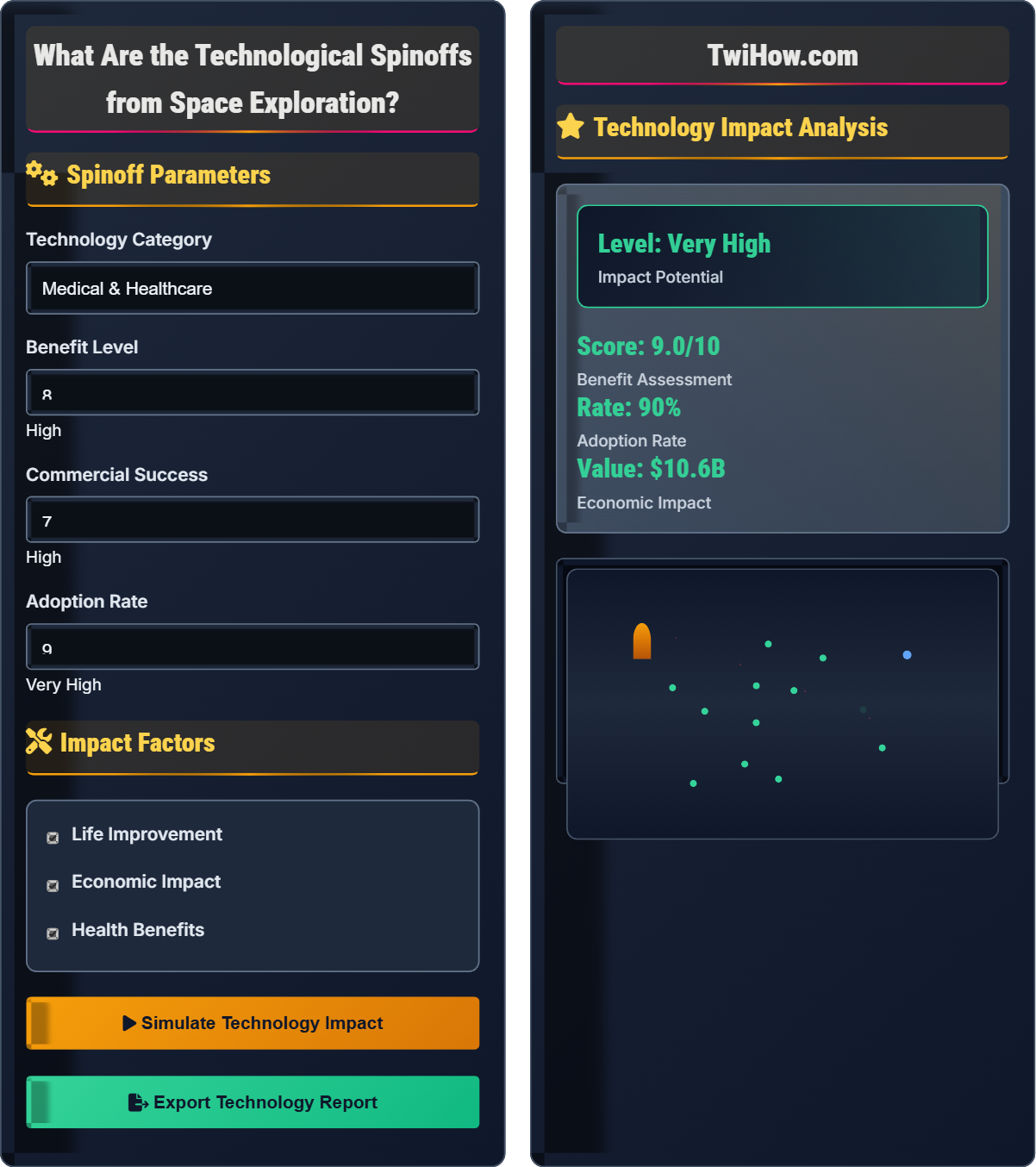
Spinoff Parameters
Impact Factors
Technology Impact Analysis
| Technology | Origin | Benefit | Commercial Success |
|---|---|---|---|
| Memory Foam | Aircraft Safety | Sleep, Comfort | Very High |
| GPS | Navigation | Location, Timing | Exceptional |
| Water Purification | Space Missions | Health, Safety | High |
| Digital Camera | Space Imaging | Photography | Exceptional |
Impact Sectors
- Healthcare: 300+ medical devices and technologies
- Consumer Goods: 500+ everyday products
- Transportation: Safety and efficiency improvements
- Environment: Monitoring and protection technologies
Space Technology Spinoffs and Innovation Transfer Explained
Space technology transfer follows a structured pathway from research to commercial application:
- Research & Development: Technology developed for space missions
- Patent & Documentation: Protecting intellectual property
- Licensing: Transferring technology to private companies
- Commercialization: Developing market-ready products
- Market Adoption: Public acceptance and use
- Feedback Loop: Improvements and refinements
The economic impact of space technology spinoffs can be calculated using:
Where:
- E: Total economic impact
- B_i: Benefit factor of technology i
- C_i: Commercial success factor of technology i
- A_i: Adoption rate of technology i
This formula quantifies the economic value of space-derived technologies.
Space exploration drives innovation through:
- Extreme Conditions: Technologies must function in harsh environments
- Miniaturization: Space constraints require compact solutions
- Efficiency: Limited resources demand optimal performance
- Reliability: Critical systems require fail-safe operation
- Cross-Disciplinary: Collaboration between different fields
- Open Innovation: Sharing knowledge and collaboration
Space technology spinoffs benefit society in multiple ways:
- Healthcare: Improved medical devices and treatments
- Safety: Enhanced protective equipment and systems
- Quality of Life: Better consumer products and services
- Environment: Pollution monitoring and mitigation
- Economic Growth: Job creation and new industries
- Education: Inspiring STEM careers and learning
Spinoff Categories
Medical, consumer products, environmental, transportation, electronics, materials, computing.
Impact = (Benefit × Adoption × Commercial Success) / Development Cost
Used to evaluate the effectiveness of technology transfer initiatives.
- Space requirements drive innovation
- Technology must be adapted for terrestrial use
- Commercial success is not guaranteed
- Long-term benefits often exceed initial investment
Technology Transfer
Licensing, partnerships, spinoff companies, patent pools, open innovation.
- Identify commercially viable technology
- Protect intellectual property
- Market the technology to industry
- Negotiate licensing agreements
- Provide technical support during development
- Monitor commercialization success
- Market demand must exist for technology
- Cost of adaptation must be justified
- Intellectual property rights must be clear
- Regulatory approval may be required
Featured Space Spinoffs
Origin: NASA Ames Research Center (1966)
Originally developed for aircraft seats to improve crash protection. The viscoelastic material molds to body shape and returns to original form. Now used in mattresses, pillows, medical devices, and protective equipment. Benefits include improved sleep quality, pressure relief, and injury prevention.
Origin: Department of Defense (1970s)
Global Positioning System developed for military navigation. Now provides location services for billions of devices worldwide. Applications include navigation, mapping, timing, and location-based services. Revolutionized transportation, logistics, and personal navigation.
Origin: NASA Water Recovery Systems
Developed for space missions to purify water from various sources. Technologies include filtration, disinfection, and recycling systems. Now used in developing countries, emergency response, and consumer products. Provides clean water access to millions of people.
Origin: NASA Jet Propulsion Laboratory
Developed CMOS active pixel sensors for space imaging applications. Smaller, more efficient than traditional film systems. Now used in digital cameras, smartphones, and medical imaging. Made photography accessible and affordable for everyone.
Origin: NASA Image Processing Technology
Adapted from satellite imaging technology for medical diagnostics. Used in CAT scans, MRI, mammography, and other imaging systems. Improved accuracy and speed of medical diagnoses. Saves countless lives through early detection.
Economic Impact
Annual Impact: Billions of dollars in economic value
Space technology spinoffs contribute significantly to GDP through job creation, new industries, and productivity improvements. Studies estimate that every dollar invested in space research generates $7-14 in economic returns through spinoff technologies and their applications.
Employment: Hundreds of thousands of jobs created
Spinoff technologies have created entire industries and employment sectors. From manufacturing memory foam products to developing GPS applications, space-derived technologies have generated millions of jobs worldwide across multiple sectors.
Multiplier Effect: Technology spurs further innovation
Space technologies often serve as platforms for additional innovation. For example, GPS technology enabled the development of ride-sharing apps, precision agriculture, and autonomous vehicles. Each spinoff creates a foundation for subsequent innovations.
Space Technology Learning Quiz
Where was memory foam originally developed?
Memory foam was originally developed by NASA's Ames Research Center in 1966 to improve crash protection for airline passengers. The material was designed to absorb impact energy and reduce g-forces during crashes. It was later adapted for use in space missions before being commercialized for consumer products like mattresses and pillows.
The answer is B) NASA for aircraft safety.
This question demonstrates how space technology often originates from safety and performance requirements. Memory foam was developed to solve a specific problem in aviation safety, showing how space research addresses practical challenges that have broader applications.
Memory Foam: Viscoelastic material that molds to shape
Ames Research Center: NASA facility specializing in aerospace research
Crash Protection: Systems designed to reduce injury during impacts
• Space technology often originates from safety requirements
• Solutions developed for space have broader applications
• Technology transfer creates unexpected benefits
• Many everyday items originated from space research
• Look for the original purpose of technologies
• Space requirements often drive innovation
• Thinking everyday items were originally developed for consumers
• Not understanding the connection to space research
• Forgetting that space requirements drive innovation
Explain the process of technology transfer from space research to commercial applications. What are the key steps and challenges involved?
Technology Transfer Process:
1. Research & Development: Technology developed for specific space mission requirements
2. Documentation & Patents: Protecting intellectual property and documenting innovations
3. Marketing: Identifying potential commercial applications and interested companies
4. Licensing: Negotiating agreements to transfer technology to private sector
5. Adaptation: Modifying technology for commercial use and manufacturing
6. Commercialization: Developing market-ready products and bringing to market
Key Challenges:
• Cost of adapting technology for commercial use
• Regulatory approval for certain applications
• Market demand and acceptance
• Intellectual property rights and licensing terms
• Technical expertise needed for adaptation
This question highlights the complex process of moving technology from research to market. It shows that successful spinoffs require not just innovation, but also business acumen, regulatory navigation, and market understanding. The transfer process bridges the gap between research and commercial value.
Technology Transfer: Moving technology from research to commercial use
Licensing: Granting rights to use intellectual property
Commercialization: Bringing technology to market
• Research is only the first step in the process
• Adaptation is often required for commercial use
• Market demand drives commercial success
• Consider both technical and business challenges
• Think about the path from lab to market
• Understand that success requires multiple steps
• Thinking innovation automatically leads to commercial success
• Not considering the adaptation challenges
• Forgetting the business aspects of technology transfer
A space technology spinoff has a benefit factor of 8, commercial success factor of 7, and adoption rate of 0.85. Using the economic impact formula E = B × C × A, calculate the economic impact score. If the original investment in the space research was $50 million, what is the return on investment?
Step 1: Calculate economic impact score
E = B × C × A
E = 8 × 7 × 0.85
E = 47.6
Step 2: Calculate return on investment
Assuming the economic impact score represents a multiplier factor:
Return = Original Investment × Economic Impact
Return = $50M × 47.6
Return = $2,380M or $2.38 billion
ROI = (Return - Original Investment) / Original Investment
ROI = ($2,380M - $50M) / $50M = 46.6 or 4,660%
The economic impact score is 47.6, and the ROI is 4,660%.
This problem demonstrates the significant economic returns possible from space technology investments. The calculation shows how a relatively small investment in space research can generate enormous economic value through spinoff technologies. This illustrates the importance of continued investment in space research.
Economic Impact: Financial value generated by technology
Return on Investment: Gain relative to initial investment
Multiplier Effect: How investment creates additional value
• Economic impact calculations are estimates
• Space research often has high ROI
• Long-term benefits may exceed initial projections
• Consider both direct and indirect economic impacts
• Long-term benefits often exceed short-term calculations
• Multiple industries may benefit from one technology
• Forgetting to multiply all factors together
• Not considering the time value of money
• Underestimating the long-term economic impact
Space technologies have contributed significantly to environmental monitoring and protection. Describe specific space-derived technologies that benefit the environment and explain how they address environmental challenges.
Environmental Monitoring Technologies:
1. Satellite Imagery: Originally developed for Earth observation missions, now used to monitor deforestation, pollution, and climate change. Provides global coverage and long-term data trends.
2. Water Purification: Developed for space missions, now used in developing countries and emergency response. Provides clean water access to millions of people.
3. Air Quality Monitoring: Sensor technologies from space missions now monitor atmospheric pollutants and greenhouse gases. Helps track and manage air quality.
4. Weather Forecasting: Satellite technology provides accurate weather prediction, helping with disaster preparedness and agricultural planning.
5. Climate Modeling: Computing technologies from space research improve climate prediction models.
Environmental Challenges Addressed: Climate change monitoring, pollution detection, resource management, disaster response, and sustainable development.
This question demonstrates how space technology addresses global challenges. Earth observation from space provides a unique perspective for monitoring our planet's health. The technologies developed for space missions often have direct applications for environmental protection and sustainability.
Earth Observation: Monitoring Earth from space
Environmental Monitoring: Tracking environmental changes
Climate Change: Long-term environmental shifts
• Space provides unique perspective for Earth monitoring
• Environmental technologies have global impact
• Space research addresses planetary challenges
• Think of space as a platform for Earth observation
• Consider global vs. local environmental impacts
• Remember that space technology enables monitoring
• Not recognizing the connection between space and Earth monitoring
• Forgetting that space provides global perspective
• Not understanding the scale of environmental applications
What was the original purpose of GPS technology?
GPS was originally developed by the U.S. Department of Defense for military navigation and timing purposes. The system was designed to provide accurate positioning and timing information for military operations. It was later made available for civilian use, revolutionizing navigation, transportation, and countless other applications. The military origins explain the system's precision and reliability.
The answer is B) Military navigation and timing.
This question highlights how military and defense needs often drive technological innovation that later benefits civilians. GPS is one of the most successful examples of dual-use technology, where a military system was adapted for widespread civilian use, creating enormous economic and social value.
GPS: Global Positioning System
Dual-Use Technology: Technology with military and civilian applications
Department of Defense: U.S. military department
• Many space technologies have military origins
• Civilian applications often exceed military value
• Consider the original purpose of technologies
• Many innovations have military origins
• Dual-use technologies benefit multiple sectors
• Thinking GPS was originally designed for consumers
• Not understanding the military origins of space technology
• Forgetting that many innovations start in defense sectors
FAQ
Q: How many spinoff technologies have come from space exploration?
A: NASA alone has documented over 2,000 spinoff technologies that originated from space research. These include everything from medical devices and consumer products to environmental technologies and safety equipment. The actual number is likely much higher, as many innovations have been developed by companies using space-derived technologies without formal documentation. The European Space Agency and other space agencies have also generated thousands of spinoffs.
Q: What are some lesser-known space spinoffs?
A: Many lesser-known spinoffs include: cordless tools (developed for space missions), freeze-dried food (for space meals), scratch-resistant lenses (from visor technology), fire-resistant materials (from spacecraft insulation), and even cochlear implants (using signal processing from space communication). Even bar codes and computer mice have space connections. These show how space research influences many aspects of daily life in unexpected ways.
Q: How do companies license space technology for commercial use?
A: Companies can license space technology through various mechanisms: direct licensing from space agencies, partnerships with research institutions, or purchasing from spinoff companies. The process typically involves identifying the technology, negotiating terms, paying licensing fees, and meeting performance milestones. Space agencies often have technology transfer offices that facilitate these arrangements and help companies navigate the process. Some technologies are available royalty-free for certain applications.