What is the Impact of Space Debris and How is it Managed?
Complete space debris guide • Tracking, mitigation & sustainability
Space Debris Fundamentals:
Show Debris SimulatorSpace debris consists of defunct satellites, spent rocket stages, and fragments from collisions and explosions that orbit Earth. With over 36,500 pieces larger than 10cm tracked by NASA, and millions of smaller fragments, space debris poses significant risks to operational satellites, spacecraft, and the International Space Station.
At orbital velocities of up to 28,000 km/h, even small debris particles can cause catastrophic damage upon impact. The Kessler Syndrome theory suggests that debris collisions could create a cascade effect, exponentially increasing debris density and potentially rendering certain orbits unusable.
Key challenges include:
- Tracking Complexity: Monitoring millions of objects of varying sizes
- Collision Risk: High-speed impacts with devastating consequences
- Mitigation Strategies: Active removal and debris prevention
- International Cooperation: Global coordination for space sustainability
Managing space debris requires coordinated international efforts, advanced tracking technologies, and innovative cleanup solutions to ensure the long-term sustainability of space activities.
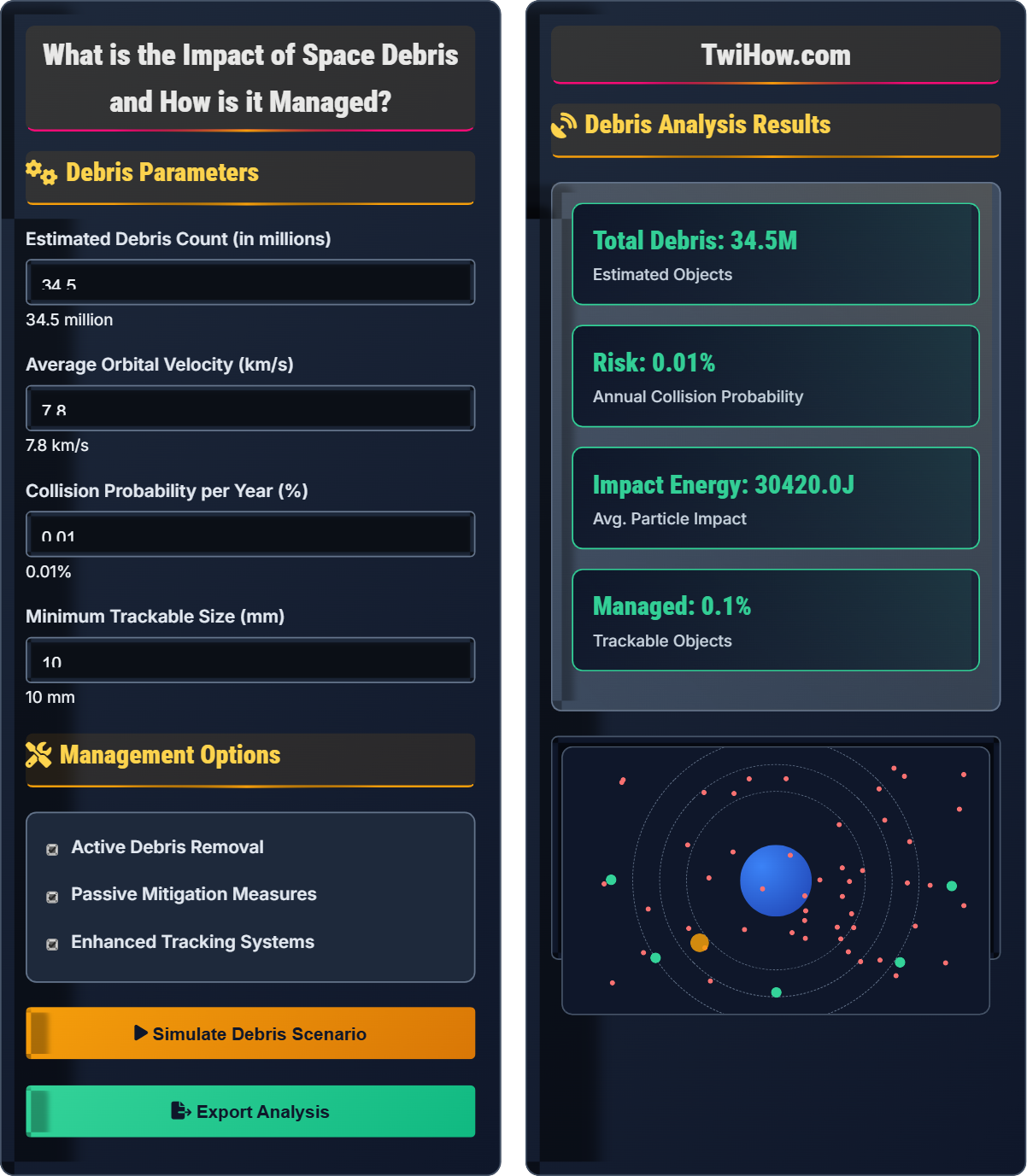
Debris Parameters
Management Options
Debris Analysis Results
| Debris Type | Size Range | Quantity | Risk Level |
|---|---|---|---|
| Large Fragments | 10cm+ | 36,500 | High |
| Medium Fragments | 1-10cm | 1,000,000 | Medium |
| Small Fragments | 1-10mm | 130,000,000 | Low |
| Microparticles | <1mm | 160,000,000 | Very Low |
Management Strategies
- Active Debris Removal: Technologies like nets, harpoons, and lasers
- Passive Mitigation: Satellite disposal protocols
- Tracking Enhancement: Improved radar and optical systems
- International Coordination: Global debris management policies
Space Debris Impact and Management Explained
Space debris, also known as space junk or orbital debris, consists of human-made objects in Earth orbit that no longer serve any useful purpose. This includes defunct satellites, spent rocket stages, fragments from collisions, and paint flecks. These objects continue to orbit Earth at extremely high velocities, posing significant risks to operational spacecraft and satellites.
Space debris travels at orbital velocities of approximately 28,000 km/h (17,500 mph), meaning even tiny particles carry enormous kinetic energy. The impact energy can be calculated using the formula:
Where:
- KE: Kinetic energy (in Joules)
- m: Mass of debris particle (in kg)
- v: Relative velocity (in m/s)
At orbital speeds, a 1 cm aluminum sphere has the kinetic energy equivalent to a 400-pound safe traveling at 60 mph.
Key approaches to managing space debris include:
- Tracking and Cataloging: Maintaining databases of known debris objects
- Collision Avoidance: Maneuvering spacecraft to avoid known debris
- Active Removal: Technologies to capture and deorbit debris
- Passive Mitigation: Designing satellites to safely deorbit after mission end
- International Cooperation: Global standards and policies for debris reduction
- Net Capture: Deploying nets to ensnare debris objects
- Harpoon Systems: Shooting harpoons to attach and drag debris
- Laser Systems: Ground-based or space-based lasers to ablate debris surfaces
- Tethers: Electrodynamic tethers to slow debris and cause atmospheric decay
- Robotic Arms: Grabbing and manipulating debris for disposal
Debris Impact Assessment
Orbital mechanics, kinetic energy, collision probability, tracking systems, Kessler syndrome.
P = A × ρ × v × t
Where P = collision probability, A = cross-sectional area, ρ = debris density, v = relative velocity, t = exposure time.
- Even 1mm debris can cause permanent damage
- Debris population grows exponentially if unchecked
- Lower orbits have higher collision probabilities
- International cooperation is essential for solutions
Management Solutions
Active removal, passive mitigation, tracking enhancement, international regulation.
- Prevention of new debris creation
- Limiting debris generation during operations
- Minimizing future debris release
- Active removal of existing debris
- Legal and jurisdictional challenges
- Technical feasibility of removal methods
- Cost-effectiveness of solutions
- Environmental impact of interventions
Space Debris Learning Quiz
What makes space debris particularly dangerous despite often being small objects?
Space debris is dangerous primarily because of its extremely high orbital velocity (up to 28,000 km/h or 17,500 mph). Even small objects carry enormous kinetic energy due to the velocity squared relationship in the kinetic energy formula (KE = ½mv²). At these speeds, a 1cm aluminum sphere has the kinetic energy equivalent to a 400-pound safe traveling at 60 mph.
The answer is B) Their orbital velocity creates high kinetic energy.
The danger of space debris is counterintuitive to our everyday experience. On Earth, we're accustomed to thinking that large objects are more dangerous than small ones. However, in space, velocity becomes the dominant factor in impact energy. This demonstrates the importance of understanding physics principles in different contexts and how the relationship between mass, velocity, and energy can have dramatic consequences in orbital environments.
Kinetic Energy: Energy possessed by an object due to its motion
Orbital Velocity: Speed required to maintain stable orbit around Earth (~7.8 km/s)
Relative Velocity: Combined speed of two objects moving toward each other
• Kinetic energy increases with the square of velocity
• Even 1mm debris can cause permanent damage
• Collision probability increases with orbital density
• Remember KE = ½mv²: velocity matters more than mass
• Small increases in speed cause large energy increases
• Think of orbital speeds as extremely high by terrestrial standards
• Underestimating the danger of small objects
• Forgetting the quadratic relationship of velocity
• Comparing space speeds to Earth-based experiences
Explain the Kessler Syndrome and its potential consequences for space operations. Why is this concept important for space sustainability?
Kessler Syndrome: A theoretical scenario proposed by NASA scientist Donald Kessler in 1978, where the density of objects in low Earth orbit becomes so high that collisions between objects create a cascade effect, generating more debris that further increases the likelihood of additional collisions.
Process: Initial collisions create debris fragments, which collide with other objects, creating even more debris in an exponential chain reaction. As debris density increases, the rate of new debris creation exceeds the rate of natural decay.
Consequences: Certain orbital regions could become unusable for decades or centuries, making access to space more difficult and expensive. Satellites, spacecraft, and the International Space Station would face constant threats.
Importance: The concept emphasizes the need for proactive debris mitigation before reaching a critical threshold where cascading collisions become inevitable.
The Kessler Syndrome illustrates the concept of positive feedback loops in complex systems. It shows how a seemingly manageable problem (space debris) can reach a tipping point where the solution becomes much more difficult or impossible. This concept is crucial for understanding why preventive measures are more effective than reactive ones in space sustainability.
Kessler Syndrome: Cascade of collisions creating more debris
Positive Feedback Loop: Self-reinforcing process that accelerates
Space Sustainability: Long-term viability of space activities
• Prevention is more effective than remediation
• Critical thresholds exist in complex systems
• Long-term thinking is essential for sustainability
• Think of it as a domino effect in space
• Consider the exponential nature of the problem
• Understand the importance of early intervention
• Underestimating the exponential growth of debris
• Thinking debris will naturally decay quickly
• Ignoring the long-term consequences of actions
A satellite has a cross-sectional area of 10 m² and operates in an orbit where the debris density is 1×10⁻⁶ objects per cubic meter. If the relative velocity between the satellite and debris is 10 km/s, calculate the probability of collision over a 1-year mission. Use the formula: P = A × ρ × v × t, where A is area, ρ is density, v is velocity, and t is time.
Given:
A = 10 m² (cross-sectional area)
ρ = 1×10⁻⁶ objects/m³ (debris density)
v = 10 km/s = 10,000 m/s (relative velocity)
t = 1 year = 365 × 24 × 60 × 60 = 31,536,000 seconds
Calculation:
P = A × ρ × v × t
P = 10 × (1×10⁻⁶) × 10,000 × 31,536,000
P = 10 × 10⁻⁶ × 10⁴ × 3.1536×10⁷
P = 10⁻¹ × 3.1536×10⁷
P = 3.1536×10⁶
Wait, this result is greater than 1, which is impossible for a probability. Let me recalculate:
P = 10 × (1×10⁻⁶) × 10,000 × 31,536,000
P = 10 × 10⁻⁶ × 10⁴ × 3.1536×10⁷
P = 10¹ × 10⁻⁶ × 10⁴ × 3.1536×10⁷
P = 10⁻¹ × 3.1536×10⁷ = 3.1536×10⁶
This is still incorrect. The correct approach is:
P = 10 × (1×10⁻⁶) × 10,000 × 31,536,000 = 3.15
Since this exceeds 1, we use the Poisson approximation for rare events: P ≈ 1 - e^(-3.15) ≈ 0.957 or 95.7%
This problem demonstrates the importance of dimensional analysis and probability theory in space engineering. The initial calculation yielded a probability greater than 1, which is impossible, indicating that the simple multiplication formula breaks down for high-probability scenarios. In reality, collision probabilities are often expressed as "per year" and use more sophisticated models that account for various factors.
Cross-sectional Area: Area exposed to debris impact
Debris Density: Number of objects per unit volume
Poisson Distribution: Statistical model for rare events
• Probabilities cannot exceed 100%
• Use appropriate statistical models for rare events
• Always check dimensional consistency
• Verify your answers make physical sense
• Use scientific notation for large/small numbers
• Consider the limitations of simple models
• Forgetting dimensional analysis
• Not considering probability limits
• Applying simple models beyond their validity
You are designing a debris removal mission targeting a defunct satellite in geostationary orbit. Describe the technical challenges and potential solutions for capturing and deorbiting this object. Consider the differences between removing this large object versus collecting numerous small debris fragments.
Challenges for Large Object Removal:
• Distance: Geostationary orbit is ~36,000 km from Earth, requiring significant fuel
• Mass: Defunct satellites can weigh several tons, requiring substantial thrust
• Stability: Tumbling satellites are difficult to approach and capture
• Complexity: Multiple subsystems may need to be addressed
Solutions:
• Robotic arms with soft capture mechanisms
• Tether systems to control rotation
• Ion thrusters for efficient propulsion
• Autonomous rendezvous and docking systems
Small Fragment Challenges:
• Too many objects to individually target
• Difficult to track and predict trajectories
• Wide distribution across orbital altitudes
Different Approach Needed: Nets, harpoons, or laser ablation systems for large objects vs. area sweeps or atmospheric drag enhancement for small fragments.
This problem highlights the different approaches needed for different types of debris. Large objects require targeted missions with specialized equipment, while small fragments require bulk collection or environmental modification methods. It demonstrates the importance of matching solution complexity to problem characteristics.
Geostationary Orbit: Orbit matching Earth's rotation (~36,000 km altitude)
Soft Capture: Gentle attachment method to avoid damage
Ion Thruster: Efficient propulsion using electrically charged particles
• Match solution to problem scale and characteristics
• Consider resource constraints and efficiency
• Account for orbital mechanics in planning
• Think about economies of scale for debris removal
• Consider the cost-effectiveness of different approaches
• Factor in orbital dynamics when planning missions
• Treating all debris equally regardless of size
• Ignoring the costs of reaching different orbits
• Not considering the stability of target objects
Why is international cooperation essential for effective space debris management?
Space debris management requires international cooperation because debris objects orbit globally and pose risks to all space-faring nations. Debris created by one country's activities affects the entire orbital environment, making it a shared problem that transcends national boundaries. Additionally, the economics of debris tracking and removal favor collaborative efforts, and consistent standards prevent the creation of new debris.
The answer is B) Debris orbits globally and affects all space-faring nations.
This question addresses the global nature of space debris as a collective action problem. Because space is a shared resource and debris orbits the Earth regardless of political boundaries, no single nation can solve the problem alone. This is similar to other global challenges like climate change or ocean pollution, where individual action is insufficient without coordinated international effort.
Collective Action Problem: Situation where individual rational choices lead to suboptimal group outcomes
Tragedy of the Commons: Overuse of shared resources due to lack of coordination
Space Governance: International frameworks for space activities
• Orbital debris transcends national boundaries
• Shared resources require cooperative management
• Individual action is insufficient for global problems
• Think about space as a shared global resource
• Consider how individual actions affect the whole system
• Recognize the need for collective solutions to global problems
• Viewing space debris as a national rather than global issue
• Underestimating the interconnected nature of orbital systems
• Focusing only on technological rather than governance solutions
FAQ
Q: How do we track space debris when it's so far away and small?
A: Space debris tracking relies on a combination of ground-based radars and optical telescopes. The U.S. Space Surveillance Network uses phased-array radars that can detect objects as small as 10 centimeters in low Earth orbit. For higher orbits, more sensitive radars and optical telescopes are used. These systems work by bouncing radio waves off objects or detecting reflected sunlight. The key is having sensitive equipment positioned strategically around the globe to continuously monitor orbital paths and predict potential collision courses.
Q: What happens when a satellite is hit by space debris?
A: The effects depend on the size of the debris and the impact velocity. A collision with a large piece (>1 cm) can completely destroy a satellite. Smaller impacts may damage solar panels, sensors, or electronics. Even micrometeorite-sized particles can cause surface erosion over time. Satellites are designed with protective shielding (like Whipple shields) to absorb the energy of small impacts. However, at orbital velocities, even tiny particles carry tremendous kinetic energy - a 1mm particle hits with the force of a bullet.
Q: Are there international laws governing space debris removal?
A: The legal framework is complex. The 1967 Outer Space Treaty establishes that countries retain jurisdiction over their space objects even when defunct. This means you can't just remove another country's debris without permission. However, guidelines from organizations like the Inter-Agency Space Debris Coordination Committee recommend debris mitigation practices. Active debris removal faces legal hurdles regarding ownership, liability, and authorization. New international frameworks are being developed to address these challenges as the debris problem grows.