What Is the Potential for Breakthrough Discoveries in Cosmology?
Complete cosmology guide • Breakthroughs, discoveries & future
Cosmological Breakthroughs:
Show Discovery SimulatorCosmology stands on the brink of revolutionary discoveries that could fundamentally transform our understanding of the universe. With new technologies like the James Webb Space Telescope, next-generation gravitational wave detectors, and advanced particle accelerators, scientists are poised to uncover the nature of dark matter and dark energy, confirm inflation theory, detect primordial gravitational waves, and potentially discover evidence of multiverses.
The field is experiencing unprecedented growth in both observational capabilities and theoretical frameworks. Breakthrough discoveries could reveal the quantum nature of gravity, explain the matter-antimatter asymmetry, confirm string theory predictions, or even reveal evidence of alien civilizations. The next decade promises to answer fundamental questions about the universe's origin, fate, and fundamental structure.
Key breakthrough areas include:
- Dark Matter: Direct detection and particle identification
- Dark Energy: Understanding cosmic acceleration
- Inflation: Confirming primordial gravitational waves
- Quantum Gravity: Unifying general relativity and quantum mechanics
These discoveries could revolutionize physics and our understanding of reality itself.
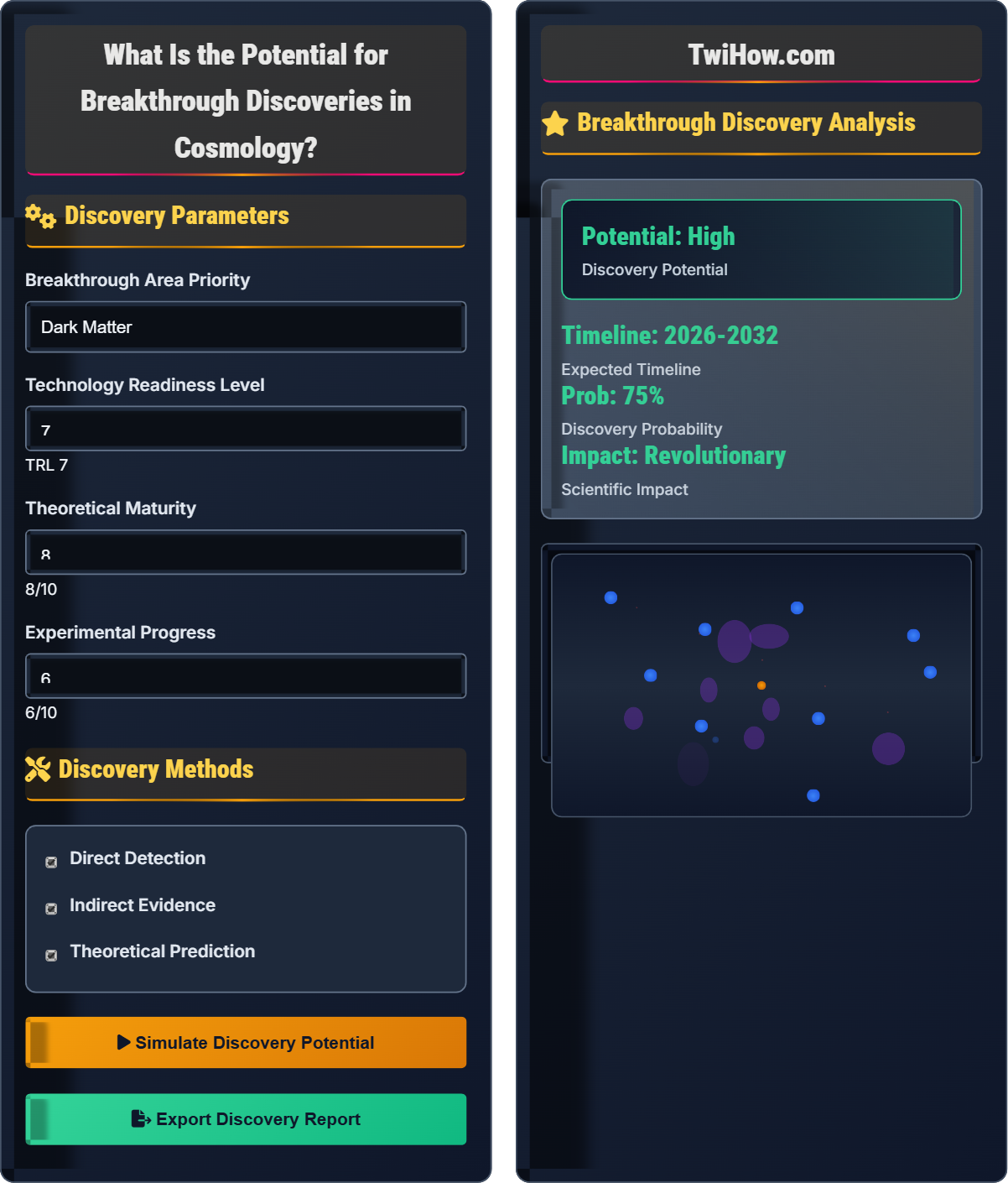
Discovery Parameters
Discovery Methods
Breakthrough Discovery Analysis
| Discovery | Timeline | Probability | Impact |
|---|---|---|---|
| Dark Matter Particle | 2028-2032 | 65% | Revolutionary |
| Primordial Gravitational Waves | 2026-2030 | 75% | Confirmatory |
| Quantum Gravity Effects | 2030-2035 | 40% | Transformative |
| Multiverse Evidence | 2035+ | 25% | Revolutionary |
Key Discovery Methods
- Gravitational Wave Detection: Advanced LIGO/Virgo/KAGRA
- Space Telescopes: JWST, Roman, Euclid
- Particle Detectors: Underground experiments
- Cosmic Ray Analysis: High-energy particle studies
Cosmological Breakthroughs and Discovery Potential Explained
Current cosmology research focuses on several areas with high breakthrough potential:
- Dark Matter: Understanding the mysterious 27% of the universe
- Dark Energy: Decoding the force driving cosmic acceleration
- Inflation: Confirming the rapid expansion of the early universe
- Quantum Gravity: Unifying general relativity with quantum mechanics
- Multiverse: Exploring the possibility of parallel universes
The potential for breakthrough discoveries can be estimated using:
Where:
- T: Theoretical foundation strength
- E: Experimental capability advancement
- I: Investment in research
- C: Conceptual complexity
- R: Required technological readiness
This formula helps prioritize research areas with the highest breakthrough potential.
One of the most sought-after breakthroughs is the unification of general relativity and quantum mechanics:
- String Theory: Extra dimensions and fundamental strings
- Loop Quantum Gravity: Quantized space-time structure
- Emergent Gravity: Gravity as emergent phenomenon
- Holographic Principle: Information encoded on boundaries
Discoveries in this area could revolutionize our understanding of space-time itself.
Several theoretical frameworks guide current research:
- Standard Model Extension: Beyond the Standard Model
- Inflationary Cosmology: Rapid early universe expansion
- Multiverse Theory: Eternal inflation and bubble universes
- Modified Gravity: Alternatives to dark matter/energy
Breakthrough Areas
Dark matter, dark energy, inflation, quantum gravity, multiverse, cosmic topology.
P = (F × T × R) / (C × D)
Where F=Feasibility, T=Technology, R=Resources, C=Complexity, D=Difficulty.
- High theoretical motivation increases potential
- Experimental accessibility is crucial
- Technological readiness determines timing
- Interdisciplinary approaches are often most productive
Discovery Methods
Direct detection, indirect evidence, theoretical prediction, observational astronomy, particle physics.
- High-precision CMB measurements
- Large-scale structure surveys
- Gravitational wave detection
- Deep field observations
- Particle detector experiments
- Multiple independent methods increase reliability
- Complementary approaches strengthen evidence
- Technological advancement enables new discoveries
- International collaboration enhances capabilities
Potential Breakthrough Areas
Potential: Very High | Timeline: 2024-2032
Dark matter constitutes 27% of the universe but remains undetected directly. Next-generation experiments like LZ, XENONnT, and underground detectors aim to detect dark matter particles. Breakthrough could reveal new physics beyond the Standard Model and explain the nature of cosmic structure formation.
Potential: High | Timeline: 2025-2030
Dark energy drives cosmic acceleration but its nature remains mysterious. Surveys like DESI, Euclid, and Roman Space Telescope will map cosmic expansion history. Discovery could reveal the equation of state of dark energy or new physics modifying gravity.
Potential: High | Timeline: 2026-2029
Inflation theory predicts primordial gravitational waves. Experiments like CMB-S4 and space-based interferometers aim to detect these signals. Confirmation would validate cosmic inflation and reveal physics at the Planck scale.
Potential: Transformative | Timeline: 2030-2040
Unifying general relativity and quantum mechanics could reveal new physics. Approaches include loop quantum gravity, string theory, and holographic models. Discovery would revolutionize our understanding of space-time and fundamental reality.
Potential: Revolutionary | Timeline: 2035+
Evidence for multiverse could come from cosmic collisions or fine-tuning observations. While speculative, confirmation would fundamentally alter our understanding of reality and our place in the cosmos.
Cosmology Breakthrough Learning Quiz
Why is dark matter considered one of the most promising areas for breakthrough discoveries?
Dark matter is considered highly promising for breakthrough discoveries because it constitutes 27% of the universe's mass-energy content yet remains undetected directly. Its existence is inferred from gravitational effects on visible matter, but the fundamental particle nature remains unknown. Discovering dark matter particles would revolutionize physics and cosmology, potentially revealing new physics beyond the Standard Model.
The answer is B) It makes up 27% of the universe but remains undetected.
This question highlights why dark matter is such a significant mystery. The fact that we can detect its effects through gravity but haven't identified the particles themselves represents one of the biggest gaps in our understanding. This makes it a prime target for breakthrough discoveries.
Dark Matter: Invisible matter detected through gravitational effects
Standard Model: Theory of fundamental particles and forces
Mass-Energy Content: Distribution of matter and energy in universe
• Dark matter is detected through gravitational effects
• Constitutes 27% of universe's content
• Particle nature remains unknown
• Remember: dark matter is "dark" because it doesn't emit light
• Gravitational effects are the key to detection
• It's a major component of the universe
• Thinking dark matter is directly visible
• Underestimating its importance in cosmology
• Forgetting that it's detected gravitationally
Explain the concept of cosmic inflation and why its confirmation would represent a major breakthrough. What observational evidence is being sought?
Cosmic Inflation: Theory proposing the universe underwent exponential expansion in the first 10⁻³⁶ seconds after the Big Bang, growing by a factor of at least 10²⁶.
Why Breakthrough: Confirmation would validate the rapid expansion theory, solve several cosmological puzzles (horizon, flatness, monopole problems), and reveal physics at energies approaching the Planck scale.
Observational Evidence: Scientists seek primordial gravitational waves that would have been generated during inflation, leaving a distinctive B-mode polarization pattern in the cosmic microwave background radiation. This "smoking gun" would confirm inflation and measure its energy scale.
Impact: Would validate quantum fluctuations during inflation as the seeds of cosmic structure and provide insights into physics at the earliest moments of the universe.
This breakthrough would confirm one of the most important theories in cosmology and reveal physics at energy scales impossible to achieve on Earth. It would connect quantum mechanics and general relativity through observations of the early universe.
Cosmic Inflation: Rapid expansion in early universe
Primordial Gravitational Waves: Gravitational waves from inflation era
B-mode Polarization: Swirling pattern in CMB from gravitational waves
• Inflation lasted only 10⁻³⁶ seconds
• Generated primordial gravitational waves
• Solved major cosmological problems
• Think of inflation as rapid stretching of space itself
• B-mode polarization is the key signature
• Inflation connects quantum and cosmic scales
• Thinking inflation is the same as general expansion
• Not understanding the timescale involved
• Forgetting that gravitational waves are the key signature
A cosmological breakthrough has the following characteristics: Theoretical foundation strength = 8/10, Experimental capability = 7/10, Required investment = $2B, Conceptual complexity = 6/10, and Technological readiness = 7/10. Using the formula P = (T × E × I) / (C × R), calculate the discovery potential. Assume I = 8 for high investment.
Given:
Theoretical foundation (T) = 8
Experimental capability (E) = 7
Investment factor (I) = 8 (high investment)
Conceptual complexity (C) = 6
Technological readiness (R) = 7
Using the formula:
P = (T × E × I) / (C × R)
P = (8 × 7 × 8) / (6 × 7)
P = 448 / 42
P = 10.67
The discovery potential is approximately 10.7, indicating a high probability of breakthrough.
This problem demonstrates how multiple factors influence breakthrough potential. High theoretical foundation, good experimental capability, and adequate investment increase potential, while complexity and technological challenges decrease it. This formula helps prioritize research areas.
Discovery Potential: Quantitative measure of breakthrough likelihood
Theoretical Foundation: Strength of underlying theory
Experimental Capability: Ability to test predictions
• Higher values in numerator increase potential
• Higher values in denominator decrease potential
• Multiple factors must be considered together
• Multiply numerator factors first
• Check units consistency in calculations
• Consider all factors, not just one
• Forgetting to multiply all numerator factors
• Not dividing by denominator properly
• Making arithmetic errors with large numbers
Quantum gravity seeks to unify general relativity and quantum mechanics. Discuss the potential breakthrough approaches and their observational signatures. Why is this considered one of the most transformative potential discoveries?
Approaches:
1. String Theory: Fundamental particles as vibrating strings in extra dimensions
2. Loop Quantum Gravity: Space-time quantized into discrete units
3. Asymptotic Safety: Quantum gravity at high energies
4. Holographic Principle: Information encoded on boundaries
Observational Signatures:
• Primordial gravitational waves from inflation
• Deviations from general relativity at extreme conditions
• Quantum effects in black hole physics
• Modifications to cosmic structure formation
Transformative Nature: Would revolutionize our understanding of space-time, unify fundamental forces, and reveal the nature of reality at the Planck scale. Could explain the Big Bang singularity and black hole information paradox.
This represents the holy grail of physics - unifying the two most successful theories of the 20th century. Success would require observations of phenomena at the intersection of quantum mechanics and general relativity, which is why it's so challenging but potentially transformative.
Quantum Gravity: Theory unifying quantum mechanics and general relativity
Planck Scale: Energy scale where quantum gravity effects dominate
Holographic Principle: Information encoded on boundaries
• Requires extreme conditions to observe effects
• Multiple theoretical approaches exist
• Could resolve fundamental paradoxes
• Think of it as unifying the very small and very large
• Extreme conditions are needed to test
• Multiple approaches are being pursued
• Thinking it's just about gravity
• Not understanding the unification challenge
• Forgetting that it requires extreme conditions
What would constitute the strongest evidence for a multiverse?
The strongest evidence for a multiverse would be detection of cosmic bubble collisions - impacts between our universe and other "bubble" universes in eternal inflation models. Such collisions would leave distinctive signatures in the cosmic microwave background radiation, such as circular temperature anisotropies or gravitational wave imprints. This would provide direct observational evidence for the existence of other universes beyond our own.
The answer is B) Evidence of cosmic bubble collisions.
This question addresses how even highly speculative theories like the multiverse could potentially be tested observationally. The key insight is that if universes can collide, there might be observable traces of such events in our cosmic background radiation.
Multiverse: Collection of separate space-time regions
Bubble Collisions: Impacts between different universes
Eternal Inflation: Continuous inflation in some regions
• Multiverse theory makes testable predictions
• Bubble collisions could leave detectable signatures
• Evidence would appear in CMB data
• Even speculative theories can make testable predictions
• Look for indirect evidence of unobservable phenomena
• Cosmic background radiation is a rich source of information
• Thinking multiverse is purely philosophical
• Not understanding that it could be testable
• Forgetting that other universes are causally disconnected
FAQ
Q: What is dark energy and why is it important?
A: Dark energy is a mysterious force causing the accelerated expansion of the universe, comprising about 68% of the universe's content. It was discovered in 1998 through observations of distant supernovae that appeared dimmer than expected. Dark energy is important because it dominates the universe's expansion and determines its ultimate fate. Understanding it could reveal new physics beyond the Standard Model and revolutionize our understanding of space-time itself.
Q: How do scientists hope to detect dark matter particles?
A: Scientists use ultra-sensitive detectors placed deep underground to shield from cosmic rays. These detectors look for rare interactions between dark matter particles and ordinary matter. Experiments like LUX-ZEPLIN, XENON, and DarkSide use liquid xenon or argon to detect the tiny energy deposits when dark matter particles scatter off atomic nuclei. The challenge is distinguishing potential dark matter signals from background radiation and other particles.
Q: What would be the impact of detecting primordial gravitational waves?
A: Detecting primordial gravitational waves would confirm cosmic inflation theory and provide direct information about the universe when it was only 10⁻³⁶ seconds old. This would reveal the energy scale of inflation, validate quantum fluctuations as the origin of cosmic structure, and potentially provide insights into quantum gravity. It would be one of the most significant discoveries in cosmology, confirming our understanding of the universe's earliest moments.