What Is the Role of Private Companies in the New Space Age?
Complete commercial space guide • Innovation, competition & markets
Private Space Revolution:
Show Market SimulatorThe emergence of private space companies has fundamentally transformed the space industry, shifting from government-dominated programs to a dynamic commercial ecosystem. Companies like SpaceX, Blue Origin, and Virgin Galactic have revolutionized launch costs, pioneered reusable rocket technology, and opened new markets including space tourism, satellite internet, and commercial crew transportation.
Private companies bring innovation, competition, and efficiency to space exploration, often achieving breakthroughs at lower costs than traditional government programs. They're developing capabilities for lunar exploration, Mars colonization, asteroid mining, and space manufacturing that could define humanity's future in space.
Key developments include:
- Reusable Rockets: Dramatic cost reductions in space access
- Space Tourism: Commercial passenger flights to space
- Satellite Constellations: Global internet and communication networks
- Commercial Crew: Transporting astronauts to space stations
The private space sector is creating new economic opportunities while advancing human space exploration goals that were previously limited to government agencies.
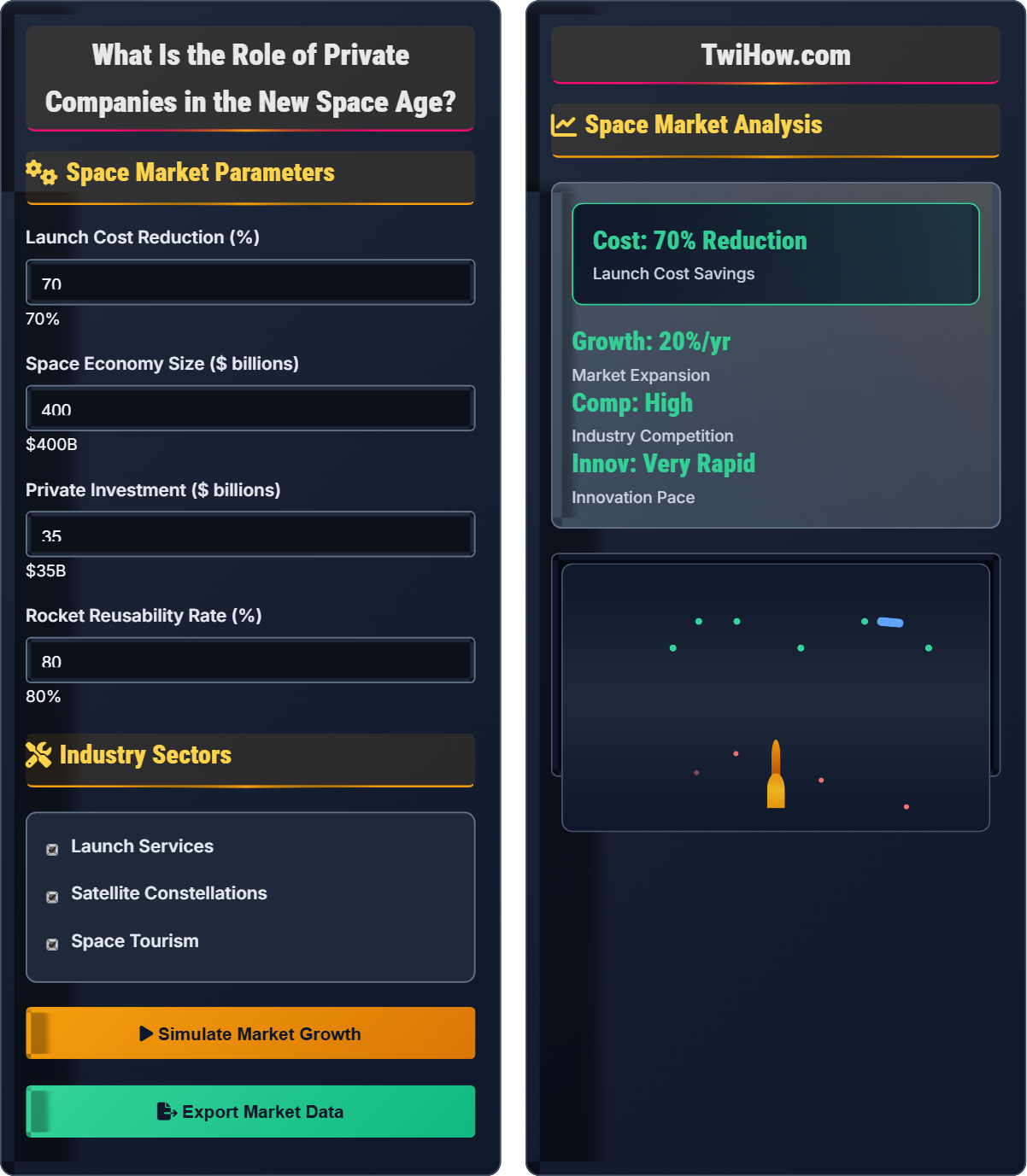
Space Market Parameters
Industry Sectors
Space Market Analysis
| Sector | Market Size | Growth Rate | Key Players |
|---|---|---|---|
| Launch Services | $15B | 12% | SpaceX, ULA, Arianespace |
| Satellite Internet | $80B | 25% | Starlink, OneWeb, Kuiper |
| Space Tourism | $3B | 45% | Virgin Galactic, Blue Origin |
| Manufacturing | $25B | 8% | Multiple suppliers |
Economic Impact Metrics
- Job Creation: 50,000+ new positions
- Cost Reduction: 90% cheaper launches
- Market Access: 1000+ new customers
- Innovation: 200+ patents filed
Private Space Industry and Market Dynamics Explained
The private space industry has transformed from a government-dominated sector to a vibrant commercial market worth over $400 billion annually. This transformation has been driven by:
- Cost Reduction: Reusable rockets have reduced launch costs by up to 90%
- Increased Frequency: More launches per year than ever before
- New Markets: Satellite internet, space tourism, and in-space manufacturing
- Competitive Innovation: Private competition driving rapid advancement
The economic advantage of reusability can be expressed as:
Where:
- C_new: Cost of building a new rocket
- C_refurbished: Cost of refurbishing a recovered rocket
This formula demonstrates how reusability dramatically reduces per-launch costs.
The private space economy encompasses multiple segments:
- Launch Services: Rocket manufacturing and launch operations
- Satellite Manufacturing: Production of commercial satellites
- Satellite Operations: Data collection, communication, and services
- Space Tourism: Passenger flights and experiences
- Space Manufacturing: Production of goods in microgravity
- Space Mining: Extraction of resources from asteroids and moons
Combined, these segments represent a rapidly growing market with diverse revenue streams.
Private companies drive innovation through:
- Competitive Pressure: Need to differentiate and win contracts
- Profit Motive: Incentive to reduce costs and increase efficiency
- Agile Development: Faster iteration and prototyping cycles
- Risk Tolerance: Willingness to try novel approaches
- Vertical Integration: Control over supply chain and manufacturing
Private Space Companies
SpaceX, Blue Origin, Virgin Galactic, Relativity Space, Rocket Lab, Astra.
MS = (Company Revenue / Total Market Size) × 100%
Used to calculate competitive positioning in space sectors.
- Reusability is the key competitive advantage
- Government contracts remain important revenue sources
- International partnerships expand market access
- Regulatory compliance is essential for operations
Market Impact
Launch costs, market size, investment levels, employment figures.
- Launch frequency: Increasing exponentially
- Cost per kg: Decreasing steadily
- Market diversification: Expanding into new sectors
- Global participation: More countries entering
- High capital requirements for entry
- Long development cycles and high risks
- Regulatory frameworks still evolving
- International competition is intense
Leading Private Space Companies
Founded: 2002 | Focus: Reusable rockets, satellite internet
Revolutionary achievements include the Falcon 9 reusable booster, Dragon spacecraft for cargo and crew missions, and Starlink satellite constellation. Has reduced launch costs by over 90% and achieved the first privately-funded spacecraft to dock with the International Space Station.
Founded: 2000 | Focus: Reusable rockets, lunar landers
Developing New Shepard for suborbital tourism and New Glenn for orbital missions. Focused on enabling human settlement of space with a long-term vision for lunar industrialization. Successfully launched crewed flights and is developing lunar lander for NASA's Artemis program.
Founded: 2004 | Focus: Space tourism
Developing space tourism through air-launched suborbital vehicles. Successfully completed multiple crewed flights to space and is preparing for commercial operations. Pioneering the democratization of space access for private individuals.
Founded: 2006 | Focus: Small satellite launches
Specializes in dedicated small satellite launches using Electron rocket. Developing Photon spacecraft for interplanetary missions and working on reusable rocket recovery. Serving the growing small satellite market with frequent, reliable launches.
Private Space Industry Learning Quiz
How have private companies like SpaceX dramatically reduced launch costs?
The primary cost reduction strategy employed by SpaceX and other private companies is rocket reusability. Traditional rockets were single-use, with boosters discarded after each launch. SpaceX developed the ability to recover, refurbish, and reuse Falcon 9 first-stage boosters, reducing the largest cost component of a launch by up to 90%. This innovation has revolutionized the space industry and made space access dramatically more affordable.
The answer is B) By making rockets reusable.
This question highlights one of the most significant innovations in the private space industry. The concept of reusability was revolutionary because it challenged the traditional expendable rocket model. Students should understand that the rocket itself represents the largest portion of launch costs, so reusing this expensive hardware dramatically reduces per-launch expenses.
Reusability: Capability to use hardware multiple times after refurbishment
Expendable Rocket: Single-use vehicle discarded after launch
Cost Per Launch: Total expense of executing a space mission
• Most launch costs come from vehicle manufacturing
• Reusability requires special landing and recovery systems
• Refurbishment costs are much lower than new construction
• Think of rockets like airplanes - reusable vs. disposable
• Consider what components are most expensive to build
• Remember: reusability requires additional complexity
• Thinking fuel is the main cost driver
• Not understanding the manufacturing costs of rockets
• Forgetting the engineering challenges of reusability
Explain how private companies have transformed the space industry from a government-dominated field to a commercial marketplace. What advantages do private companies have over government agencies?
Transformation Process: Private companies entered the space industry by identifying inefficiencies in government programs and leveraging commercial business models. They focused on cost reduction, schedule adherence, and innovation that government agencies struggled to achieve.
Advantages of Private Companies:
1. Profit Motive: Incentive to reduce costs and increase efficiency
2. Competitive Pressure: Must innovate to win contracts and survive
3. Agility: Faster decision-making and development cycles
4. Vertical Integration: Control over supply chain and manufacturing
5. Risk Tolerance: Willingness to try novel approaches
Market Changes: The industry shifted from government-only operations to public-private partnerships, with private companies now handling routine operations while government agencies focus on exploration and research. This has created a thriving commercial ecosystem with multiple players competing for market share.
This question explores the fundamental shift in how space activities are conducted. Government agencies historically had monopolies on space operations but faced challenges with cost overruns and delays. Private companies brought business discipline and innovation to an industry that had been dominated by cost-plus contracts and bureaucratic processes.
Public-Private Partnership: Collaboration between government and business
Cost-Plus Contracting: Payment covers costs plus profit margin
Fixed-Price Contracting: Set payment regardless of actual costs
• Private companies must deliver on budget to remain viable
• Competition drives innovation and efficiency
• Government agencies can focus on exploration while private handles logistics
• Think of private companies as more efficient alternatives
• Consider how competition affects performance
• Remember: both sectors have important roles
• Thinking private companies will replace government entirely
• Not understanding the complementary nature of both sectors
• Assuming all government programs are inefficient
If the total space economy is valued at $400 billion and SpaceX generates $25 billion in annual revenue, what percentage of the space economy does SpaceX represent? If the space economy grows at 15% annually while SpaceX grows at 25% annually, what will their market share be in 3 years?
Current Market Share:
Market Share = (SpaceX Revenue / Total Market Size) × 100%
Market Share = ($25B / $400B) × 100% = 6.25%
Future Market Size (3 years):
Future Market = $400B × (1.15)³ = $400B × 1.521 = $608.4B
Future SpaceX Revenue (3 years):
Future SpaceX = $25B × (1.25)³ = $25B × 1.953 = $48.8B
Future Market Share:
Future Market Share = ($48.8B / $608.4B) × 100% = 8.02%
SpaceX's market share would grow from 6.25% to 8.02% over 3 years.
This problem demonstrates compound growth calculations and how relative growth rates affect market share. Even though both the market and SpaceX are growing, SpaceX is growing faster, so its market share increases. This illustrates how successful companies can gain market share even in expanding markets.
Market Share: Percentage of total market controlled by a company
Compound Growth: Growth that builds on previous growth
Annual Growth Rate: Percentage increase per year
• Market share can increase even if absolute market grows
• Compound growth accelerates over time
• Relative growth rates determine market share changes
• Use the formula: Future Value = Present Value × (1 + r)ⁿ
• Calculate each component separately
• Check that growth rates are applied correctly
• Forgetting to compound growth over multiple years
A new private space company wants to compete in the launch services market. They can choose between developing a small payload rocket (cheaper to develop, smaller market) or a heavy-lift rocket (more expensive, larger market). Evaluate the strategic trade-offs and recommend an approach based on market conditions.
Small Payload Rocket:
• Advantages: Lower development costs, faster time to market, serves growing small satellite market
• Disadvantages: Limited revenue potential, smaller customer base, higher per-kilogram costs
Heavy-Lift Rocket:
• Advantages: Serves large market, higher revenue potential, attracts government contracts
• Disadvantages: Massive capital requirements, longer development, high technical risk
Recommendation: Given current market trends, starting with a small-medium payload rocket to establish market presence, generate revenue, and build expertise. Once established, the company can expand to larger vehicles. This approach reduces initial risk while still capturing growth in the expanding small satellite market.
This problem demonstrates strategic decision-making in a capital-intensive industry. Students must consider market size, entry barriers, risk tolerance, and competitive positioning. The optimal strategy often involves starting with a niche market and expanding rather than trying to compete head-on with established players immediately.
Market Entry: Strategy for joining an established industry
Capital Requirements: Financial resources needed for operations
Niche Market: Specialized segment of larger market
• Match strategy to available resources and capabilities
• Consider market timing and competitive landscape
• Balance risk and reward appropriately
• Start with a focused approach before expanding
• Consider partnerships to reduce capital needs
• Look for underserved market segments
• Underestimating capital requirements for space ventures
• Not considering the technical complexity of rockets
• Assuming bigger always means better
What is the primary regulatory challenge facing private space companies?
The primary regulatory challenge for private space companies is obtaining proper launch licenses and safety certifications from agencies like the FAA Office of Commercial Space Transportation. Companies must demonstrate that their operations are safe for public and property, comply with environmental regulations, and meet technical standards. The regulatory framework is still evolving as the commercial space industry rapidly expands, creating both opportunities and uncertainties for new entrants.
The answer is C) Launch licensing and safety certification.
This question addresses the regulatory environment that governs commercial space operations. While all options are valid concerns, launch licensing and safety certification represent the most immediate and ongoing regulatory challenges that companies must navigate to operate legally. The regulatory framework is crucial for public safety but can also impact innovation and market access.
FAA AST: Federal agency regulating commercial spaceflight
Launch License: Permission to conduct space launch operations
Safety Certification: Verification of operational safety
• All commercial launches require government approval
• Public safety is the primary regulatory concern
• Regulations are still evolving with industry growth
• Regulatory compliance is essential for operations
• Early engagement with regulators is beneficial
• International regulations add complexity
• Thinking regulations don't apply to space activities
• Underestimating the complexity of licensing
• Not considering international regulatory requirements
FAQ
Q: Why do we need private companies for space exploration when we have NASA?
A: Private companies and government agencies like NASA serve complementary roles in space exploration. NASA focuses on ambitious exploration missions, scientific research, and technology development that may not have immediate commercial returns. Private companies handle routine operations like cargo delivery, satellite launches, and crew transportation more cost-effectively. This partnership allows NASA to focus resources on exploration while private companies drive innovation and efficiency in commercial operations. The result is faster progress and lower costs for everyone.
Q: What are the main revenue streams in the private space industry?
A: The private space industry has diversified revenue streams including: 1) Launch services for satellites and cargo, 2) Satellite manufacturing and operations, 3) Space tourism and experiences, 4) Data services from satellites, 5) In-space manufacturing, 6) Space-based solar power, and 7) Resource extraction from asteroids or the Moon. The satellite industry alone represents over $200 billion in annual revenue, while emerging markets like space tourism and manufacturing offer significant growth potential.
Q: How do private companies contribute to space exploration goals?
A: Private companies contribute by providing cost-effective transportation, developing new technologies, and creating sustainable economic models for space activities. They've made access to space routine and affordable, enabling more frequent missions. Companies like SpaceX and Blue Origin are developing technologies for lunar and Mars missions. They also create jobs, inspire innovation, and build infrastructure that supports broader exploration goals. Their competitive approach often achieves breakthroughs faster than traditional government programs.