Best Marketing Strategies
Complete marketing strategies guide • ROI • Implementation
Marketing Strategy Overview:
Plan StrategyMarketing strategies are systematic plans designed to achieve marketing objectives. The best strategies combine multiple channels and tactics to reach target audiences effectively. Success depends on understanding your audience, setting clear goals, and measuring results.
Key marketing strategy components:
- Market Research: Understanding audience needs and preferences
- Segmentation: Dividing market into target groups
- Positioning: Defining your brand's place in the market
- Channel Selection: Choosing appropriate marketing channels
- Measurement: Tracking performance and ROI
- Optimization: Continuously improving strategies
Effective marketing strategies align with business goals and deliver measurable results.
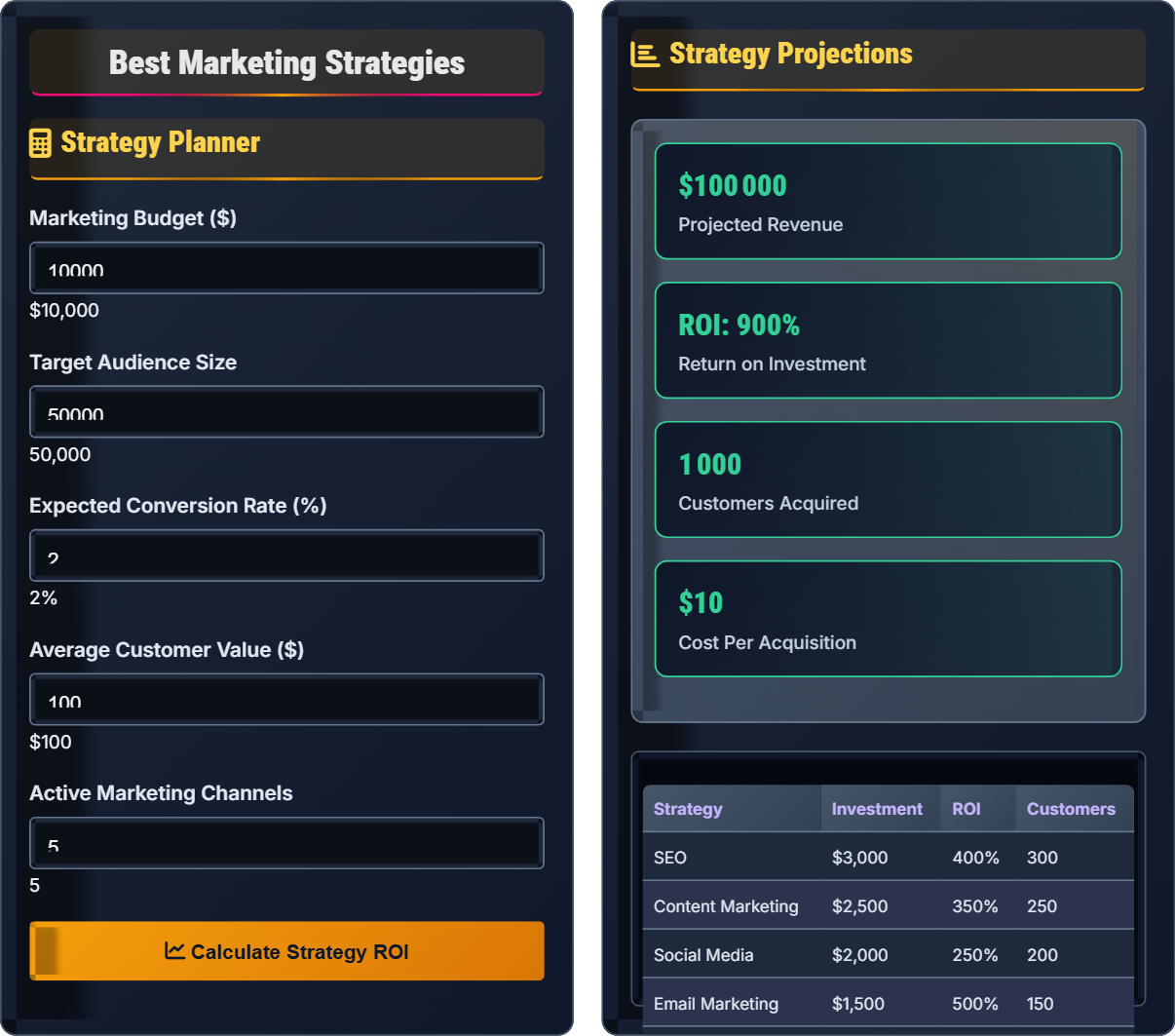
Strategy Planner
Strategy Projections
| Strategy | Investment | ROI | Customers |
|---|---|---|---|
| SEO | $3,000 | 400% | 300 |
| Content Marketing | $2,500 | 350% | 250 |
| Social Media | $2,000 | 250% | 200 |
| Email Marketing | $1,500 | 500% | 150 |
| Paid Ads | $1,000 | 200% | 100 |
Marketing Strategies Explained
Marketing strategies are comprehensive plans that define how a business will reach its target audience and achieve its marketing objectives. They encompass the "why," "what," and "how" of marketing efforts, including channel selection, messaging, and performance measurement.
Key areas where marketing strategies provide value:
- Brand Awareness: Increase visibility and recognition
- Lead Generation: Attract and qualify prospects
- Customer Acquisition: Convert prospects to customers
- Customer Retention: Keep existing customers engaged
- Market Expansion: Enter new markets or segments
- Competitive Advantage: Outperform competitors
- Inbound Marketing: Attract customers with valuable content
- Outbound Marketing: Push messages to audiences
- Content Marketing: Provide value through content
- Social Media Marketing: Engage through social platforms
- Email Marketing: Communicate through email
- Search Marketing: Optimize for search engines
Best Marketing Strategies
SEO focuses on improving your website's visibility in organic search results. It's a long-term strategy that builds sustainable traffic and credibility.
- Conduct keyword research to identify opportunities
- Optimize website content for target keywords
- Improve technical aspects (speed, mobile-friendliness)
- Build high-quality backlinks from reputable sites
- Monitor rankings and performance metrics
- Continuously update and improve content
Content marketing involves creating valuable, relevant content to attract and retain customers. It builds trust and authority over time.
- Develop a content strategy aligned with business goals
- Create valuable content addressing audience needs
- Distribute content across appropriate channels
- Promote content through social media and email
- Track engagement and conversion metrics
- Optimize content based on performance data
Email marketing remains one of the most effective ways to communicate with customers and prospects. It offers high ROI and direct access to your audience.
- Build a permission-based email list
- Segment your audience based on behavior and preferences
- Personalize content for different segments
- Set up automated email sequences
- Test subject lines, content, and send times
- Track open rates, click-through rates, and conversions
Marketing Channel Analysis
Marketing Strategy Funnel
Funnel Strategy:
- Awareness: SEO, content marketing, social media
- Interest: Targeted ads, email nurturing, webinars
- Consideration: Case studies, demos, free trials
- Purchase: Limited offers, testimonials, guarantees
Budget Allocation Strategy
Allocation Best Practices:
- Start with 40-50% for proven channels
- Reserve 10-15% for testing new channels
- Allocate based on channel performance
- Consider business lifecycle and goals
- Adjust allocation based on seasonality
- Track ROI by channel and optimize accordingly
Marketing Strategy Quiz
Which marketing strategy typically provides the highest long-term return on investment?
Search Engine Optimization (SEO) typically provides the highest long-term ROI because once your site ranks well, it continues to generate traffic without ongoing ad spend. While it requires initial investment in time and resources, the returns compound over time as rankings improve and content accumulates.
The answer is B) Search Engine Optimization.
SEO creates assets (web pages) that continue to work for you long after creation. Each piece of content becomes a potential entry point for search traffic. Unlike paid advertising, which stops delivering results when you stop paying, SEO results persist and grow over time, making it the most cost-effective long-term strategy.
ROI: Return on investment, calculated as (gain - cost) / cost
Compound Growth: Growth that builds upon previous gains
Asset Accumulation: Building resources that provide ongoing value
• SEO takes longer to show results but lasts longer
• Paid ads provide immediate but temporary results
• Long-term strategy beats short-term tactics
• Combine SEO with other channels for best results
• Focus on evergreen content for sustained traffic
• Build authority through consistent publishing
• Expecting immediate results from SEO
• Neglecting technical SEO fundamentals
• Not measuring ROI properly
Explain how to develop a multi-channel marketing strategy that maximizes reach and conversion while maintaining brand consistency.
Channel Selection: Identify which channels your target audience uses most. Consider demographics, behavior patterns, and purchase journey stages.
Message Consistency: Maintain consistent brand voice, visual identity, and value proposition across all channels while adapting messaging to each platform's unique characteristics.
Funnel Integration: Use different channels for different stages of the buyer's journey. For example, social media for awareness, email for consideration, and retargeting for conversion.
Cross-Channel Attribution: Implement tracking systems to understand how different channels contribute to conversions. Use tools like Google Analytics for multi-channel attribution modeling.
Budget Allocation: Distribute budget based on channel performance and contribution to business goals. Start with 60-70% on proven channels and reserve 20-30% for testing.
Performance Monitoring: Track KPIs for each channel and the overall strategy. Adjust allocation based on performance data and changing market conditions.
A successful multi-channel strategy recognizes that customers interact with brands across multiple touchpoints before converting. Each channel serves a specific role in the customer journey. The key is creating a seamless experience that moves customers smoothly from awareness to purchase while maintaining consistent brand messaging.
Multi-Channel: Using multiple marketing channels simultaneously
Attribution Modeling: Assigning credit to marketing channels
Touchpoint: Any interaction point with brand
• Maintain consistent brand identity
• Adapt to channel-specific best practices
• Track performance across all channels
• Use cross-channel remarketing
• Repurpose content across channels
• Test channel combinations
• Inconsistent messaging across channels
• Not tracking cross-channel performance
• Over-diluting budget across too many channels
A startup with a $50,000 annual marketing budget needs to allocate funds across SEO, content marketing, social media, and paid advertising. They have 10,000 monthly website visitors and a 2% conversion rate. How should they allocate their budget for maximum growth, and what is the expected outcome?
Recommended Allocation:
SEO: $15,000 (30%) - Build long-term organic visibility
Content Marketing: $12,500 (25%) - Create valuable content
Social Media: $10,000 (20%) - Build community and brand
Paid Advertising: $12,500 (25%) - Drive immediate traffic
Expected Outcome: After 12 months:
- Organic traffic increase: 50-100%
- Conversion rate improvement: 2.5-3%
- Customer acquisition: 3,600-5,400 annually
- Revenue impact: $360,000-$540,000 based on $100 average order value
Rationale: The combination of long-term SEO and content marketing with immediate paid advertising provides both short-term results and sustainable growth.
Effective budget allocation balances immediate needs with long-term growth. SEO and content marketing build sustainable assets, while paid advertising provides immediate results. The allocation should reflect the business stage, competitive landscape, and growth objectives.
Organic Traffic: Visitors from unpaid sources
Customer Acquisition: Process of gaining new customers
Revenue Impact: Financial effect of marketing efforts
• Balance immediate and long-term investments
• Allocate based on channel performance
• Reserve budget for testing and optimization
• Start with proven channels
• Monitor ROI by channel
• Adjust allocation based on results
• Going all-in on one channel
• Not tracking channel performance
• Failing to optimize based on results
A company currently spends $10,000/month on marketing across five channels. Their current ROI is 200%. They want to increase ROI to 300% while maintaining or growing revenue. Propose a strategy to optimize their marketing mix for improved ROI.
Current Analysis: $10,000 investment generates $30,000 return (200% ROI)
Optimization Strategy:
1. Channel Performance Analysis: Identify top-performing channels with highest ROI
2. Budget Reallocation: Shift 30% of budget from lowest ROI channels to highest ROI channels
3. Campaign Optimization: Improve targeting and messaging for underperforming channels
4. Testing & Iteration: Implement A/B testing to improve conversion rates
5. Automation: Use marketing automation to reduce operational costs
Expected Results: With 30% budget shift to higher ROI channels and 20% improvement in conversion rates, the new ROI could reach 300%+ while maintaining revenue growth.
ROI optimization involves reallocating resources from lower-performing to higher-performing channels while improving the performance of underperforming channels. The key is maintaining a balanced approach that doesn't sacrifice growth for efficiency.
ROI: Return on investment
Budget Reallocation: Shifting funds between channels
Conversion Rate: Percentage of visitors who convert
• Always test before making major changes
• Track performance metrics continuously
• Balance efficiency with growth
• Use attribution modeling to understand channel impact
• Implement gradual changes to minimize risk
• Focus on lifetime value, not just immediate ROI
• Cutting successful channels too quickly
• Not tracking channel attribution
• Focusing only on short-term ROI
Which marketing strategy typically has the highest customer lifetime value impact?
Email marketing typically has the highest customer lifetime value impact because it allows for direct, permission-based communication with customers over time. Email enables personalized communication, retention campaigns, and upselling opportunities that extend the customer relationship.
The answer is B) Email marketing.
Email marketing creates a direct line of communication with customers that persists over time. Unlike other channels where algorithm changes or platform policies can limit reach, email provides consistent access to your audience. This allows for relationship building, retention campaigns, and ongoing value delivery that extends customer lifetime value.
Customer Lifetime Value: Total value of customer over relationship
Permission-Based: Communication with consent
Retention: Keeping existing customers
• Nurture relationships after acquisition
• Focus on customer retention
• Track lifetime value by channel
• Segment emails for personalization
• Create automated retention sequences
• Use email for customer advocacy
• Only using email for promotions
• Not segmenting email lists
• Focusing only on acquisition
Marketing Strategy FAQ
Q: How often should I review and adjust my marketing strategy?
A: Marketing strategy review frequency:
Weekly: Monitor campaign performance and make tactical adjustments
Monthly: Analyze channel performance and budget allocation
Quarterly: Review overall strategy and make strategic adjustments
Annually: Comprehensive strategy overhaul and goal setting
Additionally, conduct reviews when there are significant market changes, algorithm updates, or competitive shifts. The key is maintaining a balance between consistency and agility.
Q: Should I hire a marketing agency or manage marketing in-house?
A: The decision depends on several factors:
Hire Agency When: You need specialized expertise, lack internal resources, or want to focus on core business
Manage In-House When: You have budget for staff, want direct control, or have unique business requirements
Hybrid Approach: Many companies start with agencies for expertise, then build internal teams over time. Consider your budget, timeline, and business complexity when making the decision.
Ultimately, the choice should align with your business goals, available resources, and growth stage.