How to Build a Brand?
Complete brand building guide • Strategy • Identity
Brand Building Overview:
Build BrandBrand building is the strategic process of creating and developing a unique identity for your business that resonates with your target audience. It involves establishing a distinctive name, design, and reputation that differentiates your business from competitors and creates emotional connections with customers.
Key brand building components:
- Brand Identity: Visual and verbal elements that represent your brand
- Brand Positioning: How you differentiate from competitors
- Brand Messaging: Consistent communication of value propositions
- Brand Experience: Every touchpoint with customers
- Brand Loyalty: Building long-term customer relationships
- Brand Equity: Value derived from brand recognition
Effective brand building creates lasting customer relationships and sustainable competitive advantages.
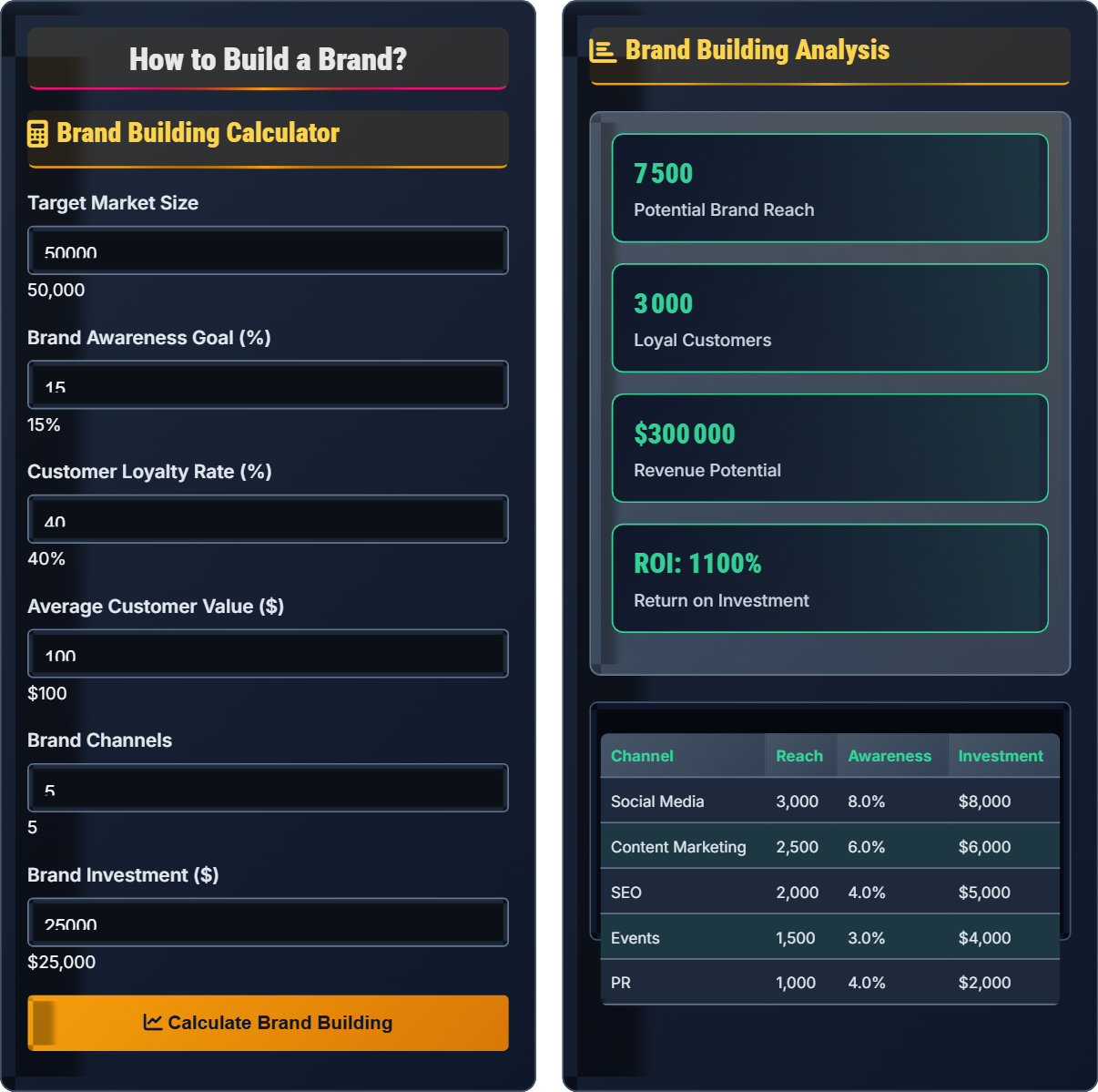
Brand Building Calculator
Brand Building Analysis
| Channel | Reach | Awareness | Investment |
|---|---|---|---|
| Social Media | 3,000 | 8.0% | $8,000 |
| Content Marketing | 2,500 | 6.0% | $6,000 |
| SEO | 2,000 | 4.0% | $5,000 |
| Events | 1,500 | 3.0% | $4,000 |
| PR | 1,000 | 4.0% | $2,000 |
Brand Building Explained
Brand building is the strategic process of creating and developing a unique identity for your business that resonates with your target audience. It involves establishing a distinctive name, design, and reputation that differentiates your business from competitors and creates emotional connections with customers.
Key areas where brand building provides value:
- Customer Loyalty: Building long-term relationships and repeat purchases
- Market Differentiation: Standing out from competitors
- Premium Pricing: Commanding higher prices due to perceived value
- Employee Engagement: Creating pride and alignment within organization
- Partnership Opportunities: Attracting strategic alliances
- Market Expansion: Easier entry into new markets with strong brand
- Corporate Branding: Building the overall company brand
- Product Branding: Individual product line branding
- Personal Branding: Individual professional brand building
- Employer Branding: Building brand as an employer
- Geographic Branding: Branding for cities or regions
- Digital Branding: Online-focused brand building
Brand Building Strategies
Create a distinctive visual and verbal identity that represents your brand values and resonates with your target audience.
- Define your brand personality and values
- Create a memorable, scalable logo
- Choose a consistent color palette
- Develop a unique voice and tone
- Establish clear brand guidelines
- Apply identity consistently across all touchpoints
Establish a unique position in the market that differentiates you from competitors and appeals to your target audience.
- Analyze competitors and market landscape
- Identify your unique value proposition
- Define your target audience precisely
- Find unmet needs in the market
- Develop clear differentiation strategy
- Communicate position consistently
Create consistent, positive experiences across all customer touchpoints to build emotional connections.
- Map all customer touchpoints
- Define experience standards
- Train all staff on brand experience
- Ensure consistency across touchpoints
- Collect and act on feedback
- Continuously optimize experience
Brand Building Elements
Brand Building Funnel
Funnel Optimization:
- Aware: Increase brand visibility and reach
- Interested: Provide value and build curiosity
- Engaged: Create meaningful interactions
- Loyal: Deliver consistent positive experiences
Brand Building Strategies
Strategy Best Practices:
- Be authentic and consistent
- Focus on customer value
- Build emotional connections
- Engage with your community
- Deliver on brand promises
- Measure brand metrics regularly
Brand Building Quiz
Which of the following is NOT a core element of brand identity?
While the business model is important for the overall business strategy, it is not considered a core element of brand identity. Brand identity specifically refers to the visual and verbal elements that represent the brand: logo, color palette, typography, voice, tone, and imagery style. The business model describes how the company creates and captures value.
The answer is C) Business model.
Brand identity is the visible face of your brand - the elements that customers recognize and associate with your company. These visual and verbal elements create consistency across all touchpoints and help establish brand recognition. The business model, while important for business success, is more about operational strategy than brand identity.
Brand Identity: Visual and verbal brand elements
Business Model: How company creates value
Brand Recognition: Ability to identify brand
• Maintain visual consistency
• Align identity with values
• Use elements across all touchpoints
• Create comprehensive brand guidelines
• Test identity with target audience
• Ensure scalability across formats
• Inconsistent brand application
• Not testing with audience
• Changing identity too frequently
Explain the importance of brand positioning and describe how to develop a strong positioning strategy.
Importance of Brand Positioning:
Brand positioning is crucial because it determines how your brand is perceived in the marketplace relative to competitors. It helps customers understand what makes your brand unique and why they should choose you over alternatives. Strong positioning creates mental shortcuts that make decision-making easier for customers.
Developing Strong Positioning Strategy:
1. Market Research: Analyze competitors and understand market gaps
2. Customer Insights: Understand target audience needs and preferences
3. Value Proposition: Define unique value you offer
4. Differentiation: Identify what sets you apart
5. Positioning Statement: Create clear, concise positioning statement
6. Consistent Communication: Ensure all messaging reinforces position
Brand positioning is about occupying a specific place in customers' minds. It's not just about what you say, but what customers believe about your brand. The most effective positioning strategies are based on authentic brand strengths and genuine customer needs, rather than fabricated claims.
Brand Positioning: Place brand occupies in mind
Value Proposition: Unique benefit offered
Differentiation: What makes brand unique
• Be authentic and truthful
• Focus on customer benefits
• Ensure consistency across touchpoints
• Conduct competitive analysis
• Test positioning with audience
• Monitor brand perception regularly
• Positioning based on internal preferences
• Not differentiating from competitors
• Inconsistent messaging
A startup with $100,000 marketing budget needs to allocate funds for brand building. They want to focus on logo design, brand guidelines, website design, content marketing, and social media. How should they allocate their budget for maximum brand impact, and what results can they expect?
Recommended Allocation:
Logo & Identity: $15,000 - Professional logo and brand guidelines
Website Design: $25,000 - Professional website with brand identity
Content Marketing: $30,000 - Content creation and strategy
Social Media: $20,000 - Platform management and advertising
Brand Materials: $10,000 - Business cards, presentations, etc.
Expected Results: After 12 months:
- Brand awareness: 5-10% in target market
- Website traffic: 5,000-10,000 monthly visitors
- Social followers: 5,000-15,000 engaged followers
- Lead generation: 50-150 qualified leads monthly
Rationale: The combination of strong foundation elements (logo, website) with ongoing content and social presence creates a comprehensive brand presence that builds recognition and trust.
Effective brand building requires investment in both foundational elements and ongoing activities. The website serves as the central hub for your brand, while content marketing and social media extend your reach and build relationships. The key is creating a consistent brand experience across all touchpoints.
Brand Foundation: Core identity elements
Brand Extension: Activities that build awareness
Brand Touchpoint: Any customer interaction point
• Invest in quality foundation first
• Maintain consistency across all touchpoints
• Track brand awareness metrics
• Start with essential identity elements
• Create comprehensive brand guidelines
• Monitor brand perception regularly
• Allocating too much to one area
• Not creating brand guidelines
• Inconsistent brand application
A well-established brand faces a social media crisis due to a controversial post. How should they respond to protect their brand reputation while addressing the issue appropriately?
Immediate Response:
1. Acknowledge the issue quickly and take responsibility if appropriate
2. Remove or address the problematic content immediately
3. Communicate transparently with stakeholders
Damage Control:
4. Issue a sincere public apology if warranted
5. Outline concrete steps to prevent recurrence
6. Engage with affected parties directly
Recovery Strategy:
7. Demonstrate commitment through actions, not just words
8. Reinforce positive brand values consistently
9. Monitor sentiment and adjust approach as needed
Long-term: Rebuild trust through consistent positive actions and communication that aligns with stated values.
Brand crises can significantly impact reputation, but how you respond often matters more than the original issue. Transparency, accountability, and genuine commitment to improvement can actually strengthen brand trust in the long term. The key is aligning your response with your core brand values.
Brand Crisis: Event threatening brand reputation
Damage Control: Efforts to minimize negative impact
Brand Trust: Confidence in brand reliability
• Respond quickly and transparently
• Take responsibility when appropriate
• Follow through on commitments
• Have crisis response plan ready
• Monitor social media constantly
• Align response with brand values
• Delaying response
• Denying responsibility inappropriately
• Not following through on commitments
What is the primary benefit of strong brand equity?
The primary benefit of strong brand equity is the ability to charge premium prices. When customers trust and value your brand, they're willing to pay more for your products or services compared to generic alternatives. This premium pricing power directly impacts profitability and creates sustainable competitive advantages.
While strong brand equity does provide other benefits like lower marketing costs and easier product launches, premium pricing capability is the most direct financial benefit.
The answer is B) Ability to charge premium prices.
Brand equity represents the value that comes from brand recognition and customer loyalty. The strongest indicator of brand equity is when customers choose your brand over competitors and are willing to pay more for it. This premium pricing power translates directly into higher profit margins and business value.
Brand Equity: Value derived from brand recognition
Premium Pricing: Charging above-market prices
Competitive Advantage: Sustainable market edge
• Build trust and recognition first
• Maintain quality standards
• Focus on customer experience
• Consistently deliver value
• Monitor brand perception
• Overpricing without delivering value
• Inconsistent brand experience
• Not measuring brand equity
Brand Building FAQ
Q: How long does it typically take to build a recognizable brand?
A: Brand building timeline varies significantly:
Initial Recognition: 6-12 months with consistent effort
Strong Recognition: 2-3 years of sustained investment
Established Brand: 5+ years for truly strong brand equity
Factors affecting timeline include market competitiveness, budget allocation, consistency of execution, and market receptiveness. The key is maintaining consistent messaging and quality delivery throughout the process.
Q: What's the difference between brand awareness and brand recognition?
A: Brand awareness refers to how familiar consumers are with your brand - they know it exists and may have some knowledge about it. Brand recognition is the ability to identify your brand when presented with it (like seeing your logo).
Brand awareness is about "knowing" the brand exists, while brand recognition is about "identifying" the brand when encountered. Recognition is generally considered a more advanced stage of brand development than mere awareness.
Brand recall (remembering the brand without seeing it) is an even stronger indicator of brand strength than recognition.