How to Create a Marketing Plan
Complete marketing plan guide • Strategy • Implementation
Marketing Plan Overview:
Build PlanA marketing plan is a comprehensive document that outlines a company's marketing strategy and tactics for a specific period. It includes market research, target audience identification, positioning, marketing mix strategies, and performance metrics. A well-crafted marketing plan serves as a roadmap for achieving business objectives.
Key marketing plan components:
- Market Analysis: Understanding industry trends and competition
- Target Market: Identifying and profiling ideal customers
- Marketing Objectives: Setting measurable goals and KPIs
- Marketing Mix: Product, price, place, and promotion strategies
- Budget Allocation: Distributing resources across marketing activities
- Implementation: Executing and monitoring the plan
Effective marketing plans align with business goals and provide clear direction for marketing activities.
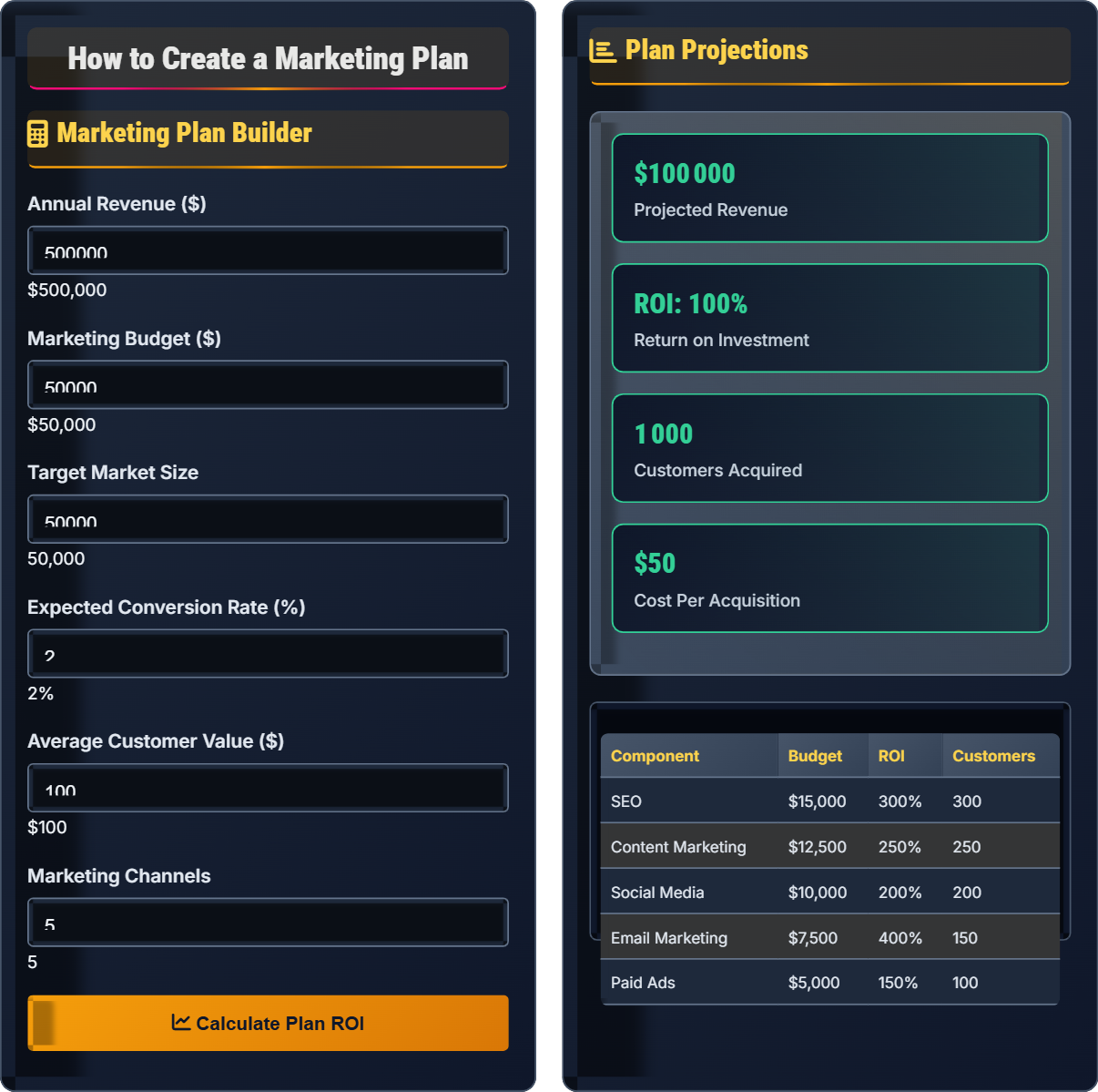
Marketing Plan Builder
Plan Projections
| Component | Budget | ROI | Customers |
|---|---|---|---|
| SEO | $15,000 | 300% | 300 |
| Content Marketing | $12,500 | 250% | 250 |
| Social Media | $10,000 | 200% | 200 |
| Email Marketing | $7,500 | 400% | 150 |
| Paid Ads | $5,000 | 150% | 100 |
Marketing Plan Explained
A marketing plan is a comprehensive document that outlines a company's marketing strategy and tactics for a specific period, typically one year. It serves as a roadmap for achieving marketing objectives and business goals. The plan includes market research, target audience identification, positioning, marketing mix strategies, and performance metrics.
Key areas where marketing plans provide value:
- Business Growth: Driving revenue and market expansion
- Brand Awareness: Increasing visibility and recognition
- Customer Acquisition: Attracting and converting prospects
- Market Positioning: Establishing competitive advantage
- Resource Allocation: Optimizing marketing investments
- Performance Tracking: Measuring and improving results
- Annual Plans: Year-long strategic marketing initiatives
- Product Launch: Focused campaigns for new product introductions
- Seasonal Plans: Time-sensitive marketing during specific periods
- Digital Plans: Online-focused marketing strategies
- Brand Plans: Comprehensive brand-building initiatives
- Event Plans: Marketing for specific events or promotions
Marketing Plan Components
Thorough market analysis provides the foundation for strategic marketing decisions. This includes understanding industry trends, competition, and customer needs.
- Research industry size and growth trends
- Analyze competitor strengths and weaknesses
- Conduct SWOT analysis of your company
- Identify market opportunities and threats
- Assess customer needs and preferences
- Determine market positioning opportunities
Defining your target market ensures marketing efforts are focused on the most promising prospects. This involves creating detailed buyer personas.
- Create detailed buyer personas
- Identify key demographic characteristics
- Understand psychographic traits
- Recognize behavioral patterns
- Identify customer pain points
- Determine buying motivations
Setting clear, measurable objectives provides direction and enables performance tracking. SMART goals ensure accountability and focus.
- Set Specific, Measurable goals
- Define Achievable targets
- Ensure Relevance to business
- Set Time-bound deadlines
- Establish key performance indicators
- Create accountability measures
Plan Component Analysis
Marketing Plan Timeline
Timeline Best Practices:
- Allow 6-8 weeks for thorough research and planning
- Set clear milestones and checkpoints
- Build flexibility for mid-year adjustments
- Plan for quarterly reviews and optimizations
- Include buffer time for unexpected challenges
- Align with fiscal year and business cycles
Budget Allocation Strategy
Typical Marketing Budget Allocation:
- SEO & Content: 25-30% - Long-term organic growth
- Paid Advertising: 20-25% - Immediate visibility and traffic
- Social Media: 15-20% - Brand awareness and engagement
- Email Marketing: 10-15% - Customer retention and nurture
- Events & PR: 10-15% - Brand building and networking
- Tools & Technology: 5-10% - Marketing infrastructure
Budget Allocation Guidelines:
- Startups: 12-20% of revenue on marketing
- Growth companies: 8-12% of revenue
- Mature companies: 6-10% of revenue
- Service businesses: 7-12% of revenue
- Product businesses: 5-10% of revenue
Marketing Plan Quiz
Which component of a marketing plan is typically placed at the beginning but written last?
The Executive Summary is placed at the beginning of the marketing plan but is typically written last. It provides a high-level overview of the entire plan, including objectives, strategies, and key recommendations. Writing it last ensures it accurately reflects the completed plan.
The answer is B) Executive Summary.
The Executive Summary serves as a snapshot of the entire marketing plan for busy executives and stakeholders. It should be concise yet comprehensive enough to convey the key points of the plan. Since it summarizes the entire document, it makes sense to write it after all other sections are completed.
Executive Summary: Brief overview of the entire plan
Stakeholders: People with interest in the plan's success
Key Points: Most important information from the plan
• Write after completing other sections
• Keep concise but comprehensive
• Highlight key recommendations
• Limit to 1-2 pages maximum
• Include key metrics and targets
• Summarize action items
• Writing it first without complete information
• Making it too lengthy or detailed
• Not including key performance indicators
Explain how to create SMART marketing objectives and provide examples for each criterion.
SMART Objectives Framework:
Specific: Clearly define what you want to achieve. Example: "Increase website traffic from organic search."
Measurable: Quantify the objective. Example: "Increase website traffic by 25%."
Achievable: Ensure the goal is realistic given resources and constraints. Example: "Based on current traffic of 10,000 monthly visitors, a 25% increase to 12,500 is achievable with our planned SEO efforts."
Relevant: Align with broader business objectives. Example: "This supports our goal of increasing online sales by 20%."
Time-bound: Set a deadline. Example: "Increase organic website traffic by 25% within 6 months."
Complete SMART Goal: "Increase organic website traffic by 25% (from 10,000 to 12,500 monthly visitors) within 6 months through improved SEO and content marketing, supporting our goal of increasing online sales by 20%."
SMART goals provide clarity and direction for marketing efforts. They ensure objectives are concrete and actionable rather than vague aspirations. The framework helps break down complex marketing goals into manageable, trackable components that can be monitored and adjusted as needed.
SMART: Specific, Measurable, Achievable, Relevant, Time-bound
Objectives: Specific goals for marketing activities
Criteria: Standards for evaluating goals
• Every objective should meet all SMART criteria
• Align objectives with business goals
• Set realistic timelines
• Start with business objectives
• Break large goals into smaller milestones
• Regularly review and adjust goals
• Setting unrealistic targets
• Not defining success metrics
• Failing to align with business goals
A company with $200,000 annual revenue plans to allocate 15% of revenue to marketing ($30,000). They need to decide how to distribute this budget across SEO, content marketing, paid advertising, and email marketing. How should they allocate the budget for maximum impact, and what results can they expect?
Recommended Allocation:
SEO & Content: $12,000 (40%) - Build long-term organic presence
Paid Advertising: $10,000 (33%) - Generate immediate visibility
Email Marketing: $5,000 (17%) - Retain and nurture customers
Tools & Analytics: $3,000 (10%) - Enable performance tracking
Expected Results: After 12 months:
- Organic traffic increase: 40-60%
- Lead generation: 200-300 new leads annually
- Customer acquisition: 50-75 new customers
- Revenue impact: $25,000-$40,000 based on $500 average customer value
Rationale: The combination of long-term SEO/content with immediate paid advertising provides both short-term results and sustainable growth. The 3:1 ratio of organic to paid investment ensures sustainable growth.
Effective marketing budget allocation balances immediate needs with long-term growth. SEO and content marketing build sustainable assets, while paid advertising provides immediate results. The key is finding the right balance for your business stage and market conditions.
Organic Presence: Natural visibility in search results
Lead Generation: Process of attracting prospects
Revenue Impact: Financial effect of marketing efforts
• Balance immediate and long-term investments
• Allocate based on channel performance
• Reserve budget for testing and optimization
• Start with proven channels
• Monitor ROI by channel
• Adjust allocation based on results
• Going all-in on one channel
• Not tracking channel performance
• Failing to optimize based on results
A SaaS company offering project management software needs to identify their target market. They serve small to medium businesses but need to narrow their focus. How should they create buyer personas and segment their market effectively?
Market Segmentation Approach:
By Company Size: Small businesses (10-50 employees), Medium businesses (50-250 employees)
By Industry: Creative agencies, Software development, Consulting firms, Construction companies
By Pain Points: Project delays, Resource management, Team collaboration, Client communication
Sample Buyer Personas:
Persona 1 - "Sarah, the Startup CEO": Tech-savvy, budget-conscious, needs quick implementation
Persona 2 - "Mike, the IT Manager": Security-focused, process-oriented, evaluates software rigorously
Persona 3 - "Lisa, the Project Manager": Task-focused, collaboration-oriented, needs intuitive interface
Research Methods: Surveys, interviews, analytics data, customer feedback, competitor analysis
Effective target market identification requires multiple segmentation approaches. Demographics provide basic categorization, while psychographics reveal deeper motivations. Combining multiple segmentation criteria creates more precise and actionable buyer personas that guide marketing strategy.
Buyer Persona: Fictional representation of ideal customer
Market Segmentation: Dividing market into groups
Pain Points: Problems customers face
• Research actual customers, not assumptions
• Create detailed, specific personas
• Update personas based on new data
• Interview existing customers
• Use analytics to identify patterns
• Test messaging with different personas
• Creating too many generic personas
• Not validating personas with data
• Failing to update personas over time
Which metric is most important for evaluating the success of a marketing plan?
Return on Investment (ROI) is the most important metric for evaluating marketing plan success because it directly measures the financial return relative to investment. While other metrics provide valuable insights into specific aspects of performance, ROI provides the ultimate measure of marketing effectiveness.
The answer is B) Return on Investment (ROI).
ROI connects marketing activities to business outcomes. It considers both the revenue generated and the cost of marketing efforts, providing a comprehensive view of marketing effectiveness. While vanity metrics like followers or traffic may indicate engagement, ROI directly measures the value created for the business.
ROI: Return on Investment, calculated as (gain-cost)/cost
Vanity Metrics: Numbers that look good but don't indicate value
Business Outcomes: Financial results of marketing efforts
• Always measure financial impact
• Track both leading and lagging indicators
• Align metrics with business objectives
• Calculate ROI by channel and campaign
• Include both direct and indirect revenue
• Compare to alternative investments
• Focusing only on vanity metrics
• Not tracking actual revenue impact
• Ignoring cost of marketing efforts
Marketing Plan FAQ
Q: How often should I update my marketing plan?
A: Marketing plan update frequency:
Monthly: Review performance metrics and make tactical adjustments
Quarterly: Assess strategy effectiveness and make strategic changes
Annually: Complete plan overhaul and goal setting for the next year
Additionally, update your plan when there are significant market changes, competitive shifts, or business pivots. The key is maintaining strategic consistency while staying agile enough to adapt to changing conditions.
Q: Should I hire a marketing consultant or create the plan myself?
A: The decision depends on several factors:
Hire a Consultant When: You lack marketing expertise, need specialized knowledge, or want to focus on core business operations
Do It Yourself When: You have marketing experience, want direct control, or have limited budget
Hybrid Approach: Many companies start with consultants for strategy and training, then execute internally. Consider your budget, timeline, business complexity, and internal resources when making the decision.
Ultimately, the plan's success depends on execution and commitment rather than who writes it.