How to Generate Leads?
Complete lead generation guide • Strategies • Implementation
Lead Generation Overview:
Calculate LeadsLead generation is the process of attracting and converting strangers and prospects into individuals who have indicated interest in your company's product or service. It's a crucial part of the sales funnel and helps businesses grow by identifying potential customers.
Key lead generation components:
- Content Marketing: Creating valuable content to attract prospects
- Lead Magnets: Offering incentives to capture contact information
- Optimization: Improving landing pages and conversion rates
- Qualification: Determining lead quality and fit
- Nurturing: Building relationships with prospects
- Tracking: Measuring and analyzing lead performance
Effective lead generation combines multiple strategies to build a sustainable pipeline of qualified prospects.
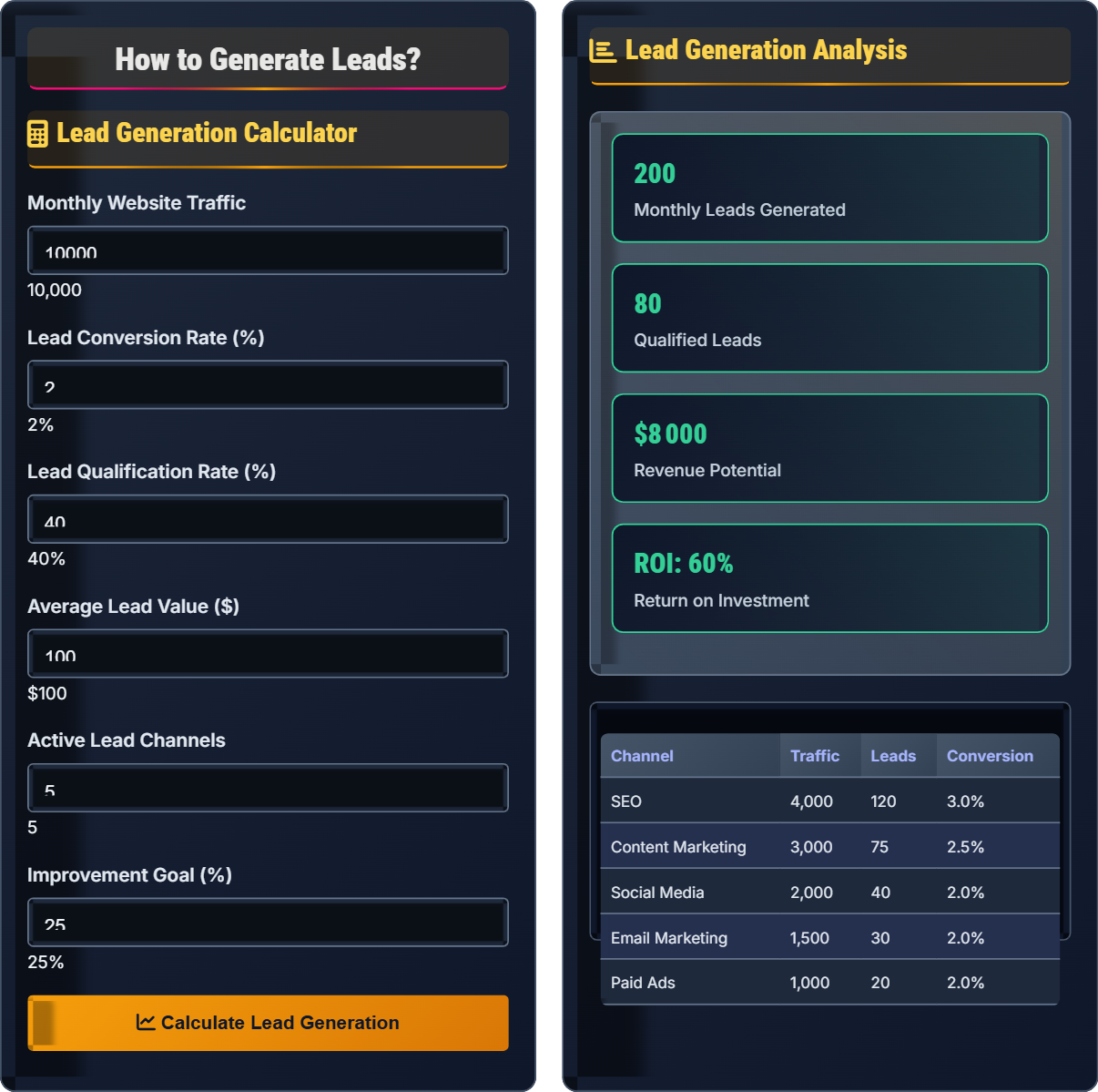
Lead Generation Calculator
Lead Generation Analysis
| Channel | Traffic | Leads | Conversion |
|---|---|---|---|
| SEO | 4,000 | 120 | 3.0% |
| Content Marketing | 3,000 | 75 | 2.5% |
| Social Media | 2,000 | 40 | 2.0% |
| Email Marketing | 1,500 | 30 | 2.0% |
| Paid Ads | 1,000 | 20 | 2.0% |
Lead Generation Explained
Lead generation is the marketing process of stimulating and capturing interest in a product or service for the purpose of developing a sales pipeline. It involves attracting and converting strangers and prospects into individuals who have indicated interest in your company's product or service.
Key areas where lead generation provides value:
- B2B Sales: Generating qualified prospects for enterprise sales
- B2C Marketing: Capturing consumer interest for retail products
- Service Industries: Attracting clients for professional services
- Software/SaaS: Building trial user bases and conversions
- Real Estate: Generating property buyers and sellers
- Education: Attracting students and course participants
- Inbound Leads: Prospects who come to you organically
- Outbound Leads: Prospects contacted proactively
- Warm Leads: Contacts with some existing interest
- Cold Leads: Prospects with no prior contact
- Hot Leads: Highly qualified prospects ready to buy
- Marketing Qualified: Leads identified by marketing
Lead Generation Strategies
Create valuable, relevant content that attracts and engages your target audience. Content marketing builds trust and positions you as an authority in your field.
- Research audience needs and pain points
- Create content that solves problems
- Optimize for search engines
- Include lead capture forms
- Promote content across channels
- Measure engagement and conversions
Offer valuable resources in exchange for contact information. Lead magnets provide immediate value while capturing prospect data for follow-up.
- Identify audience pain points
- Create valuable, specific offers
- Design attractive landing pages
- Optimize forms for conversion
- Follow up with nurture sequences
- Track performance metrics
Use social platforms to build relationships and generate leads through engagement and targeted advertising.
- Choose relevant platforms for your audience
- Create engaging, valuable content
- Use targeted advertising
- Engage with followers consistently
- Include lead capture opportunities
- Track social media ROI
Lead Generation Channels
Lead Generation Funnel
Funnel Optimization:
- Visitors: Improve traffic quality and targeting
- Leads: Optimize lead magnets and forms
- Qualified: Refine lead scoring criteria
- Customers: Enhance sales process and follow-up
Lead Generation Strategies
Strategy Best Practices:
- Focus on quality over quantity of leads
- Match lead magnets to audience needs
- Optimize for mobile devices
- Test and iterate continuously
- Track attribution across channels
- Implement lead scoring systems
Lead Generation Quiz
What is the difference between MQL (Marketing Qualified Lead) and SQL (Sales Qualified Lead)?
A Marketing Qualified Lead (MQL) is a prospect who has shown interest in your product or service based on marketing efforts and meets certain predetermined criteria. A Sales Qualified Lead (SQL) is a prospect who has been vetted by the sales team and is considered ready for a direct sales call. The key difference is that MQLs are qualified by marketing, while SQLs are qualified by sales and are closer to making a purchase decision.
The answer is B) MQL shows marketing interest, SQL shows sales readiness.
Lead qualification stages represent different levels of prospect engagement and readiness to buy. MQLs have shown interest through actions like downloading content, attending webinars, or requesting information. SQLs have been further evaluated and deemed ready for direct sales engagement. This distinction helps align marketing and sales efforts.
MQL: Marketing Qualified Lead
SQL: Sales Qualified Lead
Lead Qualification: Process of determining lead quality
• Define clear qualification criteria
• Align marketing and sales on definitions
• Track conversion rates at each stage
• Implement lead scoring systems
• Regularly review and adjust criteria
• Unclear qualification definitions
• Poor marketing-sales alignment
• Not tracking lead quality metrics
Explain what makes an effective lead magnet and provide examples of different types with their ideal use cases.
Characteristics of Effective Lead Magnets:
1. High Value: Offers immediate, practical value to prospects
2. Specific: Addresses a particular problem or need
3. Easy to Consume: Delivered in an accessible format
4. Relevant: Aligned with your audience's interests
5. Exclusive: Not readily available elsewhere
Examples and Use Cases:
Ebooks/Guides: Comprehensive information on specific topics (B2B consulting, software education)
Checklists: Step-by-step processes for completing tasks (project management, compliance)
Templates: Ready-to-use documents (proposal templates, project plans)
Free Trials: Limited access to your product (SaaS, software solutions)
Webinars: Live or recorded educational content (complex B2B solutions)
Discounts/Coupons: Immediate savings on purchases (retail, e-commerce)
Lead magnets work by solving a specific problem for prospects in exchange for their contact information. The key is matching the type of lead magnet to the audience's needs and stage in the buying journey. More complex B2B solutions benefit from educational content, while B2C businesses might use discounts or free samples.
Lead Magnet: Incentive to capture contact information
Value Exchange: Benefit provided in return for data
Buying Journey: Stages prospect goes through before purchase
• Match magnet to audience needs
• Deliver on promised value
• Follow up appropriately
• Test different magnet types
• Optimize landing pages
• Use compelling headlines
• Offering generic content
• Not delivering promised value
• Weak follow-up processes
A company invests $10,000 in a lead generation campaign and generates 500 leads. Of those, 20% are qualified leads worth $200 each. Calculate the return on investment for this campaign and determine if it's profitable.
Calculation:
Qualified leads: 500 × 20% = 100 qualified leads
Revenue potential: 100 × $200 = $20,000
ROI: ($20,000 - $10,000) ÷ $10,000 × 100 = 100%
Analysis: The campaign generates $20,000 in potential revenue from an investment of $10,000, resulting in a 100% return on investment. This is considered profitable, as the revenue potential is double the investment.
However, note that this calculation assumes all qualified leads will convert to actual sales. The actual ROI would depend on the conversion rate from qualified leads to customers.
Lead generation ROI calculations should consider the full value chain from lead generation to actual sales. While this example shows a positive ROI, the true profitability depends on the conversion rate from leads to customers. Advanced lead generation programs track the full customer acquisition cost and lifetime value.
ROI: Return on Investment calculation
Qualified Lead: Lead meeting specific criteria
Customer Acquisition Cost: Total cost to acquire customer
• Track full sales funnel conversion
• Consider customer lifetime value
• Account for all campaign costs
• Use attribution modeling
• Track conversion rates by channel
• Calculate blended acquisition costs
• Calculating ROI on leads instead of sales
• Not accounting for all costs
• Ignoring conversion rates
A B2B software company wants to generate 200 qualified leads per month. They have a budget of $20,000/month and want to use multiple channels. Propose a balanced lead generation strategy across SEO, content marketing, paid advertising, and email marketing.
Recommended Strategy:
SEO & Content Marketing (40% - $8,000): 80 qualified leads
• Blog content optimization
• Whitepapers and case studies
• Long-term organic traffic building
Paid Advertising (35% - $7,000): 70 qualified leads
• LinkedIn Sponsored Content
• Google Ads for high-intent keywords
• Retargeting campaigns
Email Marketing (15% - $3,000): 30 qualified leads
• Lead nurturing sequences
• Newsletter campaigns
• Re-engagement campaigns
Events & Partnerships (10% - $2,000): 20 qualified leads
• Webinar hosting
• Partnership referrals
• Trade show participation
Total: 200 qualified leads at $100 per lead
Multi-channel lead generation strategies balance immediate results with long-term sustainability. Paid advertising provides immediate leads, while SEO and content marketing build long-term value. The key is allocating budget based on channel performance and time-to-conversion metrics.
Multi-Channel: Using multiple lead generation methods
Time-to-Conversion: Duration from lead to customer
Channel Performance: Metrics by lead generation method
• Balance immediate and long-term results
• Track attribution by channel
• Optimize based on performance data
• Test channel combinations
• Reallocate budget based on performance
• Create channel synergies
• Going all-in on one channel
• Not tracking channel attribution
• Failing to optimize based on results
Which factor is most important for lead scoring?
Behavioral engagement is the most important factor for lead scoring because it directly indicates the prospect's level of interest and intent. Actions like visiting pricing pages, downloading product materials, attending webinars, or requesting demos show active buying behavior, which is the strongest predictor of conversion.
While demographic factors like job title, company size, and location provide context, behavioral engagement demonstrates actual interest and intent.
The answer is C) Behavioral engagement.
Lead scoring models should prioritize actions that demonstrate buying intent over static demographic information. A prospect from a small company who visits your pricing page multiple times and downloads your product comparison guide is likely more qualified than a C-level executive from a large company who only downloaded a generic industry report.
Lead Scoring: Rating system for lead qualification
Behavioral Engagement: Actions taken by prospect
Buying Intent: Likelihood to purchase
• Prioritize behavioral data
• Weight actions by conversion value
• Regularly update scoring models
• Track page visits and time spent
• Monitor email engagement
• Consider recency and frequency
• Overweighting demographic data
• Not updating scoring models
• Ignoring negative signals
Lead Generation FAQ
Q: How long does it typically take to see results from lead generation efforts?
A: Lead generation timeline varies by channel:
Paid Advertising: Immediate results (days) but stops when budget stops
Email Marketing: 2-4 weeks for initial engagement
Content Marketing: 3-6 months for meaningful lead generation
SEO: 6-12 months for significant organic lead generation
Generally, expect to see initial results within 1-3 months, with substantial growth occurring after 6+ months of consistent effort. The key is maintaining consistent execution while optimizing based on data.
Q: What's the difference between lead generation and lead nurturing?
A: Lead generation focuses on attracting and capturing new prospects who have shown initial interest. This includes activities like content marketing, lead magnets, and advertising to bring in new contacts.
Lead nurturing focuses on building relationships with captured prospects who aren't ready to buy yet. This involves email sequences, educational content, and personalized communication to move prospects through the buying journey.
Lead generation brings in new prospects, while lead nurturing develops relationships with existing prospects until they're ready to buy.