How to Get Traffic to a Website
Complete traffic generation guide • Strategies • Implementation
Traffic Generation Overview:
Estimate TrafficGetting traffic to a website involves implementing various marketing strategies to attract visitors from different sources. Success requires a combination of organic and paid approaches tailored to your audience and business goals.
Key traffic generation methods:
- Organic SEO: Improve search engine rankings naturally
- Content Marketing: Create valuable content to attract visitors
- Social Media: Leverage platforms to drive referral traffic
- Paid Advertising: Use ads to generate immediate traffic
- Email Marketing: Build and nurture subscriber lists
- Partnerships: Collaborate with other websites and influencers
Effective traffic generation combines multiple channels for maximum reach and sustainable growth.
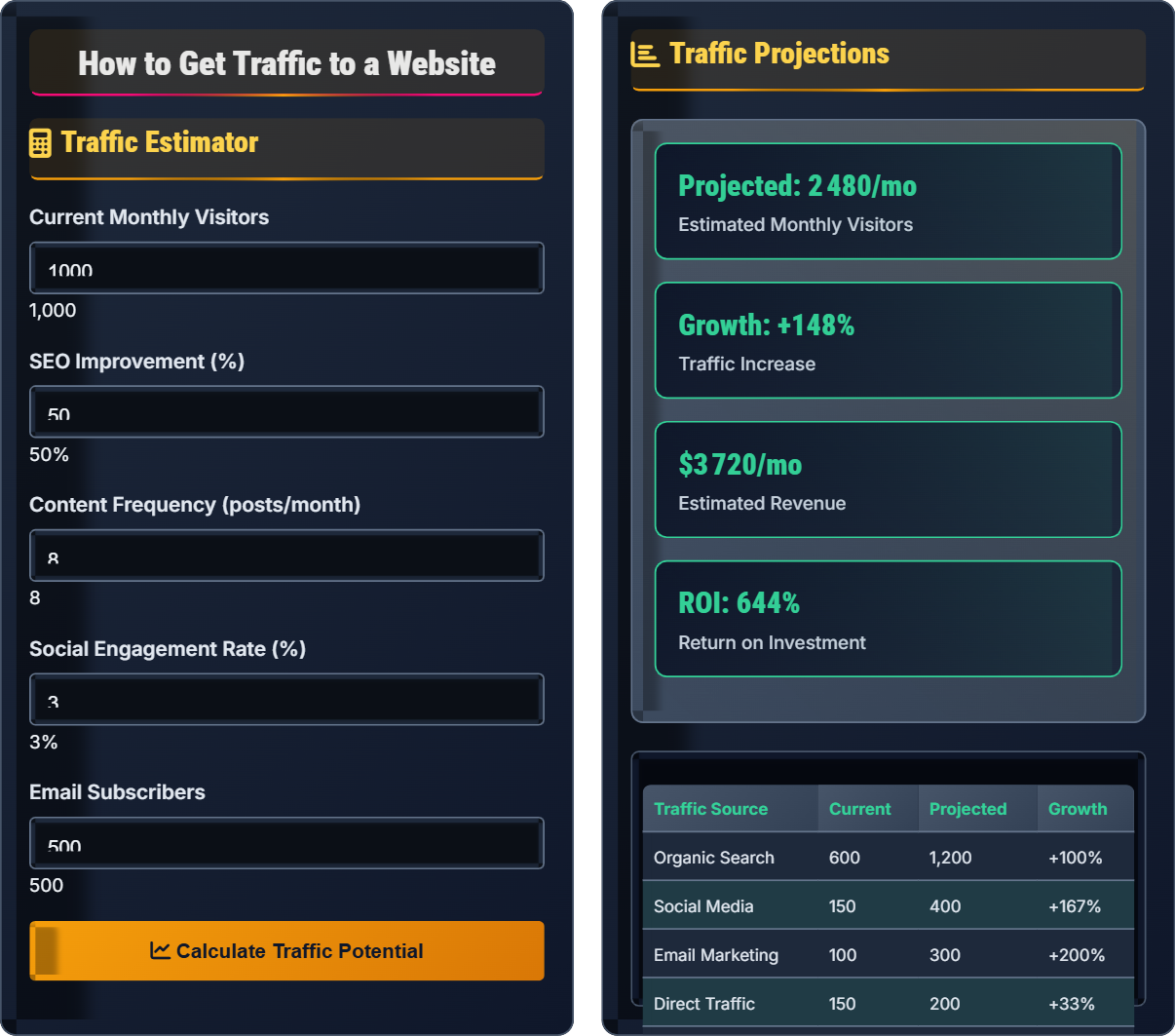
Traffic Estimator
Traffic Projections
| Traffic Source | Current | Projected | Growth |
|---|---|---|---|
| Organic Search | 600 | 1,200 | +100% |
| Social Media | 150 | 400 | +167% |
| Email Marketing | 100 | 300 | +200% |
| Direct Traffic | 150 | 200 | +33% |
| Paid Ads | 0 | 400 | +∞ |
Traffic Generation Strategies Explained
Traffic generation is the process of attracting visitors to your website through various marketing channels and tactics. It's a fundamental aspect of digital marketing that directly impacts business growth, brand awareness, and revenue potential.
Key areas where traffic generation provides value:
- E-commerce: Drive product views and sales conversions
- Lead Generation: Attract prospects for business development
- Brand Awareness: Increase visibility and recognition
- Content Monetization: Generate ad revenue and affiliate income
- Community Building: Grow audience and engagement
- Product Launches: Create buzz and initial adoption
- Organic Traffic: Natural search results and referrals
- Paid Traffic: Advertisements and sponsored content
- Direct Traffic: Visitors typing URL directly
- Social Traffic: Referrals from social platforms
- Email Traffic: Visitors from email campaigns
- Referral Traffic: Links from other websites
Proven Traffic Generation Strategies
SEO focuses on optimizing your website to rank higher in search engine results pages (SERPs). This generates free, organic traffic that continues over time.
- Conduct keyword research using tools like Google Keyword Planner
- Optimize page titles, meta descriptions, and headers
- Create high-quality, valuable content around target keywords
- Build authoritative backlinks through outreach and guest posting
- Improve site speed and mobile responsiveness
- Monitor rankings and adjust strategies accordingly
Creating valuable, relevant content attracts and retains customers, ultimately driving profitable customer action. Content marketing builds authority and trust over time.
- Identify content topics based on audience interests
- Create a content calendar with publishing schedule
- Develop content in various formats (text, video, audio)
- Promote content through social media and email
- Repurpose successful content into new formats
- Measure engagement and optimize based on performance
Paid advertising provides immediate traffic through platforms like Google Ads, Facebook Ads, and LinkedIn Ads. While it requires a budget, it offers precise targeting and measurable ROI.
- Set up conversion tracking and analytics
- Create targeted ad campaigns based on audience segments
- Design compelling ad copy and visuals
- Test different ad variations and audiences
- Optimize bids and budgets based on performance
- Scale successful campaigns and pause underperforming ones
Traffic Source Analysis
Traffic-to-Conversions Funnel
Funnel Optimization Tips:
- Improve landing page relevance and user experience
- Use clear and compelling call-to-action buttons
- Implement exit-intent popups and lead magnets
- Optimize for mobile devices and page speed
- Provide social proof and testimonials
- Offer incentives and limited-time promotions
Traffic Generation Quiz
Which traffic generation channel typically provides the highest long-term return on investment?
SEO typically provides the highest long-term ROI because once your site ranks well, it continues to generate traffic without ongoing ad spend. While it requires initial investment in time and resources, the returns compound over time as rankings improve and content accumulates.
The answer is B) Search Engine Optimization (SEO).
SEO creates assets (web pages) that continue to work for you long after creation. Each piece of content becomes a potential entry point for search traffic. Unlike paid advertising, which stops delivering results when you stop paying, SEO results persist and grow over time, making it the most cost-effective long-term strategy.
ROI: Return on investment, calculated as (gain - cost) / cost
Compound Growth: Growth that builds upon previous gains
Asset Accumulation: Building resources that provide ongoing value
• SEO takes longer to show results but lasts longer
• Paid ads provide immediate but temporary results
• Long-term strategy beats short-term tactics
• Combine SEO with other channels for best results
• Focus on evergreen content for sustained traffic
• Build authority through consistent publishing
• Expecting immediate results from SEO
• Neglecting technical SEO fundamentals
• Not measuring ROI properly
Explain how to develop a content strategy that drives website traffic, including topic selection, frequency, and promotion methods.
Topic Selection: Research keywords using tools like Google Keyword Planner, SEMrush, or Ahrefs. Focus on topics with search volume and low to medium competition. Use tools like AnswerThePublic to find question-based content ideas.
Content Frequency: Consistency matters more than frequency. Start with 1-2 high-quality pieces per week and maintain that schedule. Quality content performs better than rushed, low-quality content.
Promotion Methods: Share content across all social media platforms, email newsletters, and relevant online communities. Engage with comments and encourage sharing. Repurpose content into different formats (blog post → video → podcast).
Optimization: Include target keywords naturally, create compelling titles and meta descriptions, and add internal links to other relevant content.
Content marketing works on the principle of providing value to your audience. When you solve problems or answer questions for your readers, they're more likely to return and share your content. The key is consistency and quality - regular publication builds trust, while high-quality content builds authority.
Evergreen Content: Content that remains relevant over time
Content Calendar: Schedule for content creation and publication
Content Repurposing: Using content in multiple formats
• Focus on audience needs, not just business goals
• Quality always trumps quantity
• Promote content actively after creation
• Use trending topics to increase visibility
• Create pillar content around main topics
• Engage with your audience in comments
• Creating content without audience research
• Inconsistent publishing schedule
• Not promoting content after creation
A startup with a $2,000 monthly marketing budget needs to decide between spending on paid advertising ($2,000) or investing $500 in SEO tools and content creation with $1,500 remaining for other activities. Which approach would generate more sustainable traffic over 12 months, and why?
Recommendation: Hybrid approach - $1,000 for paid advertising + $500 for SEO tools + $500 for content creation
Reasoning: Paid advertising provides immediate traffic and helps validate market demand, while SEO and content creation build long-term sustainable traffic. The hybrid approach balances immediate needs with future growth.
12-Month Projection:
Pure Paid ($2,000/month): 12,000 visitors/month initially, but stops when budget stops
Hybrid Approach: 6,000 visitors/month from ads + growing organic traffic from SEO/content
By Month 12: Organic traffic could reach 2,000-3,000/month, plus 6,000 from ads = 8,000-9,000 total vs. 0 if paid ads stopped.
Marketing budgets should balance immediate needs with long-term growth. Paid advertising provides quick results but stops when funding ends. SEO and content marketing take time to show results but create lasting value. The optimal approach depends on business stage, market conditions, and growth objectives.
Immediate Returns: Quick results from current investments
Sustainable Growth: Long-term value creation
Market Validation: Testing demand for products/services
• Balance short-term and long-term investments
• Test and validate before scaling
• Reassess strategy based on results
• Start with smaller paid campaigns to test market
• Invest in SEO early for compounding returns
• Track attribution across channels
• Going all-in on one channel too early
• Not tracking ROI properly
• Scaling before validating results
An e-commerce business selling fitness equipment wants to increase website traffic. They currently have 10,000 monthly visitors from organic search. Propose a multi-channel strategy that could potentially double their traffic to 20,000 monthly visitors within 6 months.
Month 1-2: Foundation & Content
• Optimize existing content for better rankings
• Create 8-10 high-quality blog posts per month
• Develop product comparison guides and workout plans
• Set up Google Ads campaign with $1,000/month budget
Month 3-4: Social Media & Influencers
• Launch Instagram and YouTube accounts with daily content
• Partner with fitness influencers for sponsored posts
• Create video reviews and workout demonstrations
• Expand Google Ads to $1,500/month
Month 5-6: Email & Retargeting
• Implement email capture on all pages
• Create retargeting campaigns for website visitors
• Launch affiliate program with fitness bloggers
• Increase Google Ads to $2,000/month
Expected Results: 10,000 organic + 4,000 paid + 3,000 social + 2,000 email + 1,000 referral = 20,000 total monthly visitors
Multi-channel strategies work best when channels complement each other. Organic traffic provides foundation, paid ads accelerate growth, social media builds community, and email marketing nurtures leads. The key is to coordinate messaging and maintain consistent branding across all channels.
Multi-Channel: Using multiple marketing channels simultaneously
Attribution Modeling: Tracking which channels drive conversions
Channel Synergy: Channels working together effectively
• Maintain consistent messaging across channels
• Track performance individually and collectively
• Allocate budget based on channel performance
• Repurpose content across multiple channels
• Use cross-channel promotion strategies
• Monitor for channel cannibalization
• Inconsistent messaging across channels
• Not tracking individual channel performance
• Spreading budget too thin across channels
Which type of traffic typically converts at the highest rate?
Direct traffic typically converts at the highest rate because these visitors are already familiar with your brand and intentionally sought out your website. They have a specific intent and higher purchase readiness compared to other traffic sources.
The answer is B) Direct traffic (typed URL).
Direct traffic represents the strongest brand awareness and customer loyalty. People who type your URL directly have either visited before and remembered your site, or heard about you through word-of-mouth. This indicates a higher level of trust and intent compared to other traffic sources where visitors may be browsing casually.
Conversion Rate: Percentage of visitors who take desired action
Brand Awareness: Recognition and recall of your brand
Intent Level: Visitor's readiness to take action
• Quality matters more than quantity of traffic
• Different channels have different conversion rates
• Focus on attracting the right kind of visitors
• Track conversion rates by traffic source
• Optimize landing pages for each channel
• Build brand recognition for direct traffic
• Focusing only on traffic volume, not quality
• Not tracking conversion differences by source
• Ignoring brand building efforts
Traffic Generation FAQ
Q: How long does it typically take to see results from traffic generation efforts?
A: Timeline varies significantly by channel:
Paid Advertising: Immediate results (days) but stops when budget ends
Social Media: 1-3 months for meaningful organic growth
SEO: 3-6 months for initial results, 6-12 months for significant impact
Content Marketing: 2-4 months to build momentum
Email Marketing: Immediate results from existing lists, 1-3 months for new list building
Generally, expect to see measurable results within 1-3 months, with significant growth occurring after 6+ months of consistent effort. The key is maintaining consistent effort and optimizing based on data.
Q: What's the minimum budget needed to start getting website traffic effectively?
A: You can start with $0 using organic methods:
Free Methods: SEO, content marketing, social media posting, forum participation, guest posting
Minimal Budget ($50-100/month): SEO tools, content creation tools, basic social media ads
Starting Budget ($200-500/month): Google Ads, Facebook Ads, premium tools, content outsourcing
Recommended Approach: Start with free methods to learn and validate, then invest in paid advertising once you understand your audience and have optimized conversion funnels. Many successful businesses start with $0-100/month and scale based on results.