How to Grow on Social Media
Complete social media growth guide • Strategies • Engagement tactics
Social Media Growth Overview:
Predict GrowthSocial media growth involves strategically building and engaging an audience across various platforms. Success requires consistent content creation, authentic engagement, and understanding platform algorithms to maximize reach and visibility.
Key growth components:
- Content Strategy: Creating valuable, engaging content consistently
- Audience Engagement: Building relationships with followers
- Platform Optimization: Leveraging each platform's features
- Community Building: Fostering a loyal, active community
- Analytics & Optimization: Tracking performance and adjusting strategy
- Collaboration: Partnering with others for mutual growth
Effective social media growth combines organic strategies with platform-specific tactics to build a sustainable, engaged audience.
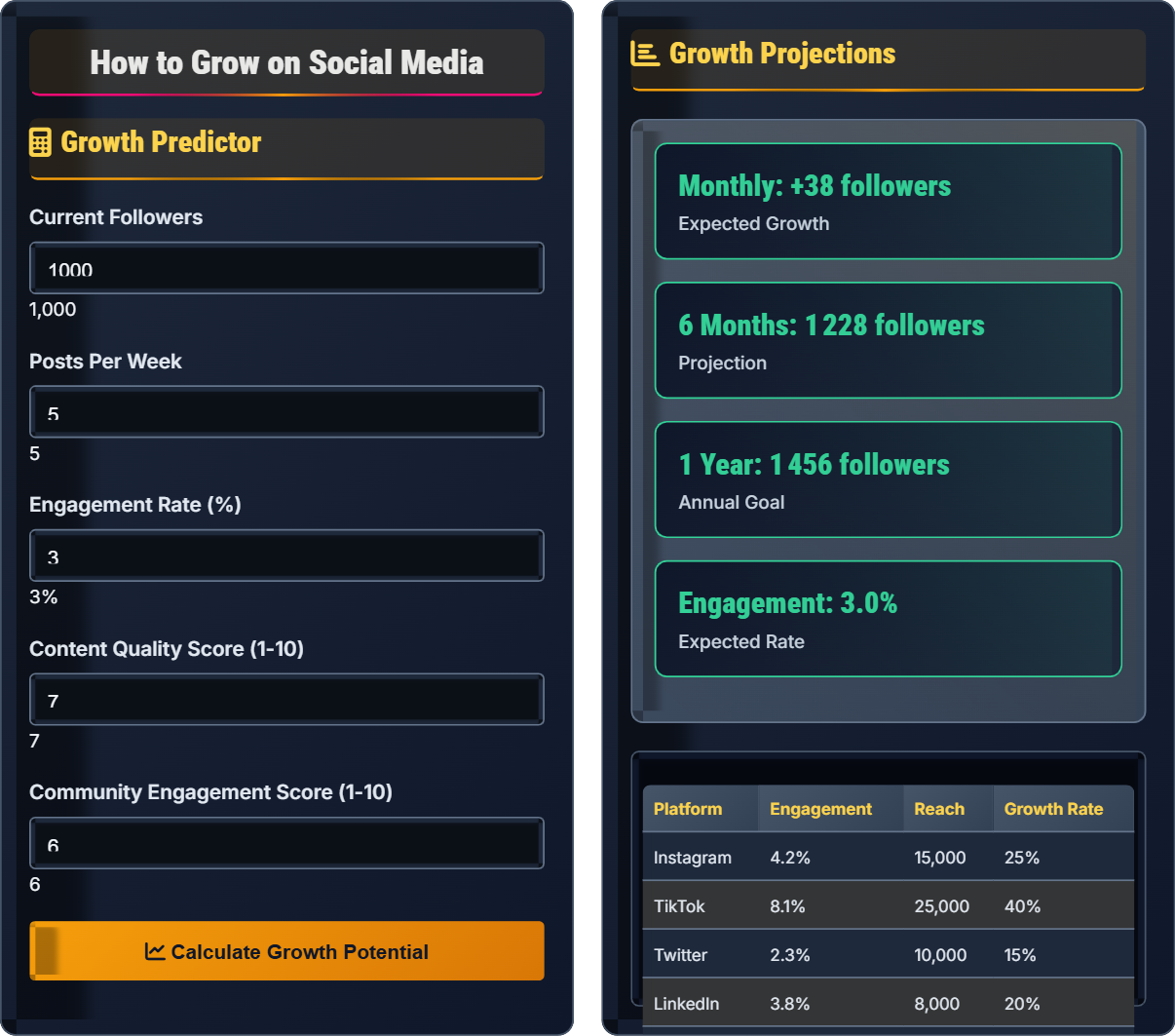
Growth Predictor
Growth Projections
| Platform | Engagement | Reach | Growth Rate |
|---|---|---|---|
| 4.2% | 15,000 | 25% | |
| TikTok | 8.1% | 25,000 | 40% |
| 2.3% | 10,000 | 15% | |
| 3.8% | 8,000 | 20% | |
| YouTube | 6.5% | 12,000 | 30% |
Social Media Growth Explained
Social media growth is the process of increasing your audience size, engagement, and influence across social platforms. It involves strategic content creation, community building, and engagement optimization to build a loyal and active follower base.
Key areas where social media growth provides value:
- Brand Awareness: Increase visibility and recognition
- Lead Generation: Attract and convert prospects
- Customer Service: Engage with customers directly
- Community Building: Foster loyal audience relationships
- Product Promotion: Showcase offerings effectively
- Thought Leadership: Establish industry expertise
- Organic Growth: Building audience through content and engagement
- Paid Promotion: Using ads to accelerate growth
- Collaborations: Partnering with others for mutual benefit
- User-Generated Content: Encouraging followers to create content
- Influencer Partnerships: Working with influencers in your niche
- Hashtag Strategy: Using relevant hashtags to increase reach
Growth Strategies
Platform-Specific Growth
Social Media Growth Funnel
Funnel Growth Strategy:
- Awareness: Reach through hashtags, trends, and collaborations
- Interest: Capture attention with valuable content
- Engagement: Interact and build relationships
- Loyalty: Create community and advocate for brand
Optimal Posting Schedule
Schedule Best Practices:
- Post 3-5 times per week for optimal engagement
- Use platform analytics to find optimal timing
- Maintain consistency in posting times
- Plan content in advance using scheduling tools
- Reserve weekends for community engagement
- Adjust schedule based on audience activity
Social Media Growth Quiz
Which social media platform typically has the highest engagement rate for business content?
Instagram typically has the highest engagement rate for business content, averaging around 3-4% engagement rate compared to other platforms. The visual nature of Instagram, combined with features like Stories and Reels, creates more opportunities for interaction.
The answer is B) Instagram.
Engagement rates vary significantly by platform due to their unique features and user behaviors. Instagram's visual focus, interactive features (like Stories, Reels, and IGTV), and algorithm that favors engaging content contribute to higher engagement rates. However, engagement rates also depend on content quality, audience, and posting strategy.
Engagement Rate: Percentage of audience interacting with content
Algorithm: Platform's system for showing content
Interaction: Likes, comments, shares, saves
• Engagement rates vary by industry and audience
• Quality content trumps quantity
• Consistency is key for growth
• Post when your audience is most active
• Use platform-specific features
• Encourage comments with questions
• Posting inconsistently
• Not responding to comments
• Using irrelevant hashtags
Explain how to develop an effective content strategy for social media growth, including content types, frequency, and audience targeting.
Content Types: Mix of educational, entertaining, and promotional content. Include behind-the-scenes, user-generated content, and industry insights. Use different formats like images, videos, carousels, and stories.
Content Frequency: Post 3-5 times per week on most platforms. Consistency matters more than frequency. Create a content calendar to maintain regular posting.
Audience Targeting: Research your audience demographics, interests, and pain points. Create content that addresses their needs and interests. Use analytics to understand what resonates.
Content Themes: Develop consistent themes that align with your brand. Create content pillars (e.g., education, entertainment, inspiration, behind-the-scenes).
Performance Tracking: Monitor engagement metrics, reach, and growth. Adjust strategy based on performance data and audience feedback.
A successful social media content strategy balances providing value with promoting your brand. The 80/20 rule suggests that 80% of content should provide value to your audience, while 20% can be promotional. Consistency in posting and messaging helps build audience trust and anticipation.
Content Pillars: Core themes for content creation
80/20 Rule: Content mix for engagementAudience Demographics: Characteristics of your followers
• Know your audience before creating content
• Maintain consistent brand voice
• Track and analyze performance
• Repurpose content across formats
• Use trending topics strategically
• Include clear calls-to-action
• Posting without strategy
• Not understanding audience needs
• Inconsistent posting schedule
A small business with a $2,000 monthly marketing budget wants to grow on social media. They can hire a social media manager ($1,500/month), invest in content creation tools ($300/month), or run paid social media ads ($1,000/month). How should they allocate their budget for maximum growth, and why?
Recommended Allocation:
Social Media Manager: $1,500/month - Strategic planning and daily management
Content Creation Tools: $300/month - High-quality content production
Remaining Budget: $200/month - Reserved for paid promotion of high-performing organic content
Why This Approach: A social media manager provides strategic oversight, consistent posting, and active engagement. Content tools improve quality and efficiency. The remaining budget allows amplifying successful organic content, maximizing ROI.
Alternative Strategy: If the business has internal capacity, they could reduce the manager's hours to $1,000/month and increase ad spend to $700/month, allowing for both organic growth and paid acceleration.
Effective social media growth requires both organic and paid strategies. Organic growth builds authentic relationships, while paid promotion accelerates reach. The key is balancing human expertise (social media manager) with tools and technology to maximize efficiency and results.
Organic Growth: Natural audience expansion
Paid Promotion: Accelerated growth through ads
ROI: Return on investment from marketing efforts
• Balance organic and paid strategies
• Invest in human expertise first
• Track performance metrics
• Start with organic, add paid gradually
• Use organic content for paid ads
• Test different budget allocations
• Going all-paid without organic foundation
• Not tracking ad performance
• Inconsistent content quality
A lifestyle brand wants to grow across Instagram, TikTok, and YouTube. They have 10 hours per week for content creation. Propose a content strategy that maximizes reach and engagement across all platforms while maintaining brand consistency.
Content Strategy:
Monday-Wednesday: Create 1 primary piece of content (e.g., recipe, tutorial)
Thursday: Film supporting content for all platforms
Friday-Sunday: Edit and adapt content for each platform
Platform-Specific Adaptation:
Instagram: 2-3 feed posts, 5-7 stories, 1-2 reels per week
TikTok: 3-5 short-form videos per week
YouTube: 1-2 long-form videos per week
Brand Consistency: Maintain consistent colors, fonts, voice, and messaging across all platforms while adapting to platform-specific formats and audience expectations.
Multi-platform social media success requires strategic content creation that maximizes efficiency while respecting each platform's unique characteristics. One primary piece of content can be repurposed and adapted for different formats, saving time while maintaining consistency. Each platform should serve a different purpose in the customer journey.
Content Repurposing: Using one piece across multiple formats
Brand Consistency: Uniform appearance and messaging
Platform-Specific: Adapting content to platform norms
• Create one primary content piece
• Adapt for each platform's audience
• Maintain brand consistency
• Batch content creation sessions
• Use scheduling tools for efficiency
• Track performance by platform
• Creating different content for each platform
• Not adapting to platform norms
• Inconsistent brand presentation
Which engagement tactic typically generates the highest response rate on social media?
Asking questions typically generates the highest response rate because it directly invites interaction from followers. Questions encourage comments, which boost engagement and increase content visibility in algorithms.
The answer is B) Asking questions.
Interactive content performs better than passive content because it requires audience participation. Questions, polls, and calls-to-action create a two-way conversation, which social media algorithms favor. Engagement is crucial for growth as it increases reach and builds community.
Response Rate: Percentage of audience interacting
Algorithm Favor: Platform preference for engaging content
Two-Way Conversation: Interactive dialogue with audience
• Encourage audience participation
• Create interactive content
• Respond to all interactions
• Ask open-ended questions
• Use polls and quizzes
• Create "this or that" scenarios
• Posting only promotional content
• Not encouraging interaction
• Not responding to comments
Social Media Growth FAQ
Q: How long does it typically take to see significant growth on social media?
A: Social media growth follows this typical timeline:
Months 1-3: Setting up profiles, creating content, initial engagement
Months 4-6: Building audience, seeing initial growth patterns
Months 7-12: Consistent growth, establishing authority
Year 2+: Significant growth and monetization opportunities
Realistic expectations include 100-500 followers in first 3 months, 1,000-2,000 in 6 months, and 5,000+ in a year with consistent effort. Patience and consistency are crucial for sustainable growth.
Q: Should I focus on one platform or spread across multiple platforms?
A: Start with one platform where your target audience is most active, then expand:
Beginner Strategy: Focus on 1-2 platforms initially to master them
Platform Selection: Choose based on your audience demographics and business type
Advanced Strategy: Once established, expand to 2-3 platforms maximum
Quality vs Quantity: It's better to excel on fewer platforms than to be mediocre everywhere
Resource Consideration: Each platform requires dedicated time and strategy. Spread yourself too thin, and you'll see poor results across all platforms.